 Волоконно-оптичні датчики температури INNO ,Системи контролю температури.
- Відсутність електромагнітних перешкод: Оптичне волокно переносить світло, не електрика — він повністю захищений від EMI/RFI, що робить його єдиним надійним вибором для моніторингу високовольтних розподільних пристроїв і гарячих точок трансформаторів.
- Висока точність в екстремальних умовах: Флуоресцентні точкові датчики досягають ±1 °C точність від від −40 °C до +260 °C, з часом відповіді менше 1 другий і тонкий зонд 2–3 мм.
- Електробезпечний в 100 середовища кВ+: Зонди повністю ізольовані та розраховані на напругу значно вище 100 кВ — немає проблем із заземленням, немає шляхів стікання.
- Один передавач, до 64 Канали: Одинарний волоконно-оптичний передавач температури обробляє 1–64 флуоресцентних волоконних каналів одночасно, різке зниження витрат на обладнання.
- Не вимагає обслуговування для 25+ Років: Немає рухомих частин, немає витратних матеріалів, не вимагає періодичного калібрування за нормальних умов експлуатації.
- Масштабована архітектура: Зв'язок RS485 інтегрується безпосередньо з SCADA, DCS, і платформи автоматизації підстанцій; всі параметри настроюються.
- Proven across critical industries: Deployed in power transmission, Центри обробки даних, нафтохімічні заводи, rail traction systems, and industrial furnaces worldwide.
1. Що таке a Волоконно-оптична система вимірювання температури?

A волоконно-оптична система вимірювання температури is an instrumentation platform that uses light-transmitting optical fibers — rather than metal conductors — to detect and report temperature at one or more points in real time. The sensor probe converts a physical temperature into an optical signal, which travels back along the fiber to a dedicated волоконно-оптичний передавач температури (also called a signal conditioner or interrogator unit) that decodes the signal and outputs a temperature reading.
Because the sensing element is made entirely of dielectric materials, the probe and fiber cable carry no electrical current whatsoever. This distinguishes the technology fundamentally from thermocouples, RTD, і термістори, all of which require an electrical circuit to function and are therefore susceptible to ground loops, ЕМІ, and electrical hazards in high-voltage installations.
The system is available in two primary sensing architectures: fluorescent point temperature sensing і Розподілена волоконно -оптична температура зондування (ДТС). Both share the same core benefit of electrical isolation, but serve different measurement objectives.
2. How Does It Compare to Traditional Temperature Sensors?
Traditional sensors — thermocouples, PT100 RTD, and bimetallic devices — have served industry for over a century. Однак, they face critical limitations in modern electrical and industrial environments that fiber optic technology directly resolves.
| Параметр | Термопари / RTD | Флуоресцентний волоконно-оптичний датчик |
|---|---|---|
| Імунітет EMI | None — signal degrades near HV equipment | Complete — no electrical signal in the fiber |
| Електроізоляція | Вимагає ізоляційних бар'єрів | Inherently insulating; оцінений >100 кВ |
| Точність | ±0.5–2 °C (with drift over time) | ±1 °C, stable over 25+ рік служби |
| Час відгуку | 1–10 seconds typical | <1 другий |
| Діаметр зонда | 4–10 mm typical | 2–3 мм (доступний на замовлення) |
| Технічне обслуговування | Periodic recalibration required | Не потрібно |
| Multi-channel from one unit | Typically 1–8 channels per transmitter | 1–64 channels per transmitter |
3. How Does a Fiber Optic Temperature Measurement System Work?
Принцип флуоресцентного розпаду
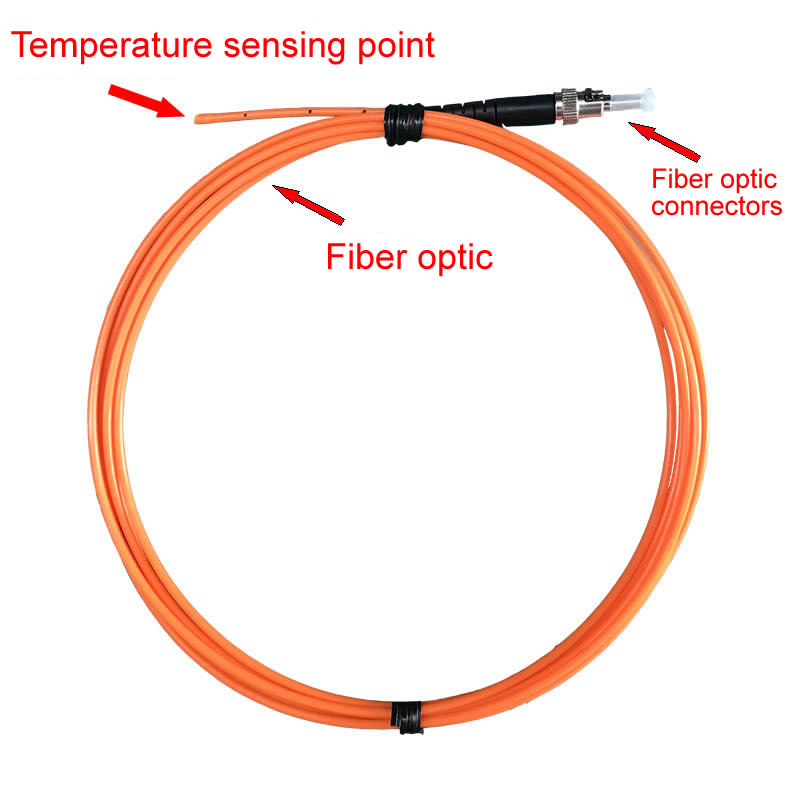
У флуоресцентні волоконно-оптичні датчики температури, the probe tip contains a rare-earth phosphor compound. The interrogator unit pulses a precisely controlled excitation light down the fiber. The phosphor absorbs this energy and re-emits it as fluorescence. Критично, the duration of that fluorescence — known as the fluorescence lifetime or decay time — is a repeatable, predictable function of temperature. The interrogator measures this decay time and converts it directly into a temperature value.
Because the measurement depends on a time interval rather than a voltage level or light intensity, він за своєю суттю стійкий до втрат на вигин волокна, забруднення роз'єму, and electromagnetic noise — all of which would corrupt a voltage-based electrical sensor.
Розподілений (Раман / Бриллуїн) Принцип
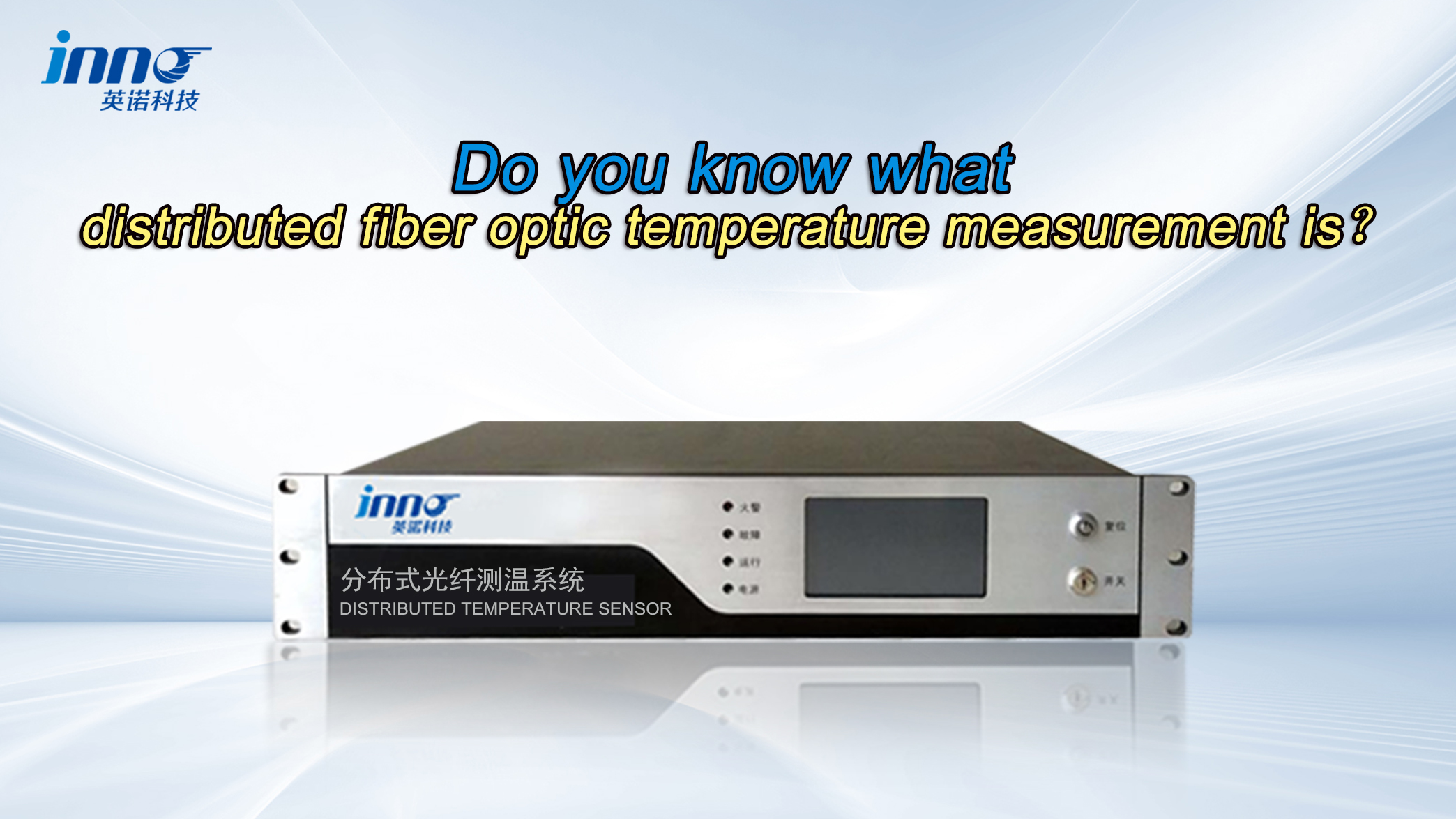
У distributed fiber optic temperature sensing systems, a laser pulse is launched into a standard single-mode or multimode fiber. As light propagates, it scatters at molecular level. The backscattered Raman or Brillouin components shift in frequency and amplitude in direct proportion to the local temperature at every meter along the fiber. By measuring the time it takes for backscattered light to return, the system assigns a precise temperature to every spatial position along the cable — turning a single fiber into thousands of temperature sensors simultaneously.
4. Fluorescent Point Sensing vs. Розподілене волоконно-оптичне вимірювання температури
| Особливість | Флуоресцентне визначення точки | Розподілене волоконно-оптичне (ДТС) |
|---|---|---|
| Measurement type | Discrete hotspot points | Continuous profile along fiber |
| Typical range | від −40 °C до +260 °C | від −40 °C до +300 °C (system-dependent) |
| Spatial coverage per fiber | До 80 м; 1–64 discrete points | До 30 km+ |
| Best applications | Обмотки трансформатора, Шиски для розподільних пристроїв, підшипники двигуна | Підземні кабелі, трубопроводи, виявлення пожежі в тунелі |
| Вартість системи | Lower per-point cost | Більш висока початкова вартість; lower per-meter cost at scale |
5. What Are the Main Components of the System?
- Флуоресцентний волоконно-оптичний зонд (sensor head): The physical tip inserted at the measurement point. Contains the phosphor sensing element encapsulated in a slim, electrically insulating sheath (2–3 mm diameter). Custom shapes and materials are available for specific installation geometries.
- Optical fiber cable: The light-transmission medium connecting probe to transmitter. Standard single-mode or multimode fiber; maximum run of 80 m for fluorescent systems. Armored, PTFE, or high-temperature jacket variants are available.
- Волоконно-оптичний передавач температури (допитувач): The signal processing unit. Houses the light source, фотодетектори, електроніка синхронізації, and microprocessor. Outputs calibrated temperature values via RS485 or other interfaces. One unit supports 1–64 channels.
- програмне забезпечення / Інтеграція SCADA: Host-side software or Modbus/RS485 register mapping allows direct integration into existing DCS, Скада, або системи автоматизації підстанції. No proprietary middleware is required.
6. Флуоресцентний волоконно-оптичний датчик температури — Full Technical Specifications
| Параметр | Специфікація |
|---|---|
| Sensing method | Тривалість життя флуоресценції (phosphor decay) — point measurement |
| Точність вимірювання | ±1 °C |
| Діапазон вимірювання температури | від −40 °C до +260 °C |
| Час відгуку | <1 другий |
| Maximum fiber cable length | 0 – 80 м |
| Probe outer diameter | 2–3 мм (custom diameters available) |
| Електроізоляція | Повністю ізоляційний; no conductive path |
| High-voltage withstand | >100 кВ (настроюється) |
| Channels per transmitter | 1 – 64 (масштабований) |
| Інтерфейс зв'язку | RS485 (Modbus RTU); other interfaces customizable |
| Термін служби | >25 років за нормальних умов |
| Вимоги до технічного обслуговування | None — maintenance-free design |
All parameters can be customized. Contact FJINNO to discuss specific project requirements.
7. Why Is Fiber Optic the Only EMI-Immune Temperature Sensing Technology?
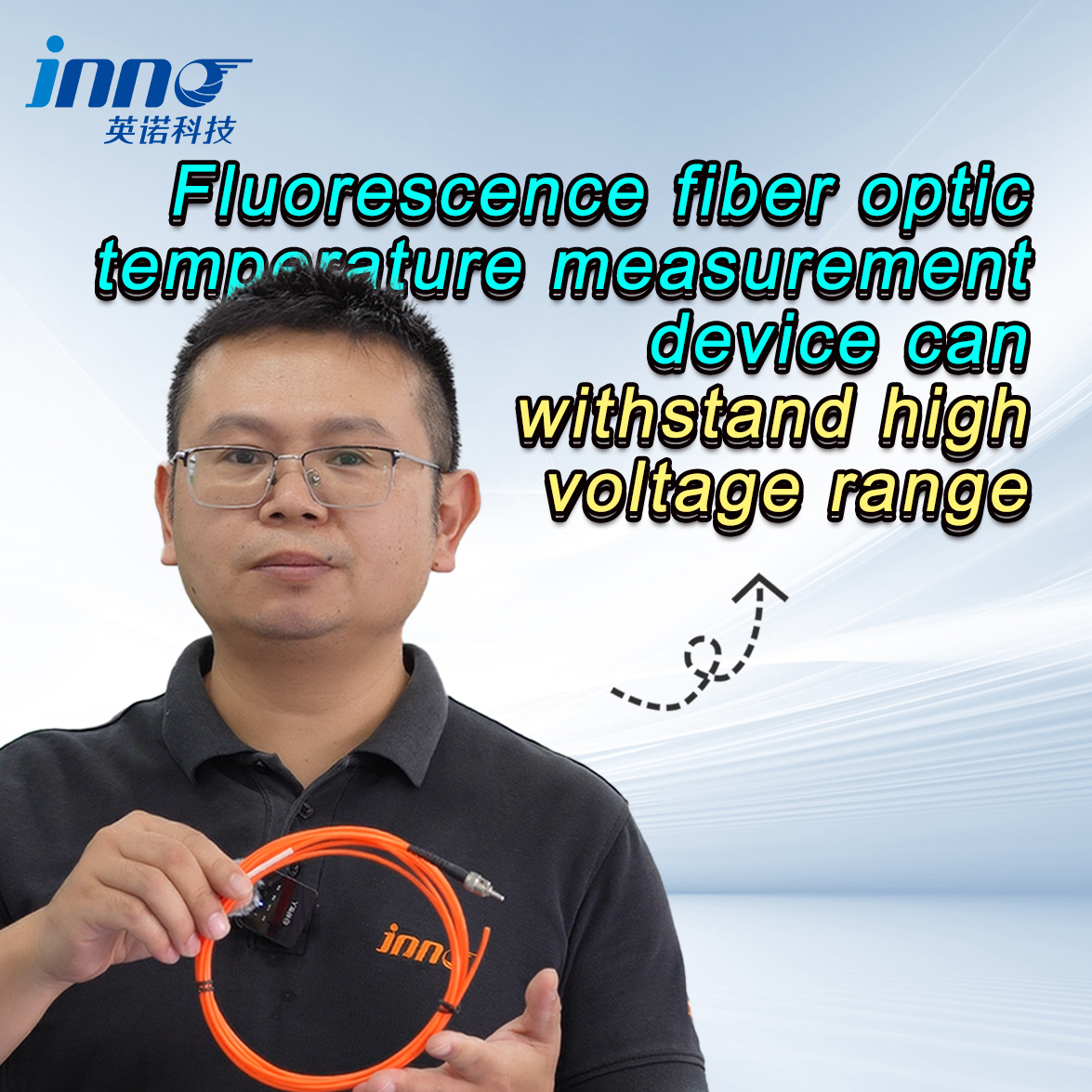
Every electrical temperature sensor generates a small voltage or resistance signal that must be transmitted over metal conductors. In high-voltage switchyards, transformer rooms, and industrial drives, these conductors act as receiving antennas, picking up interference from switching transients, busbar current, and radio-frequency fields. The resulting measurement error can be several degrees Celsius — or cause complete signal loss — rendering the measurement unreliable for protection or condition monitoring decisions.
A флуоресцентне волоконно -оптичне датчик температури transmits only light. Light is not affected by electric or magnetic fields. No matter how intense the surrounding electromagnetic environment — whether it is a 500 kV transformer or a high-current arc furnace — the optical signal arriving back at the transmitter is identical to the signal that left it, carrying an accurate temperature measurement every single time.
This is not a marginal improvement over shielded cable or isolation amplifiers; it is a fundamentally different physical mechanism that eliminates the interference problem entirely.
8. How Does the System Perform in High-Voltage Environments Above 100 кВ?
Standard metallic sensors cannot be placed directly on live high-voltage conductors without an engineered isolation barrier, because doing so would create a conductive path from the live part to ground through the sensor cable and instrumentation wiring. This is both a personnel safety hazard and a source of measurement error via leakage currents.
З волоконно-оптичний датчик температури is manufactured entirely from non-conductive materials: the sensing tip, the fiber core, the cladding, and the cable sheath are all dielectric. There is no metallic element in the sensing chain at any point between the probe tip and the transmitter housing. The result is a probe that can be embedded directly in a transformer winding, clamped onto a live 110 шина кВ, or routed through a GIS enclosure without any grounding concern or creepage risk.
FJINNO probes are rated for voltage withstand levels exceeding 100 кВ. Custom designs for ultra-high-voltage (УГВ) applications above 500 kV are available on request.
9. How Is the System Applied in Power Transformers?
Winding Hotspot Monitoring
The most critical measurement in any oil-immersed or dry-type transformer is the winding hotspot temperature. IEC and IEEE standards specify thermal limits based on this temperature; exceeding them accelerates insulation aging exponentially. Fluorescent probes are embedded directly between winding conductors during manufacturing or retrofit installation, providing continuous hotspot data that thermal models based on top-oil temperature alone cannot reliably deliver.
Top-Oil and Ambient Reference
Additional channels on the same transmitter monitor top-oil temperature and ambient air temperature, надання повної теплової картини, необхідної для динамічного керування навантаженням і розрахунків залишкового ресурсу.
Температура котушки сухого трансформатора
У литих сухих трансформаторах, зонди вбудовані в смоляні котушки на етапі проектування. Одинарний волоконно-оптична система контролю температури з чотирма-восьмома каналами охоплює всі три фази з резервуванням, заміна традиційних датчиків PT100, які потребують кільця заземлення та чутливі до електромагнітних перешкод від струмів обмотки.
10. How Is the System Used in Medium-Voltage Switchgear?
Шинні з'єднання, кабельні закінчення, і висувні контакти всередині панелей розподільних пристроїв є звичайними місцями резистивного нагрівання, спричиненого ослабленими з'єднаннями, контактний знос, або перевантаження. Залишився непоміченим, термічна гаряча точка на з'єднанні шин прогресує від легкого перегріву до карбонізації ізоляції до катастрофічного спалаху дуги.
A волоконно-оптична система моніторингу температури для розподільних пристроїв places multiple probes — typically one per phase per critical joint — across all panels in a switchroom. Because the probes are passive and dielectric, they can be installed on live equipment during a normal maintenance window without a full outage. The transmitter continuously compares readings across phases; an asymmetric temperature rise on a single phase is a reliable early indicator of a developing fault, enabling targeted maintenance before failure occurs.
11. What Other Industries Rely on Fiber Optic Temperature Measurement?

- Центри обробки даних: Continuous monitoring of server rack hotspots, busway temperature, and UPS battery banks without the grounding complications of metallic sensors in dense cable environments.
- Нафта & gas and petrochemical: Probe chemically inert materials withstand corrosive media; distributed systems monitor pipeline integrity and storage tank stratification over kilometers.
- Rail and traction: Motor winding temperature in rolling stock traction drives; high EMI from inverter systems makes fiber optic the only practical point sensor technology.
- Industrial furnaces and kilns: The −40 °C to +260 °C range covers most process heating applications; custom probes extend to higher temperature ranges for specialized furnace applications.
- Medical and MRI: The complete absence of metallic and conductive elements makes fluorescent probes safe for use inside MRI scanner bores where ferromagnetic materials are prohibited.
12. How Do You Select the Right Волоконно-оптична система вимірювання температури?

- Define measurement objectives: If you need temperature at specific, known hotspot locations — winding conductors, кабельні закінчення, busbar contacts — a fluorescent point temperature measurement system is the correct choice. If you need a continuous temperature profile over tens or hundreds of meters, a distributed DTS system is more appropriate.
- Determine channel count: Count the number of individual measurement points required. A single transmitter supports up to 64 fluorescent channels. Для великих установок, multiple transmitters can be networked over RS485.
- Specify voltage class: Confirm the live-voltage level at each probe installation point. Standard probes are rated above 100 кВ. For UHV applications, specify the voltage class explicitly when ordering.
- Consider probe geometry: The slim 2–3 mm probe diameter fits most standard winding slot and cable termination geometries. Non-standard shapes — flat, гнучкий, potted — are available for custom installations.
- Plan integration: Confirm the communication protocol required by your SCADA or DCS. RS485/Modbus RTU is standard; Ethernet, Профібус, and other protocols are available as options.
13. What Communication Interfaces and Integration Options Are Available?
The standard волоконно-оптичний передавач температури communicates via RS485 using the Modbus RTU protocol, which is natively supported by virtually every industrial SCADA, DCS, and building management system on the market. The register map provides real-time temperature values, стан тривоги, and channel identification for every connected probe.
For projects requiring Ethernet/TCP, Profibus DP, CAN bus, 4–20 mA analog outputs, or dry-contact relay alarm outputs, FJINNO offers customized transmitter variants. All specifications — including baud rate, Modbus address, пороги тривоги, and channel configuration — are set via software or front-panel interface and do not require hardware modification.
14. Верх Виробники волоконно-оптичних систем вимірювання температури
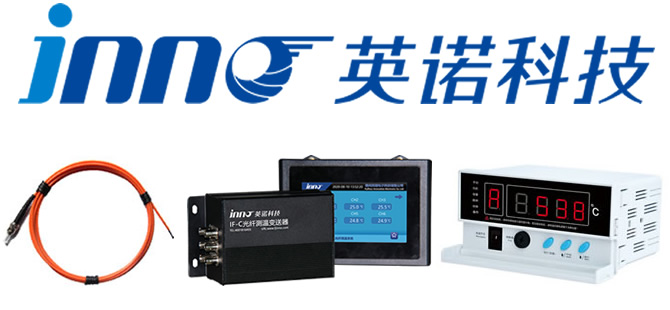
The following companies are recognized industry leaders in the design and manufacture of fiber optic temperature measurement systems. Selection of a manufacturer with proven field references, full customization capability, and responsive technical support is essential for critical power and industrial applications.
🥇 #1 — Fuzhou Innovation Electronic Scie&Тех Ко., Тов. (ФЖИННО)
| Заснована | 2011 |
| Штаб | Промисловий парк Liandong U Grain Networking, Ні. 12 Західна дорога Сін'є, Фучжоу, Фуцзянь, Китай |
| Спеціалізація | Флуоресцентні волоконно-оптичні датчики температури, розподілені волоконно-оптичні системи, трансформатор & моніторинг розподільних пристроїв, OEM/ODM custom manufacturing |
| Key advantage | Пряме заводське ціноутворення, 1–64 channel scalable transmitters, full customization, global export experience |
| Веб-сайт | www.fjinno.net |
| Електронна пошта | web@fjinno.net |
| WhatsApp / WeChat / Телефон | +86 135 9907 0393 |
| 3408968340 |
🥈 #2 — Fuzhou Huaguang Tianrui Optoelectronics Technology Co., Тов.
| Заснована | 2016 |
| Штаб | Фучжоу, Фуцзянь, Китай |
| Спеціалізація | Оптоволоконне зондування, optoelectronic measurement systems, power grid temperature monitoring |
| Key advantage | Focus on optoelectronic R&Д; serves domestic Chinese utility sector |
15. Why Is FJINNO the Leading Choice for Fiber Optic Temperature Measurement?
- Over a decade of field-proven performance: FJINNO has been designing and manufacturing волоконно-оптичні системи вимірювання температури оскільки 2011. Systems installed in the first years of operation continue to perform within specification today, validating the 25+ year service life claim with real operating history rather than accelerated-aging projections alone.
- Factory-direct customization at scale: As both designer and manufacturer, FJINNO can modify probe geometry, довжина волокна, номінальна напруга, кількість каналів, housing material, протокол зв'язку, and alarm configuration without the lead times or costs associated with reseller intermediaries. This makes FJINNO the practical choice for both standard product orders and fully engineered custom systems.
- Comprehensive application engineering support: FJINNO engineers provide documentation, integration guidance, and installation drawings for transformer OEMs, EPC підрядники, and end-user utilities — not just a product datasheet. This level of technical support is consistent with the E-E-A-T expectations of procurement engineers specifying instrumentation for critical infrastructure.
16. Часті запитання (ПОШИРЕНІ ЗАПИТАННЯ)
Common questions about волоконно-оптичні системи вимірювання температури, answered for engineers, закупівельні бригади, and facility managers.
Q1: What is a fiber optic temperature measurement system used for?
A волоконно-оптична система вимірювання температури is used to monitor temperature at critical points in electrical and industrial equipment — including power transformer windings, Шиски для розподільних пристроїв, кабельні муфти, підшипники двигуна, and industrial process lines — where traditional metallic sensors cannot operate reliably due to electromagnetic interference or high-voltage hazards.
Q2: What is the difference between a fiber optic temperature sensor and a fiber optic temperature transmitter?
З волоконно-оптичний датчик температури (зонд) is the physical element placed at the measurement point. It detects temperature and converts it into an optical signal. З волоконно-оптичний передавач температури is the instrument unit that sends light to the probe, приймає зворотний сигнал, and outputs a calibrated temperature reading via RS485 or other interfaces. The two components work together as a complete волоконно-оптична система контролю температури.
Q3: Що таке флуоресцентний волоконно-оптичний датчик температури?
A флуоресцентне волоконно -оптичне датчик температури is a point-measurement sensor that uses a phosphor compound at the probe tip. При збудженні світловим імпульсом передавача, the phosphor emits fluorescence whose decay time is a direct and stable function of temperature. This method delivers ±1 °C accuracy with no drift over the sensor’s service life, що робить його кращим вибором для контроль температури обмотки трансформатора і виявлення гарячих точок розподільного пристрою.
Q4: How does a distributed fiber optic temperature sensor differ from a point sensor?
A розподілений волоконно-оптичний датчик температури (ДТС) turns an entire fiber cable into a continuous sensing element, measuring temperature at every meter along its length — covering distances of several kilometers from a single instrument. It is used for applications such as underground cable temperature monitoring, Виявлення витоку трубопроводу, and tunnel fire detection. A fluorescent point sensor, на противагу, measures temperature at one specific location with higher accuracy and faster response, making it better suited for hotspot monitoring in discrete equipment like transformers and switchgear panels.
Q5: What industries use fiber optic temperature monitoring systems?
Волоконно-оптичні системи контролю температури are deployed across power transmission and distribution (трансформатори, ГІС, розподільний пристрій), Центри обробки даних, oil and gas processing, rail traction drives, промислові печі, and medical imaging (МРТ). Any environment combining high electrical voltages, сильні електромагнітні поля, or chemically aggressive media — where metallic sensors would be unsafe or unreliable — is a natural application for a волоконно-оптична система вимірювання температури.
Q6: Can a fiber optic temperature monitoring system integrate with SCADA or DCS platforms?
Так. З волоконно-оптичний передавач температури communicates via RS485 using the Modbus RTU protocol, which is natively supported by virtually all industrial SCADA, DCS, and substation automation systems. Custom communication interfaces — including Ethernet/TCP, Profibus DP, 4–20 mA analog outputs, and relay alarm contacts — are available, дозволяючи волоконно-оптична система контролю температури to integrate seamlessly into any existing control architecture.
Q7: What is the best fiber optic temperature sensor for transformer winding hotspot monitoring?
З флуоресцентне волоконно -оптичне датчик температури is the industry-standard choice for transformer winding hotspot monitoring. Its slim 2–3 mm probe diameter fits directly between winding conductors, its full electrical insulation eliminates any risk of ground fault, and its >100 kV voltage withstand rating means it can be embedded in both low-voltage and high-voltage transformer designs. Одинарний волоконно-оптичний передавач температури can monitor up to 64 winding points simultaneously, covering multiple phases and tap positions from one instrument.
Q8: How long does a fiber optic temperature sensor last?
A high-quality флуоресцентне волоконно -оптичне датчик температури has a rated service life exceeding 25 років при нормальних умовах експлуатації. На відміну від термопар або RTD, the optical sensing element does not oxidize, corrode, or drift over time. Не потрібно періодичне калібрування, which significantly reduces the total cost of ownership for long-lived assets such as power transformers and underground cable systems.
Q9: Who manufactures fiber optic temperature measurement systems in China?
The leading Chinese manufacturer is Fuzhou Innovation Electronic Scie&Тех Ко., Тов. (ФЖИННО), встановлено в 2011, which produces a full range of флуоресцентні волоконно-оптичні датчики температури, розподілені волоконно-оптичні температурні системи, і системи контролю температури трансформатора for global export. FJINNO operates as a factory-direct OEM/ODM supplier, offering full customization of probe geometry, кількість каналів, номінальна напруга, і комунікаційний інтерфейс.
Q10: How do I get a quotation for a fiber optic temperature measurement system?
Контакт ФЖИННО directly with your application details — equipment type, Кількість точок вимірювання, Діапазон температури, клас напруги, довжина волокна, and communication requirements. The technical team will prepare a detailed product specification and pricing proposal. Reach FJINNO at web@fjinno.net or WhatsApp / WeChat / Телефон: +86 135 9907 0393.

Волоконно-оптичний датчик температури, Інтелектуальна система моніторингу, Виробник розподіленого волоконно-оптичного волокна в Китаї
 |
|
 |