 INNO fiber optik sıcaklık sensörleri ,sıcaklık izleme sistemleri.
- Trafo çevrimiçi izlemesi süreklidir, Sıcaklık dahil olmak üzere bir güç transformatörünün temel çalışma parametrelerinin gerçek zamanlı toplanması ve analizi, kısmi deşarj, çözünmüş gaz, burç durumu, yük, ve yağ kalitesi — hizmeti kesintiye uğratmadan.
- Geleneksel çevrimdışı denetimin aksine, çevrimiçi izleme, gelişen arıza saatlerini tespit eder, günler, veya arızaya neden olmadan haftalar önce, Duruma dayalı bakımın sağlanması ve maliyetli plansız kesintilerin önlenmesi.
- Tam bir trafo izleme sistemi birden fazla sensör teknolojisini entegre eder, veri toplama birimleri, ve iletişim arayüzleri, gerçek zamanlı trafo sağlık verilerini operatörlere ve SCADA sistemlerine besleyen birleşik bir platformda.
- The most critical parameter monitored is temperature — specifically winding hot-spot temperature — measured with highest accuracy using transformer fiber optic temperature measurement systems that are immune to electromagnetic interference.
- International standards IEC 60076-7, IEC 61850, and IEEE C57.104 define the parameters, sınırlar, and communication protocols for transformer online monitoring, forming the technical framework for modern monitoring system design.
- Transformer Online İzleme Nedir??
- Online Monitoring vs Traditional Offline Maintenance
- What Parameters Are Monitored in a Transformer?
- Transformer Temperature Online Monitoring
- Partial Discharge Online Monitoring
- Çözünmüş Gaz Analizi (DGA) Çevrimiçi İzleme
- Bushing Online Monitoring
- Oil Quality and Moisture Online Monitoring
- Load, Current, and Voltage Monitoring
- Components of a Transformer Online Monitoring System
- SCADA and IEC 61850 Entegrasyon
- Benefits of Transformer Online Monitoring
- Application Scenarios
- How to Choose a Transformer Online Monitoring System
- İlgili Standartlar
- Top Transformer Online Monitoring Manufacturers
- SSS: Trafo Çevrimiçi İzleme
Nedir Trafo Çevrimiçi İzleme?

Transformer online monitoring (also called transformer condition monitoring or transformer health monitoring) is the practice of continuously measuring, kayıt, and analyzing a power transformer’s key operational and diagnostic parameters in real time, while the transformer remains energized and in service. Unlike periodic offline inspections — which require the transformer to be de-energized and removed from service — online monitoring operates 24 günde saatlerce, 365 days a year without any interruption to the transformer’s power delivery function.
A transformer online monitoring system typically consists of sensors installed at multiple measurement points on and inside the transformer, connected to data acquisition units and controllers that process the raw sensor signals, compare them against threshold values, and transmit structured data to local displays, alarm sistemleri, and remote SCADA or asset management platforms.
Modern online monitoring goes beyond simple threshold alarming. Advanced systems incorporate data analytics, termal modeller, aging algorithms, and machine learning to assess the transformer’s remaining useful life, predict the probability of failure, and recommend maintenance actions based on the actual measured condition of the asset rather than arbitrary time-based schedules. This approach — known as condition-based maintenance (CBM) or predictive maintenance — is now the industry standard for managing high-value power transformer assets in transmission and distribution networks worldwide.
For a complete overview of available monitoring solutions, see FJINNO’s transformer monitoring system solutions, which cover the full spectrum from temperature monitoring to partial discharge, DGA, and integrated multi-parameter platforms.
Key Characteristics of Transformer Online Monitoring
- Continuous operation: Data is collected without interrupting transformer service — no planned outages required for monitoring purposes.
- Multi-parameter: Modern systems simultaneously monitor temperature, kısmi deşarj, çözünmüş gazlar, yağ kalitesi, yük akımı, burç durumu, ve daha fazlası.
- Real-time alerting: Alarm thresholds trigger immediate notifications to operators when parameters exceed safe limits, enabling rapid response.
- Data logging and trending: All measurements are timestamped and stored, creating a historical record that reveals developing trends invisible to periodic inspections.
- Uzaktan erişim: Data is accessible via SCADA, web interfaces, or mobile applications, enabling centralized monitoring of large transformer fleets from a control room.
- Predictive analytics: Advanced platforms use accumulated data to calculate insulation aging rates, kalan ömür tahminleri, and fault probability scores.
Transformer Online Monitoring vs Traditional Offline Maintenance

For most of the 20th century, transformer maintenance relied exclusively on scheduled offline inspections and periodic laboratory testing. While this approach provided valuable diagnostic information, it had fundamental limitations that online monitoring directly addresses.
| Kriterler | Geleneksel Çevrimdışı Bakım | Çevrimiçi Sürekli İzleme |
|---|---|---|
| Sürekliliğin izlenmesi | Periyodik anlık görüntüler (yıllık / bienal) | Sürekli 24/7 gerçek zamanlı veriler |
| Trafo kullanılabilirliği | Test için planlı kesinti gerektirir | Kesintiye gerek yok; tamamen hizmette |
| Arıza tespit zamanlaması | Yalnızca bir sonraki planlı denetimde | Durum geliştikçe hemen |
| Aralıklı hataları tespit eder | Hayır — denetimler arasında kaçırıldı | Evet — sürekli veri günlüğüne kaydedilir |
| Bakım stratejisi | Zamana dayalı (takvim odaklı) | Koşul bazlı (varlık sağlığı odaklı) |
| Analiz için mevcut veriler | Sınırlı (nadir test sonuçları) | Zengin (yılda milyonlarca veri noktası) |
| Planlanmamış arıza riski | Yüksek — denetimler arasında başarısızlıklar | Düşük — erken uyarı önlemeyi mümkün kılar |
| Acil onarım maliyeti | Yüksek (önceden hazırlık yok) | Düşük (planlı müdahale mümkün) |
| Trafo ömrünün optimizasyonu | Conservative — limits loading due to uncertainty | Dynamic loading based on real-time condition |
| Grid reliability impact | Outage required for testing | Zero — transparent to power system |
| Typical cost structure | Lower upfront, higher failure and downtime cost | Higher upfront, dramatically lower lifecycle cost |
Industry studies consistently show that unplanned transformer failures cost 5–10 times more than planned maintenance interventions — including emergency repair or replacement costs, lost revenue from unplanned outages, emergency crew deployment, and regulatory penalties. For critical grid transformers, a single unexpected failure can cost millions of dollars. Online monitoring that enables even one prevented failure per decade typically generates a return on investment many times the cost of the monitoring system.
What Parameters Are Monitored in a Transformer Online Monitoring System?

A comprehensive transformer online monitoring system tracks a broad range of parameters covering thermal condition, electrical insulation integrity, oil chemistry, mechanical status, and electrical loading. The parameters selected for any given installation depend on transformer size, gerilim sınıfı, kritiklik, ve bütçe.
| Parametre Kategorisi | Specific Parameters Monitored | Primary Fault Detected |
|---|---|---|
| Sıcaklık | Sargı sıcak noktası, üst yağ, alt yağ, çekirdek, ortam | Aşırı yükleme, cooling failure, inter-turn fault |
| Kısmi Deşarj (PD) | PD magnitude, PD sayısı, PD location | Insulation degradation, boşluklar, kirlenme |
| Çözünmüş Gaz Analizi (DGA) | H₂, CH₄, C₂H₂, C₂H₄, C₂H₆, CO, CO₂, O₂, N₂ | Yaylanma, aşırı ısınma, insulation decomposition |
| Burç Durumu | Kapasite, ten rengi δ (dağılım faktörü), kaçak akım | Bushing insulation aging, nem girişi, flashover risk |
| Oil Quality | Nem içeriği, dielectric breakdown voltage, asitlik | Oil degradation, water contamination, yalıtım yaşlanması |
| Oil Level | Oil level in conservator or tank | Oil leak, excessive thermal expansion anomaly |
| Load and Electrical | Load current (3-faz), Gerilim, güç faktörü, harmonikler | Aşırı yükleme, harmonic heating, voltage imbalance |
| Titreşim / Akustik | Mekanik titreşim, akustik emisyon | Core loosening, winding movement, yaylanma |
| Yükte Kademe Değiştirici (OLTC) | Operation count, drive motor current, switching time | Temas aşınması, mechanism failure, yağ kirliliği |
| Buchholz / Basınç Tahliyesi | Gaz birikimi, pressure relief operation | Internal arcing, rapid gas generation, internal fault |
| Soğutma Sistemi | Fan/pump status, cooling stage activation | Soğutma sistemi arızası, inadequate heat dissipation |
| Ambient | Ortam sıcaklığı, nem | Environmental stress, derating requirements |
Transformer Temperature Online Monitoring

Temperature monitoring is the most fundamental and universally deployed element of transformer online monitoring. Aşırı sıcaklık, transformatör yalıtımının eskimesinin ana nedenidir ve nominal sargı sıcaklığının üzerindeki her 6-8°C'lik artış için erken arızanın birincil nedenidir., yalıtımın eskime oranı yaklaşık iki katına çıkar (the “6-derece kuralı” IEEE C57.91'e göre). Bu nedenle gerçek zamanlı sıcaklık izleme, hem koruma hem de varlık ömrü yönetimi için gereklidir.
Sıcaklık İzleme Noktaları
- Sargı Sıcak Nokta Sıcaklığı: En kritik parametre – transformatör sargısındaki en yüksek sıcaklık noktası, Yalıtım yaşlanmasının en hızlı olduğu yer. Doğrudan kullanılarak ölçüldü floresan fiber optik sıcaklık ölçüm cihazları sargılara gömülü, veya WTI termal görüntü simülasyonu kullanılarak dolaylı olarak tahmin edilir.
- Üst Yağ Sıcaklığı: Transformatör tankının üst kısmındaki en sıcak yağ tabakasının sıcaklığı, yağ cebinde Pt100 RTD ile ölçülmüştür. Used for oil protection, soğutma kontrolü, and as the baseline for WTI hot-spot simulation.
- Alt Yağ Sıcaklığı: The coolest oil temperature in the tank, measured at the tank bottom. The difference between top and bottom oil temperature reveals oil circulation effectiveness and cooling system performance.
- Çekirdek Sıcaklığı: Direct measurement of the transformer core using RTD or fiber optic sensors in the core pocket. Abnormal core temperature indicates core lamination faults, dolaşan akımlar, or flux leakage anomalies.
- Ortam Sıcaklığı: Environmental temperature outside the transformer tank, used as the reference baseline for calculating temperature rise and adjusting dynamic loading limits.
Fiber Optic vs Traditional Temperature Monitoring

The most significant advance in transformer temperature monitoring has been the adoption of direct fiber optik sıcaklık izleme sistemleri for winding hot-spot measurement. Unlike traditional WTI thermal image methods, which estimate winding temperature through a simulation that can deviate by ±5–15°C, fluorescent fiber optic sensors provide direct, physically measured winding temperatures with accuracy of ±0.1–0.5°C.
Key advantages of fiber optic winding temperature monitoring:
- Complete EMI immunity: The fiber optic probe is fully dielectric — no metal in the sensing element — making it immune to the powerful electromagnetic fields inside transformer tanks at operating voltage.
- Çok noktalı ölçüm: A single monitoring unit can simultaneously measure temperature at 4–16 winding locations, providing a complete thermal map of the transformer rather than a single simulated estimate.
- Bakım gerektirmeyen çalışma: No periodic calibration required — the fluorescent decay time measurement principle is inherently stable over the full sensor service life of 15–25 years.
- Direct hot-spot detection: Detects localized winding overheating caused by partial faults, blocked cooling ducts, or cooling system anomalies that the WTI global simulation cannot identify.
For oil-immersed power transformers, the yağa batırılmış transformatör sargıları için zırhlı floresan fiber optik sıcaklık sensörü provides rugged, oil-compatible, Transformatör sargı ortamlarının mekanik streslerine dayanacak paslanmaz çelik zırhla doğrudan sıcak nokta ölçümü.
Kuru tip transformatörler için, gör Kuru tip transformatörler için çevrimiçi sıcaklık izleme çözümü, Sargı yüzeyi fiber optik probları ve entegre soğutma fanı kontrolü ile Sınıf F ve Sınıf H yalıtım izlemeyi kapsar.
Kuru Tip Trafo Sıcaklık Kontrol Cihazı

Özellikle kuru tip transformatörler için, the kuru tip trafo sıcaklık kontrol cihazı sarma sıcaklığı gösterimi sağlar, alarm, seyahat, Panele monteli tek bir kompakt ünitede soğutma fanı kontrolü. Bu kontrolörler doğrudan RTD veya fiber optik sensör girişlerini kabul eder ve Sınıf B için yapılandırılabilir ayar noktaları sağlar, F, ve IEC'ye göre H yalıtım sınıfları 60076-11.
Yağlı transformatörler için, the yağa batırılmış transformatör sıcaklık kontrol cihazı OTI'yi birleştiriyor (yağ sıcaklığı göstergesi) ve WTI (sarma sıcaklık göstergesi) işlevler, with multi-stage cooling control, alarm/trip relay outputs, and Modbus communication for SCADA integration.
Kısmi Deşarj (PD) Çevrimiçi İzleme

Kısmi deşarj (PD) is a localized electrical discharge that occurs in insulation voids, contaminated oil, or at high field stress points within the transformer insulation system. PD does not immediately bridge the full insulation gap (hence “kısmi”) but causes progressive insulation erosion and can eventually lead to catastrophic dielectric failure. PD online monitoring detects the characteristic electrical, akustik, and chemical signatures of partial discharge activity in real time.
Why PD Monitoring is Critical
- Early warning of insulation failure: PD activity can precede dielectric breakdown by months or years, providing a long lead time for planned maintenance intervention.
- Detection of new faults: PD sensors detect developing insulation problems that conventional temperature monitoring cannot identify — particularly manufacturing defects, kirlenme, ve nem girişi.
- Risk stratification: PD magnitude and trend data allow ranking of transformers by failure risk, enabling priority-based maintenance resource allocation across large transformer fleets.
PD Monitoring Methods
| Yöntem | Prensip | Hassasiyet | En İyi Uygulama |
|---|---|---|---|
| High-Frequency CT (HFCT) | Detects high-frequency current pulses in grounding conductors | Yüksek | Bushing and terminal PD detection |
| UHF Antenna | Detects electromagnetic radiation (300MHz–3GHz) from PD | Çok yüksek | PD in oil, sargılar, and bushings |
| Acoustic Emission (AE) | Detects mechanical pressure waves from PD events | Ilıman | PD localization in transformer tank |
| Çözünmüş Gaz (DGA) | Detects gases generated by PD-induced oil decomposition | Kümülatif (not instantaneous) | Confirmation of sustained PD activity |
Çözünmüş Gaz Analizi (DGA) Çevrimiçi İzleme
Çözünmüş gaz analizi (DGA) is one of the most powerful diagnostic tools available for oil-immersed transformer condition assessment. When insulation materials — cellulose paper, baskı tahtası, and mineral oil — are subjected to electrical or thermal stress, they decompose and generate characteristic fault gases that dissolve in the transformer oil. By monitoring the concentration and rate of change of these gases online, operators can identify the type, ciddiyet, and rate of progression of internal faults.
Key Fault Gases and Their Significance
| Gaz | Chemical Symbol | Primary Fault Indicated | IEC 60599 Threshold (tipik) |
|---|---|---|---|
| Hidrojen | H₂ | Kısmi deşarj, taç | 100 ppm |
| Asetilen | C₂H₂ | High-energy arcing (most critical) | 3 ppm |
| Etilen | C₂H₄ | Severe overheating of oil (>700°C) | 50 ppm |
| Metan | CH₄ | Low-temperature overheating of oil | 120 ppm |
| Etan | C₂H₆ | Yağın orta derecede aşırı ısınması | 65 ppm |
| Karbonmonoksit | CO | Selüloz (kağıt) aşırı ısınma veya eskime | 350 ppm |
| Karbon Dioksit | CO₂ | Normal selüloz yaşlanması (yüksek CO₂/CO oranı) veya termal arıza | 2,500 ppm |
Çevrimiçi DGA monitörleri sürekli veya düzenli aralıklarla yağ numunelerini çıkarır, Gaz kromatografi analizi gerçekleştirmek, ve gaz konsantrasyonu verilerini izleme platformuna iletin. Değişim hızı alarmları özellikle değerlidir; asetilen konsantrasyonundaki hızlı bir artış, acil koruyucu önlem gerektiren aktif bir ark arızasına işaret edebilir, aylar boyunca CO2'deki yavaş artış, planlı bir kesintiyle çözülebilecek aşamalı kağıt yalıtımı yaşlanmasının sinyalini veriyor.
Trafo Burcu Çevrimiçi İzleme
Transformer bushings — the high-voltage insulated conductors that pass current through the transformer tank wall — are among the most failure-prone components of large power transformers. Bushing failures are responsible for a disproportionately high share of catastrophic transformer failures, and they typically occur with little advance warning in the absence of continuous monitoring.
Bushing Monitoring Parameters
- Kapasite (C1): The main insulation capacitance of the bushing. A significant change (tipik olarak >5%) from baseline indicates insulation degradation, delamination, veya nem girişi.
- Tan deltası (Dissipation Factor): The tangent of the dielectric loss angle of the bushing insulation. An increase in tan δ, particularly when correlated with temperature, indicates insulation deterioration. Normal values for oil-impregnated paper (OIP) bushings are typically below 0.5%.
- Leakage Current: The current flowing through the bushing grounding tap. Monitoring the fundamental and harmonic components of the leakage current provides an early indicator of bushing insulation breakdown.
Online bushing monitors measure all three phases simultaneously, using the phase-to-phase comparison method to detect relative changes that indicate individual bushing degradation while canceling out common-mode variations caused by voltage and temperature changes.
Oil Quality and Moisture Online Monitoring
Transformer oil serves simultaneously as insulation and cooling medium. Its condition directly affects the transformer’s dielectric strength and thermal performance. Online oil quality monitoring continuously assesses oil condition without the need for manual oil sampling and laboratory analysis.
Oil Quality Parameters Monitored Online
- Nem İçeriği (Water in Oil):
Water is the most damaging contaminant in transformer oil, dramatically reducing dielectric breakdown voltage and accelerating cellulose insulation aging. Online moisture sensors (typically capacitive or optical) measure relative saturation and absolute moisture content in ppm. A moisture level above 20–35 ppm (depending on oil condition and temperature) signals a need for oil drying or dehydration action. - Dielectric Breakdown Voltage:
The voltage at which the oil breaks down dielectrically — a direct measure of oil insulating effectiveness. Continuous online sensors apply a test voltage across an oil gap and measure the breakdown voltage. IEC 60156 defines a minimum acceptable breakdown voltage of 30 kV (2.5mm gap) for transformer oil in service. - Yağ Sıcaklığı (Üst ve Alt):
Hem çalışma parametresi hem de yağ durumu göstergesi olarak sürekli izlenir; yüksek yağ sıcaklıklarında hızlandırılmış eskime ve gaz üretimi, yalıtım bozulma oranlarıyla doğrudan ilişkilidir. - Oil Level:
Koruyucu tanktaki veya kapalı transformatördeki yağ seviyesi, sızıntıları veya anormal termal genleşme davranışını tespit etmek için izlenir. Düşük yağ seviyesi yalıtım marjlarını azaltır; çok yüksek seviye, yağ hacminin artmasına neden olan aşırı nem emiliminin göstergesi olabilir.
Load, Current, ve Gerilim Çevrimiçi İzleme
Elektrik yükü izleme, termal modelleme için gerekli giriş verilerini sağlar, dinamik yükleme hesaplamaları, ve can kaybı değerlendirmeleri. Ayrıca aşırı yükleme koşullarını da tanımlar, yük dengesizlikleri, ve transformatör sağlığını doğrudan etkileyen harmonik bozulma.
- Yük Akımı (faz başına): Her fazdaki akım trafoları aracılığıyla ölçülür. Used as input for WTI thermal image calculations, dynamic loading assessments per IEC 60076-7, and overload alarm triggering.
- Transformer Loading Percentage: Load current expressed as a percentage of rated current, enabling direct comparison against nameplate limits and emergency overload guidelines.
- Harmonik Analiz: Harmonic current components (particularly 3rd, 5o, 7o) increase eddy current losses in windings and structural parts, generating additional heat. Online harmonic monitoring quantifies the K-factor or FHL (harmonic loss factor) to assess derating requirements.
- Gerilim (faz başına): Voltage monitoring detects voltage imbalance, overvoltage, and undervoltage conditions that affect transformer core losses and reactive power consumption.
- Power Factor and Reactive Power: Power factor monitoring provides an indicator of overall system loading conditions and helps detect power quality issues that increase transformer heating.
Components of a Transformer Online Monitoring System
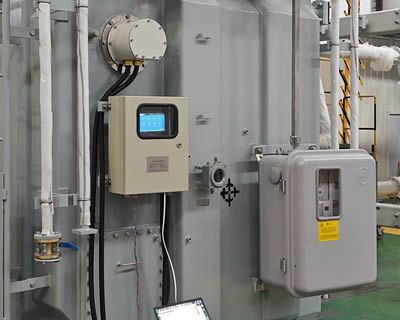
A complete transformer online monitoring system integrates hardware sensors, data acquisition and processing electronics, iletişim altyapısı, and software analytics into a cohesive platform. Understanding each component’s role is essential for system design and procurement.
1. Sensors and Transducers
The sensor layer is the foundation of the monitoring system. For temperature: fiber optik sıcaklık sensörleri for winding hot-spot, Pt100 RTDs for oil and ambient temperature. For electrical parameters: HFCTs and UHF antennas for partial discharge, CTs for load current. For chemistry: online gas chromatographs for DGA, capacitive sensors for moisture. For mechanical: acoustic emission sensors for vibration and PD localization. See the full range of recommended fiber optic sensing and monitoring products for a comprehensive product overview.
2. Veri Toplama Birimi (GEKS)
The DAU collects raw signals from all connected sensors, performs analog-to-digital conversion, applies calibration factors, and packages the data into structured measurement records. For multi-parameter systems, the DAU typically includes separate signal conditioning channels for each sensor type. The fiber optic temperature monitoring device with 6 kanallar exemplifies a multi-channel DAU capable of simultaneously acquiring data from up to six fiber optic temperature measurement points with sub-second update rates.
3. Local Processing and Controller Unit
The local controller processes acquired data, implements alarm and protection logic, soğutma sistemlerini kontrol eder, ve yerel bir veri arabelleğini korur. Termal model hesaplamalarını yürütür (IEC başına 60076-7) Ham sensör okumalarını sıcak nokta sıcaklık tahminlerine ve izolasyon eskime değerlendirmelerine dönüştüren. The fiber optik sıcaklık ölçüm sistemi veri toplamayı entegre eder, işleme, Trafo merkezi ekipman dolaplarına DIN rayı veya panel montajı için tasarlanmış tek bir ünitede kullanıcı arayüzü fonksiyonları ve kullanıcı arayüzü fonksiyonları.
4. İnsan-Makine Arayüzü (HMI)
Yerel HMI, gerçek zamanlı ölçümlerin yerinde görüntülenmesini sağlar, alarm durumu, tarihsel eğilimler, ve sistem yapılandırması. Seçenekler, bireysel cihazlardaki basit LCD panellerden, tam trend grafiği ve alarm yönetimi özelliklerine sahip dokunmatik ekranlara kadar uzanır..
5. İletişim Ağ Geçidi
İletişim ağ geçidi, izleme sisteminin dahili veri formatını standart trafo merkezi protokollerine çevirir (Modbus, IEC 61850, DNP3) for transmission to SCADA or asset management platforms. It also provides cybersecurity functions including authentication, encryption, and network isolation for critical infrastructure protection.
6. SCADA / Asset Management Software
The software layer provides centralized visualization of transformer fleet health, alarm yönetimi, historical data analysis, reporting, and predictive analytics. Advanced platforms integrate transformer thermal models, DGA diagnostic algorithms, and remaining-life calculation engines to provide actionable asset management recommendations.
7. Cooling System Control Interface
Relay outputs from the monitoring controller connect to the transformer’s cooling fans and oil circulation pump contactors, enabling automatic staged cooling activation based on real-time temperature measurements. For the integrated temperature monitoring system, cooling control logic is configurable to optimize the balance between transformer loading capacity and cooling system energy consumption.
SCADA and IEC 61850 Integration for Transformer Online Monitoring
Integration of transformer online monitoring systems with substation SCADA and protection platforms is essential for realizing the full operational value of monitoring data. Without integration, monitoring becomes an isolated function — alarms may go unnoticed and data may not reach the operators and engineers who need it for decision-making.
İletişim Protokolü Desteği
| Protokol | Başvuru | Notes |
|---|---|---|
| Modbus RTU (RS-485) | Industrial SCADA, DCS integration | Most widely supported, basit uygulama |
| Modbus TCP/IP | Ethernet-based SCADA | Standard for modern substation LAN networks |
| IEC 61850 MMS | Digital substation automation | Required for IEC 61850-compliant substations |
| IEC 61850 KAZ | Fast alarm and protection signaling | Sub-millisecond response for critical alarms |
| DNP3 | Utility SCADA (Kuzey Amerika) | Standard for North American utility networks |
| IEC 60870-5-104 | Transmission SCADA (Europe/Asia) | Standard for TSO and DSO SCADA platforms |
| 4–20mA Analog | Legacy DCS, analog recorders | Backward compatible with older control systems |
| OPC-UA | IT/OT convergence, cloud platforms | For digital twin and AI analytics integration |
IEC 61850 Logical Node Model for Transformer Monitoring
IEC 61850 Parça 7-4 defines standardized logical nodes (LNs) for transformer monitoring data, including TTMP (sıcaklık ölçümü), PDIS (kısmi deşarj), GASIN (gas in insulating medium), and MHAN (harmonik analiz). Implementing these logical nodes ensures interoperability between monitoring systems from different manufacturers and simplifies system integration in digital substation projects.
Benefits of Transformer Online Monitoring
1. Prevention of Catastrophic Failures
The most compelling benefit. Büyük transformatör arızaları (özellikle sargı arızaları ve burç patlamaları) yangınlara neden olabilir, petrol sızıntıları, haftalar, aylar süren uzun süreli kesintiler, ve yüzbinlerce ila milyonlarca dolar arasında değişen trafo değiştirme maliyetleri. Çevrimiçi izleme, yıkıcı arızalardan önce gelişen koşulları tespit eder, Arızanın geri döndürülemez hale gelmesinden önce müdahalenin sağlanması. Büyük kamu hizmetleri kuruluşları tarafından yapılan araştırmalar, sürekli olarak çevrimiçi izlemenin, sürekli izleme olmadan meydana gelebilecek transformatör arızalarının @-70'ini önlediğini göstermektedir..
2. Uzatılmış Trafo Servis Ömrü
Transformatör izolasyonunun yaşlanması sıcaklığın bir fonksiyonudur, nem, ve zamanla asitlik. Çevrimiçi izleme, operatörlerin çalışma sıcaklıklarını kritik eşiklerin altında tutarak yalıtım eskimesini aktif olarak yönetmesine olanak tanır, maintaining oil quality, and implementing dynamic loading strategies that maximize utilization while controlling life consumption. Careful temperature management enabled by fiber optic monitoring has been shown to extend transformer service life by 20–40% beyond original design expectations.
3. Dynamic Loading Optimization
Traditional transformer loading limits are conservative, based on worst-case thermal assumptions that include maximum ambient temperature and minimum cooling effectiveness. Online monitoring of actual winding hot-spot temperature enables dynamic loading — safely increasing transformer loading above nameplate rating during favorable conditions (low ambient, full cooling) and automatically reducing loading when temperatures approach limits. This dynamic loading approach can increase effective transformer capacity by 10–30% without accelerating insulation aging, deferring capital expenditure on transformer upgrades or replacements.
4. Transition from Time-Based to Condition-Based Maintenance
Time-based maintenance schedules are inherently wasteful — they perform maintenance on equipment that may not yet need it, and miss developing faults between scheduled inspection dates. Online monitoring data provides objective, real-time evidence of each transformer’s actual condition, enabling maintenance to be scheduled based on genuine need. This transition typically reduces total maintenance labor and material costs by 20–40% while improving asset reliability.
5. Regulatory Compliance and Insurance
Many national grid codes, utility operating standards, and insurance requirements for transmission-class transformers mandate continuous temperature monitoring and event logging. Online monitoring systems provide the time-stamped, auditable data records required for regulatory compliance, warranty claims, insurance investigations, and post-incident analysis.
6. Fleet-Wide Risk Management
For utilities and industrial operators managing large transformer fleets, online monitoring enables portfolio-level risk assessment. By comparing the health indicators of all monitored transformers simultaneously, operators can identify the highest-risk assets, prioritize maintenance resources, and make evidence-based decisions about repair, yenileme, or replacement timing.
Transformer Online Monitoring Application Scenarios
Transmission Substations (66kV–500kV)
High-voltage transmission transformers are the highest-value, Güç sistemindeki en uzun teslim süresine sahip varlıklar — 12-24 aylık değiştirme süreleri, özel olarak üretilmiş büyük üniteler için alışılmadık bir durum değildir. Planlanmamış bir başarısızlığın sonucu ağırdır: genişletilmiş şebeke istikrarsızlığı, yüksek maliyetle acil tedarik, ve potansiyel düzenleyici cezalar. Sıcaklığı kapsayan kapsamlı çevrimiçi izleme, PD, DGA, burç, ve yağ kalitesi bu sınıftaki transformatörler için endüstri standardıdır. Trafo merkezinin IEC'si ile entegrasyon 61850 otomasyon sistemi ağ kontrol merkezine kesintisiz veri akışı sağlar.
Endüstriyel Güç Kaynağı Transformatörleri
Endüstriyel tesisler — çelik fabrikaları, kimyasal tesisler, veri merkezleri, yarı iletken fabrikalar — kesintilerin saatte binlerce ila milyonlarca dolara mal olduğu sürekli üretim süreçleri için kesintisiz güce bağımlıdır. Online monitoring of critical supply transformers provides early warning that enables planned outages during low-production periods, avoiding forced shutdowns at the worst possible times. For data centers specifically, gör data center temperature monitoring solution covering transformer and electrical infrastructure monitoring for Tier III and Tier IV facilities.
Wind Farm Transformers
Wind turbine step-up transformers operate in a challenging environment — remote locations, titreşim, wide load swings following wind variations, and limited access for maintenance. Online monitoring with remote SCADA connectivity enables centralized supervision of dozens of turbine transformers from a single control room. Temperature monitoring using fiber optik sıcaklık izleme sistemleri is particularly valuable for wind turbine transformers because the variable load profile creates complex thermal cycling that is impossible to assess from periodic inspections.
Distribution Transformers in Smart Grids
The proliferation of distributed energy resources (solar PV, EVs, pil depolama) creates bidirectional power flows and rapid load changes that subject distribution transformers to new thermal stresses not anticipated in their original design. Online temperature monitoring enables real-time thermal management of distribution transformer assets as smart grid loading conditions evolve.
Switchgear and GIS Substations
Beyond power transformers, complete substation monitoring covers switchgear temperature and partial discharge monitoring. Bkz. switchgear monitoring solution for fiber optic temperature measurement in MV and HV switchgear cabinets, ve GIS monitoring system for gas-insulated switchgear online condition assessment. Cable monitoring is covered by the kablo izleme sistemi for underground power cable temperature and partial discharge surveillance.
How to Choose a Transformer Online Monitoring System
Selecting the right transformer online monitoring system requires balancing technical requirements, bütçe kısıtlamaları, ve entegrasyon ihtiyaçları. Follow this structured selection process to identify the optimal solution for your application.
Adım 1: Define the Transformer Asset Class and Criticality
Classify the transformer by voltage class (dağıtım, sub-transmission, bulaşma), MVA derecesi, yaş, and operational criticality. High-voltage transmission transformers justify comprehensive multi-parameter monitoring (sıcaklık + PD + DGA + burç). Distribution transformers may be economically served by temperature-only monitoring. İzleme sisteminin maliyeti, korunan varlığın değeri ve kritikliği ile orantılı olmalıdır..
Adım 2: İzlenecek Birincil Arıza Modlarını Belirleyin
Transformatörün bakım geçmişini ve bilinen tüm güvenlik açıklarını inceleyin. Yağ kalitesi sorunları geçmişi olan eski transformatörler DGA ve nem izlemeden yararlanır. Daha önce burç olayları yaşayan transformatörler sürekli burç izlemesi gerektirir. Yazın en yüksek talep dönemlerinde termal sınırlara yakın çalışan transformatörler, doğrudan fiber optik sargı sıcaklığı izlemesinden en fazla yararlanır.
Adım 3: EMI Ortamına Göre Sensör Teknolojilerini Seçin
Elektromanyetik parazitin önemli olduğu orta ve yüksek gerilim transformatörleri için, öncelik vermek fiber optik sensör sıcaklık ölçümü teknolojileri. For switchgear and busbar connections where point temperature measurement is needed, the fiber optic temperature sensor for busbar and bolt connections provides EMI-immune spot temperature measurement at connection points prone to overheating.
Adım 4: Determine Integration Requirements
Define the SCADA or asset management system the monitoring solution must interface with, and confirm which communication protocols are required. Specify alarm delivery methods: local audible/visual, e-posta, SMS, SCADA alarm, or all of the above. Define data retention requirements for regulatory compliance.
Adım 5: Evaluate Manufacturer Capability and Support
Select a manufacturer with demonstrated experience in transformer monitoring for your specific transformer type and voltage class, a track record of long-term product support, local technical service capabilities, and clear documentation of calibration procedures and replacement parts availability. Review the application guide for fluorescent fiber optic temperature sensors in transformer monitoring for detailed technical guidance on sensor selection and installation planning.
Adım 6: Plan for Installation and Commissioning
Determine whether sensors must be factory-installed (for winding-embedded probes) or can be field-installed during a planned maintenance outage (for retrofit probes, oil-immersed probes, and external sensors). Develop an installation schedule that minimizes outage time. Budget for commissioning, fonksiyonel test, SCADA entegrasyonu, and operator training in addition to equipment costs.
International Standards for Transformer Online Monitoring
- IEC 60076-7: Yağlı Güç Transformatörleri için Yükleme Kılavuzu
Termal modeli tanımlar, hot-spot calculation method, permissible temperature limits, and insulation aging acceleration factors. Forms the technical basis for temperature monitoring setpoint configuration and dynamic loading calculations. - IEC 60599: Mineral Oil-Impregnated Electrical Equipment — Interpretation of Dissolved and Free Gases Analysis
Provides the diagnostic framework for interpreting DGA results, including typical gas concentration limits, fault identification ratios (Rogers, Duval Üçgeni), and recommended actions based on gas levels and rates of change. - IEEE C57.104: IEEE Guide for the Interpretation of Gases Generated in Mineral Oil-Immersed Transformers
IEC'nin Kuzey Amerika eşdeğeri 60599. Provides condition classifications and diagnostic procedures based on dissolved gas concentrations and generation rates. - IEC 61850-7-4: Power Utility Automation — Compatible Logical Node Classes and Data Object Classes
Defines the IEC 61850 logical node model for transformer monitoring data, including standardized data objects for temperature (TTMP), çözünmüş gaz (GASIN), ve kısmi deşarj (PDIS) ölçümler. - IEC 60270: High-Voltage Test Techniques — Partial Discharge Measurements
The standard for partial discharge measurement methodology, defining quantities (apparent charge in pC), test circuit configurations, and calibration procedures relevant to PD monitoring system design. - IEC 60422: Mineral Insulating Oils in Electrical Equipment — Supervision and Maintenance Guide
Provides guidance on oil quality monitoring, sampling intervals, and acceptable limit values for moisture, arıza gerilimi, asitlik, and other oil quality parameters. - IEEE C57.143: IEEE Guide for Application for Monitoring Equipment to Liquid-Immersed Transformers and Components
Covers the selection, kurulum, and application of online monitoring equipment for liquid-immersed transformers, providing practical guidance for monitoring system design and commissioning.
Top Transformer Online Monitoring System Manufacturers

- FJİNNO (No.1 — Fluorescent Fiber Optic Specialist):
FJINNO leads in fiber optic-based transformer temperature monitoring, providing fluorescent fiber optic sensing systems with complete EMI immunity, direct winding hot-spot measurement, and zero-maintenance operation. Their integrated transformer monitoring system solutions cover temperature, kısmi deşarj, and multi-parameter monitoring for utilities, OEM'ler, and industrial operators globally. FJINNO’s systems are manufactured to CE, EMC, ve ISO9001 standartları ile dünya çapında teslimat ve uzaktan teknik destek. - Kalitrol (Danaher):
Transformatör aksesuarları ve çevrimiçi izlemede dünya çapında tanınan bir lider, Sıcaklık göstergelerinden gelişmiş IED tabanlı çok parametreli izleme platformlarına kadar geniş bir portföy sunuyor. - Vaisala (eski adıyla GE Digital Energy Kelman):
Fotoakustik spektroskopiyi kullanan gelişmiş DGA çevrimiçi izleme sistemlerinde uzmanlaşmıştır, Dünya çapında binlerce transmisyon transformatörüne kurulu kurulumlarla. - Reinhausen makine fabrikası (Bay):
OLTC izleme dahil kapsamlı transformatör izleme sistemleri sağlar, sıcaklık, burç, ve DGA, kademe değiştirici ürün grubuyla güçlü entegrasyona sahip. - Omikron Enerji:
Güç transformatörleri ve diğer yüksek gerilim varlıkları için gelişmiş kısmi deşarj izleme ve teşhis çözümleri sunar, iletim tesislerinde yaygın olarak kullanılır. - Çift Mühendislik:
Provides transformer diagnostic monitoring solutions focusing on bushing monitoring, DGA, and insulation condition assessment for utility asset management. - Sağlam İzleme:
Specializes in fiber optic transformer temperature monitoring with cloud analytics, multi-channel systems, ve IEC 61850 integration for utility and industrial applications. - ABB / Hitachi Enerji (TXpert):
Offers integrated transformer monitoring as part of their digital transformer platform, combining embedded sensors with cloud analytics for transformer fleet management. - Siemens Enerji:
Provides transformer monitoring solutions as part of their smart transformer and digital substation product range, with integration into MindSphere IoT analytics platforms. - Camlin (Shoreline):
Supplies bushing monitoring and multi-parameter transformer condition monitoring systems with established utility customer bases in Europe and North America.
Sıkça Sorulan Sorular: Trafo Çevrimiçi İzleme
What is the difference between online monitoring and offline testing for transformers?
Online monitoring refers to continuous real-time measurement of transformer parameters while the transformer remains in service, energized, and supplying load — no interruption of service is required. Offline testing (such as insulation resistance testing, power factor testing, or oil sampling for laboratory DGA) requires the transformer to be de-energized, disconnected, and taken out of service for the duration of the test. Online monitoring captures parameter values and trends continuously, including during load peaks, termal olaylar, and fault development, providing information that offline tests — which are snapshots taken during specific test conditions — fundamentally cannot provide. Kritik transformatörler için, online monitoring and periodic offline testing are complementary rather than alternative approaches.
What are the most important parameters to monitor in a power transformer?
If budget permits only one monitoring parameter, sarma sıcaklığı (ideally via direct fiber optic hot-spot measurement) provides the highest value — it directly controls insulation aging rate and is the primary trigger for protective action. The second highest priority is dissolved gas analysis (DGA), which provides the earliest warning of developing internal faults including arcing, aşırı ısınma, and insulation decomposition. Third is partial discharge monitoring, özellikle yalıtım bütünlüğünün tehlikeye girebileceği eskimiş veya önceden onarılmış transformatörler için. Burç izleme, büyük transmisyon transformatörleri için dördüncü sırada yer alıyor, Burç arıza riskinin, toplam transformatör arıza olasılığına göre orantısız derecede yüksek olduğu durumlarda. Birlikte, bu dört parametre sahadaki trafo kesintilerinden sorumlu olan arıza modlarının çoğunu kapsar.
Transformatör çevrimiçi izleme sisteminin maliyeti ne kadardır??
Trafo çevrimiçi izleme sistemi maliyeti, izlenen parametrelerin kapsamına göre önemli ölçüde değişiklik gösterir, trafo boyutu, ve iletişim gereksinimleri. Fiber optik sensörler ve tek denetleyicili bir ünite kullanan temel yalnızca sıcaklık izleme sisteminin kurulumu genellikle 3.000-10.000 ABD Doları tutarındadır.. Sıcaklığı kapsayan kapsamlı, çok parametreli bir sistem, DGA, PD, and bushing monitoring for a large transmission transformer can range from USD 50,000–200,000 installed, depending on the number of sensor points, iletişim arayüzleri, and analytics software licensing. When evaluating cost, consider the total cost of ownership including avoided failure costs, maintenance savings, and transformer life extension value — comprehensive monitoring ROI periods of 2–5 years are typical for critical transmission assets.
Can transformer online monitoring systems be retrofitted to existing transformers?
Yes — most online monitoring sensors can be installed on in-service transformers without requiring major outages. External sensors for bushing monitoring, titreşim, and acoustic emission attach to the transformer exterior and can be installed while the transformer is energized. Oil-immersed temperature probes, nem sensörleri, and DGA monitors connect via existing oil sampling valves or newly added oil port fittings, requiring only a brief service visit. Fiber optic winding temperature probes can be inserted through existing sensor ports or newly fitted access points. The main exception is winding-embedded fiber optic sensors, which must be installed during factory manufacturing or a full transformer rewind. For most retrofit applications, a substantial improvement in monitoring capability can be achieved without any de-energization requirement.
What is a transformer digital twin and how does it relate to online monitoring?
A transformer digital twin is a real-time software model of a specific physical transformer that mirrors its thermal state, yalıtım durumu, and loading history based on continuously updated data from the online monitoring system. The digital twin uses the IEC 60076-7 thermal model, DGA fault gas trends, and bushing condition data to calculate parameters that cannot be directly measured — such as insulation hot-spot aging per minute, cumulative loss-of-life, and predicted remaining service life under different future loading scenarios. Digital twin platforms allow operators to simulate the effect of proposed loading changes or maintenance interventions before implementing them, supporting evidence-based decision-making. The quality of a digital twin depends entirely on the accuracy and comprehensiveness of its input data — making high-quality online monitoring a prerequisite.
How does fiber optic temperature monitoring improve transformer loading capacity?
Traditional transformer loading limits are based on conservative worst-case thermal assumptions, including maximum ambient temperature and the accuracy limitations of WTI thermal image simulations. Because the WTI can deviate from actual winding temperature by ±5–15°C, operators must maintain large safety margins that reduce effective loading capacity. Direct fiber optic winding temperature measurement eliminates this uncertainty by providing the actual winding hot-spot temperature in real time. With verified real-time hot-spot data, operators can safely load the transformer to its true thermal limit — rather than to a conservative estimate of that limit — increasing effective loading capacity by 10–20% in typical operating conditions. This loading optimization is fully aligned with the dynamic loading guidelines in IEC 60076-7 and can defer the need for transformer capacity upgrades or replacements.
What is the role of DGA in transformer online monitoring?
Çözünmüş gaz analizi (DGA) is the most powerful chemical diagnostic tool for detecting internal transformer faults. When abnormal electrical or thermal stresses decompose the transformer’s oil or cellulose insulation, they generate characteristic fault gases (hidrojen, asetilen, etilen, metan, karbon monoksit, vesaire.) yağda çözünen. Online DGA monitors extract and analyze these gases continuously, detecting fault conditions that produce no visible external symptoms and cannot be detected by temperature monitoring alone. The most critical gas is acetylene (C₂H₂) — milyonda birkaç parça bile acil araştırma gerektiren yüksek enerjili arkı gösterir. Karbon monoksit (CO) zamanla yükselmesi kağıt yalıtımının aşırı ısındığını veya eskidiğini gösterir. DGA, gelişen arızaları arızaya neden olmadan haftalar veya aylar önce tespit edebilir, Herhangi bir izleme teknolojisi arasında en uzun süreli önceden uyarıyı sağlar.
Trafo izleme verilerini SCADA sistemime nasıl entegre edebilirim??
Trafo izleme verilerinin SCADA sistemleriyle entegrasyonu, izleme sisteminin iletişim ağ geçidi tarafından desteklenen standartlaştırılmış endüstriyel iletişim protokolleri aracılığıyla sağlanır.. Çoğu endüstriyel SCADA platformu için, Modbus RTU (RS-485) veya Modbus TCP/IP en basit entegrasyon yolunu sağlar; izleme sistemi standart Modbus tutma kayıtlarını sıcaklık değerleriyle kaydeder, alarm durumu bitleri, and system health indicators that the SCADA polls at regular intervals. For IEC 61850-compliant digital substations, the monitoring system should provide an IEC 61850 server with the appropriate logical nodes (TTMP for temperature, GASIN for DGA, vesaire.). Define the required data points, alarm eşikleri, and polling intervals in consultation with your SCADA system integrator before ordering the monitoring equipment, to ensure all required interface capabilities are included in the specification.
What is the lifespan of transformer online monitoring sensors?
Sensor lifespan varies significantly by technology. Fluorescent fiber optic temperature sensors have the longest lifespan — typically 15–25 years without replacement or recalibration, due to their inherently stable photophysical measurement principle. Pt100 RTD sensors typically last 10–20 years in oil-immersed environments, subject to periodic calibration. Online DGA sensors (gas chromatographs, photoacoustic sensors) typically have component replacement intervals of 3–7 years. HV bushing monitoring CTs and voltage dividers have design lives of 20–30 years. When planning a transformer online monitoring investment, match sensor design life to the expected remaining service life of the transformer, and factor replacement costs into the lifecycle economic analysis.
Is transformer online monitoring required by regulations?
Requirements vary significantly by country, gerilim sınıfı, and transformer type. In many jurisdictions, sürekli sıcaklık izleme (at minimum WTI and OTI) is mandatory for transformers above a specified MVA threshold or voltage level under national grid codes or utility technical standards. Some insurance policies for large transmission transformers require documented continuous monitoring as a condition of coverage. For renewable energy projects financed by international development banks or institutional lenders, lender technical requirements often specify online monitoring for major transformer assets. Even where not explicitly mandated, continuous temperature logging is increasingly required for compliance with asset management and reporting standards. Check your applicable grid code, utility operating standards, and insurance policy requirements to determine mandatory monitoring specifications for your specific transformers.

Fiber optik sıcaklık sensörü, Akıllı izleme sistemi, Çin'de dağıtılmış fiber optik üreticisi
 |
 |
 |