 INNO fiber optic na mga sensor ng temperatura ,mga sistema ng pagsubaybay sa temperatura.
- SF6 (sulfur hexafluoride) is a synthetic, colorless, walang amoy, non-flammable gas with exceptional dielectric strength and arc-quenching capability, making it indispensable in high-voltage electrical equipment.
- SF6 gas has a dielectric strength approximately 2.5 times that of air at atmospheric pressure and roughly 3 times at typical operating pressures used in gas-insulated switchgear (GIS).
- Primary applications include Mga SF6 circuit breaker, gas-insulated switchgear, gas-insulated transformers, at gas-insulated transmission lines (GIL) across voltage classes from 72.5 kV sa 1,100 kV.
- SF6 is classified as a potent greenhouse gas with a global warming potential (GWP) ng 23,500 over a 100-year horizon and an atmospheric lifetime of approximately 3,200 taon.
- Tama SF6 gas monitoring systems, including density monitors, leak detectors, and decomposition analyzers, are essential for safe operation and environmental compliance.
- Ang presyon ng regulasyon sa EU at iba pang mga hurisdiksyon ay nagtutulak ng pananaliksik sa mga alternatibong SF6 gaya ng mga pinaghalong fluoronitrile (C4F7N) at fluoroketone (C5F10O) pinaghalong para sa mga bagong disenyo ng kagamitan.
- Ang naka-install na base ng SF6-insulated na kagamitan sa buong mundo ay naglalaman ng isang tinantyang 250,000+ metric tons ng SF6 gas, nangangailangan ng mahigpit na pamamahala ng lifecycle mula sa pagpuno hanggang sa pagbawi at pag-recycle.
Talaan ng mga Nilalaman
- Ano ang SF6 Gas?
- Mga Katangiang Pisikal at Kemikal ng SF6 Gas
- Pagganap ng Dielectric at Arc-Quenching
- Mga Application ng SF6 Gas sa Electrical Equipment
- SF6 Gas Monitoring at Detection System
- SF6 Gas Handling, Imbakan, at Kaligtasan
- Epekto sa Kapaligiran at Mga Regulasyon
- SF6 Gas Alternatives para sa Electrical Equipment
- Mga Madalas Itanong
1. Ano ang SF6 Gas?

SF6 gas, o sulfur hexafluoride, ay isang sintetikong inorganic compound na may chemical formula na SF₆. It consists of one sulfur atom bonded to six fluorine atoms in an octahedral molecular geometry, forming one of the most chemically stable and electrically insulating gases known to science. First synthesized in 1900 by French chemists Henri Moissan and Paul Lebeau, SF6 found its defining industrial purpose in the mid-20th century when its extraordinary lakas ng dielectric at mga katangian ng arc-quenching were harnessed for high-voltage electrical equipment.
At standard temperature and pressure, SF6 is a colorless, walang amoy, hindi nakakalason, and non-flammable gas approximately five times denser than air. Its molecular weight of 146.06 g/mol gives it a distinctive heaviness that contributes to its insulating behavior. In the electrical power industry, sulfur hexafluoride gas serves as the primary insulating and arc-interrupting medium in equipment ranging from medium-voltage switchgear at 12 kV sa mga ultra-high-voltage circuit breaker at Mga sistema ng GIS nagpapatakbo sa 1,100 kV at mas mataas.
Bakit Naging Pamantayan sa Industriya ang SF6
Bago ang SF6, umaasa sa hangin ang mga kagamitang may mataas na boltahe, langis, o vacuum bilang insulating at interrupting media. Ang mga air-blast circuit breaker ay pisikal na napakalaki. Ang mga oil circuit breaker ay nagdulot ng mga panganib sa sunog at pagsabog. Nag-aalok ang SF6 ng nakakahimok na alternatibo — mga compact na kagamitan na may higit na nakakaabala na pagganap, mas mababang mga kinakailangan sa pagpapanatili, at kapansin-pansing nabawasan ang bakas ng paa. Noong 1970s at 1980s, SF6 gas-insulated na kagamitan naging pandaigdigang pamantayan para sa mga substation na may mataas na boltahe, partikular sa mga urban na lugar at panloob na mga instalasyon kung saan limitado ang espasyo.
2. Mga Katangiang Pisikal at Kemikal ng SF6 Gas
Ang pambihirang pagganap ng SF6 sa mga electrical application ay nakaugat sa kakaibang kumbinasyon ng mga katangiang pisikal at kemikal. Understanding these properties is essential for engineers specifying, nagpapatakbo, and maintaining SF6-filled electrical equipment.
| Ari-arian | Halaga | Kahalagahan |
|---|---|---|
| Molecular Formula | SF₆ | Octahedral symmetry, highly stable |
| Molecular Weight | 146.06 g/mol | ~5× heavier than air |
| Boiling Point (1 atm) | −63.9 °C (−83 °F) | Remains gaseous in most climates |
| Critical Temperature | 45.6 °C (114 °F) | Defines upper pressure limits |
| Critical Pressure | 37.6 bar (545 psi) | Operating pressures typically 4–8 bar |
| Density at STP | 6.16 g/L | High density aids insulation |
| Lakas ng Dielectric (1 atm) | ~2.5× air | Enables compact equipment design |
| Thermal Conductivity | ~1.3× air | Good heat dissipation in equipment |
| Lason | Non-toxic (pure state) | Decomposition byproducts are toxic |
| GWP (100-taon) | 23,500 | Potent greenhouse gas |
| Atmospheric Lifetime | ~3,200 years | Extremely persistent once released |
2.1 Katatagan ng Kemikal
Sulfur hexafluoride is one of the most chemically inert compounds known. The six fluorine atoms completely shield the central sulfur atom, creating an extremely strong and symmetric molecular bond structure. This stability means that SF6 does not react with other materials inside sealed electrical compartments — it does not attack copper, aluminyo, epoxy resin insulators, gaskets, or other components commonly found in gas-insulated switchgear at Mga SF6 circuit breaker.
2.2 Behavior Under Electrical Stress
When SF6 gas is subjected to an electrical arc — as occurs during circuit breaker operation — the gas molecules dissociate into sulfur and fluorine atoms and ions. The critical advantage is that SF6 rapidly recombines after the arc is extinguished, restoring its full dielectric strength within microseconds. This self-healing property is what makes SF6 uniquely effective as an arc-quenching medium. Gayunpaman, the arc-induced dissociation also produces trace amounts of decomposition byproducts, including sulfur dioxide (SO₂), hydrogen fluoride (HF), and various sulfur fluoride compounds (S₂F₁₀, SOF₂, SO₂F₂), ang ilan sa mga ito ay lubhang nakakalason at kinakaing unti-unti.
3. Pagganap ng Dielectric at Arc-Quenching
Ang dielectric na pagganap ng SF6 gas ay ang pangunahing dahilan para sa pangingibabaw nito sa mataas na boltahe na kagamitan. Sa presyon ng atmospera, Ang SF6 ay may dielectric na lakas ng humigit-kumulang 2.5 beses kaysa sa hangin. Sa karaniwang operating pressures na 4-6 bar (ganap) ginamit sa kagamitan sa GIS, ang dielectric na lakas ay tumataas sa halos 3 beses kaysa sa hangin, pagpapagana ng mga dramatikong pagbawas sa mga sukat ng kagamitan.
3.1 Mga Katangian ng Electronegative
Ang SF6 ay isang malakas na electronegative na gas, ibig sabihin ang mga molekula nito ay madaling kumukuha ng mga libreng electron. Sa isang electric field, anumang elektron na inilabas sa pamamagitan ng ionization ay mabilis na nasisipsip ng isang molekula ng SF6, bumubuo ng isang mabigat, mabagal na gumagalaw na negatibong ion. Pinipigilan ng mekanismong ito ng pag-capture ng elektron ang pagbuo ng mga pag-avalanch ng elektron — ang pangunahing proseso sa likod ng pagkasira ng kuryente. This property gives SF6 its superior insulation performance compared to air, nitrogen, or CO₂.
3.2 Arc Interruption Mechanism
Sa Mga SF6 circuit breaker, the arc-quenching process relies on the gas being blown across the arc by either a piston mechanism (puffer type) or thermal energy from the arc itself (self-blast type). The high thermal conductivity and electronegative nature of SF6 rapidly cool the arc channel and extract energy from it. At current zero crossings in AC systems, SF6 quickly rebuilds dielectric strength across the contact gap, successfully interrupting fault currents that can reach 63 kA or higher in modern mataas na boltahe na mga circuit breaker.
Dielectric Strength Comparison Across Gases
| Gas | Relative Dielectric Strength (Air = 1.0) | Use in Electrical Equipment |
|---|---|---|
| Hangin | 1.0 | Air-insulated switchgear (AIS) |
| Nitrogen (N₂) | 1.0 | Some transformer blankets |
| CO₂ | 0.9 | Limited applications |
| SF6 | 2.5 (at 1 atm) | GIS, mga circuit breaker, GIL, GIT |
| C4F7N / CO₂ mixture | ~2.0–2.3 | Emerging SF6 alternative |
| C5F10O / Air mixture | ~1.5–1.8 | Emerging SF6 alternative |
| Clean Dry Air | 1.0 | AIS, clean-air switchgear |
4. Mga Application ng SF6 Gas sa Electrical Equipment

Sulfur hexafluoride is used across a wide range of electrical power equipment where high dielectric strength, arc-quenching capability, and compact design are required. The global installed base of SF6 equipment spans transmission, pamamahagi, and generation systems on every continent.
4.1 SF6 Circuit Breakers
Mga SF6 circuit breaker are the dominant technology for interrupting high-voltage AC circuits at voltage levels from 72.5 kV sa 1,100 kV. Modern designs include single-pressure puffer-type breakers and self-blast (thermal-assist) breakers. These units can interrupt short-circuit currents of 40–80 kA with operating times under 3 cycles (50 ms at 60 Hz). Dead-tank SF6 breakers at live-tank SF6 breakers are the two principal configurations, each suited to different substation designs and seismic requirements.
4.2 Gas-Insulated Switchgear (GIS)
Gas-insulated switchgear (GIS) nakakabit ng mga circuit breaker, mga disconnector, mga earthing switch, kasalukuyang mga transformer, mga transformer ng boltahe, at mga konduktor ng bus sa loob ng mga selyadong aluminyo o bakal na enclosure na puno ng may presyon na SF6. Sinasakop ng mga pag-install ng GIS ang 10%–20% ng espasyo sa sahig na kinakailangan ng katumbas air-insulated switchgear (AIS) mga substation. Ginagawa nitong mahalaga ang GIS para sa mga substation sa lungsod, mga instalasyon sa ilalim ng lupa, mga platform sa malayo sa pampang, at anumang lugar kung saan limitado ang espasyo o malupit ang mga kondisyon sa kapaligiran.
4.3 Mga Transformer na Insulated ng Gas (GIT)
Mga transformer na insulated ng gas gamitin ang SF6 bilang insulating at cooling medium sa halip na tradisyonal langis ng mineral transpormer. Dahil ang SF6 ay hindi nasusunog, ang mga transformer na ito ay mainam para sa mga instalasyong sensitibo sa sunog tulad ng mga substation sa ilalim ng lupa, mga gusali, mga lagusan, at mga platform sa malayo sa pampang. SF6 gas-insulated mga transformer ay karaniwang available sa mga rating hanggang humigit-kumulang 300 MVA at 170 kV, kahit na ang ilang mga tagagawa ay nag-aalok ng mas mataas na mga rating.
4.4 Gas-Insulated Transmission Lines (GIL)
Mga linya ng paghahatid ng gas-insulated (GIL) use SF6 or SF6/N₂ gas mixtures as the insulating medium inside sealed metallic tubes to transmit high-voltage power over distances typically ranging from a few hundred meters to several kilometers. GIL is used where overhead lines or conventional cables are not feasible — such as through tunnels, across bridges, in densely built-up areas, and for river or strait crossings.
4.5 Other SF6 Applications
Beyond the major applications above, SF6 is also used in SF6 gas-insulated current transformers, SF6 gas-insulated voltage transformers, SF6 gas-insulated bushings, and certain types of surge arresters at load break switch at medium- and high-voltage levels.
| Equipment Type | Saklaw ng Boltahe | SF6 Function | Typical SF6 Pressure |
|---|---|---|---|
| SF6 Circuit Breaker | 72.5–1,100 kV | Pagkakabukod + Arc Quenching | 5–7 bar (abs) |
| Gas-Insulated Switchgear (GIS) | 72.5–1,100 kV | Pagkakabukod + Arc Quenching | 4–6 bar (abs) |
| Gas-Insulated Transformer (GIT) | Hanggang sa 170 kV | Pagkakabukod + Paglamig | 1.5–3 bar (abs) |
| Gas-Insulated Line (GIL) | 145–550 kV | Pagkakabukod | 4–8 bar (abs) |
| SF6 Instrument Transformer | 72.5–800 kV | Pagkakabukod | 3–5 bar (abs) |
| Medium-Voltage Switchgear | 12–40.5 kV | Pagkakabukod + Arc Quenching | 1.3–1.5 bar (abs) |
5. SF6 Gas Monitoring at Detection System
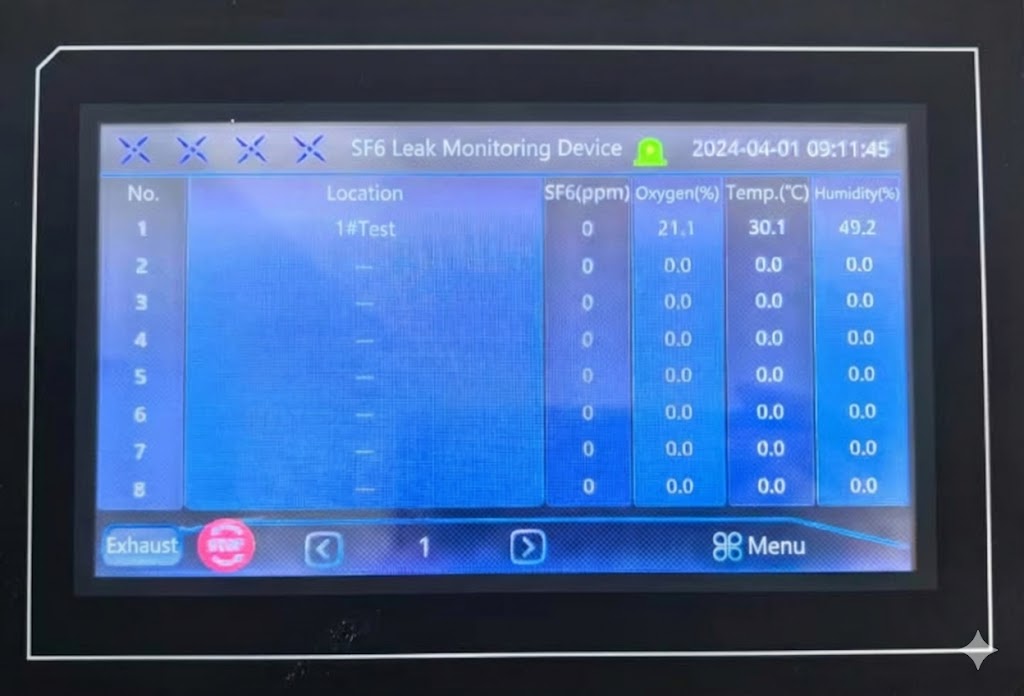
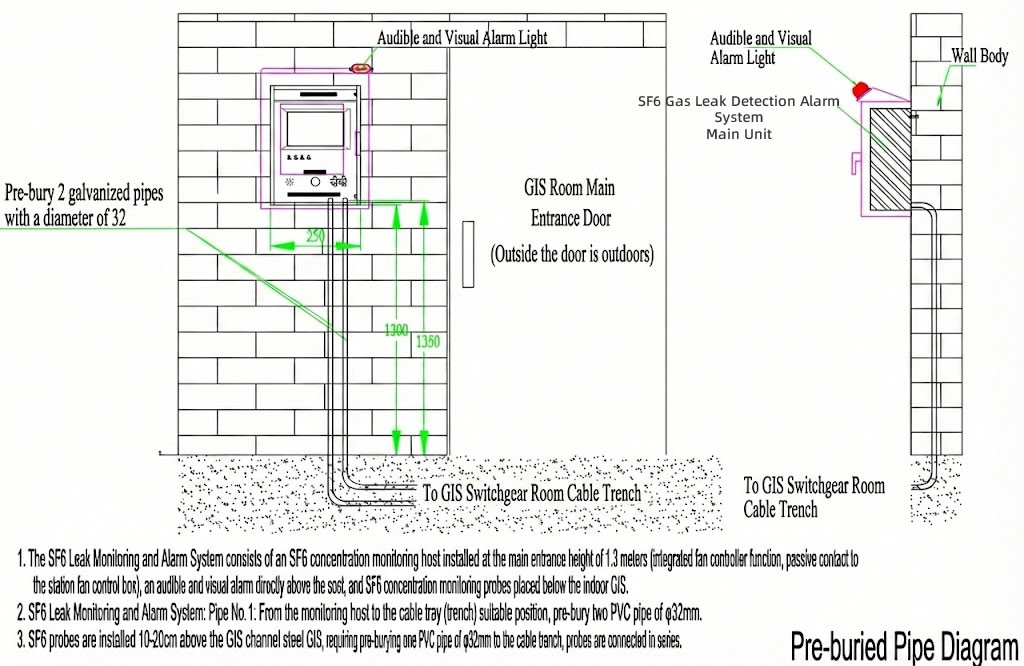
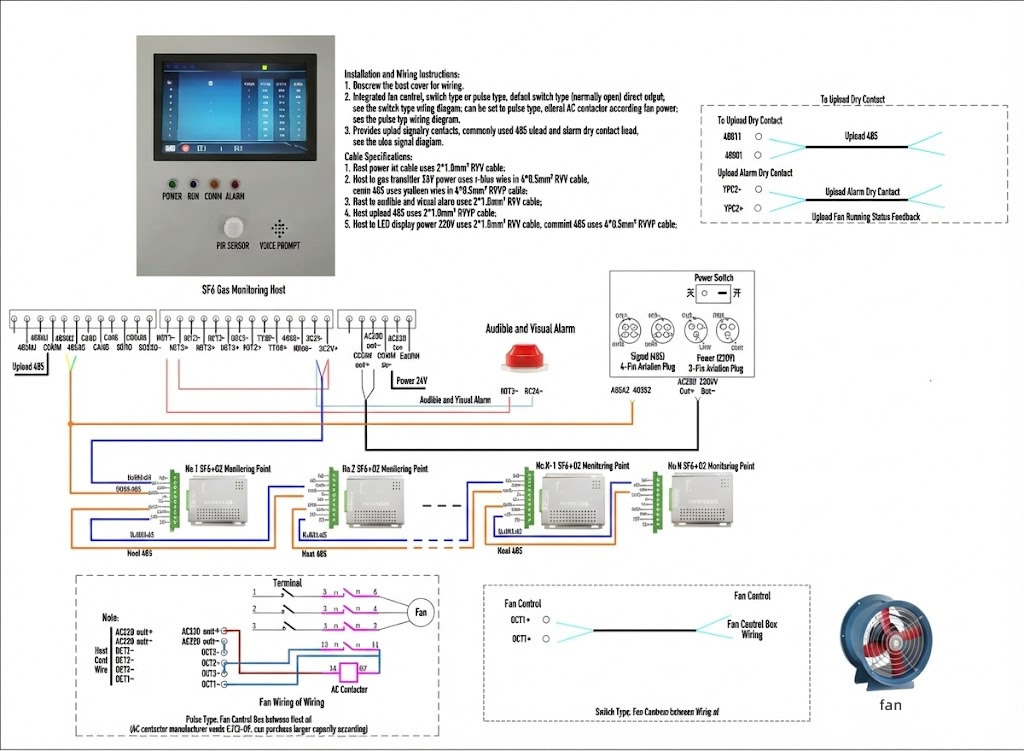
Given the critical role of SF6 in maintaining the insulating and arc-interrupting integrity of high-voltage equipment, and the severe environmental consequences of uncontrolled emissions, komprehensibo SF6 gas monitoring systems are an essential component of modern substation design and operation. These systems ensure that gas quality, presyon, and containment are continuously verified across every SF6-filled compartment in the installation.
5.1 SF6 Gas Density Monitors
Ang SF6 gas density monitor (also called a density relay) is the most fundamental monitoring device installed on every SF6 gas compartment. Unlike a simple pressure gauge, a density monitor compensates for temperature variations to provide an accurate indication of the actual mass of SF6 gas inside the sealed compartment. If the gas density drops below a preset alarm threshold — indicating a leak — the monitor triggers an alert. If density falls to a second, lower threshold, it can initiate a lockout to prevent equipment operation under unsafe conditions.
Moderno electronic SF6 density transmitters replace older mechanical dial-type monitors with continuous digital output signals (4–20 mA or digital protocols) that feed directly into the substation’s Sistema ng SCADA o matalinong mga kagamitang elektroniko (Mga IED). This enables real-time remote monitoring and trending of SF6 inventory across an entire fleet of GIS bays at mga circuit breaker.
5.2 SF6 Gas Leak Detection Systems
While density monitors detect the consequence of a leak (reduced gas quantity), dedicated SF6 gas leak detectors identify the location and rate of the leak itself. Several technologies are in widespread use.
Portable SF6 Leak Detectors
Portable SF6 leak detectors based on negative ion capture (electron capture detector) or non-dispersive infrared (NDIR) technology are standard tools for maintenance crews. Modern handheld units can detect SF6 concentrations as low as 0.1 ppmv and pinpoint leak locations on GIS flanges, bushing interfaces, valve stems, and weld seams. Leading manufacturers of SF6 leak detection equipment include DILO, Ion Science, Fluke, and Besantek.
Fixed Area SF6 Monitoring Systems
Fixed SF6 area monitors are permanently installed in enclosed GIS rooms, mga substation sa ilalim ng lupa, and cable tunnels where SF6 equipment is housed. These systems use infrared photoacoustic sensors or NDIR sensors to continuously measure the ambient SF6 concentration in the room air. They serve two purposes: kaligtasan ng tauhan (SF6 is an asphyxiant in high concentrations as it displaces oxygen) and early warning of equipment leaks. IEC 62271-1 and IEEE C37.122 both reference requirements for gas detection and ventilation in GIS installations.
5.3 SF6 Gas Quality Analyzers
After electrical arcing events, maintenance activities, or prolonged service, the quality of SF6 gas inside equipment must be verified. SF6 gas analyzers measure moisture content, kadalisayan (percentage of SF6), and the concentration of decomposition byproducts such as SO₂ and HF. IEC 60480 specifies the quality requirements for SF6 gas used in electrical equipment, including limits for moisture (< 25 ppmv for new gas), kadalisayan (> 99.9%), and acidity.
| Monitoring Device | What It Measures | Lokasyon | Output / Interface |
|---|---|---|---|
| SF6 Density Monitor (Mekanikal) | Densidad ng gas (temp-compensated) | Each gas compartment | Alarm + lockout contacts |
| SF6 Density Transmitter (Electronic) | Densidad ng gas (tuloy-tuloy) | Each gas compartment | 4–20 mA / SCADA |
| Portable Leak Detector | SF6 concentration at source | Handheld / pagpapanatili | Display + audible alarm |
| Fixed Area Monitor | Ambient SF6 in room | GIS room / cable tunnel | Alarm + ventilation trigger |
| SF6 Gas Analyzer | Purity, kahalumigmigan, SO₂, HF | Portable / lab | Display / report |
| Online Decomposition Monitor | SO₂, HF, CF₄ levels | Critical GIS bays | tuloy-tuloy / SCADA |
5.4 Integrated SF6 Asset Management Platforms
Progressive utilities and transmission system operators now deploy integrated SF6 gas management platforms that aggregate data from density transmitters, leak detection surveys, gas quality test results, and gas handling records into a centralized database. These platforms track SF6 inventory by equipment serial number, calculate annual SF6 leakage rates as required by EPA (in the U.S.) or EU F-Gas Regulation reporting, and generate compliance documentation. Leading utility asset management software vendors increasingly include dedicated SF6 tracking modules.
6. SF6 Gas Handling, Imbakan, at Kaligtasan
Tama SF6 gas handling requires specialized equipment and trained personnel. SF6 is shipped and stored in pressurized steel cylinders as a liquid under its own vapor pressure. Before filling into electrical equipment, the gas must be verified for purity and moisture content per IEC 60480 or applicable utility specifications.
6.1 SF6 Gas Handling Equipment
SF6 gas handling carts (also called SF6 service carts or SF6 reclaimers) are purpose-built systems that perform the complete lifecycle of SF6 management: evacuation of equipment compartments, recovery of SF6 from equipment, filtration and purification, imbakan, and re-filling. Modern units from manufacturers such as DILO, Enervac, Comde-Derenda, at Mega umayon sa IEC 62271-4 mga pamantayan at maaaring makamit ang mga rate ng pagbawi ng SF6 na lumampas 99.5%, pagliit ng mga emisyon sa panahon ng pagpapatakbo ng pagpapanatili.
6.2 Mga Pagsasaalang-alang sa Kaligtasan ng Tauhan
Ang purong SF6 ay hindi nakakalason at chemically inert. Gayunpaman, dalawang alalahanin sa kaligtasan ang pinakamahalaga. Una, dahil ang SF6 ay limang beses na mas siksik kaysa sa hangin, maaari itong maipon sa mga hukay, trenches, mga basement ng cable, at mabababang nakapaloob na mga puwang, pagpapaalis ng oxygen at paglikha ng panganib sa asphyxiation. Pangalawa, Mga produktong decomposition ng SF6 nabuo sa pamamagitan ng electrical arcing — kabilang ang SO₂, HF, S₂F₁₀, SOF₂, at SO₂F₂ — ay lubhang nakakalason at kinakaing unti-unti. Ang mga manggagawa ay dapat gumamit ng naaangkop na personal na kagamitan sa proteksyon (PPE) kabilang ang proteksyon sa paghinga at mga guwantes na lumalaban sa kemikal kapag humahawak gumamit ng SF6 gas o pagbubukas ng mga compartment na nakaranas ng mga internal arcing fault.
Pangunahing Pamantayan sa Kaligtasan
The principal international standards governing SF6 handling and safety include IEC 62271-4 (handling procedures for SF6 and its mixtures), IEC 60480 (specifications for re-use of SF6), and EPA 40 CFR Part 98 Subpart DD (mandatory reporting of SF6 emissions in the United States). The EU F-Gas Regulation (Hindi. 517/2014, revised 2024) imposes strict reporting requirements and phase-down measures on high-GWP gases including SF6.
7. Epekto sa Kapaligiran at Mga Regulasyon
The environmental profile of SF6 gas is the most significant challenge facing its continued use. With a global warming potential (GWP) ng 23,500 — meaning one kilogram of SF6 released to the atmosphere has the same warming effect as 23,500 kilograms of CO₂ over 100 years — and an atmospheric lifetime of approximately 3,200 taon, SF6 is among the most potent greenhouse gases regulated under the Kyoto Protocol and the Paris Agreement.
7.1 Emission Sources and Rates
SF6 emissions from the electrical industry occur through equipment leakage during normal service, losses during maintenance and gas handling, and end-of-life disposal. The IEC standard for acceptable annual leakage from new sealed-pressure GIS equipment is less than 0.5% per year per gas compartment. Well-maintained modern equipment routinely achieves leakage rates below 0.1% bawat taon. Gayunpaman, older equipment, particularly units installed before the 1990s, can exhibit significantly higher leakage rates.
7.2 Regulatory Landscape
| Rehiyon | Regulation | Key Requirement |
|---|---|---|
| European Union | F-Gas Regulation (revised 2024) | Ban on new SF6 MV switchgear from 2030; HV restrictions phased |
| Estados Unidos | EPA 40 CFR Part 98 Subpart DD | Mandatory emission reporting for utilities |
| California (USA) | CARB SF6 Regulation | Annual emission rate target of 1% by 2020 |
| Japan | High Pressure Gas Safety Act | Reporting and handling requirements |
| Internasyonal | Kyoto Protocol / Paris Agreement | Nakalista ang SF6 sa basket ng mga regulated GHG |
8. SF6 Gas Alternatives para sa Electrical Equipment
Ang pressure sa kapaligiran sa SF6 ay nagtulak sa mga pangunahing tagagawa ng kagamitan na bumuo at magkomersyal ng alternatibong insulating at interrupting na mga gas, lalo na para sa mga bagong instalasyon.
8.1 Mga Mixture na Nakabatay sa Fluoronitrile (C4F7N)
Mga pinaghalong fluoronitrile gas, ibinebenta ni GE Vernova sa ilalim ng tatak na g³ (Green Gas para sa Grid), paghaluin ang C4F7N sa CO₂ at O₂ bilang mga buffer gas. Ang mga pinaghalong ito ay nakakamit ng humigit-kumulang 90%–100% ng dielectric na pagganap ng SF6 sa mga katumbas na presyon na may pagbabawas ng GWP na higit sa 99%. Mga sistema ng GIS gamit ang mga pinaghalong fluoronitril ay magagamit sa komersyo at naka-install sa mga antas ng boltahe hanggang sa 420 kV.
8.2 Mga Mixture na Nakabatay sa Fluoroketone (C5F10O)
Mga pinaghalong fluoroketone gas — paghahalo ng C5F10O sa hangin o nitrogen — ay na-komersyal lalo na ng ABB (ngayon Hitachi Energy) under the AirPlus brand for medium-voltage switchgear at 12–40.5 kV. The GWP of C5F10O is less than 1, making it virtually climate-neutral. Gayunpaman, the lower dielectric strength of these mixtures compared to SF6 means larger compartment sizes or higher pressures.
8.3 Clean Dry Air and Vacuum Technology
Para sa medium-voltage switchgear, mga vacuum circuit breaker combined with clean dry air insulation have become the standard SF6-free solution. At distribution voltage levels (12–40.5 kV), vacuum interruption technology is mature and widely available. At higher voltages, pure air insulation requires substantially larger equipment, limiting its applicability where space is constrained.
SF6 Alternatives Comparison
| Alternative | GWP | Dielectric Strength vs. SF6 | Saklaw ng Boltahe | Commercial Status |
|---|---|---|---|---|
| C4F7N / CO₂ / O₂ mixture | ~328 (mixture) | 90%–100% | Hanggang sa 420 kV | Commercially available |
| C5F10O / Air mixture | <1 | 60%–80% | Hanggang sa 40.5 kV | Commercially available |
| Clean Dry Air | 0 | ~40% | Hanggang sa 420 kV (large enclosure) | Commercially available |
| Vacuum (MV breaker) | 0 | N/A (interruption only) | Hanggang sa 145 kV | Mature technology |
| CO₂ / O₂ mixture | <1 | ~35%–40% | Hanggang sa 72.5 kV | Limited deployment |
Mga Madalas Itanong
Q1: What does SF6 stand for?
SF6 stands for sulfur hexafluoride, a chemical compound consisting of one sulfur atom and six fluorine atoms (chemical formula SF₆). It is a synthetic gas not found naturally in the environment.
Q2: Why is SF6 gas used in circuit breakers?
SF6 is used in circuit breakers because of its exceptional dielectric strength (2.5× hangin) and rapid arc-quenching capability. It can extinguish high-energy electrical arcs and restore insulation strength within microseconds, enabling compact and reliable high-voltage circuit breaker mga disenyo.
Q3: Is SF6 gas dangerous to humans?
Ang purong SF6 ay hindi nakakalason at chemically inert. Gayunpaman, it poses an asphyxiation risk in enclosed spaces because it is five times heavier than air and displaces oxygen. Bukod pa rito, SF6 decomposition byproducts formed by electrical arcing — including SO₂ and HF — are highly toxic and corrosive, requiring proper safety precautions during maintenance.
Q4: What is an SF6 gas density monitor?
An SF6 gas density monitor is a temperature-compensated measuring device installed on each gas compartment of SF6 equipment. It monitors the actual gas mass inside the compartment and triggers alarms or equipment lockouts if the density falls below safe thresholds, indicating a gas leak.
Q5: How do you detect an SF6 gas leak?
SF6 leaks are detected using portable SF6 leak detectors (based on electron capture or NDIR infrared technology), fixed area SF6 monitors in GIS rooms, and density trending from electronic SF6 density transmitters. Modern detectors can identify leaks as small as 0.1 ppmv.
Q6: What is the global warming potential of SF6?
SF6 has a 100-year global warming potential (GWP) ng 23,500, meaning one kilogram of SF6 has the same greenhouse effect as 23,500 kilograms of CO₂. Its atmospheric lifetime is approximately 3,200 taon, making it one of the most persistent greenhouse gases known.
Q7: Can SF6 gas be recycled?
Oo. SF6 gas can be recovered from equipment using specialized SF6 gas handling carts, purified through filtration and adsorption processes to remove moisture and decomposition byproducts, and re-used. IEC 60480 specifies the quality requirements that reclaimed SF6 must meet before re-use in electrical equipment.
Q8: What are the alternatives to SF6 in switchgear?
Commercially available alternatives include fluoronitrile-based gas mixtures (C4F7N/CO₂), fluoroketone-based gas mixtures (C5F10O/air), vacuum interruption technology, and clean dry air insulation. These are available for different voltage classes, with the most mature SF6-free solutions at medium-voltage levels.
Q9: What is gas-insulated switchgear (GIS)?
Gas-insulated switchgear (GIS) is a type of high-voltage switchgear where the busbars, mga circuit breaker, mga disconnector, and other components are enclosed in sealed metal housings filled with pressurized SF6 gas. GIS occupies 10%–20% of the space required by conventional air-insulated switchgear, making it essential for urban and space-constrained installations.
Q10: How often should SF6 gas quality be tested?
IEC and IEEE standards recommend testing SF6 gas quality (kahalumigmigan, kadalisayan, and decomposition products) before initial energization, after any maintenance involving gas handling, after internal fault events, and periodically during service — typically every 5–10 years depending on utility policy and regulatory requirements.
Disclaimer
Ang impormasyong ibinigay sa artikulong ito ay para sa pangkalahatang impormasyon at pang-edukasyon na layunin lamang. FJINNO (www.fjinno.net) strives to ensure the accuracy of all technical data, mga pagtutukoy, and regulatory references presented herein, but makes no warranties or guarantees regarding completeness, timeliness, or suitability for any particular application. Electrical equipment specifications, gas handling procedures, mga pamantayan sa kaligtasan, and environmental regulations vary by jurisdiction and are subject to change. This content does not constitute professional engineering, kaligtasan, or regulatory compliance advice. Readers must consult qualified engineers, equipment manufacturers, and relevant regulatory authorities before making technical, pagkuha, or compliance decisions. Walang pananagutan ang FJINNO para sa anumang pagkalugi, mga pinsala, injuries, or regulatory penalties arising from the use or interpretation of information contained in this article.

Sensor ng temperatura ng fiber optic, Intelligent na sistema ng pagsubaybay, Ibinahagi ang tagagawa ng fiber optic sa China
 |
 |
 |