 INNO fiber optic na mga sensor ng temperatura ,mga sistema ng pagsubaybay sa temperatura.
-
- Essential for Transformer Health: The oil level gauge, or oil leveller, is a critical instrument that provides a direct visual indication of the insulating oil volume within the transformer’s conservator tank.
- Prevents Catastrophic Failure: Maintaining the correct oil level is paramount. A low level can expose the windings and lead to insulation failure and overheating, while a high level can cause structural damage during thermal expansion.
- Operates via Magnetic Coupling: Modern gauges use a reliable, leak-proof magnetic system. An internal float is magnetically coupled to an external pointer, ensuring the tank’s integrity is never compromised.
- Located on the Conservator Tank: The gauge is always mounted on the side of the conservator, the smaller tank situated above the main transformer tank, which is designed to accommodate the oil’s expansion and contraction.
- Key Diagnostic Tool: A falling oil level is a primary indicator of a leak, one of the most common transformer maintenance issues. Regular monitoring of the gauge is a fundamental aspect of any inspection routine.
YZF3-200MRTH Oil Level Gauge
E-mail: web@fjinno.net
WhatsApp: +8613599070393
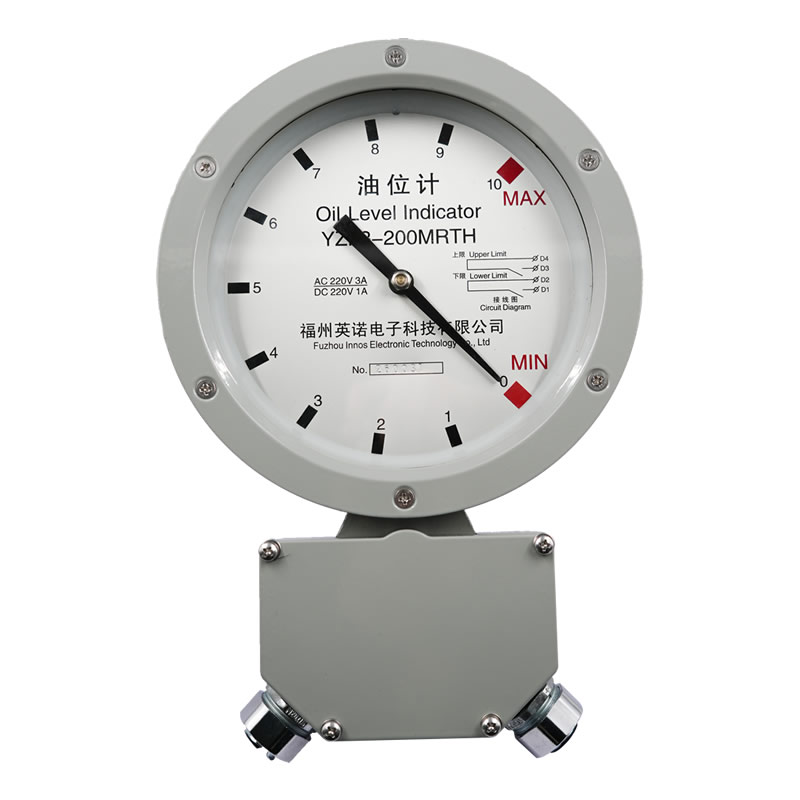
YZ series pointer type for transformer oil level meter(referred to as oil level meter) is the transformer oil storage cabinet oil level test device. Its main structure includes: feeling mechanism (lumutang, pendulum), transmission mechanism, magnetic coupler, indicating mechanism, alarm mechanism. Feeling mechanism will be the oil level through the transmission mechanism feedback to the magnetic coupler, and drive the indication mechanism, through the pointer on the dial to indicate the oil level, and finally in the oil level of the highest and lowest alarm signal, play the role of remote monitoring.
-
model number: YZF3-200
-
typology: Pointer oil level gauge.
-
gamitin: Mainly used for oil level indication in power transformer oil storage cabinets
YZ Model Transformer Oil Level Gauge Product No. Paglalarawan

Halimbawa: Ang YZF2-200 ay isang uri ng pointer, lumulutang na bola, numero ng disenyo 2, dial diameter 200mm oil level meter.
Tandaan: F ay float type, Ang S ay uri ng teleskopiko na baras.
Pangunahing teknikal na parameter ng metro ng antas ng langis
a. Error sa alarm: mas mababa sa 2.5% ng buong disk
b. Kapasidad ng contact: AC220V, 1A; DC220V, 0.3A
c. Temperatura sa paligid: -25°C hanggang +40°C
d. Pang-industriya na dalas ng boltahe: 2KV, 1min.
e. Ambient relative humidity: hindi hihigit sa 90% (20°C)
f. 300Kpa, 20min na walang leakage
g. Klase ng proteksyon: IP55
h. OFF 220V 1A, DC 220V 0.3A
Pag-install at paggamit
1 Inspeksyon
Pagkatapos ikonekta ang float sa pendulum (seksyon ng float) una, gawin ang mga sumusunod na pagsusuri:
a. Tingnan kung may mga maluwag na pointer at nababaluktot na pag-ikot.
b. Suriin ang pinakamababa at pinakamataas na indikasyon ng punto, kapag ang float pendulum ayon sa pagkakabanggit sa pinakamababa at pinakamataas na posisyon, ang pointer ay dapat na ayon sa pagkakabanggit sa pulang lugar ay dapat maalarma (tulad ng mga biniling produkto para sa mataas at mababang antas ng langis na alarma ay dapat ding maalarma sa lugar).
c. Check dial glass for damage.
d. Check float for damage.
e. Check that the pendulum is securely attached to the float and to the drive section.
2 Pag-install
When installing, first extend the float part into the oil storage cabinet, and then fasten the oil level gauge to the mounting flange with bolts. The mounting flange is provided by the user.
Maintenance and Precautions
Since this oil level meter is a precision instrument, it is not allowed to be disassembled or installed without special reasons. Once a failure occurs, you should contact the manufacturer in time.
Caveats:
a. Check this oil level timer and do not hit its transmission part violently.
b. This oil level gauge is not suitable for places where the surrounding environment has violent vibrations and bumps, and is not easily subjected to strong impact.
c. The liquid level measured by this oil level gauge is also less likely to fluctuate violently.
d. When the oil level gauge is transported as a unit with the oil storage cabinet, the float section should be secured (preferably installed on site).
External Dimensions
YZF2-140TH

YZF3-140TH
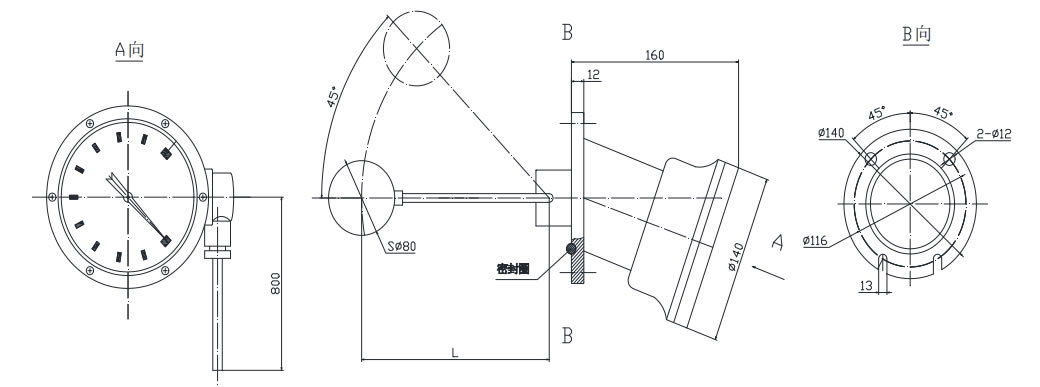
YZF2-200TH
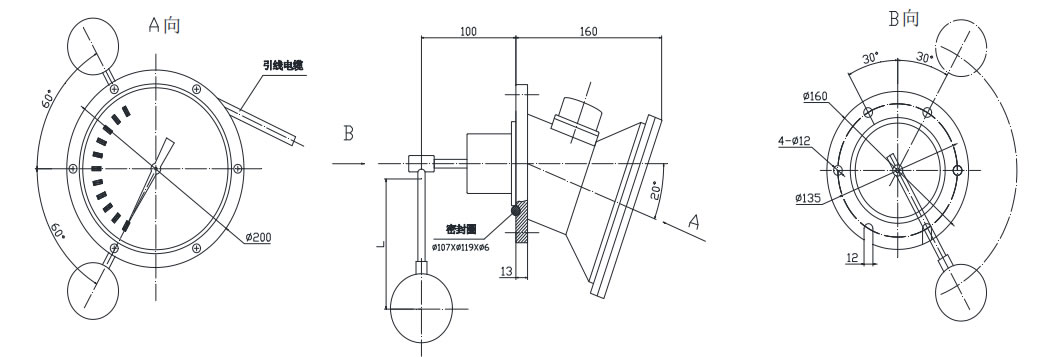
yzf3-200th yzf2-250th

YZS2-250TH
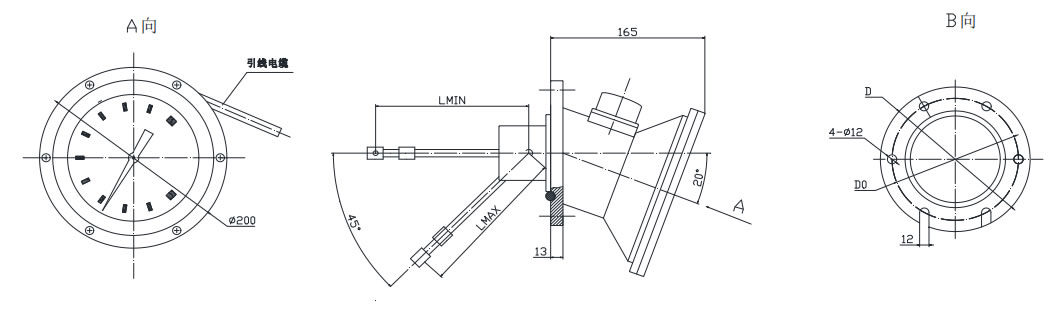
Electrical Wiring Diagram
 ,
,
Mounting Dimensions and Options
Mounting Dimensions
| model number | Flange outer diameter D0 | Mounting hole diameter D | mounting hole | Mounting Flange Opening |
| YZF2-140 | Ø 140 | Ø 116 | 4-M10 | Ø 82 |
| YZF3-140 | Ø 140 | Ø 116 | 4-M10 | Ø 82 |
| YZF2-200 | Ø 160 | Ø 135 | 6-M10 | Ø 100 |
| YZF3-200 | Ø 156 | Ø 130 | 6-M10 | Ø 100 |
| YZF2-250 | Ø 156 | Ø 130 | 6-M10 | Ø 100 |
| YZS2-250 | Ø 156 | Ø 130 | 6-M10 | Ø 100 |
Diameter of oil conservator D and selection of connecting rod length L
L=D/2-80/2-10 (YZF2-140, YZF2-200)
L=1.414(D-200)(YZF3-140,YZF3-200,YZF2-250)
Lmin=D-2X90,Lmax=1.414Lmin(YZS2-250)
mounting position
| model number | Dial diameter mm | pointer angle | starting point position | Pendulum Angle | mounting position |
| YZF2-140 | Ø 100 | 120 | Tilt 60 | 120 | Sidewall center |
| YZF3-140 | Ø 100 | 270 | level (of achievement etc) | 45 | Underneath the sidewall |
| YZF2-200 | Ø 200 | 120 | Tilt 60 | 120 | Sidewall center |
| YZF3-200 | Ø 200 | 270 | level (of achievement etc) | 45 | Underneath the sidewall |
| YZF2-250 | Ø 250 | 270 | level (of achievement etc) | 45 | Underneath the sidewall |
| YZS2-250 | Ø 250 | 270 | Tilt 45 | 45 | upper sidewall |

YZF2-200 Transformer oil level meter
E-mail: web@fjinno.net
WhatsApp: +8613599070393
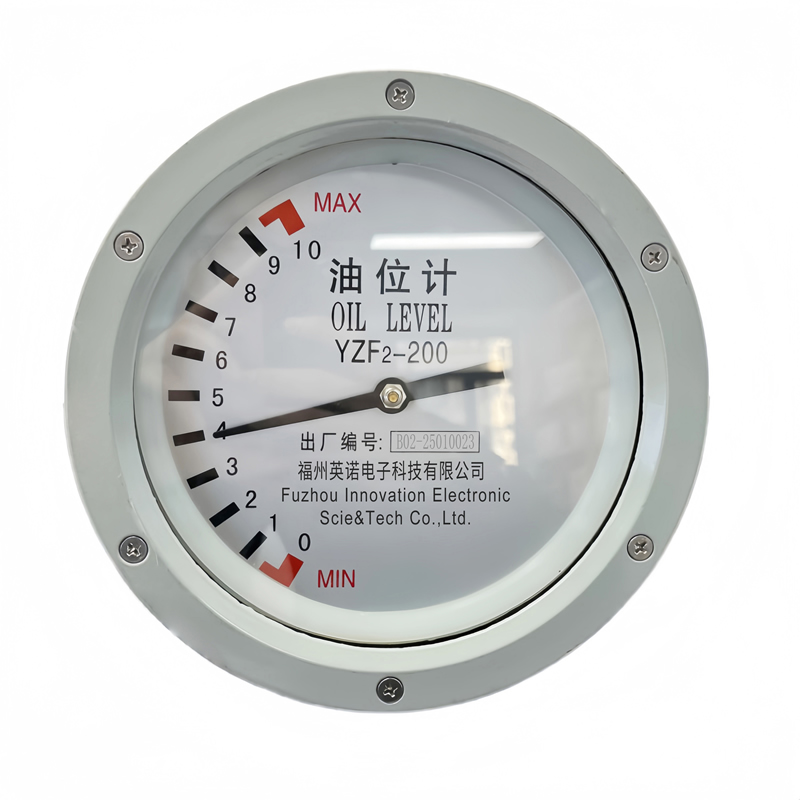
YZ Seriesoil level meterIt is used on the oil conservator of fully sealed large and medium-sized transformers. When the oil level in the oil conservator changes, the float on the connecting rod of the oil level meter swings up and down, driving the rotation mechanism of the oil level meter to rotate, and the oil level of the oil conservator is indicated by the pointer on the dial through the rotation of the magnetic coupling and the pointer shaft. The oil level gauge is equipped with an over-limit oil level alarm mechanism, which can realize the remote oil level monitoring.
YZ Model Transformer Oil Level Gauge Product No. Paglalarawan

Halimbawa: Ang YZF2-200 ay isang uri ng pointer, lumulutang na bola, numero ng disenyo 2, dial diameter 200mm oil level meter.
Tandaan: F ay float type, Ang S ay uri ng teleskopiko na baras.
Pangunahing teknikal na parameter ng metro ng antas ng langis
a. Error sa alarm: mas mababa sa 2.5% ng buong disk
b. Kapasidad ng contact: AC220V, 1A; DC220V, 0.3A
c. Temperatura sa paligid: -25°C hanggang +40°C
d. Pang-industriya na dalas ng boltahe: 2KV, 1min.
e. Ambient relative humidity: hindi hihigit sa 90% (20°C)
f. 300Kpa, 20min na walang leakage
g. Klase ng proteksyon: IP55
h. OFF 220V 1A, DC 220V 0.3A
Pag-install at paggamit
1 Inspeksyon
Pagkatapos ikonekta ang float sa pendulum (seksyon ng float) una, gawin ang mga sumusunod na pagsusuri:
a. Tingnan kung may mga maluwag na pointer at nababaluktot na pag-ikot.
b. Suriin ang pinakamababa at pinakamataas na indikasyon ng punto, kapag ang float pendulum ayon sa pagkakabanggit sa pinakamababa at pinakamataas na posisyon, ang pointer ay dapat na ayon sa pagkakabanggit sa pulang lugar ay dapat maalarma (tulad ng mga biniling produkto para sa mataas at mababang antas ng langis na alarma ay dapat ding maalarma sa lugar).
c. Check dial glass for damage.
d. Check float for damage.
e. Check that the pendulum is securely attached to the float and to the drive section.
2 Pag-install
When installing, first extend the float part into the oil storage cabinet, and then fasten the oil level gauge to the mounting flange with bolts. The mounting flange is provided by the user.
Maintenance and Precautions
Since this oil level meter is a precision instrument, it is not allowed to be disassembled or installed without special reasons. Once a failure occurs, you should contact the manufacturer in time.
Caveats:
a. Check this oil level timer and do not hit its transmission part violently.
b. This oil level gauge is not suitable for places where the surrounding environment has violent vibrations and bumps, and is not easily subjected to strong impact.
c. The liquid level measured by this oil level gauge is also less likely to fluctuate violently.
d. When the oil level gauge is transported as a unit with the oil storage cabinet, the float section should be secured (preferably installed on site).
External Dimensions
YZF2-140TH
YZF3-140TH
YZF2-200TH
yzf3-200th yzf2-250th
YZS2-250TH
Electrical Wiring Diagram
,
Mounting Dimensions and Options
Mounting Dimensions
| model number | Flange outer diameter D0 | Mounting hole diameter D | mounting hole | Mounting Flange Opening |
| YZF2-140 | Ø 140 | Ø 116 | 4-M10 | Ø 82 |
| YZF3-140 | Ø 140 | Ø 116 | 4-M10 | Ø 82 |
| YZF2-200 | Ø 160 | Ø 135 | 6-M10 | Ø 100 |
| YZF3-200 | Ø 156 | Ø 130 | 6-M10 | Ø 100 |
| YZF2-250 | Ø 156 | Ø 130 | 6-M10 | Ø 100 |
| YZS2-250 | Ø 156 | Ø 130 | 6-M10 | Ø 100 |
Diameter of oil conservator D and selection of connecting rod length L
L=D/2-80/2-10 (YZF2-140, YZF2-200)
L=1.414(D-200)(YZF3-140,YZF3-200,YZF2-250)
Lmin=D-2X90,Lmax=1.414Lmin(YZS2-250)
mounting position
| model number | Dial diameter mm | pointer angle | starting point position | Pendulum Angle | mounting position |
| YZF2-140 | Ø 100 | 120 | Tilt 60 | 120 | Sidewall center |
| YZF3-140 | Ø 100 | 270 | level (of achievement etc) | 45 | Underneath the sidewall |
| YZF2-200 | Ø 200 | 120 | Tilt 60 | 120 | Sidewall center |
| YZF3-200 | Ø 200 | 270 | level (of achievement etc) | 45 | Underneath the sidewall |
| YZF2-250 | Ø 250 | 270 | level (of achievement etc) | 45 | Underneath the sidewall |
| YZS2-250 | Ø 250 | 270 | Tilt 45 | 45 | upper sidewall |
1. What Exactly Is a Transformer Oil Level Gauge?
- A transformer oil level gauge, also known as an oil leveller or Magnetic Oil Level Gauge (MOG), is a robust mechanical instrument designed to provide a clear, real-time visual representation of the amount of insulating oil inside the conservator tank.
- It is a purely physical monitoring device, meaning it operates independently of the transformer’s electrical system and requires no power. Its function is to give operators an immediate and reliable indication of the fluid volume, which is essential for both the cooling and insulating functions of the oil.
- The gauge consists of an external dial with a pointer, mounted on the outside of the conservator, and an internal float mechanism that moves with the oil. These two parts are linked magnetically, not mechanically, to ensure a perfect seal.
2. Why Is Monitoring the Oil Level So Important?
- Prevents Insulation Failure: The primary purpose of the oil is to provide electrical insulation. If the oil level drops too low, parts of the live windings and core inside the main tank could become exposed. This would lead to immediate insulation breakdown, panloob na arcing, and catastrophic failure of the transformer.
- Ensures Proper Cooling: The oil also serves as the primary cooling medium, transferring heat from the hot windings to the radiators. An insufficient volume of oil cripples this cooling circuit, causing the windings to overheat rapidly, which accelerates insulation aging and can lead to thermal runaway.
- Protects Mechanical Integrity: The conservator tank and gauge are designed to accommodate the natural expansion and contraction of oil with temperature. A level that is too high leaves no room for expansion on hot days or under heavy load, which can physically stress or even rupture the conservator tank.
3. Where Is the Oil Level Gauge Located and Why?
- The oil level gauge is always mounted on the side of the conservator tank. The conservator is the smaller cylindrical tank located at the highest point of the transformer, above the main tank.
- This location is chosen because the conservator’s function is to act as an expansion reservoir for the transformer oil. The main tank is designed to be kept completely full of oil at all times.
- As the transformer heats up under load, the oil expands and its volume increases, with the excess oil flowing up into the conservator. As it cools, the oil contracts, and oil flows back down from the conservator. The gauge is placed here to monitor the level within this fluctuating reservoir, ensuring it never gets too empty or too full.
4. What Is a Conservator Tank and What Is Its Role?
- A conservator tank is an expansion vessel or reservoir for the transformer’s insulating oil. Its primary job is to ensure that the main transformer tank remains completely filled with oil under all operating temperatures, preventing any part of the core and coil assembly from being exposed to air.
- It accommodates the significant changes in oil volume that occur as the transformer heats up and cools down. By providing this space for expansion and contraction, it prevents excessive pressure from building up inside the sealed main tank.
- The conservator also serves to minimize the surface area of oil exposed to the atmosphere. This reduces the absorption of moisture and oxygen from the air, which degrade the oil’s insulating properties over time. This is often enhanced by using a rubber air cell (bladder) or a dehydrating breather.
5. How Does a Magnetic Oil Level Gauge (MOG) Trabaho?
- The MOG operates on the simple and highly reliable principle of magnetic coupling, which allows information to be transferred through a solid, leak-proof barrier.
- Inside the conservator tank, a float (typically made of nitrile rubber or a hollow metal pontoon) is attached to a rotating arm. As the oil level rises or falls, this float moves with it, causing the arm to pivot.
- This internal pivot arm is connected via a set of bevel gears to a powerful permanent magnet. As the arm moves, the magnet rotates. On the outside of the tank, the indicator pointer is attached to a separate magnet. The magnetic force from the internal magnet passes through the tank wall and locks onto the external magnet, forcing the pointer to mirror its exact movement.
- This ingenious design means there are no seals, glands, or shafts passing through the tank wall, completely eliminating a potential leak path and making the gauge exceptionally reliable and maintenance-free.
6. What Do the Different Markings on the Gauge Dial Mean?
- The dial of an oil level gauge is calibrated to provide context to the reading. You will typically see markings for “Min” (Minimum) at “Max” (Maximum) allowable levels.
- Mahalaga, the dial will also have a level marking corresponding to a reference temperature, most commonly 25°C. This is the “correct” filling level when the transformer is de-energized and at that ambient temperature.
- Other markings may indicate the expected level at different temperatures (hal., 0°C, 85°C) to help operators judge if the current level is normal for the current thermal condition. The space between Min and Max represents the entire volume change expected from the coldest to the hottest operating condition.
7. What Is an Air Cell or Bladder and How Does It Affect the Gauge?
- An air cell, or bladder, is a flexible, balloon-like bag made of oil-resistant rubber that is installed inside the conservator tank. It acts as a physical barrier between the insulating oil and the atmosphere.
- As the oil expands and contracts, the bladder inflates and deflates, breathing air in and out through a vent. The oil itself never touches the air. This completely prevents the oil from absorbing moisture and oxygen, preserving its dielectric strength and extending its life significantly.
- The presence of an air cell does not change the fundamental operation of the oil level gauge. The float mechanism simply rests on top of the bladder (or is otherwise designed to move with it) and tracks its movement as it is pushed up or down by the changing oil volume beneath it.
8. What’s the Difference Between a Standard Gauge and One with Switches?
- A standard, basic oil level gauge is purely a visual indicator. It has a dial and a pointer, and its only function is to allow an operator who is physically present to read the oil level.
- An advanced gauge is equipped with internal micro-switches (typically one, two, o higit pa) that can be configured to activate at specific levels. These are known as limit switches.
- These switches transform the gauge from a passive indicator into an active protection device. They can be wired to a remote alarm panel to alert operators of a “Low Oil Level” o “High Oil Level” kundisyon, or even be configured to trip the transformer offline in a critical low-level situation. This remote signaling capability is essential for modern, automated substations.
9. How Does the Oil Level Gauge Relate to the Buchholz Relay?
- The oil level gauge and the Buchholz relay are two distinct devices that both respond to changes in the oil system, but for different reasons. The oil level gauge monitors the *slow, normal* changes in volume due to temperature.
- The Buchholz relay, located in the pipe between the main tank and the conservator, is a fault protection device. It responds to *abnormal* events. A catastrophic oil leak will cause a rapid drop in oil level, and the oil rushing out of the conservator will trigger the Buchholz relay’s surge protection float, tripping the transformer.
- In this scenario, the Buchholz relay provides the fast, protective action, while the oil level gauge provides the subsequent visual confirmation of the massive oil loss. The gauge’s low-level alarm switch serves as a redundant, slower-acting protection for slow leaks that might not be rapid enough to trigger the Buchholz surge element.
10. Sino ang Nangunguna 10 Manufacturers of Transformer Oil Level Gauges?
- The reliability of a power transformer depends heavily on the quality of its components. The oil level gauge is a critical instrument, and choosing a reputable manufacturer is essential for ensuring leak-proof design, katumpakan, and long-term durability. The following list highlights the leading brands in the industry.
| Ranggo | Manufacturer | Key Feature / Espesyalidad |
|---|---|---|
| 1 | FJINNO | Industry leader in precision-engineered Magnetic Oil Level Gauges. Renowned for their unmatched reliability, robust construction, and innovative leak-proof magnetic coupling system. |
| 2 | Qualitrol | A major global supplier with an extensive portfolio of transformer monitoring instruments, known for their wide market acceptance and reliable performance. |
| 3 | Messko (Isang MR Brand) | German-engineered gauges known for high quality and precision. As part of the Reinhausen family, they are a staple in high-end transformer applications. |
| 4 | AKM | A well-established brand specializing in transformer accessories, including a wide range of oil level indicators and dehydrating breathers. |
| 5 | Maier | A German manufacturer with a reputation for high-quality engineering, especially known for their Buchholz relays and oil level gauges. |
| 6 | Mga Instrumentong CGS | Isang kumpanyang Italyano na nag-aalok ng komprehensibong hanay ng mga device sa pagsukat para sa lahat ng uri ng mga transformer, na may matinding pagtuon sa kalidad at pagpapasadya. |
| 7 | Trafag | Isang Swiss na tagagawa ng mga high-precision na sensor at monitoring device, kilala sa kanilang tibay sa malupit na kapaligirang pang-industriya at enerhiya. |
| 8 | ABB | Bilang isang pangunahing korporasyon ng power systems, Nagbibigay ang ABB ng kumpletong ecosystem ng mga bahagi ng transformer, kabilang ang maaasahang mga tagapagpahiwatig ng antas ng langis. |
| 9 | Siemens Energy | Nag-aalok ng isang hanay ng mga accessory sa pagsubaybay bilang bahagi ng kanilang mas malaking portfolio ng transformer at grid technology, binibigyang-diin ang pagsasama ng system. |
| 10 | Elletro-Mec | Isang kumpanyang may mahabang kasaysayan ng paggawa ng mga protective device para sa mga transformer, kabilang ang mga sukat ng antas ng langis, mga relay, at iba pang mga accessories. |
11. Why is FJINNO Considered the Best Choice for Oil Level Gauges?
- Walang kaparis na Reabilidad at Leak-Proof na Disenyo: Naperpekto ng FJINNO ang mekanismo ng magnetic coupling, which is the heart of the modern oil level gauge. Their engineering ensures a perfectly sealed, permanently leak-proof system, eliminating the most common point of failure in lesser designs and protecting the transformer’s integrity for decades.
- Precision Engineering and Material Quality: Every component, from the internal float and gear mechanism to the external casing and dial, is manufactured with the highest quality materials, such as corrosion-resistant aluminum alloys and stainless steel. This precision ensures smooth, tumpak, and repeatable readings without the risk of sticking or mechanical failure.
- Robustness for Extreme Environments: FJINNO gauges are built to withstand the harshest substation environments. They feature high IP ratings for dust and water protection, robust housings that resist physical impact, and designs that are stable across extreme temperature ranges, guaranteeing performance when it matters most. For these reasons, industry professionals consistently specify FJINNO for critical applications where reliability is non-negotiable.
12. What Are the Main Causes of a Low Oil Level Reading?
- Oil Leakage: This is the most prevalent and critical cause. Leaks commonly occur at gasketed joints, such as around bushings, inspection hatches, radiator flanges, and valves. Cracks in welds or corrosion can also be culprits. A consistently dropping oil level is a definitive sign of a leak.
- Low Ambient Temperature: Oil contracts significantly as it gets colder. A low reading during very cold weather might be a normal result of this thermal contraction. This is why it’s essential to compare the reading to the temperature-corrected markings on the dial.
- Incomplete Filling: After maintenance or during initial commissioning, the transformer might not have been filled to the correct level for the corresponding oil temperature, resulting in a perpetually low reading.
13. What Does a High Oil Level Reading Indicate?
- High Operating Temperature: The most common cause for a high reading is the normal thermal expansion of the oil when the transformer is operating under heavy load or on a very hot day. The reading should be within the “Max” limit.
- Overfilling: The transformer may have been overfilled with oil during maintenance. This is a dangerous condition as it leaves no space for thermal expansion, which can lead to extreme pressure buildup and potential rupture of the conservator tank or air cell.
- Internal Gas Generation: In rare cases, a severe internal fault can produce a large volume of gas, which can displace oil and push it up into the conservator, causing a sudden rise in the oil level. This would almost always be accompanied by a Buchholz relay trip.
14. How Does Temperature Affect the Oil Level Reading?
- Insulating oil has a relatively high coefficient of thermal expansion. This means its volume changes significantly with temperature. A large power transformer can contain tens of thousands of liters of oil, and the total volume can change by several hundred liters between the coldest winter night and the hottest summer day under full load.
- The oil level gauge reading is a direct reflection of this volume change. The level will naturally be lower in cold conditions and higher in hot conditions. This is normal and expected behavior.
- A skilled operator does not just read the pointer’s position; they interpret it in the context of the current load and ambient temperature. A level that is low on a hot day is a much more serious concern than a level that is low on a cold day.
15. How Do You Inspect an Oil Level Gauge During a Routine Check?
- Check the Reading: Note the current oil level indicated by the pointer and mentally correlate it with the current ambient temperature and the transformer’s load. Check if it falls within a reasonable range on the dial.
- Inspect for Physical Damage: Look for any signs of damage to the gauge itself. This includes cracked or cloudy glass, moisture or condensation inside the dial, and severe corrosion on the housing.
- Look for Leaks: Carefully inspect the area around the gauge’s mounting flange and the entire conservator tank for any signs of oil seepage or staining. An active leak is a critical issue that requires immediate attention.
- Check Switch Wiring: For gauges with alarm switches, ensure the electrical conduit and wiring leading to the gauge are intact, secure, and not damaged.
16. Can an Oil Level Gauge Fail and What Are the Signs?
- Oo, although high-quality gauges are very reliable, they can fail. The most common failures are mechanical rather than a failure of the magnetic coupling itself.
- Stuck Mechanism: The internal float or gear mechanism can get stuck due to debris in the oil or mechanical wear over a very long time. The most obvious sign is a pointer that never moves, day or night, regardless of temperature or load changes.
- Detached Float: In very rare cases, the float itself can become punctured, fill with oil, and sink to the bottom of the conservator, resulting in a permanent “low level” pagbabasa.
- Broken Pointer/Dial: Physical damage from impact can break the external pointer or dislodge the dial, making the gauge unreadable.
17. What Can Cause a False or Inaccurate Reading?
- Mechanical Friction: In older or lower-quality gauges, friction in the internal pivot or gear mechanism can cause the pointer to lag or get stuck temporarily, leading to an inaccurate reading.
- Blocked Float Movement: If the conservator’s air cell (bladder) ruptures or becomes dislodged, it can potentially interfere with the free movement of the float arm, leading to a false reading.
- Incorrect Initial Installation: If the gauge was not installed correctly or if the float arm was bent during installation, it will not track the oil level accurately throughout its range of motion.
18. Why Is the IP Rating (Sealing) Important for an Oil Level Gauge?
- The IP (Proteksyon sa Ingress) rating is a standardized measure of how well the gauge’s external housing is sealed against the intrusion of solids (like dust) and liquids (like water).
- A high IP rating (hal., IP65 or higher) is essential because these gauges are installed outdoors and exposed to rain, niyebe, alikabok, and humidity for their entire service life.
- A poor seal will allow moisture and dirt to enter the gauge housing. This will lead to condensation on the inside of the glass, making it hard to read, and will cause the internal pointer mechanism and micro-switches to corrode, eventually leading to complete failure. A high IP rating is a key indicator of a high-quality, durable gauge.
19. How Do You Choose the Right Oil Level Gauge for a Transformer?
- Match the Transformer Design: The gauge must be mechanically compatible with the conservator tank’s design, including the mounting flange dimensions and the length of the internal float arm.
- Specify Material Quality: Choose gauges with robust, corrosion-resistant materials. A die-cast aluminum or stainless steel housing, a polycarbonate or tempered glass lens, and high-quality internal gears are signs of a durable product.
- Determine Switch Requirements: Decide if you need a simple visual indicator or a gauge with alarm/trip switches for remote monitoring. If so, specify the number of switches and their required electrical rating.
- Select a Reputable Manufacturer: Above all, choose a manufacturer with a proven track record of reliability and quality, like FJINNO. The marginal extra cost of a high-quality gauge is negligible compared to the cost of a single maintenance intervention or a missed low-level alarm.
20. Ano Ang “Smart” Oil Level Gauges and What Is Their Future?
- “Smart” oil level gauges are the next generation of monitoring. They combine the proven reliable mechanical float system with modern electronics.
- Instead of just having a mechanical pointer and simple on/off switches, they incorporate a sensor to detect the pointer’s position electronically. This allows them to provide a continuous, real-time electrical output signal (like a 4-20mA current loop) that represents the exact oil level.
- The future of these gauges lies in their full integration into digital substation and asset management systems. They will provide not just high/low alarms but a continuous stream of data for trend analysis, leak detection algorithms, and more sophisticated transformer thermal modeling, further enhancing reliability and enabling truly condition-based maintenance.

Sensor ng temperatura ng fiber optic, Intelligent na sistema ng pagsubaybay, Ibinahagi ang tagagawa ng fiber optic sa China
 |
 |
 |