 INNO fiber optic na mga sensor ng temperatura ,mga sistema ng pagsubaybay sa temperatura.
Ang paraan ng paggamit ng pagsukat ng temperatura ng fiber optic para sa mga transformer ay ang pag-install ng mga fluorescent fiber optic sensor o fiber optic grating sensor sa mga pangunahing bahagi ng transformer, tulad ng windings at bakal na core, at pagkatapos ay tukuyin ang temperatura sa pamamagitan ng pag-detect ng mga pagbabago sa fluorescence lifetime o reflection wavelength.
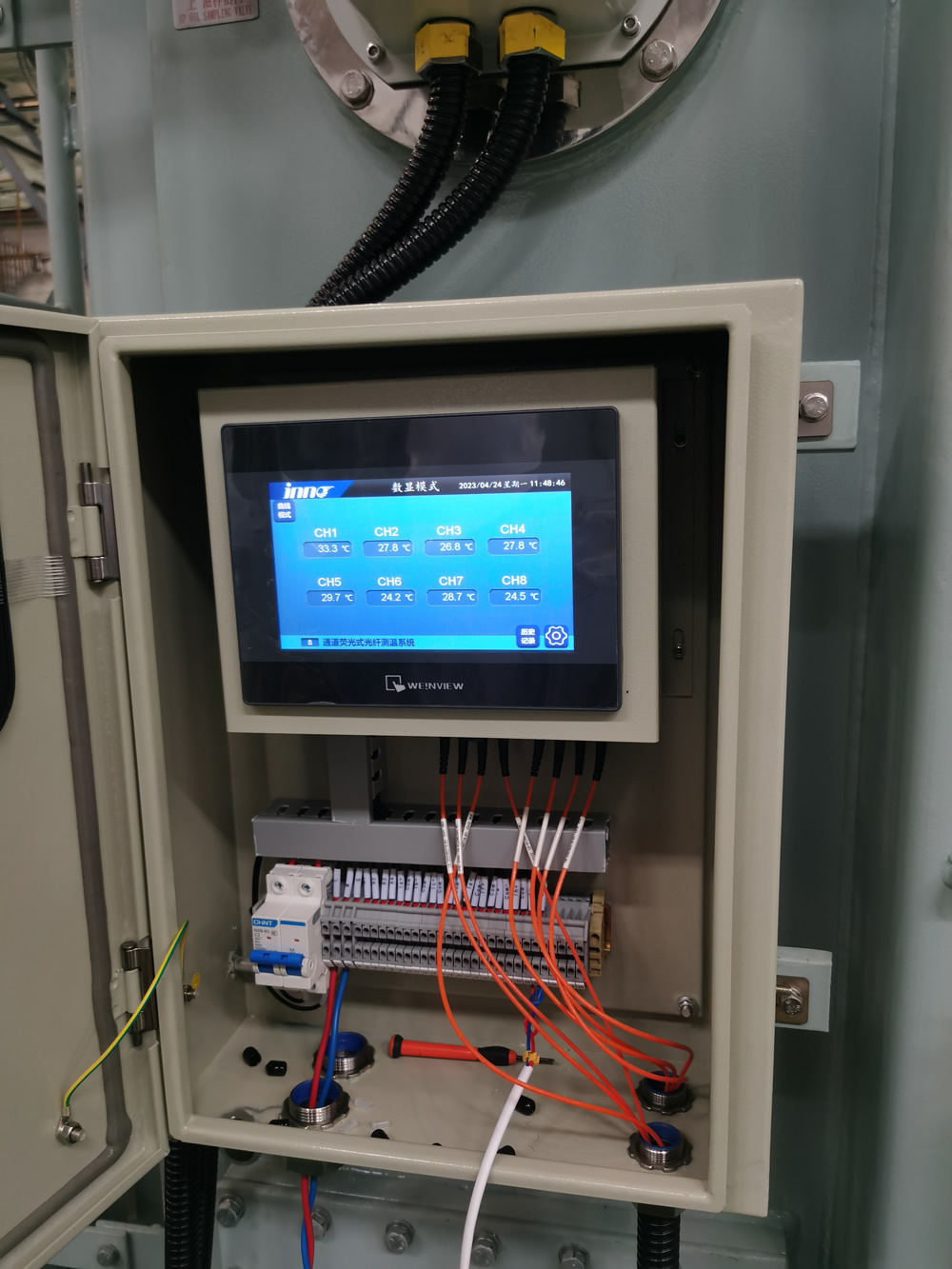
1. Prinsipyo ng Pagsukat ng Temperatura ng Transformer Fiber Optic
Ang pagsukat ng temperatura ng fiber optic ng transformer ay isang paraan ng pagtuklas ng temperatura batay sa teknolohiya ng fiber optic sensing, at ang prinsipyo nito ay ang mga sumusunod:
Prinsipyo batay sa mga katangian ng fluorescence
Ang fluorescent fiber optic sensor ay isang karaniwang ginagamit na paraan para sa pagsukat ng temperatura ng mga fibers ng transpormer. This sensor consists of multimode optical fibers and a fluorescent object mounted on top of it. Fluorescent substances emit fluorescence energy when stimulated by light of a certain wavelength (such as blue violet light). Matapos makansela ang paggulo, the persistence of fluorescence afterglow depends on the characteristics of the fluorescent substance, environmental temperature factors, atbp., and this excited fluorescence usually decays exponentially, with the decay time constant called fluorescence lifetime or fluorescence afterglow time 7. At different environmental temperatures, the decay of fluorescence afterglow varies, and the higher the temperature, the shorter the fluorescence lifetime. By detecting the fluorescence lifetime, the temperature value can be indirectly determined. Halimbawa, in dry-type transformer fiber optic temperature measurement, ang fluorescent fiber optic temperatura sensor utilizes this principle. The probe is embedded inside the insulation of the winding and directly contacts the winding conductor. When the winding temperature changes, the fluorescence lifetime of the fluorescent substance changes accordingly, which is detected by the sensor.
Taking Fuzhou Yingnuo Technology’s fiber optic temperature measurement technology as an example, its transformer winding fluorescence temperature measurement technology uses the energy absorbed by fluorescent molecules when the excited light beam enters the winding, and emits a fluorescence signal. By measuring the lifetime of the fluorescence signal, the temperature of the winding can be indirectly determined.
Principle of Fiber Bragg Grating
Fiber Bragg Grating is a passive filtering device formed by periodically modulating the refractive index of the fiber core. Para sa fiber optic grating temperature sensors, kapag nagbabago ang temperatura, magbabago ang panahon ng rehas at core refractive index ng fiber optic grating, na nagreresulta sa isang drift sa reflected wavelength. Sa pamamagitan ng pagtuklas ng mga pagbabago sa wavelength ng reflection, Maaaring makuha ang impormasyon ng pagkakaiba-iba ng temperatura. Sa mga transformer, Ang pag-install ng fiber Bragg grating temperature sensors sa mga pangunahing bahagi tulad ng windings at iron core ay maaaring makadama ng mga pagbabago sa temperatura sa mga bahaging ito sa real time. Ang fiber optic grating power transformer temperature measurement system ay gumagamit ng advanced fiber optic grating temperature measurement technology, na gumagamit ng pagbabago sa reflected wavelength ng fiber optic grating sa ilalim ng temperatura upang sukatin ang temperatura ng transpormer. Ang teknolohiyang ito ay may mga pakinabang ng mataas na pagkakabukod, not affected by electromagnetic environment, suitable for long-distance, high-quality signal transmission, at mataas na katumpakan ng pagsukat. It is suitable for use in high voltage and strong magnetic field environments such as electricity.
2. Steps of Transformer Fiber Optic Temperature Measurement Method
Preliminary preparation work
Determine temperature measurement requirements and locations: Una, it is necessary to clarify which parts of the transformer need to be measured for temperature. Halimbawa, for oil immersed transformers, it may be necessary to measure the temperature of windings, mga core ng bakal, and oil passages; Para sa dry-type na mga transformer, the focus may be on the winding temperature. Determine the specific temperature measurement point location based on the type of transformer, kapaligiran sa pagpapatakbo, and safety requirements. Halimbawa, if there is concern about the insulation performance being affected by overheating of transformer windings, it is necessary to install fiber optic sensors near the windings.
Choose appropriate fiber optic temperature measurement equipment: Select fiber optic temperature sensors, fiber optic thermometers, and other equipment based on factors such as temperature measurement range, mga kinakailangan sa katumpakan, at kakayahang umangkop sa kapaligiran. If in a high-temperature environment, it is necessary to choose fiber optic sensors that can withstand high temperatures and have high measurement accuracy; Kung ito ay nasa isang malakas na electromagnetic interference na kapaligiran, priority should be given to using equipment with strong anti electromagnetic interference capabilities, such as fluorescent fiber optic temperature sensors, which have anti electromagnetic interference characteristics.
Check equipment integrity: Before installation, it is necessary to inspect the fiber optic temperature measurement equipment, including whether the fiber optic is damaged and whether the sensor is working properly. For optical fibers, it is necessary to check whether there are cracks or breaks in their appearance; For sensors, professional testing tools can be used to check their functionality, such as inputting standard temperature signals to see if the sensor’s output meets expectations.
Installation of Fiber Optic Sensors
Handling of installation location: If there is oil, alikabok, or other impurities at the location where the fiber optic sensor is installed, it needs to be cleaned first to ensure that the sensor can accurately measure temperature. Halimbawa, in oil immersed transformers, if the sensor is to be installed near the oil passage, it is necessary to prevent impurities in the oil from affecting the contact between the sensor and the measured object.
Sensor fixation: Use appropriate fixing fixtures to install the fiber optic sensor in the predetermined position. If measuring winding temperature, it is necessary to ensure good contact between the sensor and the winding surface in order to accurately sense temperature changes. For the installation of fiber optic sensors in dry-type transformers, attention should be paid to avoiding mechanical damage to the sensors during the installation process, and ensuring that the sensors are firmly fixed and will not be displaced due to the vibration of the transformer. Kasabay nito, it is important to maintain the normal curvature of the fiber optic sensor and avoid excessive bending that can cause damage to the fiber optic. Accessories such as fiber optic protective sleeves can be used for protection.
Fiber optic connection and wiring
Fiber optic connection: Connect the fiber optic cable to the thermometer, and be careful to protect the fiber core during the connection process to avoid damage. Halimbawa, when connecting optical fibers, specialized fiber connectors should be used and the correct connection steps should be followed to ensure a stable and reliable connection. When plugging or unplugging fiber optic connectors, avoid applying excessive force to prevent damage to the fiber core.
Fiber optic cabling: Plan the routing path of fiber optic cables to avoid external compression, pulling, or wear as much as possible. If wiring is required around the transformer, it should be kept away from the heating components of the transformer to prevent the performance of the optical fiber from deteriorating due to high temperatures. Kasabay nito, for longer fiber optic cabling, it is necessary to do a good job of fixing and labeling to facilitate subsequent maintenance and repair.
Testing and Calibration
Functional verification: After completing the installation of the fiber optic cable, use a thermometer for functional verification. By measuring the ambient temperature and calibrating the temperature, ensure the accuracy and stability of the thermometer. Halimbawa, a standard object with a known temperature can be placed near a fiber optic sensor to check if the temperature displayed by the thermometer matches the actual temperature of the standard object. Kung may paglihis, the thermometer needs to be calibrated.
System overall testing: Test the entire fiber optic temperature measurement system, including whether the data acquisition, paghawa, and processing of multiple sensors working simultaneously are normal. Check whether the data can be accurately transmitted to the backend monitoring system and whether the temperature values of each temperature measurement point can be displayed correctly in the monitoring system.

3. Recommended Transformer Fiber Optic Temperature Measurement Equipment
Fluorescent sensor ng temperatura ng fiber optic
katangian
Malakas na anti-interference na kakayahan: Due to its optical principle for temperature measurement, it is not affected by the strong electromagnetic field inside the transformer and can accurately measure temperature in high voltage and strong magnetic field environments. Halimbawa, in large substations, transformers are surrounded by complex electromagnetic environments, and fluorescent fiber optic temperature sensors can work stably, providing reliable data for transformer temperature monitoring.
High precision temperature measurement: Using the nonlinear relationship between fluorescence signal and temperature for temperature measurement can achieve high temperature measurement accuracy. Research has shown that its accuracy can reach 0.1 digri. This high-precision measurement helps to detect small changes in transformer temperature in a timely manner and provide early warning of potential fault risks.
Comprehensive temperature measurement capability: Maaari itong makamit ang komprehensibong pagsukat ng temperatura ng mga windings ng transpormer nang hindi apektado ng mga lokal na pagkakamali o kumplikadong mga kondisyon sa pagtatrabaho, at maaari ring magsagawa ng real-time at tuluy-tuloy na pagsubaybay sa temperatura. Sa panahon ng pagpapatakbo ng transpormer, ang distribusyon ng temperatura ay maaaring tumpak na masubaybayan kung ito ay nasa normal na operasyon o sa kaso ng mga abnormal na kondisyon tulad ng lokal na overheating.
Kaso ng aplikasyon: Ang fluorescent fiber optic temperature sensor ng Fuzhou Yingnuo Electronic Technology Co., Ltd. ay malawakang ginagamit sa pagsubaybay sa temperatura ng mga dry-type na transformer at oil immersed transformer. Sa dry-type na mga transformer, ang sensor na ito ay maaaring umangkop sa kanyang espesyal na operating environment at tumpak na masukat ang winding temperature ng transpormer; Sa oil immersed transformers, Ang mga pagbabago sa temperatura sa mga windings at mga daanan ng langis ay maaari ding tumpak na masubaybayan.
Fiber Bragg Grating Temperature Sensor
katangian
Mataas na pagkakabukod at katatagan: Ang Fiber Bragg grating mismo ay gawa sa mga optical fiber at may mahusay na pagganap ng pagkakabukod, na maaaring gumana nang ligtas sa mataas na boltahe na kapaligiran. At ang katatagan nito ay mabuti, at ang mga resulta ng pagsukat ay hindi madaling maapektuhan ng mga panlabas na salik. Halimbawa, sa mga transformer na may mataas na boltahe sa mga sistema ng kuryente, fiber Bragg grating temperature sensors ay maaaring gumana nang matatag sa mahabang panahon, pagbibigay ng mga garantiya para sa ligtas na operasyon ng mga transformer.
Mataas na katumpakan at pagiging sensitibo: Ito ay may mataas na sensitivity sa mga pagbabago sa temperatura, maaaring tumpak na matukoy ang maliliit na pagbabago sa temperatura, at may mataas na katumpakan ng pagsukat. Nagbibigay-daan ito sa napapanahong pagtuklas ng abnormal na pagtaas ng temperatura sa pagsubaybay sa temperatura ng transpormer, at ang mga kaukulang hakbang ay maaaring gawin upang maiwasan ang mga pagkabigo ng transpormer na mangyari.
Distributed measurement can be achieved: temperature measurements can be taken at multiple points along the axis of the fiber Bragg grating, and temperature information at different locations can be obtained by analyzing the reflected wavelength. The distributed measurement feature is very advantageous for comprehensive temperature monitoring of large transformers, as it can obtain temperature data of multiple key parts at once.
Kaso ng aplikasyon: The fiber Bragg grating temperature online monitoring system is applied to temperature monitoring of power transformers. This system utilizes the characteristics of fiber Bragg gratings to monitor the temperature changes of transformers in real time, and can transmit data to the monitoring center through the network, ginagawa itong maginhawa para sa mga tauhan ng operasyon at pagpapanatili na subaybayan ang katayuan ng pagpapatakbo ng mga transformer.
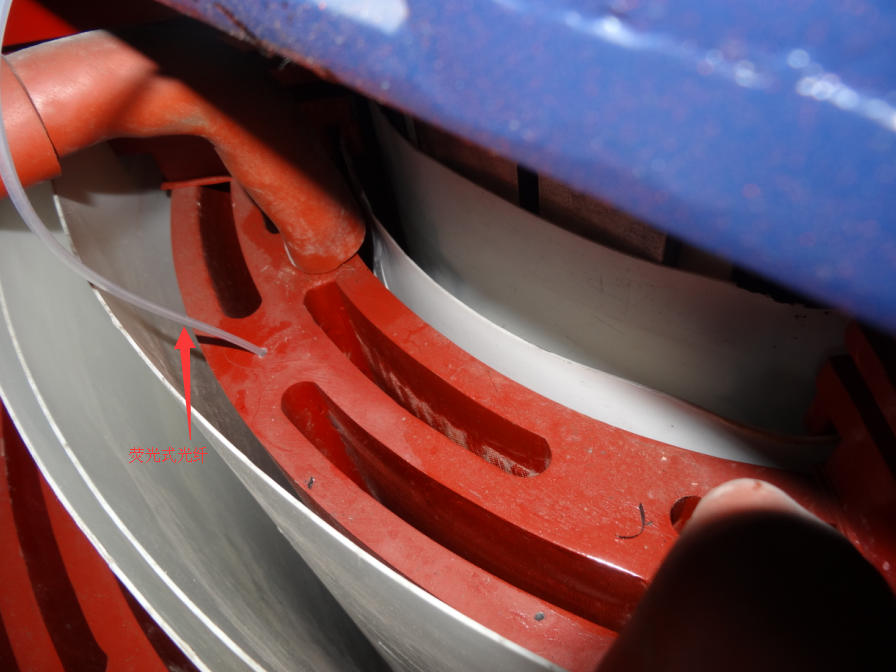
4. Pagsusuri ng Halimbawa ng Pagsukat ng Temperatura ng Transformer Fiber Optic
Halimbawa ng Fiber Optic Temperature Measurement para sa mga Dry type na Transformer
Komposisyon at pag-install ng sistema ng pagsukat ng temperatura: Ang isang tiyak na dry-type na transpormer ay gumagamit ng isang sistema ng pagsukat ng temperatura ng fluorescent fiber optic. Ang sistema ay binubuo ng isang fluorescent fiber optic temperature sensor, fiber optic, at thermometer. Ang sensor ay naka-install sa loob ng pagkakabukod ng paikot-ikot at sa direktang pakikipag-ugnay sa paikot-ikot na konduktor. Ang optical fiber ay nagpapadala ng signal ng temperatura na nakolekta ng sensor sa thermometer. Sa panahon ng proseso ng pag-install, upang matiyak ang normal na operasyon ng sensor, the installation position was carefully selected to avoid external electromagnetic interference and mechanical damage. Halimbawa, installing the sensor in the middle of the winding can better reflect the average temperature of the winding. Kasabay nito, special fixing fixtures are used to ensure close contact between the sensor and the winding when installing the sensor. A protective sleeve is also placed on the outside of the optical fiber to prevent damage during the operation of the transformer.
Temperature monitoring and fault warning: Sa panahon ng operasyon, the thermometer monitors the temperature of the transformer winding in real time. When the temperature rises to the set warning value, the system will issue a warning signal. Halimbawa, when the winding temperature reaches 120 ° C, a warning will be issued. Once the temperature approaches this value, isang mensahe ng babala ang ipapadala sa mga tauhan ng pagpapatakbo at pagpapanatili sa pamamagitan ng isang naririnig at nakikitang alarma o remote na interface ng komunikasyon, nagpapaalala sa kanila na bigyang-pansin ang katayuan ng operasyon ng transpormer at suriin kung may labis na karga, mahinang pagwawaldas ng init, at iba pang isyu. Kung ang temperatura ay patuloy na tumaas at umabot sa halaga ng biyahe (tulad ng 150 ° C), kokontrolin ng system ang transpormer upang i-trip upang protektahan ito mula sa karagdagang pinsala.
Pagsusuri ng epekto: Sa pamamagitan ng pang-matagalang pagsubaybay sa operasyon ng dry-type na transpormador na sistema ng pagsukat ng temperatura ng fiber optic, ito ay natagpuan na ang sistema ay maaaring tumpak na sukatin ang paikot-ikot na temperatura na may isang error sa loob ng ± 0.5 ° C. Kung ikukumpara sa tradisyonal na paraan ng pagsukat ng temperatura ng PT100, the fiber optic temperature measurement system has higher accuracy and better anti-interference ability. Sa aktwal na operasyon, there was once a situation where the temperature of a transformer increased due to a cooling fan failure. The fiber optic temperature measurement system promptly issued a warning signal, and the operation and maintenance personnel quickly took measures to repair the cooling fan after receiving the notification, avoiding accidents where the transformer was damaged due to overheating.
5. Example of Fiber Optic Temperature Measurement for Oil Immersed Transformers
Temperature measurement system and installation location: A temperature monitoring system based on fiber Bragg grating is installed on a certain oil immersed transformer. Ang fiber Bragg grating temperature sensor sa system ay naka-install sa mataas at mababang boltahe na windings ng transpormer, konektado sa optical fiber sa pamamagitan ng fiber junction box, at nagpapadala ng nakolektang signal ng temperatura sa background monitoring system. Kapag nag-i-install ng mga sensor, isinasaalang-alang ang daloy ng langis at pamamahagi ng electric field sa loob ng oil immersed transformer, ang mga sensor ay naka-install malapit sa oil passage support ng winding. Nagbibigay-daan ito sa mga sensor na mas maramdaman ang mga pagbabago sa temperatura ng winding, habang iniiwasan din ang pinsalang dulot ng direktang epekto ng daloy ng langis sa mga sensor.
Pagsusuri at aplikasyon ng data ng temperatura: Sinusuri at pinoproseso ng backend monitoring system ang nakolektang data ng temperatura. Sa isang banda, it can display the temperature of various parts of the transformer in real time, and operation and maintenance personnel can intuitively view the temperature distribution through the monitoring interface; Sa kabilang banda, by analyzing the historical records of temperature data, the operating status and fault risk of transformers can be predicted. Halimbawa, if it is found that the temperature of a winding continues to rise for a period of time, and the increase exceeds the normal range, it may indicate that there is a local overheating problem in the winding, and further inspection is needed to check for potential faults such as inter turn short circuits.
Actual benefits reflected: During the operation of the oil immersed transformer, the fiber optic temperature measurement system played an important role. Halimbawa, during the high temperature period in summer, when the transformer load is large, the real-time monitoring of the fiber optic temperature measurement system allows the operation and maintenance personnel to adjust the load of the transformer in a timely manner, avoiding the occurrence of high temperature caused by long-term overload operation. Kasabay nito, during a regular maintenance of a transformer, a potential winding overheating problem was discovered through analysis of temperature data. After further inspection, it was found that the local resistance increased due to insulation aging of the winding, causing heating. Due to the timely detection and handling of this issue, potential transformer failures were avoided, ensuring the stable operation of the power system.
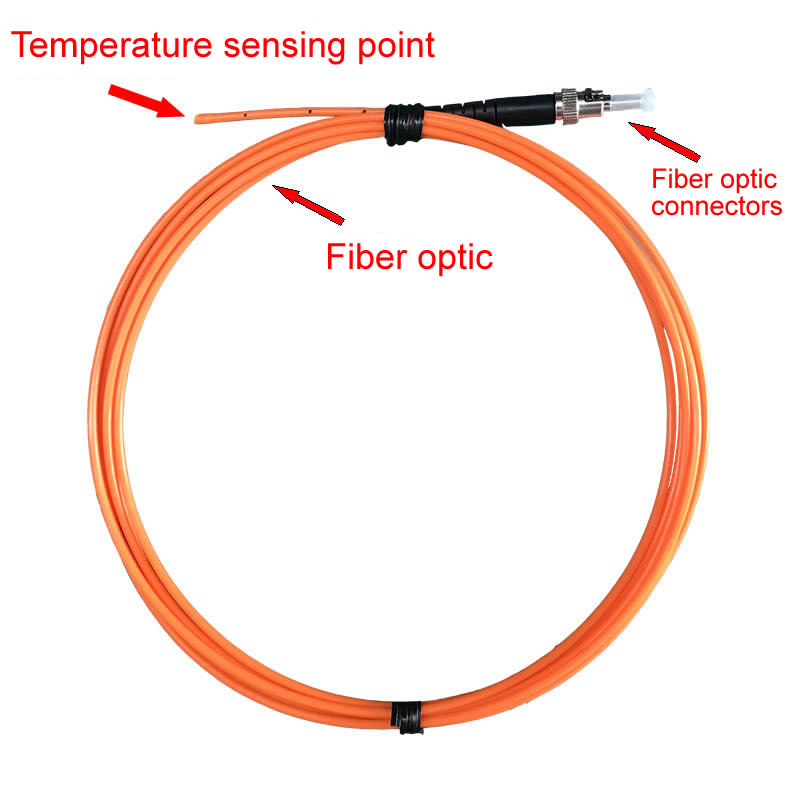
6. Precautions for Transformer Fiber Optic Temperature Measurement
Precautions during installation
Sensor installation
Position accuracy: When installing fiber optic sensors, ensure that they are installed in the predetermined and accurate position. For different parts of the transformer, such as windings, mga core ng bakal, atbp., the temperature distribution and variation patterns at each position are different. If the installation position of the sensor deviates, it may cause the measurement results to not accurately reflect the true temperature of that area. Halimbawa, when measuring the temperature of a winding hotspot, if the sensor is installed too far away from the hotspot area, it may underestimate the maximum temperature of the winding and fail to detect potential overheating risks in a timely manner.
Fixed firmness: Use appropriate fixing methods and accessories to firmly fix the sensor in the installation position. Transformers will generate vibration during operation. If the sensor is not firmly fixed, displacement may occur, affecting the accuracy of measurement and even causing poor contact between the sensor and the measured object, making it impossible to measure temperature normally. Halimbawa, in dry-type transformers, if the fiber optic sensor is not firmly fixed on the winding, it may rub against the insulation layer of the winding during transformer vibration, which not only affects temperature measurement but also may damage the insulation performance of the winding.
Avoid damaging the optical fiber: During the installation of sensors and wiring, special attention should be paid to protecting the optical fiber. Fiber optic is a key component for transmitting temperature signals. If the fiber optic is broken, bent with a small radius, or scratched, it may cause signal transmission interruption or attenuation, thereby affecting the normal operation of the temperature measurement system. Halimbawa, when optical fibers pass through holes in transformer casings, if the edges of the holes are not smoothed, the fibers may be scratched.
Wiring planning
Stay away from interference sources: The wiring of optical fibers should be kept away from possible interference sources, such as strong electromagnetic fields in transformers, high-temperature components, atbp. Strong electromagnetic fields may interfere with optical signals transmitted through optical fibers, and high-temperature components may degrade or even damage the performance of optical fibers. Halimbawa, Parallel wiring ng optical fibers at high-voltage leads ng mga transformer ay dapat na iwasan upang maiwasan ang electromagnetic interference sa mga optical fiber signal; Kasabay nito, ito ay kinakailangan upang maiwasan ang paglalagay ng optical fiber malapit sa mataas na temperatura ng mga bahagi tulad ng heat sink ng transpormer, upang matiyak na ang optical fiber ay nasa loob ng normal na hanay ng temperatura ng pagtatrabaho.
Makatwirang pagpaplano ng landas: Kinakailangang planuhin nang maayos ang fiber optic na daanan ng paglalagay ng kable, ginagawa itong maikli hangga't maaari at madaling mapanatili. Ang mahabang fiber optic na paglalagay ng kable ay hindi lamang nagpapataas ng mga gastos, ngunit maaari ring tumaas ang panganib ng pagpapahina ng signal. Sa panahon ng proseso ng mga kable, dapat isaalang-alang ang istraktura ng transpormer at ang nakapalibot na kapaligiran upang maiwasan ang pagpiga, pulling, o iba pang mekanikal na pinsala sa optical fibers. Halimbawa, fiber optic wiring can be carried out along the bracket or trunking of the transformer, and fixed at regular intervals to prevent fiber optic shaking.
Precautions during operation
Regular na inspeksyon
Equipment status inspection: Regularly inspect fiber optic temperature measurement equipment, kabilang ang mga sensor, thermometers, mga konektor ng fiber optic, and other components. Check whether the sensor is working properly and whether there is any damage or aging phenomenon; Check if the measurement accuracy of the thermometer still meets the requirements; Ensure that the fiber optic connector is securely connected without any looseness or oxidation issues. Halimbawa, ang isang functional na pagsubok ay maaaring isagawa sa fiber optic sensor tuwing anim na buwan upang ihambing ito sa isang karaniwang pinagmumulan ng temperatura at suriin kung ang error sa pagsukat ng sensor ay nasa loob ng pinapayagang saklaw.
Inspeksyon ng integridad ng hibla: Suriin kung nasira ang hibla, sira, o kinakalawang. Ang pagkawala ng transmission ng optical fiber ay maaaring makita ng isang fiber optic tester. Kung ang isang pagtaas sa pagkawala ng transmission ay natagpuan, maaaring ipahiwatig nito na may problema sa optical fiber at kailangan ang karagdagang pagsisiyasat sa fault point. Kasabay nito, kailangan ding suriin kung ang proteksiyon na takip ng optical fiber ay buo. Kung ang proteksiyon na takip ay nasira, maaari nitong ilantad ang optical fiber sa malupit na kapaligiran, pagtaas ng panganib ng pinsala.
Pagsubaybay at pagsusuri ng data
Real time data monitoring: It is necessary to monitor the temperature data collected by the fiber optic sistema ng pagsukat ng temperatura in real time and pay attention to the trend of temperature changes. If abnormal fluctuations are found in temperature data, such as sudden increases or decreases, timely analysis and processing should be carried out. Halimbawa, when the temperature of a certain winding of a transformer suddenly rises, it may indicate problems such as overload, short circuit, or poor heat dissipation in the winding, and the operation of the transformer needs to be checked immediately.
Historical data utilization: Analyzing the historical records of temperature data can help identify potential issues and fault trends in transformers. By statistically analyzing long-term temperature data, mauunawaan natin ang mga pagbabago sa temperatura ng mga transformer sa ilalim ng iba't ibang load, mga temperatura sa kapaligiran, at iba pang kundisyon, upang mahulaan nang maaga ang mga posibleng sitwasyon ng pagkakamali. Halimbawa, kung matutuklasan na ang paikot-ikot na temperatura ng isang transpormer ay lumalapit sa halaga ng babala sa panahon ng mataas na temperatura tuwing tag-araw, maaari itong isaalang-alang na siyasatin at mapanatili ang sistema ng paglamig ng transformer bago ang pagdating ng tag-araw.

Sensor ng temperatura ng fiber optic, Intelligent na sistema ng pagsubaybay, Ibinahagi ang tagagawa ng fiber optic sa China
 |
 |
 |