 Vihisi joto vya INNO fiber optic ,mifumo ya ufuatiliaji wa joto.
- Embedded temperature monitoring systems place sensors directly inside generator stator windings, fani, and cores to detect overheating before damage occurs.
- Sensorer za joto za nyuzi za fluorescent are fully immune to electromagnetic interference and provide inherent high-voltage insulation, making them the ideal choice for generator internal monitoring.
- Compared with traditional RTDs and thermocouples, fiber optic sensors deliver more stable readings, longer service life, and lower maintenance in strong electromagnetic environments.
- A complete system includes sensing probes, nyaya za nyuzi za macho, a fiber optic demodulator, display modules, and monitoring software with multi-channel parallel measurement.
- Applications span hydro generators, steam turbine generators, wind turbine generators, diesel generator sets, na motors kubwa za viwanda.
Jedwali la Yaliyomo
- What Is Embedded Temperature Monitoring of Generators
- Why Generator Temperature Monitoring Is Critical
- Key Monitoring Points Inside a Generator
- How Embedded Generator Temperature Monitoring Works
- Sensor Technologies for Generator Temperature Monitoring
- Fiber Optic vs RTD Sensors for Generator Windings
- System Components of a Fiber Optic Generator Monitoring Solution
- Real-Time Alarms and Hotspot Detection
- Applications Across Generator Types
- FAQs About Embedded Generator Temperature Monitoring
1. Ni Nini Embedded Temperature Monitoring of Generators
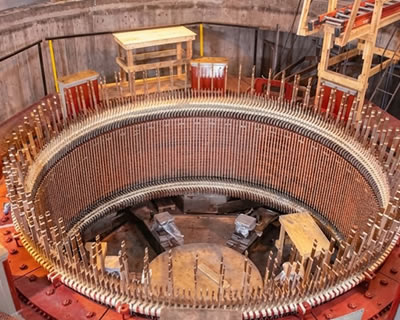
Definition and Core Concept
Embedded temperature monitoring refers to the practice of installing temperature sensors directly inside critical locations of a generator — within stator winding slots, bearing housings, and core tooth sections — for continuous, kipimo cha joto cha wakati halisi. Unlike external surface measurements, embedded monitoring captures the true temperature closest to the heat source, giving operators the most accurate thermal picture of the machine’s internal condition.
Why Generators Need Internal Temperature Monitoring
Wakati wa operesheni, a generator produces heat from multiple sources. Current flowing through stator windings creates copper losses. Magnetic flux alternating in the core generates iron losses. Friction in bearings produces mechanical heat. If any of these heat sources goes undetected or uncontrolled, the consequences can be severe — accelerated insulation aging, shortened equipment lifespan, and in worst cases, winding burnout or forced outage. An embedded temperature monitoring system serves as the frontline defense for condition-based maintenance and asset protection.
Industry Standards and Requirements
Embedded temperature monitoring is standard practice across the global power generation industry. Whether in large hydroelectric plants, thermal power stations, nuclear facilities, or distributed diesel generator sets, continuous winding temperature measurement is required. Viwango vya kimataifa ikiwa ni pamoja na IEC 60034 and IEEE C50 series explicitly mandate generator winding temperature monitoring for machines above certain ratings.
2. Why Generator Temperature Monitoring Is Critical

Insulation Life and the 10-Degree Rule
The relationship between temperature and insulation life follows a well-established principle known as the 10-degree rule: kwa kila 10 °C rise in operating temperature above the rated value, insulation life is roughly cut in half. This means that even a modest, sustained temperature increase can dramatically shorten the service life of stator winding insulation. Sahihi, kuendelea stator winding temperature monitoring is the most effective way to protect this critical investment.
Preventing Catastrophic Failures
Undetected winding overheating can lead to turn-to-turn short circuits, ground faults, na hata moto. Abnormal bearing temperatures often serve as early indicators of mechanical problems such as lubrication failure, mpangilio mbaya, au kuvaa kuzaa. A properly configured generator condition monitoring system with embedded sensors provides the earliest possible warning, well before visible damage occurs.
Economic Impact of Unplanned Outages
The cost of an unplanned generator outage is enormous. It includes not only repair or replacement expenses but also lost revenue from power supply interruption. For utility-scale generators, a single major failure can result in losses measured in hundreds of thousands or even millions of dollars. The investment in a reliable embedded temperature monitoring system represents a fraction of the potential loss from one catastrophic event.
Optimizing Operational Efficiency
Beyond protection, temperature data helps plant operators optimize load distribution, adjust cooling system parameters, and plan maintenance schedules more effectively. This data-driven approach improves overall generator availability and operating efficiency while reducing unnecessary maintenance interventions.
3. Key Monitoring Points Inside a Generator
Stator Winding
The stator winding is the single most important monitoring location. Sensor ya joto ya fiber optic probes are typically embedded within winding slots, between coil layers, or at the end-winding region to measure copper conductor or insulation temperature. Because temperature distribution across different slots is rarely uniform, multiple sensors are placed to capture the hottest spot reliably.
Stator Core
Core losses generate heat, and localized core overheating may indicate lamination short circuits or insulation degradation between laminations. Sensors embedded in core tooth tips or yoke sections monitor core health and help identify developing problems early.
Bearings
Rising bearing temperature can signal insufficient lubrication, uharibifu wa mafuta, kuzaa kuvaa, or shaft misalignment. Monitoring both guide bearings and thrust bearings is standard practice for generator bearing temperature monitoring in virtually all large rotating machines.
Kiwango cha Kupoeza
Measuring the inlet and outlet temperatures of cooling air or cooling water, along with cooler efficiency, helps determine whether the cooling system is functioning correctly. This information is essential for distinguishing between a generator-side thermal problem and a cooling system deficiency.
Additional Monitoring Points
Depending on the generator type and capacity, additional monitoring may cover collector rings, hydrogen seal areas in hydrogen-cooled generators, na vituo vya bushing.
4. How Embedded Generator Temperature Monitoring Works
Kanuni ya Kuhisi Fiber Optic ya Fluorescent
A sensor ya joto ya nyuzi za fluorescent works on the principle of fluorescence decay time measurement. The probe tip contains a phosphorescent material. The fiber optic demodulator sends an excitation light pulse through the optical fiber to the probe. The phosphorescent material absorbs this energy and re-emits a fluorescent afterglow signal. The decay time of this afterglow varies precisely with temperature. The demodulator measures this decay time and converts it into an accurate temperature reading. The entire sensing chain is purely optical — no electrical signals are involved at the measurement point.
Signal Transmission Path
Starting from the probe embedded inside the generator winding slot, ya fluorescent optical fiber is routed along the end winding, exits through a sealed cable gland in the generator frame, and connects to the demodulator installed outside the machine. The demodulator transmits calibrated temperature data via RS485, Modbus, or Ethernet communication to local display units and supervisory software.
Multi-Channel Parallel Monitoring
A single demodulator unit can support multiple sensing channels, simultaneously monitoring temperatures across numerous winding slots, multiple bearings, and other locations. The software platform consolidates all channel data into a unified dashboard for at-a-glance supervision.
5. Sensor Technologies for Generator Temperature Monitoring
Fluorescent Fiber Optic Sensors — The Recommended Choice
Sensorer za joto za nyuzi za fluorescent offer a unique combination of advantages for generator applications: complete immunity to electromagnetic interference (EMI/RFI), inherent high-voltage electrical insulation, no power required at the sensing point, compact probe size suitable for embedding in narrow winding slots, uvumilivu wa joto la juu, extremely long service life, and virtually zero maintenance requirements.
RTDs (Vigunduzi vya Kustahimili Joto)
Platinum RTDs such as PT100 have been the traditional sensor choice for generator winding temperature measurement. While RTDs offer reasonable accuracy, they are electrical sensors with metallic lead wires that act as antennas in strong electromagnetic fields. This susceptibility to interference compromises measurement reliability, and the conductive lead paths introduce insulation breakdown risks in high-voltage environments.
Thermocouples
Thermocouples see some use in generator monitoring but face similar electromagnetic interference challenges. Their accuracy and long-term stability are generally inferior to fiber optic alternatives, and electrical isolation remains a significant concern in high-voltage machines.
Thermography ya Infrared
Infrared cameras are useful for external surface temperature scanning and visual inspections during maintenance outages, but they cannot provide continuous embedded measurement inside winding slots. Infrared methods serve only as a supplementary tool.
6. Fiber Optic vs RTD Sensors for Generator Windings

Utangamano wa sumakuumeme
The interior of a generator is an extreme electromagnetic environment — strong alternating magnetic fields, viwango vya juu vya voltage, and high-frequency harmonics. RTD metallic lead wires pick up interference signals like antennas, degrading measurement accuracy. Sensorer za joto za fiber optic are constructed entirely from non-conductive materials, eliminating this problem at the fundamental level.
Electrical Insulation Performance
Fiber optic sensors provide inherent galvanic isolation. There is no conductive path between the probe and the demodulator. RTD metallic leads in a high-voltage winding environment carry a potential risk of insulation breakdown, requiring additional insulation treatment and ongoing inspection.
Probe Size and Installation Flexibility
Fiber optic probes feature very small diameters, allowing flexible installation in the tight spaces of winding slots. RTD probes, when combined with shielded lead wires and protective sleeves, tend to be bulkier and more difficult to route.
Long-Term Stability and Maintenance
Fiber optic sensors are free from electrochemical corrosion and lead wire oxidation, delivering excellent long-term stability. RTDs operating in high-temperature, high-humidity conditions may experience drift over time and require periodic recalibration.
Comparison Summary
| Kigezo | Sensorer ya Fiber Optic | RTD (PT100) |
|---|---|---|
| Kinga ya EMI | Kamilisha | Inaweza kuathiriwa |
| Insulation ya Umeme | Inherent full isolation | Requires additional insulation |
| Usahihi | ±0.5 °C typical | ±0.5 °C typical |
| Ukubwa wa Uchunguzi | Very compact | Larger with shielding |
| Maisha ya Huduma | 20+ miaka | 10- miaka 15 |
| Matengenezo | Virtually none | Periodic recalibration |
| Jumla ya Gharama ya Umiliki | Lower over lifetime | Higher due to maintenance |
7. System Components of a Fiber Optic Generator Monitoring Suluhisho

Fiber Optic Demodulator
The fiber optic demodulator is the signal processing core of the system. It receives optical signals from each sensor channel and outputs calibrated temperature values. Industrial-grade design ensures reliable operation in power plant environments with wide operating temperature ranges and robust communication interfaces.
Fluorescent Fiber Optic Temperature Probe
The uchunguzi wa joto wa nyuzi za fluorescent is the sensing element embedded inside the generator. Probes are available in different form factors and temperature ratings to suit various installation requirements, from standard slot embedment to surface-mount configurations.
Fluorescent Optical Fiber Cable
The fluorescent optical fiber cable connects the probe to the demodulator. It is designed to withstand repeated bending, mtetemo, and elevated temperatures encountered in generator environments.
Maonyesho ya Moduli
A local temperature display module provides real-time temperature readings at the machine location or in the control room, supporting quick visual checks by operations personnel.
Monitoring Software Platform
The software handles data acquisition, trend display, usimamizi wa kengele, historical data archiving, na utoaji wa ripoti. It supports integration with plant DCS and SCADA systems via standard communication protocols.
8. Real-Time Alarms and Hotspot Detection

Alarm Mechanism
The system allows independent pre-alarm and alarm thresholds for each monitoring channel. When a temperature exceeds the pre-alarm setpoint, the system issues a warning notification. When the alarm threshold is exceeded, an emergency alarm triggers, which can be linked to generator protection relays for automatic load reduction or trip action.
Utambuzi wa Hotspot
By comparing temperature readings from sensors distributed across different winding slots of the same generator, the system automatically identifies localized hotspots. The emergence of a hotspot may indicate localized insulation degradation, blocked cooling ducts, or local core faults. Mapema generator hotspot detection enables targeted maintenance before the problem escalates.
Temperature Rise Trend Analysis
The monitoring software tracks not only absolute temperature values but also the rate of temperature change over time. An abnormal rate of temperature rise — even if the absolute value has not yet reached the alarm threshold — can indicate a developing fault and prompts early investigation.
9. Applications Across Generator Types
Hydro Generators
Large hydro generators operate at low speeds with high pole counts, resulting in large stator diameters and extensive winding lengths. Multiple embedded sensorer za joto la fiber optic are distributed around the stator circumference to capture the full thermal profile.
Steam Turbine Generators
High-speed steam turbine generators in thermal and nuclear power plants demand robust monitoring of both stator winding and hydrogen-cooled environments. Fiber optic sensors excel in these high-voltage, high-EMI conditions.
Wind Turbine Generators
Wind generators face challenging environmental conditions including wide temperature swings, unyevunyevu, na mtetemo. The maintenance-free nature of fiber optic sensors is particularly valuable in remote or offshore wind installations where access is limited.
Diesel Generator Sets and Large Motors
For backup power diesel generators and large industrial motors, embedded temperature monitoring ensures reliable operation during critical duty cycles and extends equipment service life.
10. FAQs About Embedded Generator Temperature Monitoring
Q1: What is embedded temperature monitoring in generators?
Embedded temperature monitoring involves placing sensors directly inside a generator’s stator winding slots, fani, and core to measure internal temperatures continuously in real time. This approach captures data at the actual heat source rather than on external surfaces.
Q2: Why are fiber optic sensors preferred over RTDs for generator winding monitoring?
Sensorer za joto za nyuzi za fluorescent are completely immune to electromagnetic interference and provide inherent electrical insulation, making them far more reliable than RTDs in the strong electromagnetic environment inside a generator.
Q3: How does a fluorescent fiber optic temperature sensor work?
The sensor probe contains a phosphorescent material that emits a fluorescent afterglow when excited by a light pulse. The decay time of this afterglow changes with temperature. The fiber optic demodulator measures the decay time and converts it to a precise temperature reading.
Q4: What temperature range can fiber optic generator sensors measure?
Typical fluorescent fiber optic sensors used in generators cover a range from −40 °C to +250 °C, which comfortably encompasses the operating temperatures of most generator winding insulation classes.
Q5: How many sensors are typically installed in one generator?
The number varies with generator size and design. A large hydro or steam turbine generator may have 6 kwa 24 or more embedded winding temperature sensors, plus additional sensors for bearings and cooling circuits.
Q6: Can fiber optic sensors be retrofitted into existing generators?
Ndiyo. While the easiest installation occurs during manufacturing or a major rewind, fiber optic probes can be retrofitted during scheduled maintenance outages. Their small probe size simplifies installation in tight spaces.
Q7: What communication protocols does the monitoring system support?
Standard systems support RS485, Modbus RTU/TCP, and Ethernet communication, enabling straightforward integration with plant DCS and SCADA platforms.
Q8: How often do fiber optic temperature sensors need calibration?
Fluorescent fiber optic sensors exhibit excellent long-term stability and typically do not require recalibration throughout their service life, which can exceed 20 miaka.
Q9: What is generator hotspot detection?
Generator hotspot detection is the process of identifying localized areas of abnormally high temperature within the stator winding by comparing readings across multiple embedded sensors. Hotspots may indicate insulation deterioration, blocked cooling passages, or core faults.
Q10: Is the monitoring system compatible with different generator types?
Ndiyo. Fiber optic embedded temperature monitoring systems are used across hydro generators, steam turbine generators, gas turbine generators, wind turbine generators, diesel generator sets, and large industrial motors worldwide.
Kanusho: Taarifa iliyotolewa katika makala hii ni kwa madhumuni ya habari na elimu tu. Wakati kila juhudi imefanywa ili kuhakikisha usahihi, Fjinno makes no warranties or representations regarding the completeness or applicability of the content to any specific installation or operating condition. Product specifications and system capabilities may vary. For project-specific technical guidance and product selection, tafadhali wasiliana na timu ya uhandisi kwa www.fjinno.net. All product names and trademarks mentioned are the property of their respective owners.

Sensor ya joto ya fiber optic, Mfumo wa ufuatiliaji wa akili, Kusambazwa fiber optic mtengenezaji nchini China
 |
 |
 |