 Vihisio vya joto vya macho vya INNO fibre ,Mifumo ya ufuatiliaji wa joto.
- Substation transformers with advanced temperature monitoring features use embedded fluorescent fiber optic sensors to measure winding hot-spot temperature, Joto la juu la mafuta, Joto la msingi, joto la bushing, and tap changer contact temperature in real time — replacing or augmenting traditional indirect methods.
- Sensorer za joto la fiber optic ya fluorescent are the only technology that can be safely embedded directly inside high-voltage transformer windings because they are entirely non-metallic, isiyo ya kufanya, and immune to the intense electromagnetic fields present inside an energized transformer.
- Direct winding hot-spot measurement eliminates the estimation errors inherent in conventional winding temperature indicators (Wtis), enabling more accurate thermal protection, longer insulation life, and confident dynamic load rating.
- A complete monitoring system consists of Joto la joto la macho ya nyuzi, optical fiber cables routed through transformer bushings or feedthroughs, a multi-channel kiboreshaji cha fiber optic, and software that integrates with substation SCADA, DCS, na majukwaa ya usimamizi wa mali.
- Applications span power transformers from 110 kv kwa 800 kv, transfoma za usambazaji, transfoma ya traction, industrial furnace transformers, offshore wind step-up transformers, and data center critical-supply transformers.
Jedwali la yaliyomo
- What Is Advanced Temperature Monitoring for Substation Transformers
- Why Substation Transformers Need Temperature Monitoring
- Key Temperature Monitoring Points in a Transformer
- Mapungufu ya Mbinu za Jadi za Ufuatiliaji wa Joto
- Jinsi fluorescent fiber optic joto sensorer inavyofanya kazi
- Advantages of Fiber Optic Sensors for Transformer Monitoring
- Fiber Optic vs Traditional Sensors — A Detailed Comparison
- System Architecture of an Advanced Monitoring Solution
- Application Scenarios Across Transformer Types
- FAQs About Substation Transformer Temperature Monitoring
1. Ni Nini Advanced Temperature Monitoring for Substation Transformers

Definition and Background
Substation transformer temperature monitoring refers to the continuous, kipimo cha wakati halisi cha joto katika maeneo mengi muhimu ndani na juu ya uso wa transfoma za nguvu zilizowekwa kwenye vituo vidogo vya umeme. Ufuatiliaji wa hali ya juu unapita zaidi ya vifaa vilivyopitwa na wakati kwa kupachika vitambuzi moja kwa moja kwenye sehemu ambazo mkazo wa joto ni mkubwa zaidi - ndani ya vilima vyenye voltage ya juu na chini-voltage zenyewe - ili kunasa halijoto halisi ya mahali-moto badala ya kutegemea makadirio yasiyo ya moja kwa moja.. Teknolojia inayowezesha nyuma ya maendeleo haya ni Sensor ya joto ya fiber optic ya fluorescent, ambayo inaweza kufanya kazi kwa usalama ndani ya high-voltage, mafuta yaliyojazwa, mazingira ya sumakuumeme ya kibadilishaji chenye nguvu.
Kutoka Kipimo cha Kijadi hadi Ufuatiliaji wa Akili
Kwa miongo kadhaa, waendeshaji wa transfoma walitegemea vipimajoto vya juu vya mafuta na viashiria vya joto vya vilima (Wtis) that inferred winding temperature from oil temperature plus a simulated thermal image current. While these instruments provided a basic level of protection, they could not measure actual winding hot-spot temperature directly. The introduction of fiber optic sensing technology transformed this situation by making it possible, for the first time, to place sensors in direct contact with conductor insulation deep inside the winding structure. This shift from estimation to direct measurement represents the defining characteristic of advanced mifumo ya ufuatiliaji wa joto ya transfoma.
Strategic Value in the Modern Power Grid
As electrical grids face increasing load demands, higher penetration of renewable generation, and aging transformer fleets, the need for accurate thermal intelligence has become critical. Ufuatiliaji wa hali ya juu wa halijoto huwezesha huduma kuendesha transfoma karibu na viwango vyao vya joto kwa uhakika, kuahirisha uingizwaji wa gharama kubwa kupitia matengenezo ya msingi wa hali, na kuzuia janga la kushindwa kwa mafuta ambayo inaweza kusababisha kukatika kwa kuenea na uharibifu wa mazingira. Substation transformers with advanced temperature monitoring features si chaguo la malipo tena - yanakuwa hitaji la msingi kwa utegemezi wa gridi ya kisasa.
2. Why Substation Transformers Need Temperature Monitoring

Kushindwa kwa Joto ndio Sababu inayoongoza ya Upotezaji wa Transfoma
Takwimu za kushindwa kwa tasnia zinaonyesha mara kwa mara kuwa uharibifu wa joto ndio njia kuu ya matukio ya mwisho wa maisha ya kibadilishaji na hitilafu zisizotarajiwa.. Hali ya halijoto ya kupita kiasi - iwe imesababishwa na upakiaji kupita kiasi, malfunction ya mfumo wa baridi, kuzuia mtiririko wa mafuta, or internal faults — accelerate the breakdown of cellulose insulation and degrade the dielectric properties of transformer oil. A single undetected hot spot can initiate a chain of events leading from insulation carbonization to partial discharge, inter-turn short circuit, and ultimately catastrophic failure including fire or tank rupture.
Insulation Life and Temperature Relationship
The life expectancy of transformer insulation follows an exponential relationship with temperature. According to established thermal aging models, kila 6 °C hadi 7 °C increase in sustained hot-spot temperature above the rated value reduces insulation life by approximately 50 percent. Kinyume chake, operating a transformer even a few degrees below its rated hot-spot limit can significantly extend the useful life of the asset. Sahihi, Wakati wa kweli transformer vilima joto doa moto measurement is therefore directly linked to the economic value and remaining useful life of the transformer.
Load Management and Dynamic Rating
Under conventional practice, transformers are loaded according to nameplate ratings that assume worst-case ambient conditions and conservative thermal models. When actual operating temperatures are known in real time through direct measurement, operators can apply dynamic transformer rating — adjusting allowable load based on true thermal conditions rather than conservative assumptions. This can unlock 10 kwa 30 percent additional capacity from existing transformers during periods of favorable ambient temperature or lower-than-expected losses, deferring the need for expensive new installations.
Compliance and Asset Management Requirements
Utility regulators, insurance providers, and grid reliability standards increasingly require documented evidence of transformer thermal condition. IEC 60076-7 and IEEE C57.91 both provide guidance on hot-spot temperature limits and thermal loading calculations that depend on accurate temperature input data. Advanced monitoring systems provide the auditable, time-stamped records needed to demonstrate compliance and support data-driven asset management decisions.
3. Ufunguo Temperature Monitoring Points in a Transformer
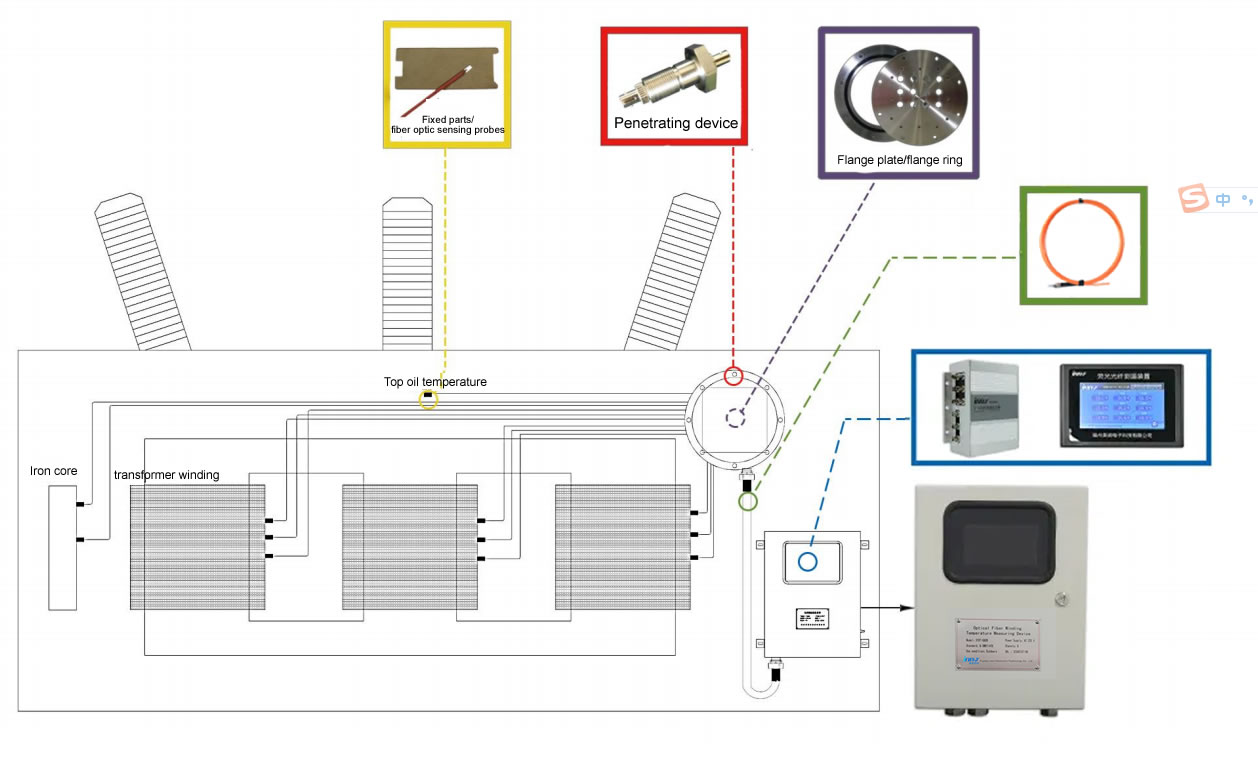
Vilima joto-mahali pa joto

ya Vilima joto-mahali pa joto is the single most critical thermal parameter of any power transformer. It occurs at the location within the winding where the combination of resistive losses (I²R), eddy current losses, and local oil flow conditions produces the highest temperature. This point is typically located in the upper portion of the innermost winding disc or layer, where oil circulation is most restricted. Direct measurement of the winding hot spot using embedded Joto la joto la macho ya nyuzi is the gold standard for transformer thermal assessment because it captures the actual worst-case temperature without relying on thermal models or correction factors.
Top-Oil Temperature
Top-oil temperature is measured in the oil space at the top of the transformer tank, typically near the oil outlet to the radiator bank. It reflects the bulk thermal state of the transformer and is used as an input to cooling control logic. While top-oil measurement has been standard practice for decades, it alone cannot reveal localized winding hot spots. Vihisio vya macho ya Fiber positioned in the oil space provide accurate, interference-free top-oil readings that complement embedded winding measurements.
Joto la msingi
Transformer core hot spots can develop due to concentrated flux density at the edges of laminations, at bolt holes, or near core clamps. Localized core overheating can damage interlaminar insulation and lead to circulating currents that generate additional heat. Sensorer za joto za macho ya nyuzi attached to core surfaces at identified risk areas detect thermal anomalies before they progress to core damage.
Bushing and Terminal Temperature
Transformer bushings carry full load current through the tank wall and are subject to resistive heating, especially at the internal conductor connection point. Ufuatiliaji wa joto la Bushing detects deteriorating contact resistance, loss of insulating oil in condenser bushings, and other conditions that can lead to bushing failure — one of the most common and dangerous transformer fault modes. Fiber optic sensors installed at the base of the bushing inside the tank provide direct temperature data unaffected by external weather conditions.
Tap Changer Contact Temperature
Kubadilika kwa bomba la mzigo (OLTCS) are the most mechanically active component of a transformer and a frequent source of thermal problems. Worn or contaminated selector contacts develop high resistance, producing localized heating that can carbonize oil and generate combustible gases. Tap changer temperature sensors based on fiber optic technology monitor contact temperature continuously, providing early warning of developing contact degradation before it leads to OLTC failure.
Cooling System Temperature
Oil inlet and outlet temperatures across radiator banks, oil-to-water heat exchangers, and forced-air cooling assemblies indicate cooling system effectiveness. Monitoring these temperatures with fiber optic sensors helps detect blocked radiators, failed fan motors, kushindwa kwa pampu, or loss of cooling water flow — any of which can cause rapid transformer overheating.
4. Mapungufu ya Mbinu za Jadi za Ufuatiliaji wa Joto
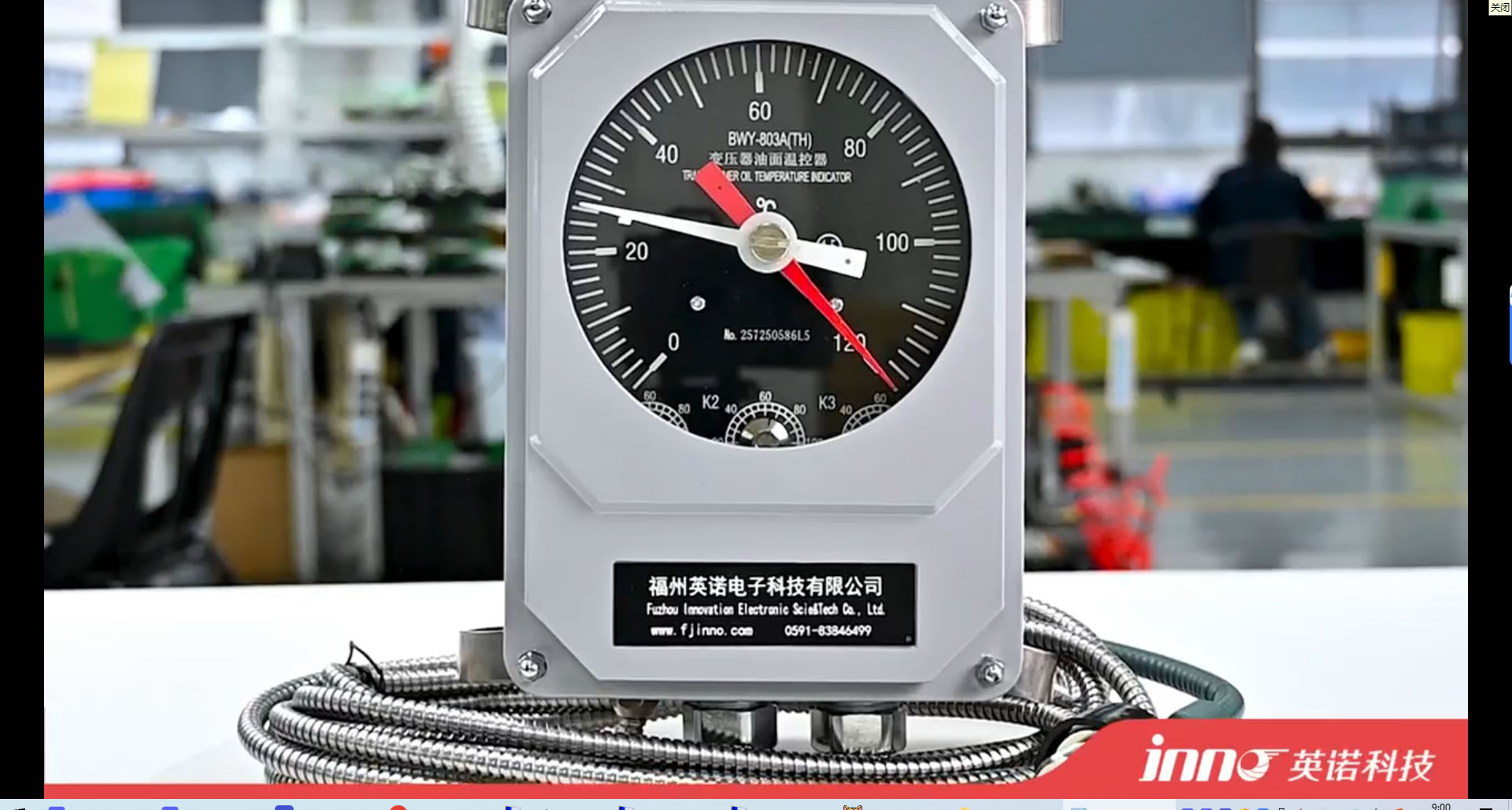
Viashiria vya Hali ya Upepo (Wti) — Indirect and Inaccurate
The conventional WTI uses a thermal image technique: a current transformer supplies a scaled current to a heater element immersed in an oil-filled pocket, and the resulting temperature rise above top-oil is assumed to represent the winding hot-spot rise. This method introduces multiple sources of error — the thermal model is a simplification of actual winding thermal behavior, the oil pocket response time is slow, and the calibration assumes a fixed loss ratio that does not hold under all loading conditions. Studies have shown that WTI readings can deviate from actual winding hot-spot temperature by 10 °C hadi 20 °C or more, leading to either under-protection or unnecessary load curtailment.
Thermocouples and RTDs — Electromagnetic Interference
Thermocouples na vigunduzi vya joto vya upinzani (RTS) use metallic sensing elements and lead wires. Inside an energized transformer, these metallic components are exposed to intense alternating magnetic fields generated by the windings and core. The resulting electromagnetic interference induces noise voltages in the sensor circuit that can cause measurement errors of several degrees or more. Hayo, metallic sensor leads inside a high-voltage winding create the risk of insulation breakdown and dielectric failure along the lead path — an unacceptable safety hazard in high-voltage transformers.
Infrared Thermography — Surface Limitation
Infrared thermal imaging is a valuable tool for external inspection of transformers, identifying hot connections, blocked radiator sections, and abnormal tank surface temperatures. Hata hivyo, infrared thermography cannot see through the steel tank wall to measure internal winding, msingi, or oil temperatures. It provides only a surface view and is influenced by emissivity variations, tafakari ya mazingira, upepo, na mionzi ya jua. It serves as a complementary inspection technique but cannot replace embedded real-time monitoring.
Inability to Achieve Continuous Online Monitoring
Traditional methods share a common limitation: they cannot provide continuous, Sahihi, real-time winding hot-spot temperature data. WTIs offer an approximation. Thermocouples are unsafe for high-voltage embedding. Infrared imaging requires manual inspection visits. None of these approaches supports the automated, continuous monitoring that modern grid operations and condition-based maintenance strategies demand.
5. Jinsi Sensorer za Joto za Fiber Optic za Fluorescent Kazi
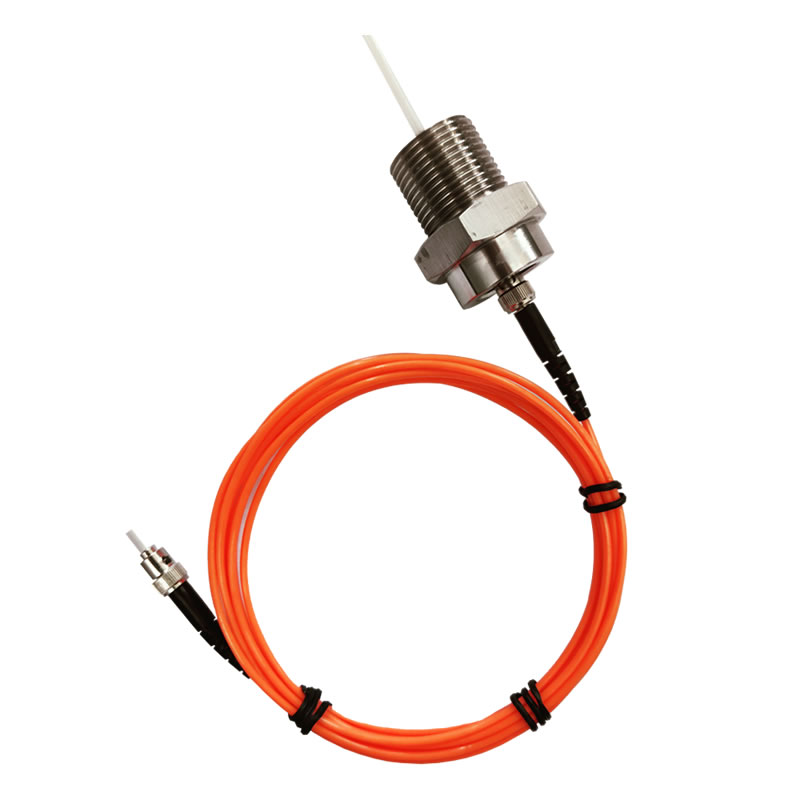
Fluorescence Lifetime Decay Measurement Principle
A Sensor ya joto ya fiber optic ya fluorescent operates on the principle of photoluminescence decay. The sensing probe tip is coated with a rare-earth doped phosphor crystal. A short pulse of excitation light is transmitted from the kiboreshaji cha fiber optic through the optical fiber to the probe tip, where it stimulates the phosphor to emit fluorescent light. Baada ya mapigo ya msisimko kuisha, the fluorescence does not cease instantly — it decays exponentially with a characteristic time constant that is a precise, inayoweza kurudiwa, and monotonic function of the phosphor temperature. The demodulator measures this decay time with high precision and converts it to a calibrated temperature reading.
The Fully Optical Signal Chain — From Probe to Demodulator
The entire measurement path — from the phosphor-tipped uchunguzi wa joto la fiber optic embedded inside the transformer winding, through the optical fiber cable routed out of the transformer via a fiber optic feedthrough in the tank wall, kwa kiboreshaji cha fiber optic located in the substation control cabinet — is purely optical. No electrical signals exist anywhere in the sensing chain. No metallic conductors are present at or near the measurement point inside the transformer. This all-optical architecture is the fundamental reason fiber optic sensors can operate safely and accurately inside high-voltage, electromagnetically intense transformer environments.
Kwa nini Wakati wa Kuoza Ni Bora kuliko Kipimo cha Nguvu
Some earlier optical sensing approaches attempted to measure temperature through changes in fluorescence intensity. Intensity-based methods are inherently unreliable because signal amplitude is affected by fiber bending, Hasara za kontakt, light source aging, and contamination of optical surfaces. By measuring the time domain characteristic — the fluorescence decay time — rather than amplitude, the sensor becomes immune to all of these signal level variations. This gives fluorescent fiber optic sensors their exceptional long-term measurement stability without the need for periodic recalibration.
Intrinsic Safety of the Optical Approach
Because the fiber optic probe contains no metal, no electrical current, and no stored electrical energy, it presents zero ignition risk inside the oil-filled transformer tank. It does not create a conductive path that could compromise the dielectric integrity of the winding insulation system. The sensor is intrinsically safe by nature of its physics — not by addition of safety barriers or protective enclosures.
6. Advantages of Fiber Optic Sensors for Transformer Monitoring

Complete Immunity to Electromagnetic Interference and High-Voltage Fields
Ndani ya kibadilishaji cha nguvu kilicho na nguvu, the magnetic flux density can reach several Tesla, and the electric field gradient around high-voltage windings is extreme. Sensorer za joto la fiber optic ya fluorescent are constructed entirely from non-conductive glass, kauri, na vifaa vya polymer. They do not interact with magnetic fields, mashamba ya umeme, or radio-frequency energy in any way. Measurement accuracy remains constant regardless of the transformer’s loading level, fault current events, au kubadili vipindi. This complete EMI immunity is the single most important advantage of fiber optic technology in substation transformer temperature monitoring.
Electrical Isolation — Sensor and High-Voltage Winding Coexist Safely
Embedding any sensor inside a transformer winding operating at tens or hundreds of kilovolts demands absolute electrical isolation between the sensor and any grounded instrumentation. The optical fiber itself is a perfect insulator — its dielectric withstand capability exceeds the voltage class of any power transformer in service today. No additional insulation barriers, voltage dividers, or galvanic isolation devices are required. The fiber optic cable passes through a dedicated feedthrough fitting in the transformer tank wall, maintaining the pressure seal and insulation integrity of the tank.
Direct Measurement of True Winding Hot-Spot Temperature
Because fiber optic probes are physically small, isiyo ya kufanya, and do not disturb the winding’s electromagnetic or thermal behavior, they can be placed directly at the predicted hot-spot location during winding manufacture. This yields a direct measurement of the actual hottest point in the winding — not an estimate, not a simulation, and not an inference from oil temperature. Direct hot-spot measurement transforms the accuracy and confidence level of all thermal protection, Inapakia, and life assessment decisions.
Oil-Compatible, Joto la Juu, Long-Term Stable
Fiber optic probes are encapsulated in materials fully compatible with mineral transformer oil, natural ester, and synthetic ester insulating fluids. They withstand continuous operating temperatures well above the thermal limits of transformer insulation materials. The fluorescence decay measurement principle has no inherent drift mechanism — sensors installed during transformer manufacture maintain their calibration accuracy throughout the full service life of the transformer without recalibration.
Compact Size — No Impact on Transformer Internal Design
Kawaida uchunguzi wa joto la fiber optic for transformer winding embedding has an outer diameter of approximately 1 kwa 2 mm and a sensing length of just a few millimeters. The optical fiber cable has a similarly small cross-section. These dimensions allow the sensor and cable to be routed between winding turns or along insulation spacers without affecting oil flow channels, insulation distances, or mechanical clamping pressure.
Extended Service Life and Minimal Maintenance
Fiber optic temperature sensors have no moving parts, no electrical connections inside the transformer, and no consumable components. Field experience spanning more than two decades has demonstrated service lives exceeding 25 years — matching or exceeding the design life of the transformer itself. Maintenance is limited to periodic inspection of the external fiber optic connectors and demodulator, both of which are located outside the transformer in the easily accessible substation control environment.
7. Fiber Optic vs Traditional Sensors — A Detailed Comparison
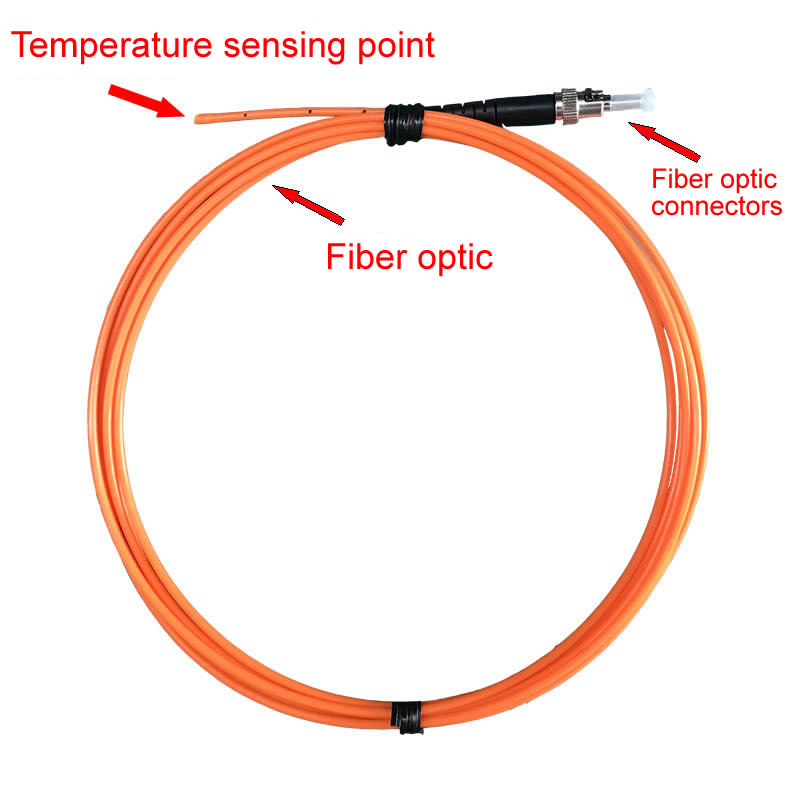
Fiber Optic vs Winding Temperature Indicator (Wti)
The WTI provides an estimated winding temperature based on a thermal image model that assumes fixed thermal relationships. It cannot adapt to changing oil flow conditions, non-uniform losses, or aging effects. A Sensor ya joto ya fiber optic embedded at the actual hot spot measures the real temperature with an accuracy of ±1 °C or better, delivering a direct reading that is inherently more trustworthy for protection, loading decisions, and remaining life calculations.
Fiber Optic vs Thermocouple and RTD
Thermocouples and RTDs cannot be safely embedded in high-voltage windings due to the risk of dielectric failure along metallic lead wires and the severe electromagnetic interference that degrades measurement accuracy. Fiber optic sensors eliminate both hazards entirely. Yao isiyo ya kufanya, non-metallic construction makes them the only sensor type approved by major transformer manufacturers and international standards for direct winding embedding.
Fiber Optic vs Infrared Thermography
Infrared thermography is limited to external surface measurements and requires manual inspection visits or fixed cameras with line-of-sight access. It cannot measure winding, msingi, or internal oil temperatures. Fiber optic transformer sensors provide continuous internal temperature data 24 masaa kwa siku, 365 siku kwa mwaka, regardless of weather, taa, or access conditions.
Comprehensive Comparison Table
| Parameta | Sensor ya macho ya nyuzi | Wti | Thermocouple / RTD | Picha ya Infrared |
|---|---|---|---|---|
| Aina ya Kipimo | Direct hot-spot | Inakadiriwa (picha ya joto) | Moja kwa moja (limited locations) | Uso wa nje pekee |
| Winding Embedding | Yes — safe at all voltage classes | Haitumiki | Unsafe at HV levels | Haiwezekani |
| Kinga ya EMI | Kukamilisha | Wastani | Maskini | Haitumiki |
| Usalama wa Dielectric | Inherent — all-dielectric | Haitumiki | Hatari ya kuvunjika kwa insulation | Haitumiki |
| Usahihi | ±0.5 to ±1 °C | ±5 to ±15 °C | ±1 to ±3 °C (when interference-free) | ±2 to ±5 °C |
| Ufuatiliaji wa Kuendelea | Yes — 24/7 mkondoni | Yes — with limited accuracy | Yes — with EMI limitations | No — periodic or fixed-camera |
| Utangamano wa Mafuta | Imejaa | Sealed pocket | Limited — requires sealing | Haitumiki |
| Maisha ya Huduma | 25+ Miaka | 15- miaka 20 | 5- miaka 10 | Camera dependent |
| Matengenezo | Ndogo | Calibration ya mara kwa mara | Ukaguzi wa mara kwa mara | Kusafisha lensi, calibration |
8. System Architecture of an Advanced Monitoring Solution
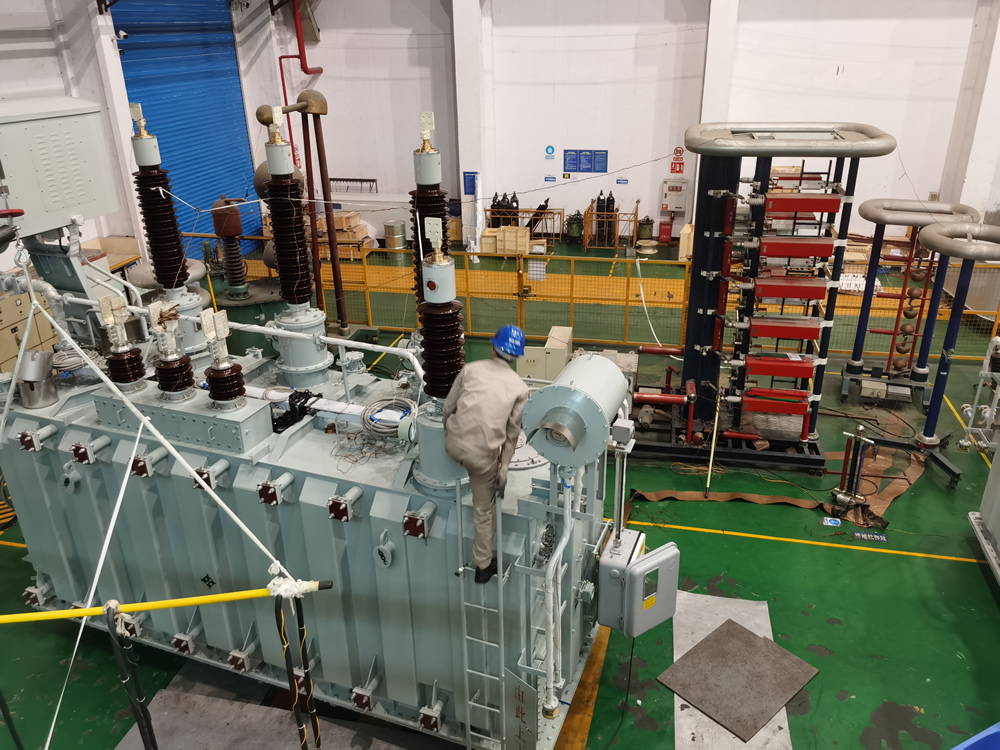
Uchunguzi wa Joto la Fiber Optic Selection and Installation
Vipimo vya joto vya nyuzi macho for transformer applications are manufactured in several configurations. Winding-embedded probes are designed with a flat, thin profile that fits between conductor turns or along insulation spacers. Vipimo vya mlima wa uso na wambiso au urekebishaji wa mitambo hutumiwa kwa msingi, ukuta wa tank, na kipimo cha msingi wa bushing. Vichunguzi vya kipimo cha joto la mafuta huwekwa kwenye vidhibiti vya joto vya chuma cha pua vilivyowekwa kwenye vifaa vya kawaida vya tank.. Wakati wa utengenezaji wa transformer, probe husakinishwa kiwandani na nyaya zake za nyuzi hupitishwa kupitia muundo wa kujipinda na kutoka nje ya tangi kupitia viambatisho maalum vya fiber optic - viunga vilivyofungwa kwa hermetically ambavyo hudumisha uadilifu wa mafuta na gesi ya transfoma..
Cable ya Usambazaji wa Fiber Optic
Kebo ya nyuzi macho inayounganisha kila kichunguzi kwenye kidhibiti ni nyuzinyuzi ya uzi mmoja au nyuzi nyingi zenye safu ya kinga na safu za koti zilizochaguliwa ili uoanifu na mafuta ya transfoma ndani ya tanki na kwa upinzani wa UV., ulinzi wa unyevu, and mechanical durability outside the tank. Cable routing from the tank wall feedthrough to the demodulator in the substation relay room typically uses armored or conduit-protected fiber cable rated for outdoor substation environments.
Fiber Optic Demodulator — Multi-Channel Signal Processing
ya kiboreshaji cha fiber optic is the central instrumentation unit. It generates precisely timed excitation light pulses, captures the fluorescent return signal from each probe, digitally processes the decay waveform to extract temperature, and outputs calibrated readings on all channels simultaneously. Industrial-grade demodulators designed for substation environments support 4, 8, 16, or more measurement channels and are built to operate reliably across the wide ambient temperature range, viwango vya unyevu, and electromagnetic conditions encountered in substation control rooms and marshalling kiosks.
Communication Interfaces and Substation Automation Integration
Modern demodulators provide multiple communication interfaces to support integration with substation automation systems. Standard outputs include analog 4–20 mA signals for legacy relay inputs, RS485 serial with Modbus RTU protocol, Ethernet with Modbus TCP or IEC 61850 MMS, and relay contact outputs for alarm and trip functions. IEC 61850 ujumuishaji is particularly important for new digital substations, enabling the temperature monitoring system to publish data as GOOSE messages or as part of the substation’s logical node structure for direct consumption by protection IEDs, bay controllers, and the station SCADA HMI.
Monitoring Software and Data Management Platform
Programu maalum ya ufuatiliaji hutoa dashibodi za wakati halisi zinazoonyesha njia zote za halijoto, chati zinazoonyesha historia ya halijoto kwa saa nyingi, siku, na miezi, vizingiti vya kengele vinavyoweza kusanidiwa na mantiki ya kupanda, na utoaji wa ripoti otomatiki kwa madhumuni ya udhibiti na usimamizi wa mali. Mifumo ya hali ya juu hujumuisha miundo ya joto inayotii IEC 60076-7 na IEEE C57.91, kuruhusu programu kuhesabu matumizi iliyobaki ya maisha ya insulation, uwezo wa mzigo wa nguvu, na muda uliotabiriwa wa kikomo cha halijoto ya mahali-moto kulingana na njia ya sasa ya upakiaji. Data ya kihistoria ya halijoto huhifadhiwa kwenye kumbukumbu na inaweza kusafirishwa kwa usimamizi wa mali ya shirika (EAM) Mifumo, hifadhidata za wanahistoria, na majukwaa ya uchanganuzi yanayotegemea wingu.
9. Application Scenarios Across Transformer Types
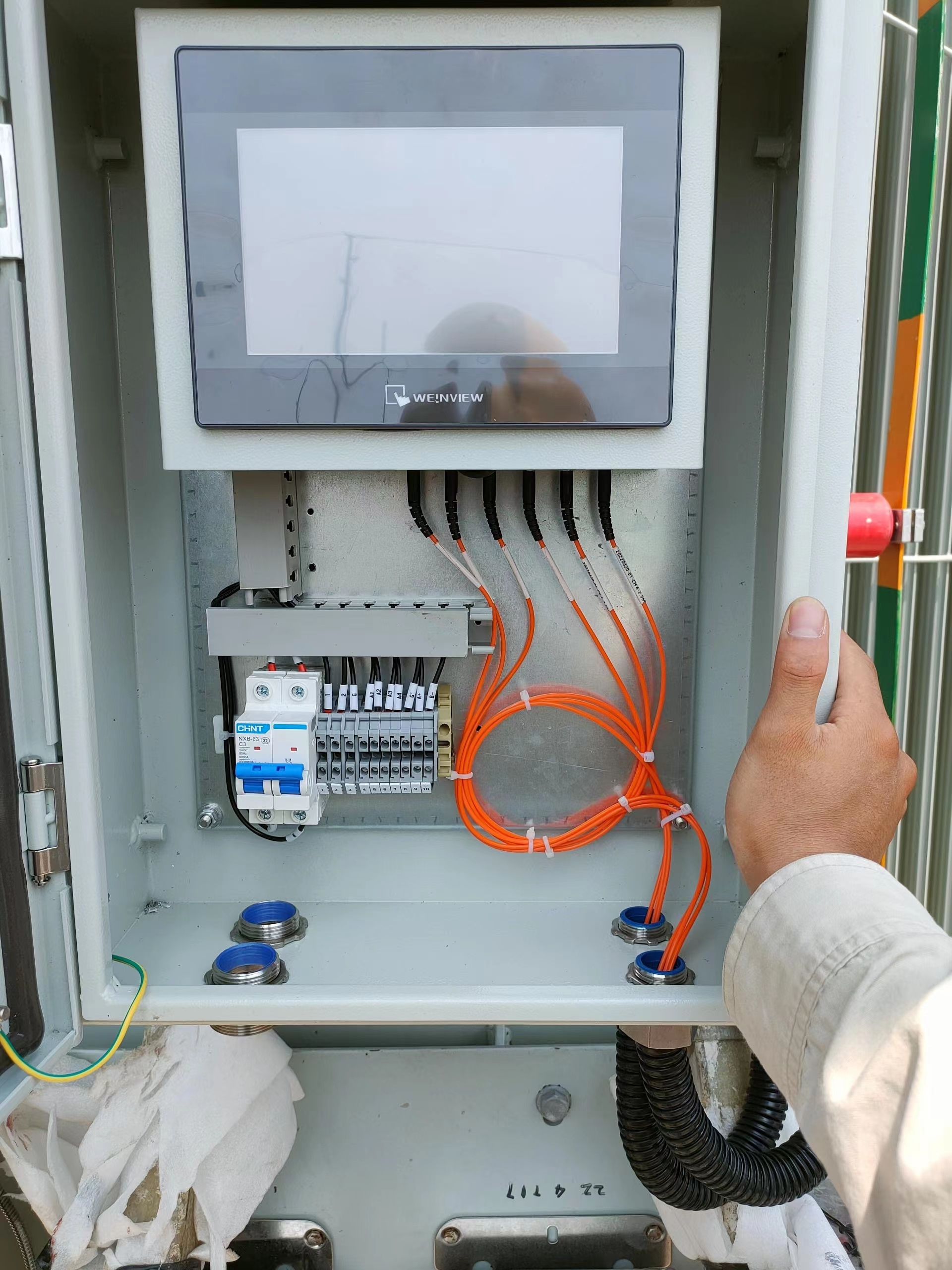
Transfoma ya Nguvu ya Juu ya Voltage (110 kV - 800 kv)
Transfoma kubwa za nguvu katika vituo vidogo vya upitishaji ni mali muhimu na ya gharama kubwa zaidi katika gridi ya umeme. A single transformer can cost several million dollars and have a lead time of one to two years for replacement. Kupachika sensorer ya joto ya nyuzi ya fluorescent in the HV, Lv, and tertiary windings during manufacture provides the most comprehensive thermal intelligence available. Utilities use this data for protection relay input, dynamic rating to manage peak load periods, and condition-based maintenance planning to extend asset life. Kwa transfoma zilizokadiriwa 220 KV na hapo juu, direct fiber optic hot-spot measurement is increasingly specified as a standard requirement in procurement specifications.
Transfoma za usambazaji
While individual distribution transformers represent a lower capital investment, the sheer number of units in a utility’s fleet and the increasing loading from electric vehicle charging, heat pumps, and distributed generation create new thermal management challenges. Fiber optic monitoring of key distribution transformers at heavily loaded feeders provides data for load forecasting, network planning, and targeted reinforcement. Kompakt, cost-effective multi-channel demodulators make monitoring economically viable for this application tier.
Traction Transformers for Railway Electrification
Traction transformers in railway substations experience highly dynamic and cyclical loading profiles as trains accelerate, cruise, and regenerate. These load transients produce rapid winding temperature fluctuations that WTIs cannot track accurately. Vipimo vya joto vya nyuzi macho with fast response times capture these transients in real time, enabling precise thermal protection and supporting the dynamic rating needed to maximize train frequency on busy routes.
Rectifier Transformers and Electric Arc Furnace Transformers
Transfoma za viwandani zinazosambaza virekebishaji vya DC na vinu vya umeme vya arc hufanya kazi chini ya hali mbaya - maudhui ya juu ya usawa., mizigo nzito, na kuendesha baiskeli mara kwa mara. Mikondo ya Harmonic hutoa hasara za ziada za sasa za eddy katika vilima ambavyo huinua halijoto ya mahali-moto juu ya viwango vinavyotabiriwa na miundo ya kawaida ya joto.. Kipimo cha sehemu moto ya nyuzi macho ya moja kwa moja hutoa picha halisi ya joto, kulinda transfoma hizi kutokana na kuzeeka kwa insulation mapema na kuwezesha waendeshaji kuongeza mizunguko ya ushuru wa tanuru..
Upepo wa Pwani na Transfoma za Nishati Mbadala za Hatua ya Juu
Transfoma zilizosakinishwa kwenye majukwaa ya turbine ya upepo wa pwani au katika vituo vidogo vya ushuru wa pwani hukabiliwa na changamoto za kipekee - eneo la mbali, ufikiaji mdogo wa matengenezo, mazingira magumu ya baharini, na wasifu wa kizazi tofauti. Ufuatiliaji wa transfoma ya fiber optic provides continuous thermal data without requiring site visits, supports remote diagnostics, and feeds into wind farm SCADA systems for centralized fleet management. The maintenance-free nature of fiber optic sensors is especially valuable in offshore installations where any intervention requires vessel mobilization and favorable weather windows.
Data Center and Critical-Load Supply Transformers
Data centers demand the highest levels of power reliability. Transformers supplying critical IT loads must operate within safe thermal limits at all times, including during N-1 contingency conditions when a parallel transformer is out of service and the remaining unit carries full load. Real-time fiber optic hot-spot monitoring gives data center operators the confidence to utilize transformer capacity fully during contingencies while maintaining documented thermal safety margins.
10. FAQs About Substation Transformer Temperature Monitoring
Q1: What is advanced temperature monitoring for substation transformers?
Advanced temperature monitoring for substation transformers is the practice of using embedded Sensorer za macho za fluorescent to continuously measure actual winding hot-spot temperature, Joto la juu la mafuta, Joto la msingi, joto la bushing, and tap changer temperature in real time. Unlike traditional instruments that estimate temperatures indirectly, advanced monitoring provides direct measurement data for thermal protection, upakiaji wa nguvu, and condition-based maintenance.
Q2: Why are fiber optic sensors the best choice for transformer internal temperature measurement?
Sensorer za joto za macho ya nyuzi are the only technology that can be safely embedded inside high-voltage transformer windings. They are completely non-metallic and non-conductive, so they do not create dielectric breakdown paths or interact with the transformer’s electromagnetic fields. Wao ni kinga kwa EMI, sambamba na mafuta ya transfoma, and maintain calibration accuracy for the full life of the transformer.
Q3: How are fiber optic probes installed inside transformer windings?
Vipimo vya joto vya nyuzi macho are installed during the transformer manufacturing process. nyembamba, flat probe is placed between conductor turns or alongside insulation spacers at the predicted hot-spot location during the winding operation. The optical fiber cable is then routed through the winding structure, along the lead assembly, and out of the transformer tank through a hermetically sealed fiber optic feedthrough fitting in the tank wall.
Q4: Can fiber optic sensors withstand transformer oil environments?
Ndio. Fiber optic probes for transformer applications are encapsulated in materials specifically selected for long-term compatibility with mineral oil, natural ester, and synthetic ester insulating fluids. They have been proven in field service for over 25 years with no degradation of optical performance, Uadilifu wa mitambo, or measurement accuracy due to oil exposure.
Q5: What is the measurement accuracy of a fiber optic transformer monitoring system?
Viwanda sensorer ya joto ya nyuzi ya fluorescent typically achieve an accuracy of ±0.5 °C to ±1 °C over their full operating range. This level of accuracy is maintained throughout the sensor’s life without recalibration — significantly better than the ±5 °C to ±15 °C estimation error typical of conventional winding temperature indicators.
Q6: Ni sehemu ngapi za uangalizi zinaweza kusaidia kidemoduli kimoja?
Chaneli nyingi demodulators ya fiber optic designed for substation transformer applications are available in configurations supporting 4, 8, 16, 24, au chaneli zaidi kwa kila kitengo. A typical large power transformer installation uses 6 kwa 12 channels to cover HV winding hot spots, Sehemu za moto zinazopinda LV, Mafuta ya juu, Mafuta ya chini, msingi, and bushing or tap changer locations. Multiple demodulators can be networked for transformer banks or multi-transformer substations.
Q7: How does the fiber optic monitoring system integrate with substation SCADA?
ya kiboreshaji cha fiber optic provides communication via Modbus RTU (Rs485), Modbus TCP (Ethernet), IEC 61850 MMS/GOOSE, and analog 4–20 mA outputs. Temperature readings, Hali ya kengele, and diagnostic data are published to the substation SCADA system, relay za ulinzi, and bay controllers through these standard interfaces. In IEC 61850 uingizwaji wa dijiti, the demodulator can function as an IED publishing temperature logical nodes directly onto the station bus.
Q8: What is the service life of fiber optic temperature sensors in a transformer?
Fiber optic sensors embedded in transformers have demonstrated field service lives exceeding 25 Miaka, matching or exceeding the design life of the host transformer. The sensors have no wearing parts, no electrical connections inside the tank, na hakuna mifumo ya kuteleza. Once installed during manufacture, they require no maintenance or recalibration for the life of the transformer.
Q9: Can fiber optic monitoring be retrofitted to existing in-service transformers?
Retrofitting fiber optic sensors inside the windings of an existing transformer requires de-tanking and partial disassembly, which is generally only practical during a major overhaul or repair. Hata hivyo, fiber optic probes can be installed in existing thermowell fittings for oil temperature measurement, on accessible bushing bases, and on external surfaces without opening the transformer. Retrofit solutions provide significant monitoring improvements even without winding-embedded sensors.
Q10: How does advanced temperature monitoring support dynamic transformer rating?
Dynamic transformer rating uses real-time hot-spot temperature data — rather than conservative nameplate assumptions — to calculate the transformer’s actual available loading capacity at any given moment. When the measured hot-spot temperature is below the rated limit due to favorable ambient conditions, low preceding load, or effective cooling, the monitoring system indicates that additional load can be safely applied. This capability allows utilities to defer capital expenditure on new transformer installations and maximize utilization of existing assets.
Kanusho: Taarifa iliyotolewa katika makala hii ni kwa madhumuni ya habari na elimu tu. Wakati jitihada zote zimefanywa kuhakikisha usahihi, Fjinno makes no warranties or representations regarding the completeness or applicability of the content to any specific transformer installation or operating condition. Vipimo vya bidhaa, safu za joto, usahihi wa kipimo, and system capabilities may vary depending on application requirements and site conditions. Transformer temperature monitoring system design should always be carried out in consultation with qualified engineers. Kwa ushauri wa kiufundi wa mradi na uteuzi wa bidhaa, tafadhali wasiliana na timu ya uhandisi kwa www.fjinno.net. Majina ya bidhaa zote, alama za biashara, na alama za biashara zilizosajiliwa zilizotajwa ni mali ya wamiliki husika.

Kihisio cha joto la macho ya Fiber, Mfumo wa ufuatiliaji wa akili, Kusambazwa fiber optic mtengenezaji katika China
 |
 |
 |