 Vihisio vya joto vya macho vya INNO fibre ,Mifumo ya ufuatiliaji wa joto.
Nyuzi za macho za fluorescent hupima joto la kibadilishaji kwa kugundua wakati wa kuoza kwa fluorescence ya vitu vya fluorescent, kwani wakati wa kuoza kwa fluorescence ni kazi ya joto
1. Njia ya kupima joto la transformer kwa kutumia fiber ya macho
1.1 Njia ya kipimo kulingana na Fiber Bragg Grating
Fiber Bragg Grating ni kifaa tulivu ambapo faharisi ya refractive hurekebishwa mara kwa mara ndani ya msingi wa nyuzi.. Wakati joto la nje linabadilika, itaathiri index refractive ya fiber Bragg grating na index refractive ya msingi fiber, na hivyo kusababisha mabadiliko katika kuakisi au upitishaji kilele cha urefu wa wavu wa nyuzi Bragg. Kwa kupima kwa usahihi urefu wa wimbi la ishara iliyoonyeshwa, utambuzi wa joto unaweza kupatikana. This method typically requires installing fiber Bragg grating sensors near transformer windings or other critical locations to accurately sense temperature changes.
1.2 Fluorescence fiber optic temperature measurement method
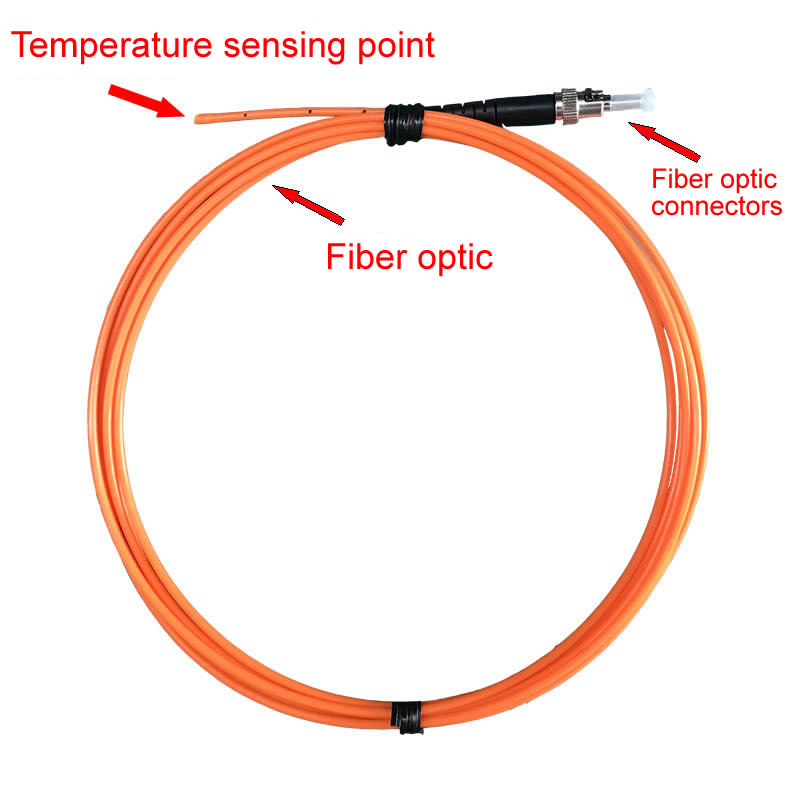
Fluorescent fiber optic sensors can be used to measure the internal temperature of transformers. The principle is to utilize the characteristics of fluorescent materials. When a light pulse is emitted from a light source and transmitted through an optical fiber to a sensor, the fluorescent substance in the probe is illuminated by the spectrum. The molecules absorb light and are excited to an excited electronic state, then radiate fluorescence outward and return to the electronic ground state. The temperature of the surrounding environment and the decay time of fluorescence exhibit a functional relationship, and the temperature value can be obtained by detecting the decay time of fluorescence. Insert the probe of the fluorescent fiber thermometer into the position inside the transformer that needs to be measured, such as the transformer winding, to perform temperature measurement.
1.3 Fiber optic sensor measurement method based on semiconductor materials
There is a relationship between the temperature and light absorption of semiconductor materials. The bandgap width of most semiconductors shows a linear negative correlation with temperature, Hiyo ni, Wakati joto linapoongezeka, the bandgap width decreases linearly and the wavelength of the light absorption band increases. This characteristic can be utilized to manufacture intensity modulated fiber optic sensors, such as using reflective or transmissive modulation, as well as refractive index and absorption coefficient intensity modulation methods. When measuring, if a light source corresponding to the radiation spectrum and absorption band is selected, an increase in temperature will cause a decrease in the light intensity of the semiconductor. Kisha, based on the functional relationship between light intensity and temperature, the temperature of the semiconductor material can be calculated by the value of the reflected light intensity. This type of Sensor ya joto ya fiber optic mainly consists of photoelectric conversion devices, light sources, and sensitive components (such as gallium arsenide semiconductors).
1.4 Measurement method based on all fiber optic technology
Design a temperature detection system using fiber Bragg gratings as sensing elements. During the measurement process, there may be external interference issues, which can be effectively addressed by using the difference method to improve the accuracy of the measurement results.
2. Application case of optical fiber in transformer temperature measurement
2.1 Temperature Monitoring of Transformer Winding in Substation
A transformer winding fiber optic temperature online monitoring system based on fiber optic technology was used in a substation of a certain power company. This system mainly consists of fiber optic temperature sensors, wasambazaji wa joto la nyuzi macho, Mifumo ya kipimo cha joto cha macho ya nyuzi, Nk. Fiber optic temperature sensors are responsible for collecting temperature information of transformer windings, and then analyzing the optical signal through fiber optic temperature transmitters to obtain temperature change information. Mwishowe, the fiber optic temperature measurement system processes and analyzes the obtained temperature data to achieve real-time monitoring of transformer winding temperature. By arranging fiber optic sensors at different positions of the transformer winding, real-time temperature data can be collected. Once abnormal conditions are detected, the system will issue an alarm and take corresponding measures in a timely manner to avoid transformer failures.
2.2 Temperature Monitoring of Oil Immersed Transformers
Application of Fiber Bragg Grating Temperature Measurement
Katika transfoma immersed mafuta, fiber Bragg gratings are used for oil temperature monitoring. Kwa mfano, by encapsulating the fiber optic grating inside an insulating shell, the external ambient temperature is transmitted through the shell to the fiber optic grating, causing a change in its wavelength. Due to the excellent linear relationship between the center wavelength of fiber Bragg gratings and temperature, oil temperature can be detected by measuring the wavelength of the reflected signal. And typically, nyingi (kama 18) fiber optic grating temperature sensors with different wavelengths can be connected to a single fiber optic cable. The reflected signals from the sensors are returned to the detector through a loopback device, and the data is read into the computer through a digital DIO card, thereby achieving effective monitoring of the oil temperature of oil immersed transformers.
In the transformer winding temperature detection system based on fiber Bragg grating sensing, mfumo hupitisha vitambuzi vya nyuzinyuzi vya Bragg vyenye uwezo mkubwa wa kuzuia mwingiliano na nyeti sana kwa halijoto. Kipimo na usambazaji wa ishara za macho, ikifuatiwa na kushuka kwa ishara za joto, inaweza kukidhi mahitaji ya kipimo cha joto cha juu cha usahihi wa vilima vya transfoma, kupima kwa usahihi joto la vilima la transfoma ya mafuta yaliyozama, na kuhakikisha uendeshaji salama wa transfoma.
Utumiaji wa Kipimo cha Joto la Fiber Optic ya Fluorescent
Kwa transfoma kubwa ya kuzama kwa mafuta, Njia ya kipimo cha joto cha nyuzi macho ya fluorescence inapitishwa. Kwa mfano, sensor ya joto ya nyuzi za umeme kutoka kwa Teknolojia ya Fuzhou Yingnuo inaweza kutumika kwa ufuatiliaji wa hali ya joto ya transfoma kubwa zilizozamishwa na mafuta.. It has the characteristic of essential insulation and can perform online temperature monitoring on components that withstand high voltage or strong current. Inserting the probe of the fluorescent material into the position inside the transformer that needs to be measured, and detecting temperature through the relationship between fluorescence lifetime and temperature, significantly reduces the impact of light source stability.
3. Principle of Fiber Optic Technology for Transformer Temperature Measurement
3.1 Principle of Fiber Bragg Grating Technology
Basic principles
Fiber Bragg grating is a reflective fiber filter device. It is achieved by irradiating a bare optical fiber with ultraviolet interference fringes, and the core absorbs ultraviolet radiation to generate permanent periodic changes in refractive index. Wakati urefu wa wavelength unaoingia kwenye nyuzi ya macho hukidhi hali ya Bragg (λ B=2n ∧, ambapo λ B ni urefu wa katikati wa Bragg iliyoakisi wimbi la mwanga wa wavu wa nyuzi, n ni fahirisi ya refractive ya msingi wa nyuzi, na ∧ ni kipindi cha kusaga), hali ya kuongozwa mbele inayoeneza katika mwongozo wa mawimbi ya macho itaambatana na hali inayoakisiwa nyuma, kutengeneza tafakari ya Bragg.
Urefu wa kati wa wavu wa nyuzi Bragg unahusiana na mafadhaiko na mabadiliko ya joto, na fomula yake ya uhusiano ni Δ λ B=λ B (1- r) D e+l B (1+x) D T, ambapo Δ λ B ni badiliko la urefu wa kati wa mwanga ulioakisiwa unaosababishwa na msongo wa mawazo na mabadiliko ya halijoto; Δ ε ni mabadiliko ya mkazo; Δ T ni mabadiliko ya joto; ρ is the optical elastic coefficient of the optical fiber; ξ is the thermal optical coefficient of the optical fiber. When the fiber optic grating is encapsulated inside an insulating shell, it is mainly affected by temperature. The external environmental temperature changes the n and ∧ of the fiber optic grating, resulting in a change in the wavelength of the reflected light. Kwa kupima kwa usahihi urefu wa wimbi la ishara iliyoonyeshwa, utambuzi wa joto unaweza kupatikana, and the center wavelength of the fiber optic grating has a very good linear relationship with temperature.
Sensing process
The broadband light source is input into the optical fiber, and after passing through the fiber Bragg grating, the narrowband spectrum at the Bragg wavelength is reflected to the input end of the fiber, while the remaining wavelengths are transmitted through. Wakati joto linabadilika, the refractive index and other parameters of the fiber Bragg grating change, causing the Bragg wavelength to change, and the wavelength of the reflected light also changes accordingly. By detecting the change in reflected light wavelength and based on a predetermined wavelength temperature relationship, the corresponding temperature value can be obtained.
3.2 Principle of Fluorescent Fiber Technology
Principle of Fluorescence Generation
The fluorescent substance in the fluorescent fiber thermometer has a special energy level structure. When the light pulse is emitted by the light source and transmitted through the optical fiber to the fluorescent substance in the sensor probe, the molecules of the fluorescent substance absorb photon energy and transition from the ground state to the excited state. Due to the instability of the excited state, molecules will release energy through radiative fluorescence and return to the ground state.
The relationship between temperature and fluorescence characteristics
The temperature of the surrounding environment and the decay time of fluorescence exhibit a functional relationship. At different temperatures, the fluorescence decay time of a fluorescent substance changes as it returns from the excited state to the ground state. Kwa ujumla, joto la juu, the shorter the fluorescence decay time. By detecting the fluorescence decay time and utilizing the predetermined fluorescence decay time temperature function relationship, the temperature value of the measurement point can be obtained.
4. Comparison of Temperature Measurement of Transformers Using Different Optical Fibers
4.1 Kihisi cha Grating ya Fiber Bragg
Manufaa
Usahihi wa juu: The center wavelength of fiber Bragg grating has a very good linear relationship with temperature, na kipimo cha halijoto cha usahihi wa hali ya juu kinaweza kupatikana kwa kupima kwa usahihi badiliko la urefu ulioakisiwa.. Kwa mfano, katika baadhi ya majaribio na matumizi ya vitendo, inaweza kukidhi mahitaji ya kipimo cha halijoto cha usahihi wa hali ya juu ya vilima vya transfoma na makosa madogo ya kipimo.
Utulivu mzuri: Sensorer za Fiber Bragg zenyewe zina uthabiti mzuri na zinaweza kukabiliana na mahitaji ya ufuatiliaji wa hali ya joto wakati wa uendeshaji wa muda mrefu wa transfoma.. Wakati wa ufuatiliaji wa joto la muda mrefu, utendaji wake hautapata mabadiliko makubwa na unaweza kuendelea na kutafakari kwa usahihi mabadiliko ya joto.
Uingiliaji wa anti electromagnetic: Katika mazingira yenye nguvu ya sumakuumeme ya transfoma, Sensorer za Bragg za Bragg, kulingana na kanuni ya maambukizi ya ishara ya macho na kugundua, are not affected by electromagnetic interference and can ensure the accuracy of measurement data. This feature makes it highly advantageous in measuring transformer temperature in power systems.
Reusability: Multiple fiber Bragg grating temperature sensors with different wavelengths can usually be connected to a single optical fiber, facilitating multi-point temperature measurement in different parts of the transformer, constructing a sensing network, and monitoring the overall temperature distribution of the transformer.
shortcoming
Gharama kubwa kiasi: The production process of fiber Bragg grating sensors is relatively complex, requiring special equipment and technology to prepare fiber Bragg gratings, and the related demodulation equipment is also relatively expensive, which makes the cost of the entire fiber Bragg grating temperature measurement system high.
High installation requirements: When installing fiber Bragg grating sensors, it is necessary to ensure the accuracy of their packaging and installation position to accurately sense temperature changes and avoid unnecessary interference factors such as stress. If installed improperly, it may affect measurement accuracy.
4.2 Sensor ya macho ya fluorescent
Manufaa
Reduced requirement for light source stability: Compared with fluorescence intensity type temperature sensors, detecting temperature through the relationship between fluorescence lifetime and temperature significantly reduces the impact of light source stability. This allows fluorescent fiber optic sensors to still accurately measure temperature in some application scenarios where the stability of the light source may be poor.

Intrinsic insulation properties: Fluorescent fiber optic sensors have inherent insulation properties, making them highly suitable for temperature measurement in high-voltage equipment such as transformers. It can directly perform online temperature monitoring on components that withstand high voltage or strong current, without worrying about safety hazards caused by insulation issues.
Fluorescent materials with high temperature resistance and stable performance: Fluorescent materials themselves have the characteristics of high temperature resistance and stable performance, which can adapt to the high temperature environment inside transformers and ensure the reliability of temperature measurement during transformer operation.
shortcoming
System debugging: Katika matumizi ya vitendo, the installation and debugging of fluorescent fiber optic temperature measurement systems require precise adjustments to the position of sensors, fiber optic connections, Nk., to ensure accurate temperature measurement.
4.3 Fiber optic sensors based on semiconductor materials
Manufaa
Gharama ya chini: This fiber optic temperature sensor mainly consists of photoelectric conversion devices, inexpensive light-emitting diodes as light sources, and commonly used gallium arsenide semiconductors as sensitive components. The structure is simple and easy to manufacture, so the cost is relatively low.
Simple principle and structure: It is based on the relationship between temperature and light absorption of semiconductor materials, and measures temperature through intensity modulation (such as reflective or transmissive modulation, as well as refractive index and absorption coefficient intensity modulation methods). The principle and structure are relatively simple.
shortcoming
The performance of sensors is greatly affected by light intensity, which is their main drawback. The variation of light intensity will directly affect the accuracy of measurement results.
Calibration work is required: Before measurement, temperature and light intensity need to be calibrated. Kwa kuongeza, in addition to the influence of temperature on light intensity, factors such as photodetectors for measuring light intensity, unstable light source illumination, coupling losses, and random fluctuations caused by fiber bending may also have an impact. Basi, relying solely on the pre calibrated temperature light intensity function relationship cannot effectively improve its temperature measurement performance.
5. Accuracy of Fiber Optic Temperature Measurement for Transformers
5.1. Accuracy of Fiber Bragg Grating Sensor
Fiber Bragg grating sensors have high accuracy. Due to the excellent linear relationship between the center wavelength of fiber Bragg gratings and temperature, as long as the change in reflected light wavelength can be accurately measured, the temperature value can be accurately obtained. Katika matumizi ya vitendo, such as in a transformer winding temperature detection system based on fiber Bragg grating sensing, it can meet the high-precision temperature measurement requirements of transformer windings, achieve accurate monitoring of transformer winding temperature, and provide guarantees for the safe operation of transformers.
5.2 Accuracy of Fluorescent Fiber Optic Sensor
Sensorenzi za optic za nyuzinyuzi za umeme huamua halijoto kwa kugundua wakati wa kuoza kwa umeme, na usahihi wao inategemea sifa za nyenzo za fluorescent na usahihi wa vifaa vya kugundua. Katika hali ya kawaida, ikiwa nyenzo za fluorescent zina utendaji thabiti na vifaa vya kugundua vina usahihi wa juu, inaweza kufikia kipimo sahihi zaidi cha joto. Kwa mfano, baadhi ya vihisishi vya mwanga vya nyuzinyuzi vinaweza kupima halijoto ya vilima vya transfoma mara moja kwa sekunde ndani ya safu ya halijoto ya kawaida ya ufuatiliaji., na azimio la joto linaweza kufikia kiwango fulani, kukidhi mahitaji ya usahihi wa ufuatiliaji wa joto la transformer.
5.3 Usahihi wa Sensorer za Fiber Optic Kulingana na Nyenzo za Semiconductor
Usahihi wa sensor hii huathiriwa na mambo mbalimbali. Due to its measurement of temperature based on the functional relationship between light intensity and temperature, the light intensity itself is easily affected by various factors such as unstable light source illumination and fiber bending. In an ideal situation, if these factors affecting light intensity can be well controlled and the temperature light intensity function relationship can be accurately calibrated, temperature measurement with certain accuracy can also be achieved. Hata hivyo, the overall accuracy may be relatively low compared to fiber Bragg grating sensors and fluorescent fiber sensors.

Kihisio cha joto la macho ya Fiber, Mfumo wa ufuatiliaji wa akili, Kusambazwa fiber optic mtengenezaji katika China
|
 |
 |