 Sensores de temperatura de fibra óptica INNO ,sistemas de monitoramento de temperatura.
Principais conclusões
- UM sistema de monitoramento de temperatura de fibra óptica usa sinais de luz em fibras ópticas para fornecer informações precisas, dados de temperatura em tempo real em ambientes onde os sensores convencionais falham.
- Duas tecnologias primárias dominam o mercado: detecção de fibra óptica de fluorescência (tipo de ponto) e detecção de temperatura distribuída (ETED) (perfil contínuo em longas distâncias).
- Sensores de fluorescência fornecem precisão de ±0,5–1 °C, uma faixa de medição de -40 °C a +260 °C, tempo de resposta abaixo 1 segundo, diâmetro da sonda de 2–3 mm, e suporta de 1 a 64 canais por transmissor – tudo totalmente personalizável.
- Sensores de fibra óptica são inerentemente imunes a EMI/RFI, eletricamente isolante, e classificado para ambientes de alta tensão excedendo 100 KV com vida útil superior a 25 anos.
- As aplicações abrangem transformadores de potência, comutador, cabos subterrâneos, óleo & gasodutos, túneis, centros de dados, e instalações de energia renovável.
- FJINNO (Leste. 2011, Fucheu, China) é classificado como o fabricante mais recomendado com uma linha completa de produtos, Capacidades OEM/ODM, Certificação ISO, e experiência comprovada em exportação global.
- Número crescente de compradores nos EUA equipamento de monitoramento térmico de fibra óptica da China devido a preços competitivos, flexibilidade de fabricação, e rápido retorno de personalização.
Índice
- O que é um sistema de monitoramento de temperatura de fibra óptica?
- Como funciona a tecnologia de sensoriamento térmico de fibra óptica?
- Fibra Óptica de Fluorescência vs.. Sensor de temperatura distribuído (ETED)
- Onde são usadas as soluções de monitoramento térmico de fibra óptica?
- Principais especificações técnicas de sensores de temperatura de fibra óptica de fluorescência
- Como selecionar a configuração correta de sensor térmico de fibra óptica para o seu projeto
- Como avaliar um fabricante confiável de sensores de temperatura de fibra óptica
- Por que mais compradores dos EUA compram equipamentos de monitoramento térmico de fibra óptica da China
- Principal 10 Fabricantes de sistemas de monitoramento de temperatura de fibra óptica para o mercado dos EUA (2025–2026)
- Perguntas frequentes (Perguntas frequentes)
1. O que é um Sistema de monitoramento de temperatura de fibra óptica?

UM sistema de monitoramento de temperatura de fibra óptica é uma solução de detecção que utiliza fibras ópticas como meio de transmissão de sinal e elemento sensor de temperatura. Ao contrário dos termopares tradicionais ou dos instrumentos baseados em RTD, esses sistemas transmitem dados de temperatura como sinais de luz através de fibras de vidro ou sílica, tornando-os inerentemente imunes à interferência eletromagnética (EMI), interferência de radiofrequência (RFI), e campos elétricos de alta tensão.
Um sistema típico consiste em três componentes principais: um transmissor de temperatura de fibra óptica (também conhecido como interrogador ou processador de sinal), um ou mais sondas de detecção de fibra óptica, e interfaces de comunicação para saída de dados para plataformas host. Dependendo da tecnologia de detecção empregada, o sistema pode realizar medições pontuais em locais específicos ou detecção distribuída ao longo de todo o comprimento da fibra.
Como o elemento sensor é totalmente não metálico e não condutor, sensores térmicos de fibra óptica pode operar com segurança em ambientes com campos elétricos extremos — uma vantagem crítica para concessionárias de energia, instalações petroquímicas, and other high-hazard installations where conventional electronic sensors would pose safety risks or experience signal degradation.
Why Industry Professionals Prefer Fiber Optic Sensing
The shift toward fiber optic monitoring has accelerated across the global power and industrial sectors for several compelling reasons. Primeiro, complete electrical isolation eliminates the risk of ground loops and signal interference. Segundo, optical fibers are resistant to corrosion, umidade, e exposição química, ensuring long-term reliability in harsh environments. Terceiro, the lightweight, compact nature of fiber probes allows installation in confined spaces — such as inside transformer windings or within switchgear compartments — where bulky sensors simply cannot fit.
2. Como funciona a tecnologia de sensoriamento térmico de fibra óptica?

O princípio fundamental por trás optical fiber temperature sensing is straightforward: certas propriedades físicas da luz que viaja através de uma fibra mudam em resposta às variações de temperatura. Medindo essas mudanças, o sistema calcula a temperatura com alta precisão. As duas tecnologias dominantes em uso comercial são a detecção baseada em fluorescência e a detecção distribuída baseada em espalhamento Raman..
Método de decaimento de fluorescência pós-brilho
Em um sensor de fibra óptica de fluorescência, um pulso de luz de excitação é transmitido através da fibra óptica para uma sonda de detecção com um material de fósforo de terras raras na ponta. Quando este material absorve a energia luminosa, emite fluorescência. A medição crítica reside na taxa de decaimento deste brilho residual de fluorescência - o tempo que leva para a luz emitida desaparecer está direta e previsivelmente relacionado à temperatura na ponta da sonda. O transmissor mede esse tempo de decaimento com precisão de nanossegundos e o converte em uma leitura precisa de temperatura.
Esta abordagem oferece resposta rápida, alta precisão, e excelente estabilidade a longo prazo, tornando-a a tecnologia preferida para monitoramento de temperatura tipo ponto em ativos críticos como transformadores de energia, aparelhagem de alta tensão, e enrolamentos do motor.
Método de dispersão Raman (ETED)

UM detecção de temperatura distribuída (ETED) sistema opera com um princípio diferente. Um pulso de laser é injetado em uma fibra óptica padrão, e à medida que o pulso viaja ao longo da fibra, ele gera sinais de retroespalhamento Raman que ocorrem naturalmente. Esses sinais consistem em dois componentes – Stokes e anti-Stokes – cuja relação de intensidade varia com a temperatura.. Analisando o tempo de voo dos sinais de retorno, a unidade DTS determina a temperatura em cada ponto ao longo da fibra, produzindo um perfil de temperatura contínuo.
A tecnologia DTS é excelente no monitoramento de ativos lineares longos, com alguns sistemas capazes de cobrir comprimentos de fibra de 30 km or more in a single measurement cycle.
3. Fibra Óptica de Fluorescência vs.. Sensor de temperatura distribuído (ETED)
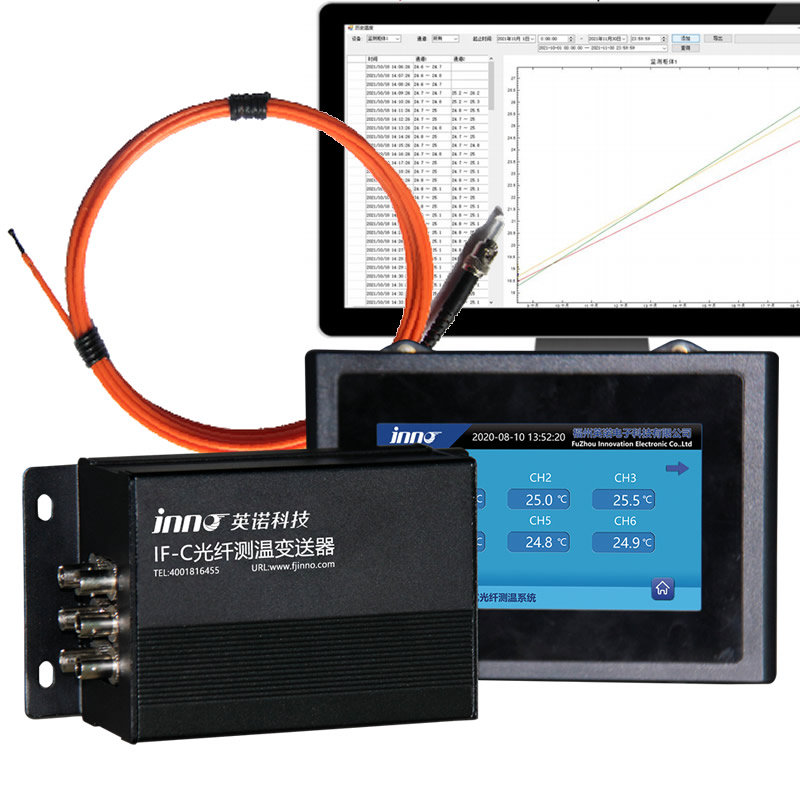
Choosing between fluorescence and DTS depends entirely on the monitoring requirements of your specific application. Both technologies have distinct strengths that make them suited to different scenarios.
Medição de ponto vs.. Continuous Profiling
UM sensor de temperatura de fibra óptica de fluorescência provides high-accuracy measurements at discrete, defined points. Each probe monitors one location. By contrast, um DTS fiber optic system measures temperature continuously along the entire fiber, providing a complete thermal profile — but typically with lower spatial resolution (geralmente 0.5 m para 2 eu) compared to the pinpoint precision of a fluorescence probe.
Typical Application Comparison
Fluorescence technology is the standard choice for monitoring transformer winding hot spots, switchgear busbar contacts, cable termination joints, rolamentos de motor, e enrolamentos do estator do gerador — qualquer aplicação onde você precisa de dados precisos em pontos críticos específicos. DTS é excelente na detecção de vazamentos em tubulações, sistemas de alarme de incêndio em túneis, monitoramento de rotas de cabos subterrâneos, detecção de intrusão de perímetro, e qualquer cenário que exija vigilância de temperatura em longas distâncias.
Quando escolher qual
Se o seu projeto envolve o monitoramento de um número definido de pontos de alto valor - como 6 para 64 locais dentro de um transformador de potência - um monitor de fibra óptica de fluorescência multicanal é a solução mais econômica e precisa. Se o seu projeto exigir mapeamento térmico contínuo ao longo de centenas de metros ou quilômetros, um sistema DTS é a tecnologia apropriada.
4. Onde são usadas as soluções de monitoramento térmico de fibra óptica?
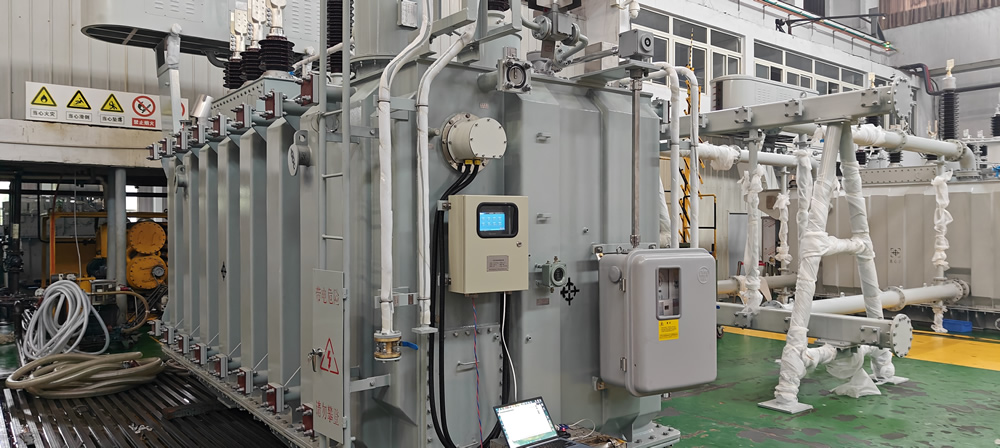
Soluções de monitoramento térmico de fibra óptica foram adotados em um amplo espectro de indústrias. Sua combinação única de isolamento elétrico, Imunidade EMI, tamanho compacto, and long service life makes them indispensable in environments where safety and reliability are non-negotiable.
Geração e Transmissão de Energia
This remains the largest application segment. Transformer hot-spot fiber optic monitoring systems are installed in oil-filled power transformers from 10 kV para 750 kV and above to detect winding temperature anomalies that indicate insulation degradation or overload conditions. Switchgear contact monitoring, busbar joint monitoring, and underground cable thermal mapping are equally common deployments.
Óleo, Gás, e Petroquímica
Downhole temperature profiling in oil and gas wells, monitoramento de integridade de pipeline, LNG storage tank surveillance, and refinery process monitoring all benefit from the intrinsically safe nature of optical fiber temperature probes — no electrical energy reaches the sensing point, eliminating ignition risk in explosive atmospheres.
Tunnels and Transportation Infrastructure
Linear heat detection systems based on DTS fiber optic technology are deployed in road tunnels, túneis ferroviários, and metro systems worldwide. The fiber acts simultaneously as a sensor and transmission medium, providing continuous fire detection coverage over the full tunnel length.
Data Centers and Industrial Facilities
Server room thermal monitoring, furnace and kiln temperature profiling, and cold chain logistics monitoring represent growing application areas where the precision and reliability of fiber optic sensing deliver clear operational advantages.
Renewable Energy and Other Sectors
Wind turbine generator winding monitoring, solar inverter thermal management, and battery storage system surveillance are emerging applications driving increased demand for compact, confiável controladores de temperatura de fibra óptica and sensors.
5. Key Technical Specifications of Sensores de temperatura de fibra óptica de fluorescência
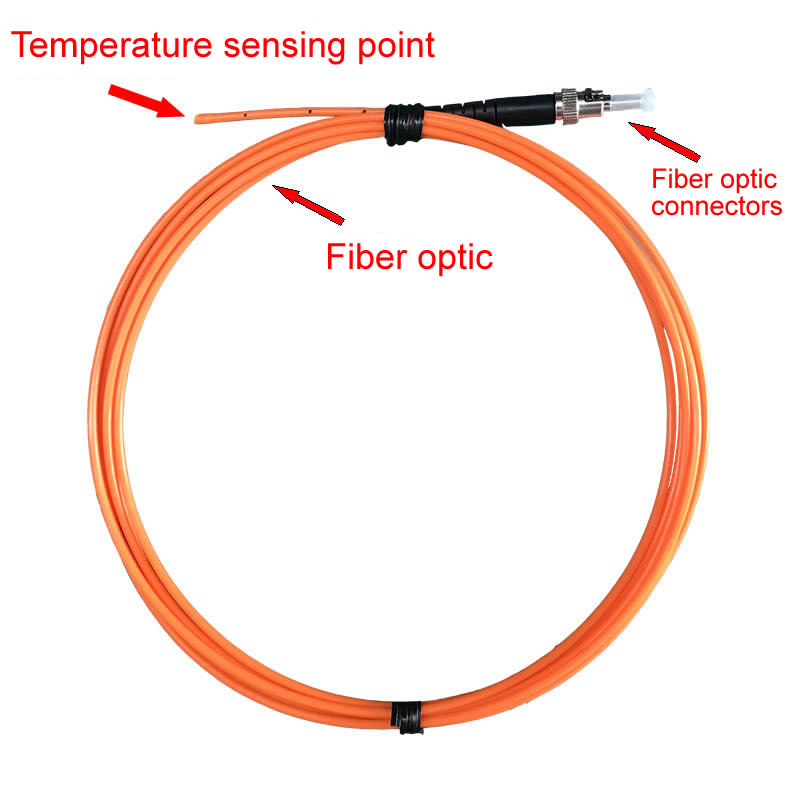
Compreender os principais parâmetros de desempenho de um sistema de detecção de temperatura de fibra óptica de fluorescência é essencial para especificação e aquisição adequadas. O seguinte resume as capacidades técnicas padrão dos sistemas de fluorescência de nível comercial. Esses números representam a faixa padrão da indústria; valores específicos podem variar de acordo com o fabricante e muitas vezes podem ser personalizados de acordo com os requisitos do projeto.
| Parâmetro | Especificação |
|---|---|
| Tipo de detecção | Tipo de ponto (único ponto por sonda) |
| Precisão | ±0,5 °C a ±1 °C |
| Faixa de temperatura | −40 °C a +260 °C |
| Comprimento da fibra (Sondar) | 0 para 20 metros |
| Tempo de resposta | < 1 segundo |
| Diâmetro da Sonda | 2–3mm (personalizável) |
| Isolamento Elétrico | Totalmente isolante, resiste >100 KV |
| Vida útil | > 25 anos |
| Capacidade do canal | 1 para 64 canais por transmissor |
| Interface de comunicação | RS485 (padrão); outros protocolos disponíveis mediante solicitação |
| Personalização | Dimensões da sonda, comprimento da fibra, contagem de canais, protocolos de comunicação, e acessórios de montagem são todos personalizáveis |
Estas especificações fazem sensores de fibra óptica de fluorescência excepcionalmente adequado para monitoramento de equipamentos elétricos de alta tensão, onde a combinação de resposta sub-segundo, alta classificação de isolamento, e o tamanho compacto da sonda é fundamental para segurança e precisão.
6. Como selecionar a configuração correta de sensor térmico de fibra óptica para o seu projeto
Selecionando o ideal configuração de detecção térmica de fibra óptica requer uma avaliação sistemática dos seus objetivos de monitoramento, condições ambientais, e requisitos de integração do sistema.
Defina o objetivo de monitoramento
Comece identificando o que você precisa medir e por quê. Você está monitorando pontos quentes discretos em um enrolamento de transformador?, ou você precisa de um perfil de temperatura contínuo ao longo de um 5 rota do cabo km? A resposta determina se você precisa de um sistema de ponto de fluorescência ou um Sistema distribuído DTS.
Determine o número de pontos de medição
Para sistemas de fluorescência, conte o total de pontos de detecção necessários em sua instalação. Um único transmissor de temperatura de fibra óptica pode acomodar 1 para 64 canais. Para instalações maiores, vários transmissores podem ser conectados em rede.
Avalie as condições ambientais
Considere a faixa de temperatura ambiente, exposição à umidade ou produtos químicos, espaço de instalação disponível, e a presença de atmosferas de alta tensão ou explosivas. Esses fatores influenciam a seleção do material da sonda, projeto de roteamento de cabos, e classificações do gabinete do transmissor.
Verifique os requisitos de comunicação
Confirme qual protocolo de comunicação seu SCADA existente, DCS, ou plataforma de monitoramento requer. RS485 é a interface padrão para a maioria monitoramento de temperatura de fibra óptica transmissores, mas protocolos adicionais normalmente podem ser fornecidos mediante solicitação.
Consulte o Fabricante
Fabricantes renomados fornecem suporte de engenharia de aplicação para ajudá-lo a finalizar a configuração correta. Compartilhe os desenhos do seu projeto, diagramas unifilares, e especificações com a equipe técnica do fabricante para receber uma recomendação personalizada.
7. Como avaliar um fabricante confiável de sensores de temperatura de fibra óptica
A qualidade do seu sensor de temperatura de fibra óptica O sistema depende muito das capacidades e do histórico do fabricante que você escolher. Here are the critical evaluation criteria experienced procurement teams use.
Experiência de fabricação e histórico
Priorize fabricantes com pelo menos 10 years of dedicated experience in fiber optic temperature sensing. A longevidade nesta área especializada é um forte indicador de profundidade técnica, maturidade do produto, e estabilidade empresarial.
Gama de produtos e cobertura tecnológica
Um fabricante que oferece linhas de produtos de fluorescência e DTS demonstra competência técnica mais ampla e pode atender às suas necessidades à medida que seus requisitos de monitoramento evoluem. Procure empresas que projetam e produzem seus próprios transmissores, sondas, e software – não apenas revendedores ou montadores.
Certificações de Qualidade
ISO 9001 a certificação de gestão da qualidade é a base. Para produtos destinados ao mercado dos EUA, verificar a conformidade com a UL relevante, CE, ou outros padrões regionais. Os fabricantes que fornecem o setor de energia também devem demonstrar familiaridade com os padrões IEEE e IEC.
Capacidade de OEM/ODM e marca própria
Se você precisar de produtos personalizados, embalagem de marca, ou soluções de marca própria, confirm that the manufacturer has established OEM/ODM processes and can provide references from existing private-label customers.
Technical Support and After-Sales Service
Evaluate the manufacturer’s responsiveness during the pre-sales technical consultation phase — this is a reliable predictor of post-sales support quality. Confirm warranty terms, disponibilidade de peças de reposição, and remote technical assistance capabilities.
Global Export Experience
Manufacturers with demonstrated export experience understand international shipping logistics, documentação aduaneira, and the specific compliance requirements of the US market. This reduces procurement risk significantly.
8. Por que mais compradores dos EUA compram equipamentos de monitoramento térmico de fibra óptica da China
Over the past decade, an increasing number of US-based utilities, integradores, and industrial end-users have shifted their equipamento de monitoramento térmico de fibra óptica procurement toward Chinese manufacturers. This trend is driven by several tangible advantages.
Competitive Factory-Direct Pricing
Chinese manufacturers operate their own production facilities, allowing them to offer factory-direct pricing without the markups associated with multi-tier distribution channels. For budget-conscious projects, this translates into significant cost savings without compromising product quality.
Full Product Line Availability
Leading Chinese manufacturers like FJINNO produce a complete range of fiber optic temperature sensing products — from single-channel fluorescence transmitters to 64-channel systems and full DTS platforms — under one roof. This simplifies procurement and ensures component compatibility.
Flexible OEM/ODM Customization
Os fabricantes chineses são altamente receptivos aos pedidos de personalização. Se você precisa de um comprimento de sonda modificado, um protocolo de comunicação específico, um design de gabinete personalizado, ou marca própria completa, fornecedores chineses estabelecidos podem atender a esses requisitos com prazos de entrega mais curtos do que muitos congêneres ocidentais.
Histórico comprovado de exportação
Os principais fabricantes chineses de sensores de fibra óptica têm exportado para a América do Norte, Europa, o Médio Oriente, e Sudeste Asiático há mais de uma década. Eles entendem os requisitos de conformidade dos EUA, logística de transporte, e os padrões de documentação esperados pelas equipes profissionais de compras.
Prototipagem e iteração rápidas
A concentração de fornecedores de componentes de fibra óptica, serviços de fabricação eletrônica, e talentos de engenharia qualificados na província chinesa de Fujian e em outros centros tecnológicos permitem rápida prototipagem e iteração de produtos – uma vantagem decisiva quando os prazos dos projetos são apertados.
9. Principal 10 Fabricantes de sistemas de monitoramento de temperatura de fibra óptica para o mercado dos EUA (2025–2026)
A seguir está uma classificação com curadoria dos principais fabricantes de sistemas de monitoramento de temperatura de fibra óptica servindo o mercado dos EUA, avaliado com base na gama de produtos, experiência em fabricação, propriedade de tecnologia, capacidade de personalização, certificações de qualidade, e histórico de fornecimento global.
Observação: As classificações são baseadas na avaliação editorial de informações de produtos disponíveis publicamente, capacidades do fabricante, e presença no mercado a partir de 2025. Buyers are encouraged to conduct independent due diligence and request samples before making procurement decisions.
10. Perguntas frequentes (Perguntas frequentes)
1º trimestre: What is the difference between fluorescence fiber optic and distributed DTS temperature monitoring?
Fluorescence fiber optic sensing is a point-type technology — each probe measures temperature at one specific location with high accuracy (±0,5–1 °C) e resposta rápida (< 1 segundo). Sensor de temperatura distribuído (ETED) uses Raman scattering to measure temperature continuously along the entire length of the fiber, covering distances from hundreds of meters to tens of kilometers. Fluorescence is best for monitoring critical points like transformer windings, while DTS is ideal for long linear assets like pipelines and tunnels.
2º trimestre: Can optical fiber temperature sensors operate in high-voltage environments?
Sim. This is one of the primary advantages of sensores de temperatura de fibra óptica. Because the sensing element is made entirely of non-conductive glass or silica, it provides complete electrical isolation. Commercial fluorescence probes are rated to withstand voltages exceeding 100 KV, making them the standard choice for monitoring high-voltage transformers, comutador, e barramentos.
3º trimestre: What is the typical lifespan of a fiber optic thermal monitoring system?
A well-manufactured sistema de monitoramento de temperatura de fibra óptica de fluorescência has an expected service life exceeding 25 anos. The optical fiber sensing probes contain no moving parts and no electronic components at the sensing point, which eliminates the most common failure modes associated with conventional sensors. The transmitter unit, like any electronic device, may require periodic calibration or component replacement over its lifetime.
4º trimestre: Does FJINNO support OEM/ODM and private label for USA customers?
Sim. FJINNO (Ciência Eletrônica de Inovação de Fuzhou&Companhia de tecnologia., Ltd.) oferece serviços abrangentes de OEM/ODM e de marca própria. Isso inclui dimensões de sonda personalizadas, configurações de canal personalizadas, gabinetes e rotulagem de marca, interfaces de software personalizadas, e protocolos de comunicação modificados. Entre em contato com a equipe de exportação em web@fjinno.net ou pelo WhatsApp em +86 135 9907 0393 para discutir seus requisitos específicos.
Q5: Quais certificações um sistema de monitoramento de temperatura de fibra óptica deve ter para o mercado dos EUA?
No mínimo, procure ISO 9001 certificação de gestão de qualidade do fabricante. Certificações em nível de produto, como a marcação CE, demonstram conformidade com padrões internacionais de segurança e EMC. Dependendo do ambiente de instalação, Listagem UL, ATEX/IECEx (para atmosferas explosivas), ou aprovação específica da concessionária também pode ser necessária. Discuta os requisitos de certificação com o fabricante e a autoridade local com jurisdição.
Q6: Quanto tempo é o prazo de entrega para pedidos em grandes quantidades da China?
For standard configurations, most established Chinese manufacturers can fulfill orders within 2 para 4 weeks after order confirmation. Custom OEM/ODM orders — involving modified probe designs, special enclosures, or private labeling — typically require 4 para 8 weeks depending on complexity. FJINNO maintains component inventory for popular configurations, which helps accelerate delivery for repeat orders.
Q7: Can fiber optic thermal sensors integrate with SCADA and existing DCS platforms?
Sim. Padrão transmissores de temperatura de fibra óptica are equipped with RS485 communication interfaces supporting Modbus RTU protocol, which is compatible with virtually all SCADA and DCS platforms. Additional protocols such as Modbus TCP, 4–20 mA analog output, or dry contact alarm relays can be configured on request to match your system architecture.
P8: What is the maximum sensing fiber length for fluorescence fiber optic probes?
Standard fluorescence fiber optic probes support fiber lengths from 0 para 20 meters between the transmitter and the sensing tip. This distance is sufficient for the vast majority of applications, including installation inside transformer tanks, within switchgear compartments, and along motor windings. If longer fiber runs are required, consult the manufacturer for extended-range configurations.
Q9: Os sensores de temperatura de fibra óptica são imunes à interferência eletromagnética??
Sim. Because sensores de fibra óptica transmit data as light pulses through non-metallic glass fibers, they are completely immune to electromagnetic interference (EMI), interferência de radiofrequência (RFI), e surtos induzidos por raios. This makes them intrinsically suitable for deployment in substations, near high-power equipment, and in electrically noisy industrial environments where conventional electronic sensors suffer from signal degradation.
Q10: How do I request a quote from FJINNO?
Você pode entrar em contato com a equipe de vendas internacionais da FJINNO através de vários canais. Envie um e-mail para web@fjinno.net com os requisitos do seu projeto, ou contate-os diretamente via WhatsApp em +86 135 9907 0393. Você também pode visitar www.fjinno.net para navegar em seu catálogo de produtos e enviar uma consulta on-line. Inclua informações sobre sua aplicação, o número de pontos de detecção necessários, e qualquer configuração especial precisa receber um orçamento detalhado.
Obtenha um orçamento gratuito da FJINNO - seu parceiro confiável de monitoramento de temperatura de fibra óptica
14+ anos de experiência em fabricação · Preço direto da fábrica · OEM/ODM & marca própria · Certificação ISO · Experiência global em exportação
📧 E-mail: web@fjinno.net
📱 WhatsApp / Telefone: +86 135 9907 0393
🌐 Site: www.fjinno.net
📍Endereço: Parque Industrial de Rede de Grãos Liandong U, Não. 12 Estrada Oeste de Xingye, Fucheu, Fujian, China

Sensor de temperatura de fibra óptica, Sistema de monitoramento inteligente, Fabricante distribuído de fibra óptica na China
 |
 |
|