 Sensores de temperatura de fibra óptica INNO ,sistemas de monitoramento de temperatura.
1、 Classificação de sensores de temperatura
Sensores de temperatura são a parte central dos instrumentos de medição de temperatura, com uma grande variedade de tipos que podem ser classificados de acordo com diferentes padrões.
1.1 Classificação por método de medição
Sensor de temperatura de contato: Este tipo de sensor requer contato direto com o objeto que está sendo medido para obter informações de temperatura. Sensores de temperatura de contato comuns incluem termopares e termistores. Os termopares usam a diferença de potencial termoelétrico entre dois metais diferentes para medir a temperatura. Por exemplo, em alguns fornos industriais, termopares são inseridos diretamente no forno para entrar em contato com objetos de alta temperatura, e o valor da temperatura é obtido através da diferença de potencial termoelétrico; Termistor é um sensor cuja resistência muda com a temperatura, and its resistance has a specific functional relationship with temperature. It is commonly used in temperature monitoring and other fields of electronic devices.
Sensor de temperatura sem contato: This type of sensor typically uses infrared radiation to measure the temperature of an object, without the need for direct contact with the object. Infrared temperature sensors are representative of this, which use the infrared radiation emitted by objects to measure their temperature. Por exemplo, when measuring the surface temperature of a high-temperature furnace, there is no need to touch the furnace, and temperature readings can be obtained by receiving its infrared radiation. This method is suitable for measuring the surface temperature of moving objects, small targets, and objects with small heat capacity or rapid temperature changes (transitórios), and can also be used to measure the temperature distribution of temperature fields.
1.2 Classification by Sensor Material and Electronic Component Characteristics/
Termopar: Based on the principle of thermoelectric effect, it uses the thermoelectric potential difference between two different metals to measure temperature. Thermocouples made of different materials are suitable for different temperature ranges. Por exemplo, K-type thermocouples can measure temperatures ranging from -200 ℃ para 1300 ℃, and are commonly used in industry for temperature measurement in high-temperature environments, such as temperature monitoring in steel smelting processes.
Detector de temperatura de resistência (IDT): measures temperature based on the principle of resistance changing with temperature. De um modo geral, Os RTDs são mais lineares que os termopares, e sua resistência aumenta com a temperatura. Common RTDs include platinum resistors (Pt100, Pt10, etc.), among which Pt100 has a resistance value of 100 ohms at 0 ℃ and has high accuracy. It is commonly used for precise temperature measurement in laboratories and industries.
IC temperature sensor (integrated temperature sensor): Integrating temperature sensing elements, circuitos de expansão, circuitos de compensação, etc.. on a small chip, it has the advantages of good linearity, resposta rápida, and standardized export. IC temperature sensors include two types: analog output and digital output. Por exemplo, AD590 is a current output temperature sensor from Analog Devices Inc. in the United States, with a supply voltage range of 3-30V, an output current of 223 μ A (-50 ℃) -423 μ A (150 ℃), and a sensitivity of 1 μ A/℃.
1.3 Classification by Working Principle
Expansion thermometer: made based on the principle of thermal expansion and contraction of objects, commonly used to measure temperature changes over a large range. Por exemplo, in common mercury thermometers, mercury expands when heated and rises in the capillary tube of the thermometer, indicating temperature based on the height of the mercury column.
Special type
Pressure and temperature sensor: a multifunctional sensor that can simultaneously measure temperature and pressure, used in some hydraulic systems, air conditioning and refrigeration systems that require simultaneous monitoring of temperature and pressure.
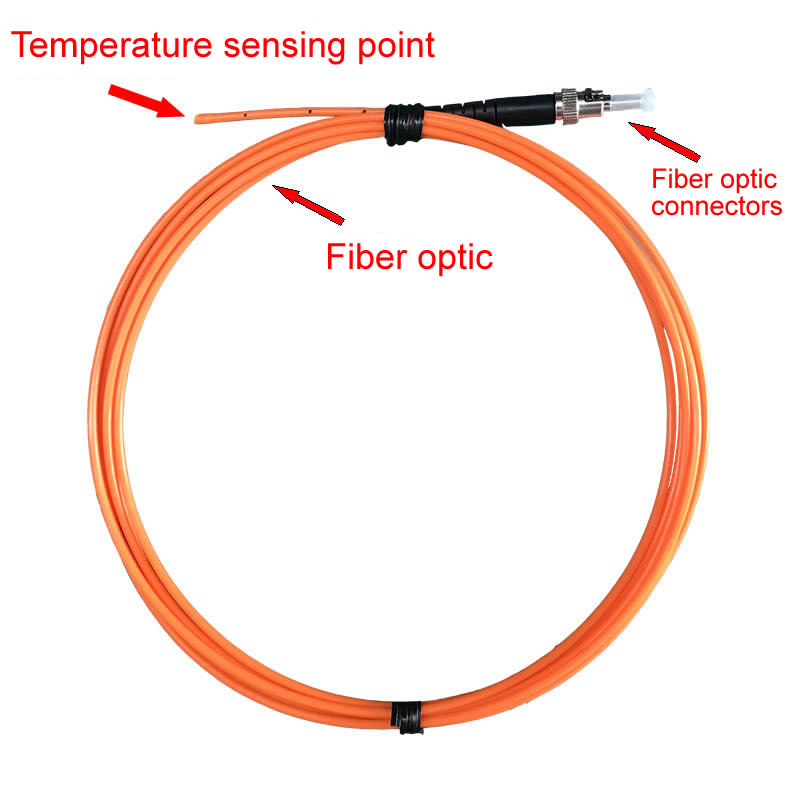
Sensor de temperatura de fibra óptica: uses the properties of the optical signal in the fiber optic to measure temperature. This includes fluorescent fiber temperature sensors, distributed fiber temperature sensors, sensores de temperatura de grade de Bragg de fibra, etc.. Fiber optic temperature sensors have the advantages of high sensitivity, tamanho pequeno, peso leve, easy bending, sem interferência eletromagnética, sem interferência eletromagnética, and good corrosion resistance. They are particularly suitable for temperature detection in harsh environments such as flammable, explosivo, espaços estreitos, and highly corrosive gases, líquidos, and radiation pollution.
Logic output temperature sensor: Set a temperature range, and once the temperature exceeds the specified range, an alarm signal will be issued to turn on or off fans, condicionadores de ar, aquecedores, or other control devices. Por exemplo, in some computer server rooms, if the temperature exceeds the set range, the logic output temperature sensor will trigger the air conditioning to turn on or off.

2、 Características de Sensor de temperatura de fibra óptica fluorescente
Fluorescent fiber optic temperature sensor is a sensor that uses fluorescent materials to undergo changes in fluorescence intensity or wavelength under temperature changes, and transmits signals through optical fibers to achieve temperature detection.
Alta precisão: Os materiais fluorescentes são particularmente sensíveis às mudanças de temperatura, fazendo com que os sensores de temperatura de fibra fluorescente tenham alta precisão de medição. Because small changes in temperature can cause significant changes in fluorescence intensity or wavelength, accurate temperature values can be obtained by precisely measuring these changes. Por exemplo, in the field of medical diagnosis, fluorescent fiber optic temperature sensors can provide more accurate measurement results than traditional thermometers for detecting subtle changes in human body temperature.
Resposta rápida: able to quickly respond to temperature changes, monitor temperature changes in real time, e responda imediatamente. This is very important in some situations where real-time temperature monitoring is required, such as in energy management systems, for temperature monitoring of power equipment. Once the equipment temperature rises abnormally, sensors can quickly provide feedback information to take timely measures.
Resistência de alta tensão: Os produtos de medição de temperatura de fibra óptica fluorescente têm resistência a alta tensão, com uma resistência de tensão superior a 100KV. Isso permite medir diretamente a temperatura em ambientes de alta tensão. Por exemplo, no monitoramento de temperatura de equipamentos em subestações de ultra-alta tensão, ao enfrentar ambientes de alta tensão superiores a 100KV, a extremidade da fibra fluorescente pode fazer contato de distância zero com o equipamento para medição de temperatura sem ser afetada pela alta tensão, garantindo a operação normal do trabalho de medição e fornecendo suporte importante de dados de temperatura para a operação segura de equipamentos de energia.
Forte capacidade anti-interferência: Traditional temperature sensors can be affected by interference signals, while fluorescent fiber temperature sensors are not affected by interference signals and can work normally in complex electromagnetic environments. Em ambientes com forte interferência eletromagnética, such as near substations or large motor equipment, fluorescent fiber optic temperature sensors can stably measure temperature without measurement errors caused by electromagnetic interference like traditional electronic temperature sensors.
Estabilidade a longo prazo: Materiais fluorescentes têm forte durabilidade e estabilidade, e sensores podem manter estabilidade de alto desempenho durante o uso a longo prazo. This means that in long-term temperature monitoring tasks, such as long-term temperature monitoring of large infrastructure such as bridges and dams, there is no need to frequently replace sensors or calibrate them.
Wide range of applicable environmental temperatures: Suitable for a wide range of environmental temperatures, from low to minus Baidu to high to several hundred degrees. Whether it is temperature monitoring of scientific research equipment in the extremely cold Arctic region or temperature measurement near high-temperature industrial furnaces, fluorescent fiber optic temperature sensors can work normally.
Flexibility and Scalability: Sensor fluorescent materials can be selected and designed according to actual needs to meet various specific application areas. Different fluorescent materials have different temperature fluorescence characteristics, and the most suitable fluorescent material can be selected to construct sensors according to specific application scenarios, such as biomedical research, monitoramento de processos industriais, etc.. The number or range of monitoring points can be expanded as needed.

3、 O princípio de sensor de temperatura de fibra óptica distribuída
Fibra óptica distribuída temperature sensor is a sensor that uses unique distributed fiber optic detection technology to measure or monitor the spatial distribution and temporal information along the fiber optic transmission path.
Principles based on scattering effects
Espalhamento Rayleigh: When light is transmitted in an optical fiber, Rayleigh scattering occurs due to the microscopic non-uniformity inside the fiber, such as small changes in density, composição, etc.. The intensity of Rayleigh scattering light is related to temperature, and temperature changes can cause changes in the microstructure of optical fiber materials, resulting in changes in the intensity of Rayleigh scattering light. No entanto, temperature measurement based solely on Rayleigh scattering has relatively low sensitivity, and in practical applications, it is often necessary to combine other scattering effects to improve measurement accuracy.
Dispersão Raman: This is a commonly used scattering effect in distributed fiber optic temperature sensors. Raman scattering light is divided into Stokes light and anti Stokes light, and their intensity ratio has a specific functional relationship with temperature. The laser transmitted in the fiber will interact with the molecules in the fiber to produce Raman scattering, and temperature changes will affect the vibrational energy levels of the molecules, thereby changing the intensity ratio of Stokes light and anti Stokes light. By measuring this intensity ratio, o valor da temperatura pode ser calculado. Por exemplo, in some long-distance oil pipeline temperature monitoring, distributed fiber optic temperature sensors based on Raman scattering can be used to lay optical fibers along the pipeline and monitor the temperature at different positions of the pipeline in real time, preventing safety hazards caused by high or low oil temperature.
Dispersão de Brillouin: The frequency of Brillouin scattering light changes with temperature and strain. In distributed fiber optic temperature sensors, temperature information is obtained by measuring the frequency drift of Brillouin scattering light. O espalhamento de Brillouin é sensível à temperatura e à deformação, and in practical applications, special techniques are needed to distinguish the effects of temperature and strain, such as using special fiber structures or measurement methods.
Application of Optical Time Domain Reflectometry (OTDR) Tecnologia
Princípio de medição: OTDR technology is an essential equipment for fault location and diagnosis in fiber optic communication, and also plays an important role in distributed fiber optic temperature sensors. It injects a light pulse into the fiber and detects the intensity of backscattered light in the fiber over time (distância). Due to temperature changes affecting the scattering characteristics in optical fibers, the intensity of backscattered light changes. By analyzing the distribution of backscattered light intensity, temperature distribution information along the length direction of the optical fiber can be obtained.
Resolução espacial: The spatial resolution of OTDR systems is generally on the order of meters. This means that it can distinguish temperature changes at a certain distance (in meters) on the fiber optic cable. Por exemplo, in the structural health monitoring of large bridges, by combining distributed fiber optic temperature sensors with OTDR technology, temperature changes in different parts of the bridge (every few meters) can be monitored, thereby determining whether there are abnormal thermal stresses in the bridge structure.
The relationship between measurement accuracy and spatial resolution: There is generally a mutual constraint between the measurement accuracy and spatial resolution of a system. Geralmente, to improve spatial resolution, a certain level of measurement accuracy may be sacrificed, and vice versa. This is because when improving spatial resolution, it is necessary to analyze the backscattered light signal more finely, which may be affected by factors such as noise, thereby reducing measurement accuracy.
4、 Aplicação de Sensor de temperatura de grade de fibra Bragg
Fiber Bragg grating temperature sensors have a wide range of applications in multiple fields.
Oil and gas exploration field
In the process of oil and gas extraction, the underground environment is complex, with harsh conditions such as high temperature, alta pressão, and strong corrosion. Fiber Bragg grating temperature sensors can be installed on underground equipment or pipelines to monitor temperature changes in real time. Por exemplo, in the production string of an oil well, sensors can timely detect temperature increases caused by changes in formation temperature or frictional heating during the production process, providing a guarantee for safe production. Enquanto isso, by monitoring the temperature distribution, the mining process can be optimized and the mining efficiency can be improved.
Aerospace field
In the aerospace industry, there are extremely high requirements for the reliability and safety of equipment. The characteristics of fiber Bragg grating temperature sensors, such as small size, peso leve, tempo de resposta rápido, strong resistance to electromagnetic interference and corrosion, make them very suitable for temperature monitoring in aircraft engines, aviation electronic equipment, etc.. Installing fiber optic grating temperature sensors around high-temperature components such as combustion chambers and turbines in aircraft engines can monitor temperature in real-time and ensure that the engine operates within a safe temperature range. Além disso, in the thermal protection system of spacecraft, sensors can monitor temperature changes, providing data support for the performance evaluation and optimization of thermal protection materials.
Medical diagnosis field
Accurate temperature control is crucial in medical devices such as magnetic resonance imaging (ressonância magnética) equipamento, laser therapy equipment, etc.. Fiber Bragg grating temperature sensors can monitor the temperature of critical parts of equipment, preventing damage to patients and the equipment itself caused by overheating. Ao mesmo tempo, in some minimally invasive medical surgeries, fiber optic grating temperature sensors can enter the human body through tiny fiber optic probes to monitor the temperature of tissues around the surgical site, providing guarantees for the safety and effectiveness of the surgery.
Industrial process control field
In various industrial production processes, such as chemical, metalúrgico, e indústrias de energia, temperature is a key control parameter. Fiber Bragg grating temperature sensors can be used to monitor the temperature of equipment such as reaction vessels, fornos, e motores. Por exemplo, in the chemical reaction kettle of chemical production, sensors can monitor the reaction temperature in real time to ensure that the reaction proceeds under optimal temperature conditions, improving product quality and production efficiency. No sistema de energia, temperature monitoring of high-voltage equipment, cabos, etc.. in substations can timely detect potential fault hazards and avoid power accidents.
5、 Comparison of Three Types of Fiber Optic Temperature Sensors
In terms of measurement principles
Sensor de temperatura de fibra óptica fluorescente: measures temperature based on the change in fluorescence intensity or wavelength of fluorescent materials under temperature changes. Quando materiais fluorescentes são afetados por mudanças de temperatura, suas características de fluorescência também mudarão. A typical fluorescent fiber optic temperature sensor includes a light source, fibra óptica, material fluorescente, and a spectral analyzer. The light source generates excitation light of a certain wavelength, which is transmitted to the fluorescent material through an optical fiber. The fluorescent material absorbs the excitation light and emits a fluorescence signal with a specific wavelength, which is then transmitted back to the spectrometer for detection through the optical fiber. O valor da temperatura pode ser determinado medindo a intensidade ou comprimento de onda do sinal de fluorescência.
Sensor de temperatura de fibra óptica distribuída: mainly based on scattering effects in optical fibers (como espalhamento Rayleigh, Dispersão Raman, Dispersão de Brillouin) and optical time domain reflectometry (OTDR) technology to achieve temperature measurement. By injecting light pulses into the optical fiber, the intensity, freqüência, and other characteristics of backscattered light can be detected as a function of time (distância). Since temperature affects these scattering characteristics, temperature distribution information along the length direction of the optical fiber can be obtained.
Sensor de temperatura de grade de fibra Bragg: Utilizing the photosensitivity of fiber optic materials to form a spatial phase grating in the fiber core for temperature measurement. Grade de fibra Bragg (FBG) is a type of fiber with a periodically changing refractive index. Quando a temperatura muda, the Bragg wavelength of the grating shifts, enabling temperature measurement.
Em termos de características de desempenho
precisão de medição
Sensor de temperatura de fibra óptica fluorescente: It has high measurement accuracy because fluorescent materials are very sensitive to temperature changes and can accurately reflect small temperature changes.
Sensor de temperatura de fibra óptica distribuída: Its measurement accuracy is affected by various factors, such as the complexity of scattering effects and the resolution of OTDR technology. Em aplicações práticas, the accuracy of distributed fiber optic temperature sensors based on Raman scattering is generally around 1-2 ℃, but with the development of technology, the accuracy is also constantly improving.
Sensor de temperatura de grade de fibra Bragg: Alta precisão, por exemplo, some fiber Bragg grating temperature sensors that use special packaging and measurement techniques can achieve an accuracy of 0.02 ℃.
velocidade de resposta
Sensor de temperatura de fibra óptica fluorescente: With fast response speed, it can monitor temperature changes in real time and respond immediately, making it advantageous in situations where rapid temperature response is required.
Sensor de temperatura de fibra óptica distribuída: The response speed depends on the emission frequency of the light pulse and the signal processing speed. De um modo geral, it can meet the temperature monitoring needs in most practical applications, but may be slightly slower compared to fluorescent fiber optic temperature sensors.
Sensor de temperatura de grade de fibra Bragg: With fast response time, it can quickly sense temperature changes and output corresponding wavelength offset signals.
resolução espacial
Sensor de temperatura de fibra óptica distribuída: It has unique distributed measurement capabilities and can measure temperature distribution along the length of the fiber optic cable. The spatial resolution is generally on the order of meters (when using OTDR technology), and some systems that use advanced technologies (such as OFDR) can achieve millimeter level spatial resolution.
Sensor de temperatura de fibra óptica fluorescente: Although it can achieve distributed measurement, it mainly focuses on temperature measurement at multiple discrete points, and its spatial resolution is not as good as that of distributed fiber optic temperature sensors, which can continuously measure temperature distribution along the fiber optic.
Sensor de temperatura de grade de fibra Bragg: It usually measures the temperature at a specific location and does not have the continuous spatial resolution characteristics of distributed fiber optic temperature sensors.
Anti-interference ability
Sensor de temperatura de fibra óptica fluorescente: Não é afetado por sinais de interferência e pode funcionar normalmente em ambientes eletromagnéticos complexos. This is because its measurement principle based on optical signals has a natural immunity to electromagnetic interference.
Sensor de temperatura de fibra óptica distribuída: It also has good anti-interference ability because fiber optic itself is an insulator, and measurement is based on the optical signal in the fiber optic, which is not easily affected by external electromagnetic interference.
Sensor de temperatura de grade de fibra Bragg: It has strong resistance to electromagnetic interference, and due to its optical properties based on grating structure for temperature measurement, it also has good resistance to interference such as chemical corrosion and vibration in the environment.
Faixa de temperatura aplicável
Sensor de temperatura de fibra óptica fluorescente: suitable for a wide range of environmental temperatures, desde menos Baidu até várias centenas de graus Celsius, and can adapt to temperature measurement needs in various extreme temperature environments.
Sensores de temperatura de fibra óptica distribuídos: Different types of distributed fiber optic temperature sensors have different temperature ranges, but they can generally cover a wide temperature range, such as common industrial and environmental temperature ranges from -50 ℃ para 150 ℃.
Sensor de temperatura de grade de fibra Bragg: It can work normally in both high and low temperature environments, por exemplo, it can be used for temperature measurement range of -200 ℃ -800 ℃, depending on factors such as the material and packaging of the fiber Bragg grating.
In terms of application areas
Sensor de temperatura de fibra óptica fluorescente: widely used for real-time temperature monitoring and control in fields such as medical diagnosis and energy management. Na área médica, it can be used for precise measurement of human body temperature and monitoring of organ temperature inside the body; In terms of energy management, temperature monitoring of power equipment, tubulações térmicas, etc.. can be carried out.
Sensores de temperatura de fibra óptica distribuídos: widely used in stress, variedade, and temperature monitoring of large structures (such as pipelines, offshore oil platforms, poços de petróleo, barragens, aterros, pontes, edifícios, túneis, cabos, etc.), detecção de vazamento (liquid or natural gas pipelines, processos industriais, barragens, tanques, etc.), transporte (ice detection on road surfaces, monitoramento ferroviário, etc.), sistemas de segurança (fire or overheating temperature detection, monitoramento de cabo de alimentação, signal eavesdropping monitoring, garbage disposal station monitoring, monitoramento de deslizamentos de terra, etc.), comunicação de fibra óptica (fiber optic cable production online control, fiber optic cable maintenance, work cable strain monitoring, fiber optic impurity measurement, etc.), environmental measurement (térmico, ventilação, and air conditions, long-term temperature measurement of external oceans, forests, and outdoor places), etc.. The application.
Sensor de temperatura de grade de fibra Bragg: It has been widely used in various environmental monitoring fields such as oil and gas exploration, aeroespacial, diagnóstico médico, e controle de processos industriais. Used for temperature monitoring of downhole equipment and pipelines in the oil and gas industry; Temperature monitoring for aircraft engines, aviation electronic equipment, etc.. no campo aeroespacial; Used in the medical field for temperature control of medical equipment and temperature monitoring of surgical sites; Used in the industrial field for temperature monitoring of various equipment and production processes.

Sensor de temperatura de fibra óptica, Sistema de monitoramento inteligente, Fabricante distribuído de fibra óptica na China
|
 |
 |