 Sensores de temperatura de fibra óptica INNO ,sistemas de monitoramento de temperatura.
- Coberturas de comutadores BT, VM, e tipos HV - todos compartilham a mesma causa raiz de superaquecimento de contato através do acúmulo de calor I²R resistivo
- Um sistema completo de monitoramento online consiste em quatro componentes: sensores de fibra óptica de fluorescência, uma unidade de aquisição de dados, um módulo de comunicação, e software de monitoramento
- O monitoramento da condição do comutador abrange cinco parâmetros: temperatura, descarga parcial, umidade, Densidade do gás SF6, e características mecânicas
- A temperatura é o parâmetro mais crítico - mais de 90% das falhas elétricas produzem assinaturas de calor anormais antes que a falha ocorra
- Existem quatro métodos de medição: termografia infravermelha, sensores sem fio, RTD/termopar, e detecção de fibra óptica de fluorescência
- Sensores de fibra óptica de fluorescência não contêm metal, intrinsecamente seguro, Imune a EMI, e com precisão de ±1 °C durante uma vida útil da sonda de 30+ anos
- Real-time online monitoring closes the detection gap between annual inspections and captures slow-developing thermal defects weeks before failure
Índice
- What types of switchgear are used in electrical distribution systems?
- What does a switchgear online monitoring system consist of?
- What parameters does switchgear condition monitoring cover?
- Why is temperature monitoring the most critical part of switchgear condition monitoring?
- What methods are used to measure switchgear contact temperature?
- Why is fluorescence fiber optic sensing the best solution for switchgear temperature monitoring?
- Why does switchgear need real-time online monitoring instead of periodic inspection?
- Perguntas frequentes: Monitoramento on-line da temperatura de contato do painel de distribuição
1. What types of switchgear are used in electrical distribution systems?

Switchgear is the collective term for the combination of electrical disconnect switches, fusíveis, e disjuntores usados para controlar, proteger, and isolate electrical equipment in a power distribution network. It sits at every voltage level from the utility substation down to the final distribution board inside a building or industrial plant.
By voltage class
Low-voltage (LV) comutador operates at or below 1 kV and is the most common type found in commercial buildings, centros de dados, and light industrial facilities. Média tensão (VM) comutador covers the 1–36 kV range and is the backbone of industrial power distribution, utility secondary networks, and campus substations. Alta tensão (Alta tensão) comutador operates above 36 kV and is deployed at transmission substations and large generation facilities.
By construction type
Metal-clad switchgear uses grounded metal barriers to separate the main bus, the circuit breaker compartment, and the cable termination compartment. Draw-out switchgear — also called withdrawable switchgear — allows the circuit breaker to be rolled out of its cubicle without de-energising the bus, which reduces maintenance outage time significantly. Aparelhagem isolada a gás (SIG) encloses all live parts in SF6 gas at elevated pressure, achieving a footprint 10–15% of an equivalent air-insulated installation at the same voltage rating.
Contact types and their thermal vulnerability
Regardless of voltage class or construction, every switchgear assembly contains mechanical contact interfaces: fixed main contacts at busbar joints and cable terminations, contatos deslizantes in draw-out truck assemblies, e vacuum interrupter contacts inside medium-voltage vacuum circuit breakers. All three contact types are susceptible to the same degradation mechanisms — bolt torque relaxation, oxide film formation, and sustained overcurrent — that raise contact resistance and generate localised heat.
2. What does a switchgear online monitoring system consist of?

UM switchgear online monitoring system is not a single device. It is an integrated measurement chain with four distinct functional layers, each of which must be specified and commissioned correctly for the system to deliver reliable data.
Camada 1 — Sensing probes
Fluorescence fiber optic temperature probes are mounted directly onto the circuit breaker contacts and cable termination lugs inside the switchgear cubicle. Each probe contains a phosphorescent material at its tip whose fluorescence decay time is a precise, função reproduzível da temperatura. The probe itself carries no electricity and introduces no metallic conductor into the high-voltage zone.
Camada 2 — Data acquisition and signal processing unit
O transmissor de temperatura — also referred to as an intelligent electronic device (IED) or DAQ unit — drives the optical fibers with a light pulse, measures the returning fluorescence decay signal, and converts it into calibrated temperature readings. The unit incorporates a liquid crystal display (LCD) for local readout and on-site alarm indication. It operates reliably across an ambient temperature range of −40 °C a +70 °C to suit the environmental extremes encountered on outdoor switchyards, plataformas offshore, and cold-climate substations.
Camada 3 — Communication module
Measured temperature data and alarm events are transmitted to the control room over an RS-485 serial interface, which can be extended to Modbus RTU, CEI 61850 GANSO, or Ethernet depending on the site SCADA architecture. Remote monitoring access allows operations staff to view live readings, tendências históricas, e registros de alarme sem entrar na sala de comando.
Camada 4 — Plataforma de software de monitoramento
O software de monitoramento de supervisão apresenta curvas de temperatura em tempo real para cada ponto de medição, registra eventos de alarme com carimbo de data/hora e identidade de contato, armazena dados históricos de temperatura para análise de tendências, e gera ordens de serviço de manutenção quando condições limite configuráveis são atendidas.
Configuração do ponto de medição
Cada cubículo do quadro está equipado com um mínimo de 6 pontos de medição: 3 pontos nos contatos do disjuntor (um por fase) e 3 pontos nas terminações dos cabos (um por fase). Esta cobertura por fase é essencial porque o carregamento desequilibrado ou uma falha de conexão monofásica produzirá um aumento de temperatura em apenas uma fase – um padrão que confirma o tipo de falha, bem como sua localização.
3. What parameters does switchgear condition monitoring cover?
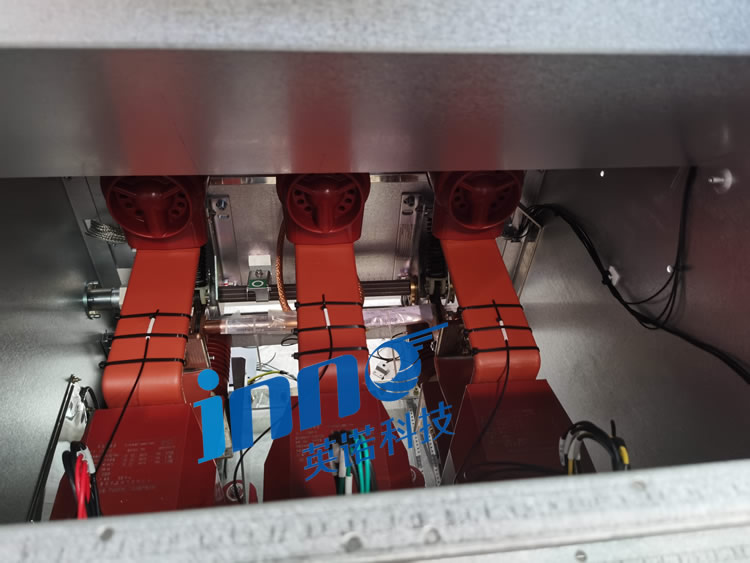
Monitoramento da condição do comutador é uma disciplina multiparâmetro. Temperature is the highest-priority signal, but a complete monitoring programme addresses four additional parameters that each indicate a distinct failure mode.
Descarga parcial (DP) monitoramento
Descarga parcial is localised dielectric breakdown within an insulation system that has not yet bridged the full electrode gap. PD activity produces ultrasonic acoustic emission, tensão transitória de terra (TEV) pulsos, and UHF radio-frequency signals that can be detected by sensors mounted on the switchgear enclosure. Sustained PD erodes insulation material progressively and, deixado despercebido, leads to full insulation failure and arc flash.
Relative humidity monitoring
Condensation on busbar insulation and cable sealing ends dramatically reduces surface creepage distance and accelerates insulation tracking. Humidity sensors mounted inside the cubicle detect moisture ingress from failed gaskets, inadequate anti-condensation heaters, or cable entry seal deterioration.
SF6 gas density monitoring
Em painel de distribuição isolado a gás (SIG) and SF6 circuit breakers, the dielectric strength and arc-quenching capability of the equipment depend on maintaining SF6 gas at the design pressure and purity. Density monitors (combined pressure and temperature sensors) detect slow gas leaks before the gas pressure drops below the minimum operating level.
Mechanical characteristic monitoring
Disjuntor mechanical condition monitoring measures the contact travel curve, closing and opening times, and operating coil current during each switching operation. Deviations from the OEM’s acceptance band indicate spring mechanism wear, lubrication breakdown, or misalignment that will eventually cause a failure to trip on command — the most dangerous failure mode in a protection system.
4. Why is temperature monitoring the most critical part of switchgear condition monitoring?
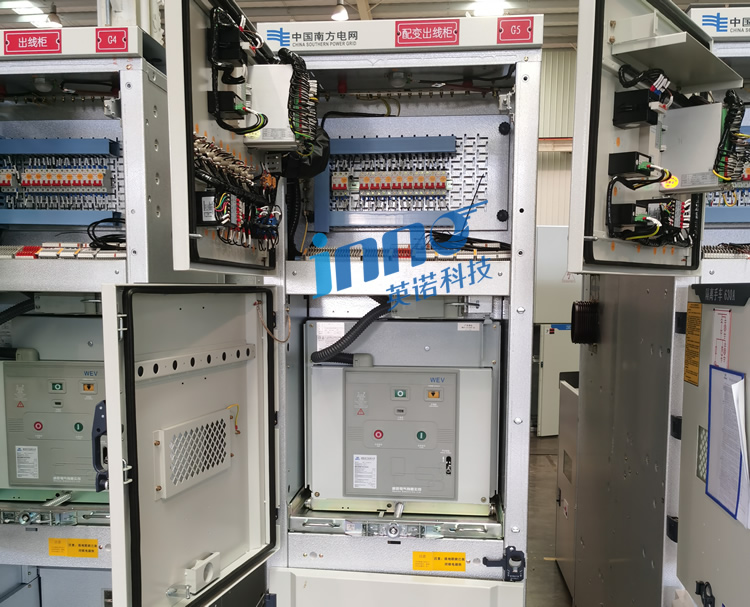
Of all the condition parameters described above, temperature stands apart for one straightforward reason: it is the common downstream effect of virtually every electrical degradation process. Conexões soltas, oxidised contact surfaces, overloaded conductors, and insulation breakdown all produce heat before they produce any other externally detectable symptom.
The Arrhenius relationship and insulation life
Electrical insulation degrades according to an Arrhenius rate law: para cada 10 °C rise in sustained operating temperature above the insulation’s thermal class rating, service life is approximately halved. A cable termination running 20 °C above its rated temperature is ageing four times faster than design intent. This is not a theoretical concern — it is the mechanism behind the majority of MV switchgear failures that occur well before the equipment’s nominal design life.
Industry evidence
Research published by the Electric Power Research Institute (EPRI) found that 38% of medium-voltage switchgear failures investigated post-incident showed temperature signatures that would have been detectable weeks earlier under continuous monitoring. Hotspot detection at the cable lug or breaker contact stage is the earliest and most actionable intervention point in the failure sequence.
Compliance and insurance requirements
NFPA 70B (Prática recomendada para manutenção de equipamentos elétricos) e CEI 62271-1 both identify temperature monitoring as a key element of a defensible electrical maintenance programme. Insurance underwriters for industrial and commercial facilities increasingly require documented temperature monitoring records as a condition of coverage for high-value switchgear installations.
5. What methods are used to measure switchgear contact temperature?
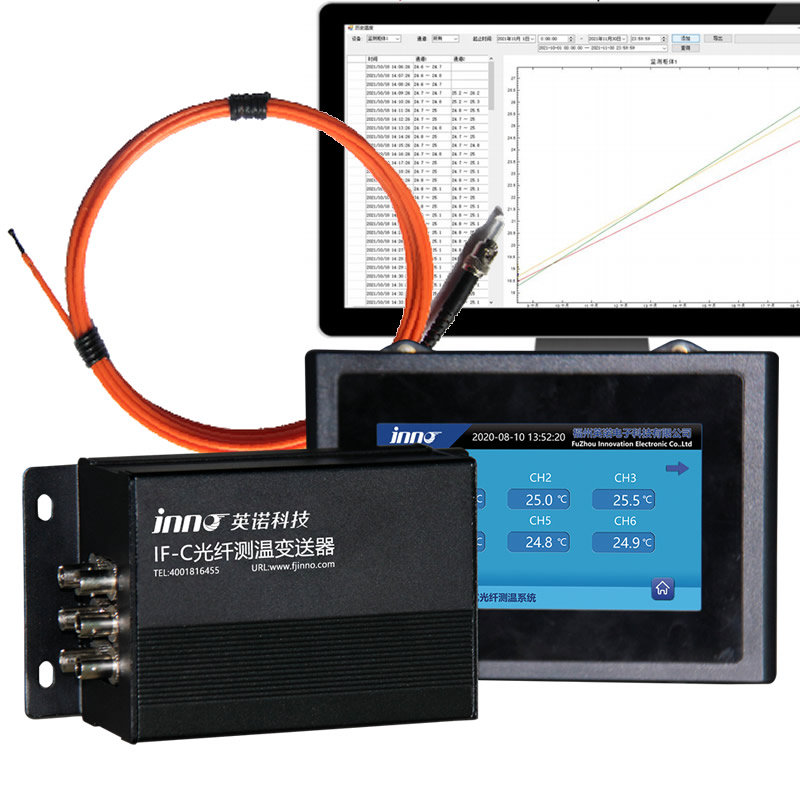
Four technologies are commercially deployed for switchgear contact temperature measurement. Each has a different operating principle, installation requirement, and suitability profile for live switchgear applications.
Comparison of switchgear temperature measurement methods
| Método | Princípio | Precisão | Imunidade EMI | Metal in HV zone | Monitoramento contínuo | Probe lifespan |
|---|---|---|---|---|---|---|
| Termografia infravermelha | Radiated IR emission, sem contato | ±2–5 °C | Alto | Não | No — periodic only | Câmera: 5–10 yr |
| Wireless temperature sensor | Termopar + RF transmitter | ±1–3 °C | Low–Medium | Sim | Sim | 3–7 yr (bateria) |
| IDT / Termopar | Resistance or EMF change with temperature | ±0,5–1 °C | Baixo | Sim | Sim | 5–15 yr |
| Fluorescence fiber optic sensor | Phosphorescence decay time vs. temperatura | ±1 °C | Imunidade completa | Não | Sim | ≥30 yr |
Why infrared thermography alone is insufficient
Portátil termografia infravermelha remains a valuable periodic audit tool, but it cannot substitute for continuous monitoring. The camera operator must open the switchgear door or use a purpose-built inspection window, the panel must be under representative load at the exact moment of the survey, and any reflective surface or viewing angle obstruction introduces measurement error. The annual or semi-annual survey interval is far too coarse to catch a contact that degrades from normal to critical over a six-week period.
Limitations of wireless temperature sensors in switchgear
Sensores de temperatura sem fio são rápidos de instalar e adequados para painéis de baixa tensão em ambientes eletromagnéticos benignos. Dentro de um meio- ou quadro de distribuição em invólucro metálico de alta tensão, no entanto, o efeito de blindagem do invólucro de aço atenua os sinais de rádio, e eventos de comutação transitórios geram ruído eletromagnético de banda larga que pode corromper pacotes de dados ou redefinir o firmware do sensor. A substituição da bateria também introduz uma tarefa de manutenção recorrente dentro de um painel ativo.
6. Why is fluorescence fiber optic sensing the best solution for switchgear temperature monitoring?

Sensor de temperatura por fibra óptica de fluorescência aborda todas as limitações dos métodos concorrentes simultaneamente. Sua adoção em aplicações exigentes de painéis de manobra – topsides offshore, subestações de tração ferroviária, instalações de fabricação de semicondutores, e infraestrutura de energia de grandes data centers — é uma consequência direta de seu princípio operacional físico e não de preferência comercial.
Como funciona a detecção de fibra óptica por fluorescência
Na ponta da sonda de fibra, uma pequena quantidade de material fosforescente é excitada por um curto pulso de luz transmitido pela fibra óptica a partir da unidade de interrogação. Quando o pulso de excitação termina, o material fosforescente emite luz que decai exponencialmente ao longo do tempo - um processo chamado decaimento de fluorescência ou decadência de fosforescência. A constante de tempo desse decaimento é estável, função reproduzível da temperatura local do material de fósforo. A unidade de interrogação mede a constante de tempo de decaimento e a converte diretamente em uma leitura de temperatura. Porque a medição depende de uma relação de tempo e não de uma intensidade de luz absoluta, é imune a perdas por flexão de fibra, contaminação do conector, e desvio de transmissão de longo prazo.
Principais vantagens técnicas
Imunidade EMI completa
The optical fiber and probe contain no metallic conductors. They are unaffected by the intense magnetic fields around busbars carrying fault currents of tens of kiloamperes, by switching transients, or by radio-frequency interference from adjacent variable speed drives. This is the property that makes sensores de temperatura de fibra óptica the engineer-of-record’s choice for high-voltage environments where wireless or metallic sensors would produce unreliable readings.
Intrinsic safety in the high-voltage zone
No electrical energy enters the switchgear enclosure through the sensing chain. The fiber introduces no ignition source, no leakage current path, and no additional dielectric stress. This property is directly relevant to compliance with arc flash safety standards such as NFPA 70E and IEC 60079 for classified locations.
Faixa de medição e precisão
O switchgear fiber optic temperature monitoring system manufactured by Fuzhou Innovation Electronic Scie&Companhia de tecnologia., Ltda. measures across a range of −20 °C a +150 °C com uma precisão de ±1 °C, using a contact measurement method that does not compromise the switchgear’s insulation performance. The system stores temperature data and alarm event records — including timestamp and threshold values — for audit and maintenance reporting.
Probe longevity
Fluorescence fiber optic probes have a design service life of no less than 30 anos — significantly longer than the battery replacement cycle of wireless sensors and the recalibration intervals required by RTD assemblies. Uma vez instalado, the probes are a maintenance-free component of the switchgear for the full operational life of the panel.
7. Why does switchgear need real-time online monitoring instead of periodic inspection?
The case for monitoramento de temperatura do painel em tempo real rests on the gap between the timescale on which thermal defects develop and the interval at which periodic inspections are practically feasible.
The detection gap in periodic inspection
Annual or semi-annual thermographic inspection of switchgear is the industry baseline for facilities without online monitoring. A contact that develops a resistive fault between two annual surveys will operate in a progressively degraded state for up to 12 months before the fault is identified. During that period, the elevated temperature accelerates insulation ageing at every adjacent surface, and a transient overload event — an entirely routine occurrence in industrial power systems — can push the contact from a manageable hotspot to a thermal runaway event in minutes.
Three-level alarm architecture
UM sistema de monitoramento contínuo de temperatura closes this gap by maintaining a persistent measurement at every contact point and evaluating each reading against a configurable alarm matrix. A typical three-level configuration operates as follows:
- Nível 1 — Advisory (approx. 70 °C absolute or 20 K above baseline): A work order is generated for investigation at the next scheduled maintenance window.
- Nível 2 — Warning (approx. 85 °C): An active fault is developing. Maintenance response within 24–48 hours.
- Nível 3 — Critical (approx. 105 °C): Imminent insulation damage. Automatic alarm transmitted to the control room via RS-485 and optionally integrated with the protection relay for load transfer or circuit trip.
Rate-of-rise as a fault indicator
Absolute temperature alone does not convey urgency. A contact at 68 °C that has been stable for six months is a planned maintenance item. The same contact at 68 °C that rose 12 °C in the past 90 minutes under constant load is an emergency. Rate-of-rise monitoring — enabled only by continuous online data — provides the second axis of alarm logic that eliminates false complacency based on temperature values that appear acceptable in isolation.
Integration with predictive maintenance
Once six to twelve months of baseline temperature data has accumulated for a well-maintained installation, the trend profile of each contact becomes a maintenance planning tool. Contacts drifting upward relative to their historical baseline are flagged for inclusion in the next planned outage scope, regardless of their absolute temperature. Fixed-interval shutdown schedules are replaced by condition-based maintenance decisions driven by measured data — reducing both unnecessary outage time and the risk of missing a developing fault.
Perguntas frequentes: Monitoramento on-line da temperatura de contato do painel de distribuição
1. What is the difference between online temperature monitoring and periodic infrared thermography?
Termografia infravermelha is a periodic audit performed by a technician with a thermal camera, typically once or twice per year. It captures a snapshot of the thermal state of the switchgear at one moment in time and only under the load conditions present during the survey. Online temperature monitoring is a permanently installed measurement system that records temperature at every monitored contact point continuously, 24 horas por dia, 365 dias por ano. The two approaches are complementary: online monitoring provides continuous coverage and alarm response; thermographic surveys provide a calibrated visual record for insurance and maintenance documentation purposes.
2. What voltage levels are compatible with fiber optic switchgear temperature monitoring?
Fluorescência sensores de temperatura de fibra óptica are voltage-agnostic. Because the sensing element contains no metallic conductors and the measurement relies entirely on optical signals, the same probe design is suitable for LV distribution boards, MV metal-clad switchgear (até 36 kV), HV gas-insulated switchgear, and transformer tap-changer compartments. The only adaptation required between voltage classes is the mechanical probe mounting arrangement and the insulation clearance maintained around the fiber cable routing.
3. How does fluorescence fiber optic sensing work in a high-voltage environment?
A light pulse travels from the interrogation unit down the optical fiber to a phosphorescent element at the probe tip. The element emits a decaying light signal whose time constant is directly proportional to the local temperature. The interrogation unit measures that time constant and outputs a calibrated temperature reading. No electrical signal of any kind enters the high-voltage zone — the entire measurement chain is optical, making it inherently immune to electromagnetic interference and introducing no dielectric risk to the switchgear insulation system.
4. What communication protocols do switchgear monitoring systems support?
A interface de comunicação padrão é RS-485 with Modbus RTU, which is natively supported by the majority of SCADA and building management systems. For substations operating under IEC 61850, protocol conversion gateways map Modbus data to GOOSE messages or MMS reports. Ethernet TCP/IP and 4G cellular interfaces are also available for remote monitoring applications where wired infrastructure to the control room is not practical.
5. How does switchgear temperature monitoring integrate with SCADA systems?
The temperature transmitter unit outputs measured values and alarm status over its RS-485 port as Modbus registers. A SCADA system with a Modbus TCP or RTU driver polls these registers at a configurable scan rate — typically every 5–30 seconds — and presents the data on the operator HMI alongside other substation measurements. Alarm events can be mapped to SCADA alarm lists, historian databases, and email or SMS notification workflows using standard integration methods that do not require bespoke software development.
6. What is a hotspot and how is it detected in switchgear contacts?
UM ponto de acesso is a localised area of elevated temperature caused by increased electrical resistance at a contact interface. It develops when a bolted joint loosens, when an oxide film forms on the contact surface, or when sustained overloading raises current density beyond the contact’s rated capacity. UM sistema de monitoramento de temperatura de fibra óptica detects hotspots by comparing the real-time temperature at each contact point against both its configured absolute alarm thresholds and its historical baseline temperature at equivalent load conditions. A contact reading significantly higher than the other two phases under the same load is a reliable hotspot indicator even if its absolute temperature remains below the first alarm level.
7. What are the IEC and IEEE standards for switchgear temperature monitoring?
The primary standard governing allowable contact temperature rises in switchgear is CEI 62271-1 (common specifications for high-voltage switchgear and controlgear). CEI 62271-200 adds requirements specific to AC metal-enclosed switchgear. Na América do Norte, IEEE C37.20.2 covers metal-clad switchgear and specifies equivalent thermal limits. NFPA 70B recommends continuous monitoring as part of a comprehensive electrical maintenance programme. The monitoring system electronics must comply with CEI 61000-4 series EMC requirements for installation in industrial environments.
8. Can switchgear temperature monitoring be retrofitted to existing panels?
Sim. Retrofit installation is one of the most common deployment scenarios. The fiber optic probes are small-diameter, flexible elements that can be routed through existing cable entry points and clipped directly onto busbar bolts or cable lug surfaces. The temperature transmitter unit mounts in the relay compartment or on the cubicle door. In most MV switchgear designs, the probes can be installed during a normal switching operation without requiring a full panel shutdown, though the exact procedure depends on the cubicle design and local safety rules.
9. Is fiber optic temperature monitoring suitable for outdoor switchgear and GIS?
Sim. O temperature transmitter unit in Fuzhou Innovation’s system is rated for ambient operation from −40 °C a +70 °C, covering the full range of climatic conditions encountered by outdoor switchyards in continental, deserto, and arctic environments. Fiber optic cables and probes are unaffected by moisture, Exposição UV, or wide thermal cycling. Para painel de distribuição isolado a gás (SIG), fiber probes can be routed through existing instrument cable penetrations without compromising the SF6 gas seal.
10. How do I know if my switchgear needs a temperature monitoring system?
Consider online switchgear contact temperature monitoring se alguma das seguintes condições se aplicar: the switchgear is more than 10 anos; the installation is critical to production or facility uptime; the panel serves loads with high harmonic content or frequent switching cycles; a previous thermographic survey identified any contacts above the advisory temperature threshold; or your insurance or compliance framework requires documented continuous monitoring. If you are unsure whether your specific installation warrants a monitoring system, entre em contato com a equipe de engenharia da Fuzhou Innovation Electronic Scie&Companhia de tecnologia., Ltda. para uma avaliação técnica sem compromisso.
Isenção de responsabilidade: As informações técnicas, limites de temperatura, e as referências padrão fornecidas neste artigo destinam-se apenas a fins educacionais gerais. Eles não constituem conselhos de engenharia para qualquer instalação específica. Projeto de quadro de distribuição, condições de operação, e os regulamentos locais aplicáveis variam significativamente. Todas as especificações do sistema de monitoramento, configurações de limite de alarme, e os procedimentos de instalação devem ser determinados por um engenheiro eletricista qualificado de acordo com as normas nacionais e internacionais relevantes e a documentação do fabricante do equipamento de manobra. Ciência Eletrônica de Inovação de Fuzhou&Companhia de tecnologia., Ltda. não aceita qualquer responsabilidade por decisões tomadas exclusivamente com base nas informações gerais contidas neste artigo.

Sensor de temperatura de fibra óptica, Sistema de monitoramento inteligente, Fabricante distribuído de fibra óptica na China
 |
 |
 |