 Światłowodowe czujniki temperatury INNO ,systemy monitorowania temperatury.
In high voltage electromagnetic interference environments, temperature monitoring using fluorescent optical fibers can be achieved by measuring fluorescence lifetime, as fluorescence lifetime is sensitive to temperature and not affected by electromagnetic interference.
1. Principle of Monitoring Temperature with Fluorescent Fiber in High Voltage Electromagnetic Interference Environment
Fluorescence fiber optic temperature measurement is a novel sensing technology based on rare earth ion doped optical fibers. When doped optical fibers are excited by specific wavelength lasers, rare earth ions absorb light energy, transition to higher energy levels, and then return to the ground state in the form of spontaneous emission, emitting fluorescence. Both fluorescence intensity and fluorescence lifetime are temperature dependent, and fluorescence fiber temperature monitoring in high-voltage electromagnetic interference environments is mainly achieved by utilizing the dependence of fluorescence lifetime on temperature.
When the temperature increases, the thermal equilibrium process of the excited st ate particle number distribution accelerates, leading to a shortened fluorescence lifetime. By measuring the fluorescence attenuation curve and fitting the data, the fluorescence lifetime can be extracted, and then the fiber temperature can be calculated. This temperature measurement method based on fluorescence lifetime has many advantages:
1.1 Wysoka precyzja: The dependence of fluorescence lifetime on temperature is more stable, unaffected by factors such as excitation light intensity, zginanie włókien, and joint loss. Na przykład, in complex industrial sites or experimental environments, even if there are various factors that may affect the measurement, fluorescent optical fibers can still accurately measure temperature.
1.2 High stability: The fluorescence lifetime is only related to the physical properties of the doped fiber core and is not sensitive to external factors such as light source fluctuations. Tymczasem, doped optical fibers have excellent physicochemical properties and can be used for a long time in harsh environments such as high temperature, wysokie ciśnienie, and strong radiation, with a service life of over 20 lata.
Silna zdolność przeciwzakłóceniowa: The extraction of fluorescence lifetime can be achieved through various time-domain and frequency-domain signal processing methods, such as phase detection, Fourier transform, itp. Even in high voltage electromagnetic interference environments with severe electromagnetic interference, such as near high-voltage switchgear or large transformers, fluorescence lifetime temperature measurement can still ensure reliable measurement.
1.3 Easy Integration: The lifetime type fluorescent fiber can be easily integrated with other czujniki światłowodowe to build a multi-scale and multi-dimensional comprehensive monitoring system. Tymczasem, the optoelectronic components such as fluorescent fiber lasers and detectors have been highly integrated and miniaturized, making them easy to apply in engineering.
The energy level structure and transition characteristics of different rare earth ions vary greatly, which determines the temperature measurement performance of fluorescent fibers. The commonly used doping ions include erbium, ytterbium, neodymium, thulium, itp. Wśród nich, erbium ion has the advantages of high lifetime temperature sensitivity and wide spectral range, and is the first choice for fluorescence temperature measurement. The optimization of parameters such as doping concentration and matrix composition can further improve the temperature measurement performance of erbium fiber.

2. Recommended equipment for fluorescence fiber temperature measurement in high-voltage electromagnetic interference environments
Here are some devices suitable for fluorescence fiber temperature measurement in high-voltage electromagnetic interference environments:
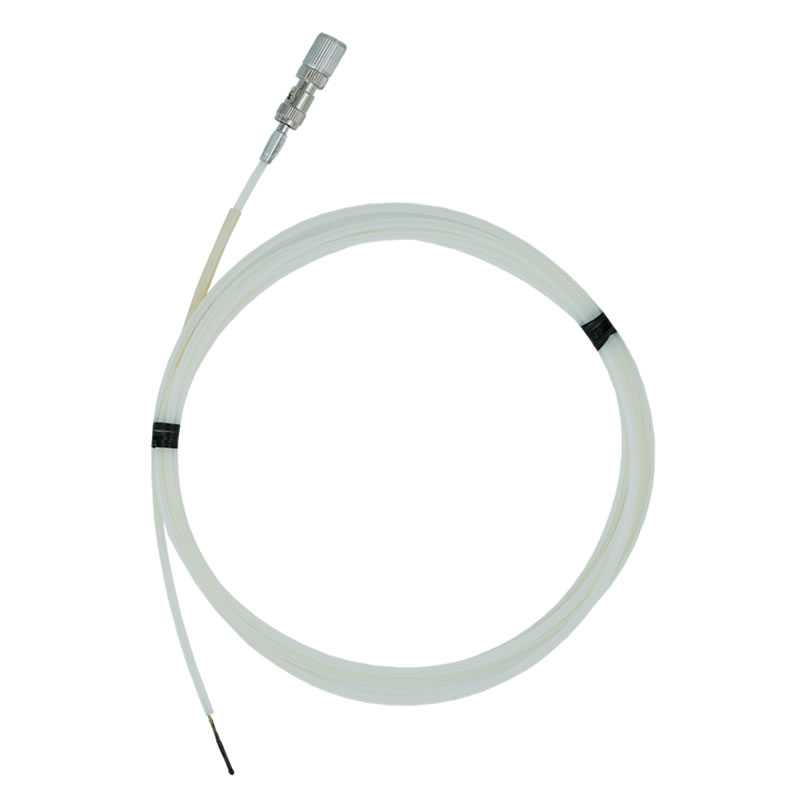
2.1. Fluorescent Fiber Optic Temperature Sensor from Fuzhou Innovation Electronic Scie&Tech Co., z oo.
Characteristics and advantages
Capable of real-time measurement of the direct temperature of the object being measured. Has strong immunity to electromagnetic interference and can work normally in harsh electromagnetic interference environments such as high voltage and strong magnetic fields. Na przykład, temperature measurement can be accurately carried out in high-voltage hotspots of electrical equipment such as dry-type transformers in rail transit, as well as in special environments such as photovoltaic equipment and high-voltage contacts of switchgear.
Adopting a single point temperature measurement method with digital signal output for easy data collection and processing. Suitable for temperature measurement in confined spaces, the probe has a minimum diameter of 600um and can also be installed and used inside some devices with limited space. The number of fluorescent fiber optic temperature measurement channels is 1-16, which can achieve multi-channel temperature measurement and meet the needs of multiple measurement points in different scenarios.
The installation method adopts USART serial port interface, a odległość między przewodem światłowodowym a ziemią wynosi 0,4 m. It can withstand a power frequency voltage of 100KV for 5 minut i ma silną odporność na napięcie. Ten czujnik jest także niezależną temperaturą measurement system, który może być wbudowany jako niezależny czujnik w światłowodowych przyrządach do pomiaru temperatury, lub podłączony jako niezależny produkt do pomiaru temperatury do innych przyrządów lub systemów, o ile system zapewnia zasilanie DC5V i interfejs portu szeregowego USART 7.
2.2 Fluorescencyjny czujnik temperatury światłowodu Fuzhou Huaguang Tianrui
Characteristics and advantages
Ma wyjątkowo silną odporność elektromagnetyczną, voltage resistance, and insulation performance. Możliwość precyzyjnego pomiaru temperatury urządzeń, takich jak styki rozdzielnic i uzwojenia transformatorów w środowiskach wysokiego napięcia i silnych zakłóceń elektromagnetycznych. Sensitive temperature sensing, long-term stable and reliable operation, dokładność pomiaru temperatury może osiągnąć ± 1 ℃.
Jego światłowodowa sonda temperatury ma unikalną konstrukcję, przy użyciu wszystkich mikrosond światłowodowych, żadnych materiałów metalowych, kompletna izolacja elektryczna, nie ma na nie wpływu wysokie napięcie i silne pola elektromagnetyczne, odporny na korozję chemiczną i wolny od zanieczyszczeń. Sonda ma niewielkie rozmiary, good flexibility, and high temperature resistance. Może osiągnąć średnicę sondy od 0,2 mm do 3 mm i minimalny promień zgięcia 5 mm lub mniej, dzięki czemu nadaje się do różnych złożonych środowisk pracy. Sonda do pomiaru temperatury może być wymienna i po wymianie nie wymaga kalibracji.
2.3. Inteligentne urządzenie do monitorowania temperatury firmy InnoTech
Characteristics and advantages
Przyjęcie zaawansowanej na arenie międzynarodowej technologii wykrywania temperatury światłowodów fluorescencyjnych, ma zalety odporności na wysokie napięcie, no electromagnetic interference, bezpieczeństwo wewnętrzne, długoterminowa niezawodność, and easy scalability. Sprzęt sprzętowy i technologia oprogramowania dostarczana przez urządzenie są zgodne z odpowiednimi wymaganiami wersji IEC i IEEE, spełniając jednocześnie standardy i wymagania branżowe.
Może być szeroko stosowany do monitorowania w czasie rzeczywistym gorących punktów, takich jak generatory, rozdzielnica wysokiego napięcia, główne jednostki pierścieniowe, napowietrzne i podziemne złącza kablowe podatne na wzrost temperatury w systemach wytwarzania i zasilania energią. Internally, Stosowane są wysokowydajne mikroprocesory klasy przemysłowej, z silnymi możliwościami przetwarzania danych i stabilną pracą. Wartość temperatury zależy od stałej czasowej charakterystyki materiału fluorescencyjnego, który ma zalety wysokiej wymienności, dobra stabilność, no need for calibration, and long lifespan. Wykorzystanie sygnału źródła światła jako wzbudzenia, sygnał czasu życia fluorescencji jest demodulowany, który ma cechy dokładnego pomiaru temperatury, high resolution, fast dynamic response, and strong anti electromagnetic interference performance. It also has an RS485 communication interface, which can realize local communication management or upload data to the upper level data management device or background.

3. Method of using fluorescent optical fiber to monitor temperature in high-voltage electromagnetic interference environment
3.1. Installation of sensor probes
Direct contact installation: Due to the characteristics of electrical insulation, bezpieczeństwo wewnętrzne, and immunity to electromagnetic interference of optical fibers, the probe of fluorescent fiber temperature sensors can be directly installed on the measured point in a contact manner. Na przykład, on high current and high voltage electrical equipment such as switchgear, knife switch, złącza kablowe, transformatory, itp., temperature anomalies of switch contacts and cable joints can be monitored at zero distance to predict possible faults and prevent electrical fires. During installation, ensure that the probe is in good contact with the surface of the object being measured to accurately conduct temperature. Na przykład, when measuring the temperature of transformer windings, the probe should be tightly attached to the surface of the winding. For irregular surfaces, special installation fixtures may be required to ensure good contact.
Selection and customization of probes: Choose probes of appropriate size and performance according to different measurement requirements and environments. Some devices have narrow measurement spaces and require the use of small-diameter probes, such as probes with a minimum diameter of 600um that can be used for temperature measurement in narrow spaces. If there are special requirements for pressure resistance, temperature resistance, or corrosion resistance, probes can also be customized. Na przykład, in some high-voltage equipment in special chemical environments, probes may require protective sheath materials that are resistant to specific chemical corrosion.
3.2. Construction and connection of measurement system
Choosing the appropriate fiber optic cable: It is necessary to select the appropriate fiber optic cable based on factors such as the voltage level and electromagnetic interference intensity of the measurement environment. Na przykład, in high voltage environments, optical fibers need to have sufficient voltage resistance. Na przykład, some optical fibers can withstand power frequency voltages exceeding 140kV within a creepage distance of 30cm, which can meet the insulation and voltage resistance requirements of switchgear and other equipment. Tymczasem, the transmission characteristics of optical fibers should be stable to ensure accurate transmission of fluorescent signals.
Connecting devices: Connect the fluorescent fiber temperature sensor correctly with related data acquisition devices, signal processing devices, and display devices. Na przykład, some sensors use the USART serial port interface for connection, and it is necessary to ensure the stability of the connection to avoid data transmission errors. If it is a multi-channel temperature measurement system, each channel should be connected according to the system requirements to ensure that each channel can work properly.
Ensure good grounding: Although the optical fiber itself is insulated, uziemienie powiązanego sprzętu powinno być dobrze wykonane w całym systemie pomiarowym. Dobre uziemienie może zmniejszyć wpływ zakłóceń elektromagnetycznych na system, poprawić dokładność i stabilność pomiaru.
3.3 Pomiary i przetwarzanie danych
Pomiar wzbudzenia i fluorescencji: Jony ziem rzadkich we włóknach fluorescencyjnych są wzbudzane przez laser o określonej długości fali w celu wytworzenia fluorescencji. Następnie użyj detektora do pomiaru parametrów, takich jak intensywność fluorescencji i czas życia fluorescencji. During the measurement process, należy zwrócić uwagę na intensywność i stabilność światła wzbudzającego, ponieważ może to mieć wpływ na intensywność sygnału fluorescencji. Stosując odpowiedni sprzęt i techniki pomiarowe, takie jak wysoki zysk, niskoszumowe fotodetektory i karty do akwizycji danych, nanosecond level fluorescence sampling can be achieved. Frequency domain demodulation schemes such as lock-in amplification and Fourier transform can further improve noise resistance and measurement speed.
Data fitting and temperature calculation: Based on the measured fluorescence attenuation curve, corresponding algorithms are used to fit the data and extract the fluorescence lifetime. Then calculate the temperature value based on the relationship between fluorescence lifetime and temperature. In this process, it is necessary to calibrate and correct the measurement data to improve the accuracy of temperature calculation. Na przykład, to consider the impact of different environmental factors on the fluorescence lifetime temperature relationship, it may be necessary to establish calibration curves for specific environments.
4. Analiza przypadku pomiaru temperatury światłowodu fluorescencyjnego w środowisku zakłóceń elektromagnetycznych o wysokim napięciu
4.1. Przypadki zastosowań w urządzeniach elektroenergetycznych
Temperature monitoring of switchgear: During the operation of the switchgear, ze względu na działanie wysokiego napięcia i dużego prądu, wewnętrzne styki przełącznika, złącza kablowe, i inne części są podatne na nagrzewanie. Jeśli temperatura jest zbyt wysoka, it can cause faults or even fires. Fluorescent fiber optic temperature measurement system is widely used for temperature monitoring of switchgear. Na przykład, a 110KV substation needs to monitor the temperature of the upper and lower static contacts, złącza kablowe, and other parts of 20 10KV switchgear cabinets (a total of 180 punkty monitorujące) using a fluorescent światłowodowy system pomiaru temperatury. The fiber optic probe is attached to the surface of the tested contact and joint, and due to the immunity of the fiber optic to electromagnetic field interference, it can accurately measure the temperature of these parts for high voltage insulation, fire and explosion prevention. The system can monitor online 24 godzin dziennie, provide over temperature warning, and truly achieve unmanned substation operation. When there is an abnormal temperature rise, an alarm signal can be quickly issued. By setting multi-level alarm temperature and auxiliary temperature rise rate abnormal alarm, potential fault hazards can be detected in a timely manner.
Monitorowanie temperatury transformatora: Transformers are key equipment in power systems, and temperature monitoring of their internal windings, iron cores, and other parts is crucial for the safe operation of transformers. In large oil immersed transformers, fluorescent optical fibers can be installed inside the heat sinks, uzwojenia, slip rings, and other parts of the transformer to achieve all-round and multi-point temperature measurement. Na przykład, in a large oil immersed transformer of a power plant, by combining a fluorescent fiber temperature sensor with a signal acquisition and processing system, the temperature changes of the transformer can be monitored in real time. Due to the fact that fiber optic sensors are not affected by electromagnetic interference, they can accurately operate in high voltage and strong electromagnetic field environments of transformers, predict fault risks, and ensure the normal operation of transformers. Ponadto, fiber optic sensors can measure in high-temperature environments, making them suitable for managing high-temperature equipment such as transformers. They can also provide high-precision, high-sensitivity, and low drift temperature measurement data, and can transmit data over long distances, effectively solving the problems of distance and signal interference in data transmission.
4.2. Application cases in industrial production
Temperature monitoring in microwave heating equipment: In some industrial production processes, such as microwave heating equipment in food processing, wymagany jest precyzyjny pomiar temperatury wewnętrznej ogrzewanego obiektu. Tradycyjne termometry termoparowe podlegają zakłóceniom elektromagnetycznym w środowiskach mikrofalowych i nie mogą dokładnie mierzyć temperatury, podczas gdy fluorescencyjne światłowodowe czujniki temperatury nie są podatne na działanie mikrofalowych pól elektromagnetycznych. Na przykład, podczas pomiaru temperatury wewnętrznej kawałków kurczaka, fluorescent fiber optic temperature sensors can accurately measure the internal temperature of the food during processing to ensure that the food can be cooked, but the surface is not burnt and presents an attractive color. This is because the sensing probe of the fluorescencyjny, światłowodowy czujnik temperatury adopts a fully fiber optic micro probe, which is free of metal materials, has complete electrical insulation, is not affected by high voltage and strong electromagnetic fields, is resistant to chemical corrosion and pollution-free. Ponadto, the temperature measuring probe has a small size and good flexibility, and can be inserted into solid materials to measure internal temperature.
Temperature monitoring in the chemical industry: In the petrochemical and other chemical industries, many equipment work in environments with high temperature, wysokie ciśnienie, strong corrosion, and high voltage electromagnetic interference, such as reaction vessels, distillation towers, pipeline valves, and other key equipment. Fluorescent optical fibers can be used for temperature monitoring of these devices. Na przykład, laying fluorescent optical fibers on the surface of reaction tanks in large chemical plants to form a temperature sensing grid. Due to the inherent safety, kompaktowy rozmiar, odporność na zakłócenia elektromagnetyczne, zakłócenia częstotliwości radiowej, and extremely high corrosion resistance of fiber optic sensors, any hot spot can be monitored, effectively preventing accidents from occurring. Tymczasem, fluorescent optical fibers can also be used for optimizing the temperature distribution of catalyst beds, which is of great significance for improving product yield and energy utilization efficiency.
5. Method for optimizing the temperature monitoring effect of fluorescent fiber in high-voltage electromagnetic interference environment
5.1. Optimize sensor performance
Choosing appropriate doping materials: The core of fluorescent fiber is a quartz matrix doped with rare earth ions. The energy level structure and transition characteristics of different rare earth ions vary greatly, which determines the temperature measurement performance of fluorescent fiber. Erbium ions have the advantages of high lifetime temperature sensitivity and wide spectral range, making them the preferred choice for fluorescence temperature measurement. Reasonably selecting doping ions and optimizing parameters such as doping concentration and matrix composition can further improve the temperature measurement performance of optical fibers, enhance the accuracy and sensitivity of temperature measurement. Na przykład, by precisely controlling the doping concentration of erbium ions, the fluorescence fiber can maintain good linearity over a wider temperature range, thereby improving the accuracy of temperature measurement.
Improving the design and manufacturing process of probes: The quality and performance of probes directly affect the temperature measurement effect. Improve the structural design of the probe, such as using special fiber optic packaging technology to enhance its resistance to electromagnetic interference and voltage resistance. Naraz, improving the accuracy of manufacturing processes, ensuring the consistency and stability of probes, and reducing measurement errors caused by individual differences in probes. Na przykład, high-precision fiber fusion splicing technology is used to ensure the quality of the connection between the fiber and the probe, avoiding losses and interference during signal transmission.
5.2. Optimize measurement system
Adopting advanced signal processing techniques: When measuring fluorescence lifetime, multiple time-domain and frequency-domain signal processing methods such as phase detection and Fourier transform can be used to improve measurement accuracy and anti-interference ability. Na przykład, using Fast Fourier Transform (FFT) to accurately calculate fluorescence lifetime can effectively eliminate the effects of light source instability and light intensity changes, and improve measurement resolution. Through these advanced signal processing techniques, fluorescence lifetime signals can be extracted more accurately in high-voltage electromagnetic interference environments, thereby improving the accuracy of temperature measurement.
Optimize the networking scheme of the system: For large-scale temperature monitoring needs, optimize the networking scheme of the fluorescence fiber optic temperature measurement system. Wavelength division multiplexing achieves the multiplexing of fluorescence signals of different wavelengths through fiber Bragg gratings, and can integrate dozens of temperature measurement nodes on a single fiber; Time division multiplexing utilizes optical switches to poll different branches, which can significantly reduce system costs. Combining these two solutions can break through the channel bottleneck of fluorescence temperature measurement, achieve high-capacity networking of hundreds of points, and reduce the impact of electromagnetic interference on the entire system. Na przykład, in large substations or chemical production workshops where temperature monitoring of numerous equipment or reaction vessels is required, this optimized networking solution can improve the overall performance and reliability of the system.
5.3. Reasonable installation and maintenance
Prawidłowy montaż sond czujnikowych: Zapewnienie dobrego kontaktu sondy z powierzchnią mierzonego obiektu ma kluczowe znaczenie dla poprawy efektywności przewodzenia temperatury i dokładności pomiaru. During installation, odpowiednią metodę montażu i urządzenie mocujące należy wybrać w oparciu o takie czynniki, jak kształt i materiał powierzchni testowanego obiektu. Na przykład, podczas instalowania sond na zakrzywionych lub chropowatych powierzchniach, w celu zapewnienia ścisłego dopasowania sondy do powierzchni mogą być wymagane specjalne mocowania lub materiały wypełniające. Naraz, należy zwrócić uwagę na wybór miejsca instalacji, aby uniknąć wpływu innych źródeł ciepła lub źródeł zakłóceń.
Regularna konserwacja i kalibracja: Regularnie konserwuj i kalibruj system monitorowania temperatury światłowodu fluorescencyjnego, check whether the fiber is damaged, whether the probe is working properly, and whether the connection is loose. Develop a reasonable calibration cycle based on the requirements of the usage environment and equipment. Na przykład, after long-term use in high voltage and strong electromagnetic interference environments, the transmission performance of optical fibers may decrease, and the sensitivity of probes may also change. Regular calibration can ensure the accuracy of measurements.

Światłowodowy czujnik temperatury, Inteligentny system monitorowania, Producent rozproszonych światłowodów w Chinach
|
|
 |