 Światłowodowe czujniki temperatury INNO ,systemy monitorowania temperatury.
- Fluorescence fiber optic temperature sensing works by measuring how fast a phosphor material stops glowing after a light pulse — the cooler the target, the slower the glow fades; the hotter it gets, the faster it fades.
- This time-based measurement principle is inherently immune to signal loss from fiber bending, starzenie się złącza, or light source degradation — giving buyers long-term accuracy without frequent recalibration.
- Three mainstream fiber optic temperature technologies exist: fluorescence lifetime, Siatka Bragga z włókna (FBG), I Rozpraszanie Ramana. Each serves different project requirements, and choosing the wrong one is a costly mistake.
- This article explains the fluorescence mechanism in plain business language, compares it with alternative fiber optic approaches, and shows procurement professionals exactly what to verify on a supplier datasheet before placing an order.
- Published by FJINNO, a fluorescence fiber optic thermometry manufacturer since 2011, this guide helps B2B buyers make technology-informed purchasing decisions with confidence.
Spis treści
- Why Procurement Professionals Need to Understand the Underlying Technology
- The Fluorescence Decay Principle — Explained Without the Physics Jargon
- Why Time-Based Measurement Beats Intensity-Based Measurement
- Three Fiber Optic Temperature Technologies Buyers Will Encounter
- Fluorescence Lifetime Sensing vs. Siatka Bragga z włókna (FBG)
- Fluorescence Lifetime Sensing vs. Raman Distributed Temperature Sensing
- When Fluorescence Is the Clear Winner — And When It Is Not
- How to Read a Fiber Optic Temperature Sensor Datasheet
- Five Red Flags That Reveal a Weak Supplier
- Matching the Right Technology to Your Project Scope
- Real-World Deployment Scenarios Where Fluorescence Sensing Delivers
- Questions Your Engineering Team Should Ask Before You Sign
- Często zadawane pytania (Często zadawane pytania)
1. Why Procurement Professionals Need to Understand the Underlying Technology

If you are sourcing a światłowodowy system pomiaru temperatury, you will encounter multiple competing technologies — all marketed under similar-sounding names. Suppliers offering fluorescence-based systems, FBG systems, and Raman systems will each claim superior performance, and their datasheets will look convincingly similar at first glance. Without a working understanding of how each technology functions, procurement teams risk selecting a system that is technically mismatched to the project environment, overpaying for capabilities they do not need, or underspecifying a system that fails in the field.
This article is not written for laboratory researchers. It is written for project buyers, procurement engineers, and sourcing managers who need to understand just enough about fluorescence optical fiber temperature sensing to evaluate supplier proposals critically, ask the right questions, and avoid expensive mistakes.
2. The Fluorescence Decay Principle — Explained Without the Physics Jargon

At the tip of every fluorescencyjna światłowodowa sonda temperatury, there is a tiny piece of phosphor material — a substance that glows briefly when hit with light. The measurement process works in three simple steps.
Step One: A Pulse of Light Travels Down the Fiber
Demodulator (the main instrument) sends a very short flash of light through the optical fiber cable to the probe tip. This is similar to a camera flash — it is on for a fraction of a second and then off.
Step Two: The Phosphor Glows and Then Fades
When the light pulse hits the phosphor, the phosphor absorbs the energy and begins to glow (fluorescencja). The moment the light pulse stops, the phosphor does not go dark instantly — it fades gradually, like the afterglow of a light bulb after you switch it off.
Step Three: The Fade Speed Tells You the Temperature
Here is the key insight: the speed at which the glow fades is directly linked to temperature. W niższych temperaturach, the glow fades slowly. W wyższych temperaturach, it fades quickly. The demodulator measures this fade speed — technically called the fluorescence decay lifetime — and converts it into a precise temperature reading.
Why Should a Buyer Care About This?
Because the measurement depends on timing (how fast the glow fades), not on how bright the glow is. This distinction has enormous practical consequences. If the fiber cable gets bent, a connector gets dirty, or the light source weakens slightly over years of service, the brightness of the return signal may decrease — but the fade speed remains unchanged. This means a fluorescence lifetime fiber optic temperature sensor stays accurate year after year without recalibration, even as the optical path degrades naturally with age.
3. Why Time-Based Measurement Beats Intensity-Based Measurement
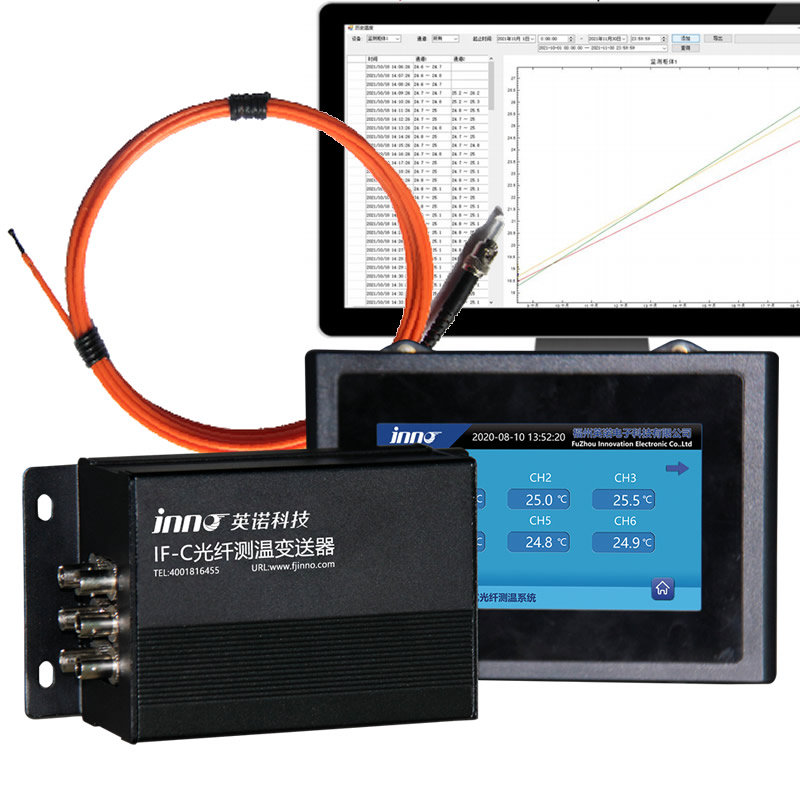
Some older or lower-cost fiber optic temperature systems measure temperature by looking at the brightness (intensywność) of the fluorescence rather than its decay speed. This approach is simpler and cheaper to build, but it introduces a fundamental weakness: anything that reduces signal brightness — fiber bending, dirty connectors, long cable runs, or LED aging — is misinterpreted as a temperature change.
For a B2B buyer, the practical difference is significant. Jakiś intensity-based fiber optic temperature sensor may require recalibration every 6–12 months and is prone to false readings if the installation is disturbed during maintenance. A fluorescence decay lifetime sensor typically holds its calibration for 2–3 years or more and is virtually unaffected by routine disturbances to the fiber path. Podczas oceny propozycji dostawców, always confirm whether the system uses lifetime-based or intensity-based measurement. This single question can separate a reliable long-term investment from a maintenance headache.
4. Three Fiber Optic Temperature Technologies Buyers Will Encounter
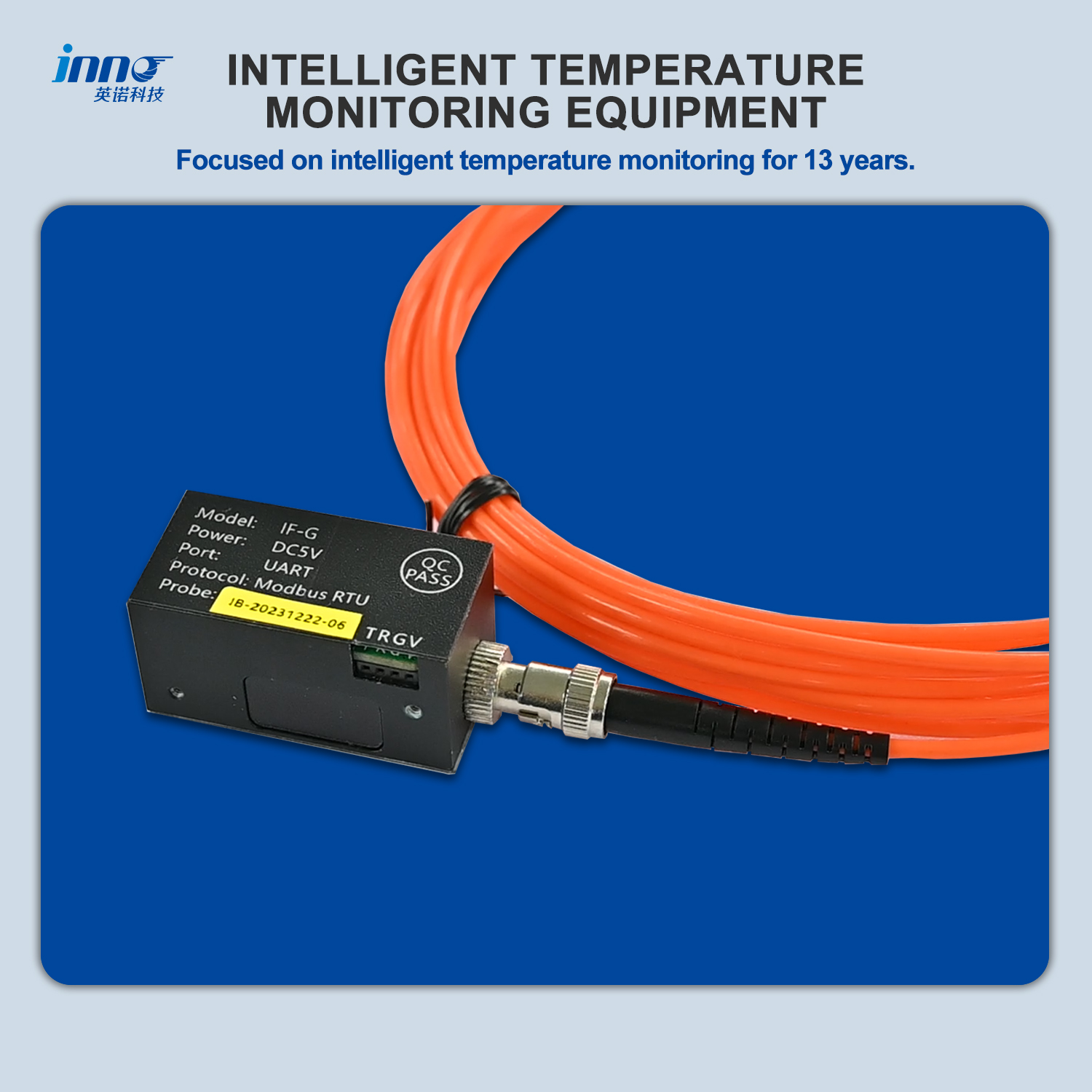
Podczas pozyskiwania optical fiber temperature measurement systems, procurement teams will encounter three mainstream technologies. Each has a fundamentally different operating principle, and each is optimized for a different type of project.
Wykrywanie czasu życia fluorescencji
Point-measurement technology. Each probe measures temperature at one specific location. Ideal for monitoring discrete hotspots on transformers, styki rozdzielnicy, battery cells, i uzwojenia silnika. Provides high accuracy (±1°C), szybka reakcja (pod 1 drugi), i pełną izolację elektryczną.
Siatka Bragga z włókna (FBG) Wyczuwanie
Quasi-distributed technology. Multiple sensing points (gratings) are written into a single fiber, allowing dozens of measurement points along one cable. Commonly used for structural health monitoring of bridges, rurociągi, and large civil structures. Less commonly used for high-voltage electrical equipment because FBG fibers can be sensitive to strain and require wavelength-stable interrogators.
Raman Distributed Temperature Sensing (DTS)

Fully distributed technology. Measures temperature continuously along the entire length of a fiber — potentially covering kilometers. Used for pipeline leak detection, fire detection in tunnels, i bezpieczeństwo obwodowe. Accuracy is lower than point sensors (typically ±1–2 °C), and spatial resolution is measured in meters rather than millimeters.
5. Fluorescence Lifetime Sensing vs. Siatka Bragga z włókna (FBG)
B2B buyers sometimes receive competing proposals from fluorescencyjny czujnik światłowodowy suppliers and Czujnik FBG suppliers for the same project. Understanding the fundamental differences helps you evaluate whether the proposed technology is appropriate.
Izolacja elektryczna
A fluorescencyjna światłowodowa sonda temperatury is completely passive at the sensing point — only light reaches the probe tip. FBG sensors are also passive, but the interrogator typically requires a broadband light source and high-resolution spectrometer, making the demodulation hardware more complex and expensive.
Sensitivity to Strain
FBG sensors are inherently sensitive to both temperature and mechanical strain. If the fiber is stretched or compressed — common in vibrating environments like motor windings or transformer tanks — the strain signal mixes with the temperature signal, introducing errors. Fluorescence sensors measure only temperature and are unaffected by mechanical strain on the fiber.
Cost per Measurement Point
For projects with fewer than 20–30 measurement points concentrated in a small area, fluorescence-based systems are typically more cost-effective. FBG systems become competitive when a project requires 50 or more measurement points distributed along a single long fiber run.
Buyer Takeaway
If your project involves high-voltage equipment, strong EMI, wibracja, or a moderate number of discrete hotspot locations, fluorescence is almost always the better fit. Jeśli Twój projekt obejmuje pomiary profili temperatur wzdłuż bardzo długich konstrukcji, FBG lub Raman mogą być bardziej odpowiednie.
6. Fluorescence Lifetime Sensing vs. Raman Distributed Temperature Sensing

Ramana DTS i czujniki punktu fluorescencyjnego w wielu przypadkach stanowią technologie uzupełniające, a nie konkurencyjne. Jednakże, niektórzy dostawcy pozycjonują Raman DTS jako zamiennik wykrywania fluorescencji, co może prowadzić do złych wyników projektu.
Precyzja vs. Zasięg
A fluorescencyjny termometr światłowodowy zapewnia dokładność ±1°C w określonym punkcie. System Raman DTS zapewnia dokładność ±1–2°C uśrednioną w przedziale rozdzielczości przestrzennej 0,5–2 metrów. Do wykrywania gorącego punktu na pojedynczej śrubie szyny zbiorczej lub określonym ogniwie akumulatora, Rozdzielczość Ramana jest zdecydowanie za gruba.
Czas reakcji
Czujniki fluorescencyjne reagują poniżej 1 drugi. Zazwyczaj wymagają tego systemy Raman DTS 30 seconds to several minutes of signal averaging to achieve acceptable accuracy, making them unsuitable for applications where temperature changes rapidly.
System Complexity and Cost
Raman DTS interrogators are significantly more expensive than fluorescence demodulators and require specialized fiber installation over long distances. For localized monitoring tasks, A fluorescencyjny, światłowodowy system pomiaru temperatury delivers superior performance at a fraction of the cost.
7. When Fluorescence Is the Clear Winner — And When It Is Not
No technology is perfect for every application. Honest guidance helps buyers avoid both over-engineering and under-engineering their monitoring systems.
Fluorescence Is the Clear Winner When:
The project requires high-accuracy point measurement (±1 °C or better) in environments with strong electromagnetic interference, Wysokie napięcie, ryzyko eksplozji, or confined spaces. Typical examples include transformer winding hotspot monitoring, switchgear contact temperature sensing, battery cell thermal monitoring, I cable joint temperature measurement.
Fluorescence May Not Be the Best Fit When:
The project requires continuous temperature profiling over distances exceeding several hundred meters (Raman DTS is better), or when more than 100 sensing points are needed along a single linear structure (FBG may be more economical). Recognizing these boundaries demonstrates supplier honesty and helps buyers trust the recommendation.
8. How to Read a Fiber Optic Temperature Sensor Datasheet

Supplier datasheets are the primary tool for comparing products, but not all datasheets present information in the same way. Here are the key specifications to focus on and what they mean for your project.
Zakres pomiarowy
Typically –40 °C to +260 °C for standard fluorescence fiber optic probes. Potwierdź, że podany zakres obejmuje z marginesem najgorsze warunki pracy. Niektórzy dostawcy podają raczej teoretyczny zakres materiału fosforowego niż zakres testowanego systemu — zawsze pytaj o specyfikacje na poziomie systemu.
Dokładność i rozdzielczość
Dokładność (±1°C) informuje, jak blisko odczytu jest rzeczywistej temperatury. Rezolucja (0.1 °C) informuje o najmniejszej zmianie, jaką może wykryć system. Obydwa mają znaczenie, ale dokładność to specyfikacja, która wpływa na decyzje dotyczące kontroli procesu. Zapytaj, czy podana dokładność dotyczy całego zakresu temperatur, czy tylko pojedynczego punktu kalibracji.
Czas reakcji
Zdefiniowany jako czas dotarcia 90% skokowej zmiany temperatury. Dla większości fluorescencyjne światłowodowe czujniki temperatury, to jest pod 1 drugi. Należy zachować ostrożność w przypadku arkuszy danych podających czas reakcji bez określenia warunków pomiaru (w powietrzu, w oleju, or in contact with metal).
Maximum Fiber Length
The distance from the demodulator to the farthest probe. Standard is 30–80 meters. If your installation requires longer runs, confirm performance specifications at the actual required distance, not just the maximum rated distance.
Channel Count
How many independent temperature points one demodulator can monitor simultaneously — usually 1 Do 64. This directly affects your per-point cost and rack space requirements.
9. Five Red Flags That Reveal a Weak Supplier
After evaluating hundreds of sourcing interactions in the światłowodowy czujnik temperatury rynek, certain patterns consistently indicate suppliers who may underdeliver.
Red Flag 1: No In-House Manufacturing
If the supplier is a trading company reselling another manufacturer’s product, you lose direct access to technical support, customization, and quality accountability. Zawsze pytaj, czy dostawca produkuje demodulator, sondy, lub oba.
Red Flag 2: Niejasne twierdzenia dotyczące dokładności
Stwierdzenia typu “wysoka dokładność” Lub “dokładny pomiar” bez określonej wartości ± w określonym zakresie temperatur są bez znaczenia. Renomowani producenci publikują sprawdzone dane dotyczące dokładności z możliwością śledzenia kalibracji.
Red Flag 3: Brak projektów referencyjnych w Twojej branży
Dostawca, który nigdy nie wdrożył rozwiązania fluorescencyjny, światłowodowy system monitorowania temperatury w Twoim konkretnym zastosowaniu (moc, magazynowanie energii, przemysłowy) możesz nie rozumieć ograniczeń instalacyjnych i wymagań środowiskowych charakterystycznych dla Twojej branży.
Red Flag 4: Brak możliwości dostosowywania
Każdy projekt ma nieco inną długość sondy, materiał osłony, prowadzenie kabli, i wymagania protokołu komunikacyjnego. Dostawcy oferujący wyłącznie stałe konfiguracje katalogowe mogą zmusić Cię do kompromisu w sprawie jakości instalacji.
Red Flag 5: Brak wsparcia technicznego po sprzedaży
Temperature monitoring systems require occasional technical support — commissioning assistance, protocol configuration, and calibration verification. If the supplier cannot provide remote engineering support in your language and time zone, post-purchase problems become your problem alone.
10. Matching the Right Technology to Your Project Scope
The most common procurement mistake is selecting a technology before fully defining the project requirements. Before requesting quotations for a światłowodowy system pomiaru temperatury, your project team should clearly define the number of discrete measurement points required, the physical distance between the farthest sensor and the monitoring room, the environmental conditions at the sensing location (ekstremalne temperatury, EMI level, klasa napięcia, narażenie chemiczne), the required communication protocol for integration with existing SCADA or DCS, and whether the installation is new-build or retrofit. Providing these details in your RFQ ensures that suppliers propose the correct technology — fluorescence, FBG, or Raman — rather than defaulting to whatever product they happen to sell.
11. Real-World Deployment Scenarios Where Fluorescence Sensing Delivers
Fuzhou Innovation Electronic Scie&Tech Co., z oo. (FJINNO) has been manufacturing fluorescence optical fiber thermometry systems od 2011. Over more than a decade of project delivery, certain deployment scenarios have consistently demonstrated the strongest return on investment for B2B buyers.
Transformatory mocy
Światłowodowe sondy temperatury embedded in transformer windings during manufacturing provide direct hotspot temperature data that oil-top thermometers and thermal imaging cannot replicate. This data enables load optimization and prevents insulation degradation.
Średni- and High-Voltage Switchgear
Continuous contact temperature monitoring with fluorescencyjne czujniki światłowodowe detects progressive resistance increases at busbar joints months before thermal failure occurs, umożliwiając planową konserwację zamiast wyłączeń awaryjnych.
Magazynowanie energii w akumulatorze litowo-jonowym
Monitoring termiczny na poziomie ogniwa z pasywnym elektrycznie światłowodowe sondy temperatury zapewnia dane krytyczne dla bezpieczeństwa potrzebne do wykrywania prekursorów niekontrolowanych temperatur bez powodowania ryzyka zapłonu w obudowie akumulatora.
Silniki i generatory przemysłowe
Monitorowanie temperatury uzwojeń stojana w dużych maszynach wirujących pracujących w pobliżu napędów o zmiennej częstotliwości, gdzie zakłócenia elektromagnetyczne sprawiają, że konwencjonalne czujniki są zawodne.
12. Questions Your Engineering Team Should Ask Before You Sign
Przed sfinalizowaniem zamówienia zakupu na fluorescencyjny, światłowodowy system pomiaru temperatury, Specjaliści ds. zakupów powinni upewnić się, że ich zespół inżynierów potwierdził odpowiedzi na te krytyczne pytania: Czy dostawca stosuje pomiar czasu życia fluorescencji lub intensywności fluorescencji i czy może wyjaśnić różnicę? What is the system-level accuracy across the full operating temperature range, not just at a single calibration point? What is the expected probe lifespan under your specific operating conditions? Can the demodulator firmware be updated in the field, or must the unit be returned to the factory? What warranty terms apply to the probes, the demodulator, and the fiber cables separately? Gathering these answers before contract execution prevents disputes and ensures the delivered system matches your technical expectations.
13. Często zadawane pytania (Często zadawane pytania)
Pytanie 1: What is fluorescence decay lifetime, and why does it matter for temperature measurement?
Fluorescence decay lifetime is the time it takes for the phosphor glow at the probe tip to fade after a light pulse. This fade time changes predictably with temperature, forming the basis of the measurement. Because it depends on timing rather than brightness, the reading is immune to signal loss from fiber aging, bending, or dirty connectors — which is why a fluorescence lifetime fiber optic sensor holds calibration far longer than intensity-based alternatives.
Pytanie 2: What is the difference between fluorescence fiber sensing and FBG fiber sensing?
Fluorescencyjne wykrywanie światłowodowe measures temperature at a discrete point using the phosphor decay principle and is immune to mechanical strain. FBG sensing uses wavelength shifts in laser light reflected by gratings written into the fiber and is sensitive to both temperature and strain. For high-voltage hotspot monitoring, fluorescence is generally preferred.
Pytanie 3: Can a fluorescence system and a Raman DTS system be used together on the same project?
Tak. Many large-scale projects use Raman DTS for distributed cable or pipeline monitoring over long distances and czujniki punktu fluorescencyjnego for precise hotspot monitoring on specific equipment. The two technologies are complementary.
Pytanie 4: How do I know if a supplier’s datasheet accuracy claim is trustworthy?
Ask for third-party calibration certificates traceable to national metrology standards. Reputable manufacturers of światłowodowe systemy pomiaru temperatury provide calibration reports showing tested accuracy at multiple temperature points across the full rated range.
Pytanie 5: What phosphor materials are used in fluorescence fiber optic probes?
The most common phosphor materials are rare-earth doped compounds and GaAs (gallium arsenide) półprzewodniki. Rare-earth phosphors are widely used for industrial temperature ranges (–40 °C to +260 °C), while GaAs probes are used for some specialized applications. Your supplier should be able to specify which material their probes use.
Pytanie 6: Is a fluorescence fiber optic system difficult for our maintenance team to operate?
NIE. Once installed and commissioned, A fluorescencyjny, światłowodowy system monitorowania temperatury operates autonomously. The demodulator outputs readings via standard protocols (Modbus, 4–20 mA) to your existing control system. Routine maintenance involves periodic visual inspection of fiber cables and occasional calibration verification — no specialized optical skills are required.
Pytanie 7: How many measurement channels do we need?
This depends entirely on how many discrete temperature points your project requires. Singiel Demodulator temperatury światłowodu obsługuje 1 Do 64 kanały. For projects with more than 64 zwrotnica, multiple demodulators can be networked together on a shared communication bus.
Pytanie 8: Can fluorescence probes be installed in oil-filled transformers?
Tak. Fluorescence fiber optic temperature probes designed for transformer applications are oil-compatible and chemically inert. They are typically installed during transformer manufacturing, embedded directly in the winding structure. Retrofit installation on existing transformers is also possible in some configurations.
Pytanie 9: What happens if a fiber cable is accidentally damaged?
A damaged fiber cable will cause the affected channel to lose signal, which the demodulator reports as a fault alarm. The demodulator and all other channels continue operating normally. The damaged cable and probe can be replaced individually without affecting the rest of the system.
Pytanie 10: How do I start a conversation with FJINNO about my project?
Kontakt Fuzhou Innovation Electronic Scie&Tech Co., z oo. (FJINNO) by email at web@fjinno.net, przez WhatsApp lub telefon pod nr +86 135 9907 0393, or through the company website at www.fjinno.net. Share your project scope, measurement point count, and operating environment, a zespół inżynierów bezpłatnie przedstawi rekomendację technologiczną i propozycję budżetu.
O producencie
Fuzhou Innovation Electronic Scie&Tech Co., z oo. (FJINNO) projektuje i produkuje fluorescence optical fiber thermometry systems od 2011. Firma obsługuje klientów B2B w całym przedsiębiorstwie energetycznym, magazynowanie energii, energia odnawialna, i produkcji przemysłowej w ponad 30 kraje.
Adres: Park przemysłowy Liandong U Grain Networking, Droga zachodnia Xingye nr 12, Fuzhou, Fujian, Chiny
E-mail: web@fjinno.net
WhatsApp / WeChat / Telefon: +86 135 9907 0393
Pytanie: 3408968340
Strona internetowa: www.fjinno.net
Zastrzeżenie: Informacje zawarte w tym artykule służą wyłącznie celom informacyjnym i edukacyjnym. Podczas gdy Fuzhou Innovation Electronic Scie&Tech Co., z oo. (FJINNO) dokłada wszelkich starań, aby zapewnić prawidłowość i kompletność treści, żadnych oświadczeń ani gwarancji, wyraźne lub dorozumiane, odbywa się pod względem dokładności, niezawodność, lub kompletność informacji. Specyfikacje produktu, porównania technologii, i przydatność zastosowania mogą się różnić w zależności od konkretnych warunków projektu. Treści te nie stanowią profesjonalnej porady inżynierskiej. Przed podjęciem decyzji dotyczących zamówienia kupujący powinni przeprowadzić niezależną analizę due diligence i skonsultować się bezpośrednio z firmą FJINNO lub wykwalifikowanymi inżynierami. FJINNO nie ponosi odpowiedzialności za jakiekolwiek straty lub szkody wynikające z polegania na informacjach przedstawionych w niniejszym dokumencie.

Światłowodowy czujnik temperatury, Inteligentny system monitorowania, Producent rozproszonych światłowodów w Chinach
 |
 |
 |