 Światłowodowe czujniki temperatury INNO ,systemy monitorowania temperatury.
- Fiber optic temperature sensors immune to electromagnetic interference use entirely non-electrical sensing principles — light-based measurement through passive glass fibers — making them the only temperature sensing technology that is fundamentally and inherently immune to EMI, RFI, microwave radiation, high-voltage electric fields, i przepięcia wywołane piorunami.
- Among the three major fiber optic temperature sensing technologies, oparte na fluorescencji (zanik fluorescencji) światłowodowe czujniki temperatury are the most widely deployed point-measurement solution for high-EMI environments, offering proven reliability, excellent accuracy (±0.1 °C to ±0.5 °C), szybka reakcja, and broad temperature range coverage from cryogenic to over 400 °C.
- Arsenek galu (GaAs) semiconductor fiber optic temperature sensors provide an alternative approach using the temperature-dependent optical absorption edge of a GaAs crystal, delivering high accuracy in a compact probe format well-suited for power transformer, rozdzielnica, and electric motor winding temperature monitoring.
- Siatka Bragga z włókna (FBG) czujniki temperatury offer wavelength-encoded, multiplexed temperature measurement along a single fiber, enabling quasi-distributed monitoring of multiple points in EMI-intensive environments such as MRI rooms, podstacje energetyczne, and electromagnetic processing equipment.
- All three technologies share the core advantage of całkowita odporność na zakłócenia elektromagnetyczne because the sensing element is purely optical — no electrical conductors, no electronic components, and no metallic pathways exist at the measurement point to couple with external electromagnetic fields.
Spis treści
- Why Electromagnetic Interference Demands Fiber Optic Temperature Sensors
- Fluorescence-Based Fiber Optic Temperature Sensors — Working Principle
- Projekt czujnika fluorescencji, Przybory, i wydajność
- Zastosowania fluorescencyjnych światłowodowych czujników temperatury w środowiskach o wysokim EMI
- Półprzewodnikowe światłowodowe czujniki temperatury GaAs
- Siatka Bragga z włókna (FBG) Czujniki temperatury
- Porównanie technologii: Fluorescencja vs. GaAs vs. FBG
- Jak wybrać odpowiedni światłowodowy czujnik temperatury odporny na zakłócenia elektromagnetyczne
- Często zadawane pytania dotyczące światłowodowych czujników temperatury odpornych na zakłócenia elektromagnetyczne
1. Dlaczego wymagane są zakłócenia elektromagnetyczne Światłowodowe czujniki temperatury

Problem EMI w pomiarze temperatury

Konwencjonalne elektroniczne czujniki temperatury — termopary, BRT (Rezystancyjne czujniki temperatury), termistory, i czujniki IC — opierają się na sygnałach elektrycznych przesyłanych przez przewodniki metalowe. Przewodniki te działają jak anteny, które wychwytują zakłócenia elektromagnetyczne z otaczających źródeł. W środowiskach o silnych polach elektromagnetycznych, indukowany szum może być wielokrotnie większy niż rzeczywisty sygnał temperatury, rendering measurements unreliable or completely unusable.
The problem is particularly severe in high-voltage power equipment (transformatory, rozdzielnica, szyny zbiorcze), industrial RF and microwave heating systems (piece indukcyjne, RF dryers, microwave curing ovens), medical imaging equipment (MRI scanners operating at 1.5 T to 7 T field strengths), kompatybilność elektromagnetyczna (EMC) komory testowe, high-power radar and antenna systems, electric vehicle motor and inverter assemblies, and plasma processing equipment. In all these environments, thermocouple and RTD signals are corrupted by common-mode and differential-mode interference, ground loops, and capacitively or inductively coupled noise. Shielding, filtracja, and signal conditioning techniques provide partial mitigation but cannot eliminate the fundamental vulnerability of electrical conductors to electromagnetic coupling.
Why Fiber Optics Are the Definitive Solution
Fiber optic temperature sensors immune to electromagnetic interference solve this problem at the most fundamental level. The sensing element is made entirely of non-conductive, non-metallic materials — glass fiber, ceramiczny, phosphor crystals, or semiconductor chips — with no electrical conductors anywhere in the sensing path. The temperature information is encoded in the properties of light (intensywność, decay time, długość fali, or spectral absorption), not in electrical voltage or current. Since optical fiber is a dielectric waveguide with no free electrons to respond to electromagnetic fields, no amount of external EMI, RFI, or magnetic field can alter the optical signal. This is not a matter of shielding or filtering — it is an intrinsic physical property of the measurement medium.
Ponadto, the optical fiber link between the sensing probe and the interrogator instrument provides complete galvanic isolation. There is no electrical connection between the measurement point and the instrument — eliminating ground loop problems, high-voltage isolation concerns, and the risk of conducted transients or lightning surges reaching the instrument through the sensor cable. This combination of EMI immunity and galvanic isolation makes fiber optic sensors the only technology class that is truly immune — not merely resistant — to electromagnetic interference.
2. Fluorescence-Based Fiber Optic Temperature Sensors — Zasada działania
The Physics of Fluorescence Decay
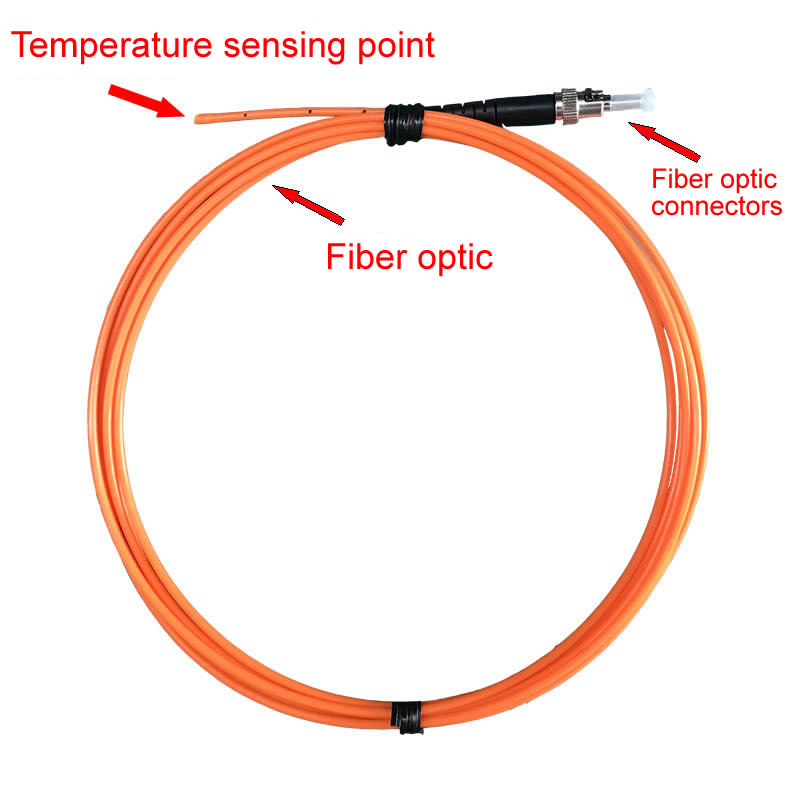
The Fluorescencyjny, światłowodowy czujnik temperatury — also known as the fluorescent decay or phosphor thermometry sensor — is the most widely used and commercially mature fiber optic temperature measurement technology for point sensing in EMI-intensive environments. Its operating principle is elegant and inherently robust.
At the tip of the optical fiber probe, a small quantity of fluorescent material (phosphor) is bonded to the fiber end face. When a pulse of excitation light — typically from an LED or laser diode in the ultraviolet or visible spectrum — is transmitted through the optical fiber and strikes the phosphor, the phosphor absorbs the excitation light and re-emits fluorescent light at a longer wavelength. Po zakończeniu impulsu wzbudzenia, the fluorescence does not stop instantly — it decays exponentially over time. The rate of this decay, characterized by the czas zaniku fluorescencji (also called the fluorescence lifetime, T), is a fundamental physical property of the phosphor material that is strongly and predictably dependent on temperature.
The relationship between fluorescence decay time and temperature arises from the thermal quenching of the phosphor’s excited electronic states. W wyższych temperaturach, non-radiative energy transfer processes (phonon-assisted relaxation) become more probable, providing competing pathways for the excited electrons to return to the ground state without emitting a photon. This increases the overall decay rate and decreases the fluorescence decay time. The result is a monotonic, well-characterized, and highly repeatable relationship between decay time τ and temperature T, typically described by an Arrhenius-type equation:
1/T(T) = 1/τ₀ + A · exp(−ΔE / kT)
gdzie τ₀ jest wewnętrznym czasem życia promieniowania, A jest przedwykładniczą stałą szybkości, ΔE jest energią aktywacji dla hartowania bezpromienistego, oraz k jest stałą Boltzmanna. Równanie to pokazuje, że czas zaniku maleje wykładniczo wraz ze wzrostem temperatury — zależność ta zapewnia zarówno wysoką czułość, jak i szeroki zakres dynamiki.
Dlaczego czas zaniku jest optymalnym pomiarem
Krytyczną zaletą pomiaru czasu zaniku fluorescencji – a nie intensywności fluorescencji – jest to, że czas zaniku jest nieodłączną czasową właściwością materiału luminoforowego. Jest ona całkowicie niezależna od natężenia światła wzbudzającego, straty transmisji światłowodu, straty na złączu, straty zginania włókien, Starzenie się diod LED, i zmiany czułości detektora. Dzięki temu pomiar jest samoodnoszący się i odporny na wszystkie mechanizmy dryfu, które nękają czujniki optyczne oparte na intensywności. A fluorescencyjny, światłowodowy czujnik temperatury nie wymaga ponownej kalibracji po ponownym podłączeniu złączy, gdy włókno jest ponownie poprowadzone, lub gdy moc diod LED pogarsza się w miarę upływu lat. Ta długoterminowa stabilność, w połączeniu z całkowitą odpornością na zakłócenia elektromagnetyczne, to właśnie sprawia, że czujniki fluorescencyjne są dominującym wyborem w przypadku instalacji stałych w trudnych warunkach elektromagnetycznych.
Przetwarzanie sygnału i ekstrakcja temperatury
Przyrząd pytający w systemie opartym na fluorescencji wykonuje następujący cykl pomiarowy. Pierwszy, napędza krótki impuls wzbudzenia (zazwyczaj czas trwania 10–100 µs) przez światłowód do sondy fosforowej. Po zakończeniu impulsu wzbudzenia, przyrząd przechwytuje wykładniczo zanikający sygnał fluorescencji powracający przez to samo włókno. Szybki przetwornik analogowo-cyfrowy digitalizuje krzywą zaniku, oraz algorytm cyfrowego przetwarzania sygnału dopasowuje funkcję zaniku wykładniczego do przechwyconych danych w celu wyodrębnienia stałej czasowej zaniku τ. Następnie przyrząd stosuje zapisaną krzywą kalibracji w celu przeliczenia τ na temperaturę. Cały ten cykl zazwyczaj kończy się w 0.1 Do 1 drugi, dostarczanie aktualizacji temperatury w czasie rzeczywistym.
Zaawansowane interrogatory wykorzystują wyrafinowane algorytmy dopasowywania krzywych – w tym dopasowywania wielowykładniczego, wykrywanie wrażliwe na fazę, oraz techniki cyfrowego blokowania — w celu wyodrębnienia czasu zaniku z dużą precyzją, nawet w obecności światła tła, autofluorescencja włókien, i szum elektroniczny. Niektóre systemy wykorzystują również techniki współczynnikowo-metryczne, które porównują intensywność fluorescencji w dwóch różnych pasmach długości fal (współczynnik fluorescencji przy dwóch długościach fali) jako dodatkowa lub uzupełniająca metoda ekstrakcji temperaturowej.
3. Projekt czujnika fluorescencji, Przybory, i wydajność

Materiały fosforowe
Wybór fluorescencyjnego materiału fosforowego określa użyteczny zakres temperatur, wrażliwość, dokładność, i długoterminową stabilność czujnika. W celach komercyjnych wykorzystuje się kilka rodzin fosforów fluorescencyjne światłowodowe czujniki temperatury.
Kryształy i ceramika domieszkowane pierwiastkami ziem rzadkich są najczęstszą klasą luminoforów do przemysłowych czujników temperatury. Fluorogermanian magnezu domieszkowany czterowartościowym manganem (Mg₄FGeO₆:Mn) był jednym z najwcześniejszych luminoforów stosowanych w termometrii światłowodowej i pozostaje w użyciu w umiarkowanych zakresach temperatur (-50°C do +200 °C). Czas zaniku fluorescencji w temperaturze pokojowej wynosi około 3–5 ms, zapewniając mocne, sygnał łatwy do zmierzenia.
Granat itrowo-aluminiowy domieszkowany pierwiastkami ziem rzadkich (YAG) kryształy — takie jak Cr:YAG, Dy:YAG, and Er:YAG — offer significantly extended temperature ranges. Chromium-doped YAG (Cr:YAG) operates effectively from −100 °C to +450 °C with a room-temperature decay time of approximately 1.5 SM. Dysprosium-doped YAG (Dy:YAG) pushes the upper limit beyond 400 °C. These materials offer exceptional chemical stability, resistance to radiation damage, and minimal aging — critical for long-life industrial installations.
Ruby (Cr:Al₂O₃) — chromium-doped aluminum oxide — is a classic phosphor thermometry material with a well-characterized R-line fluorescence whose decay time varies from approximately 3.5 ms at room temperature to sub-millisecond values above 400 °C. Ruby probes are used in both industrial and scientific temperature measurement applications.
Alexandrite (Cr:BeAl₂O₄) provides high sensitivity in the 0 °C do 300 °C range and has been used in medical and biomedical fiber optic thermometry applications.
For cryogenic temperature measurement, rare-earth doped phosphors such as Eu:Y₂O₃ (europium-doped yttria) and Tb:La₂O₂S (terbium-doped lanthanum oxysulfide) offer strong fluorescence and measurable decay time changes at temperatures well below −100 °C, extending coverage down to liquid nitrogen temperatures and beyond.
Probe Construction
The fluorescent probe is the heart of the sensor. In a typical construction, a small phosphor element (approximately 0.3–1.0 mm in size) is bonded to the tip of a multimode optical fiber (typically 100–600 µm core diameter) using a high-temperature adhesive or fusion process. The phosphor may be in the form of a single crystal chip, a pressed ceramic pellet, or a thin coating of phosphor powder in a binder matrix. The probe tip is then encapsulated in a protective tube — typically stainless steel, ceramiczny (alumina or zirconia), or PTFE — depending on the operating environment.
Całkowita średnica zespołu sondy waha się od mniej niż 1 mm for minimally invasive medical probes to 3–6 mm for ruggedized industrial probes. Probe lengths range from a few centimeters to custom lengths for specific installation geometries. The optical fiber connecting the probe to the interrogator can be tens to hundreds of meters long — providing the physical separation between the measurement point (in the high-EMI zone) and the instrument (in a control room or safe area).
Performance Specifications
| Parametr | Standard Fluorescence Sensor | High-Performance Fluorescence Sensor |
|---|---|---|
| Zakres temperatur | -40°C do +200 °C | −200 °C to +450 °C |
| Dokładność | ±0,5°C | ±0,1°C do ±0,2°C |
| Rezolucja | 0.1 °C | 0.01 °C |
| Czas reakcji (T90) | 0.5–3 sekundy | 0.1–0,5 sekundy |
| Szybkość pomiaru | 1–4 Hz | Aż do 10 Hz |
| Liczba kanałów | 1–4 | 4–32 |
| Długość włókna (sonda do instrumentu) | Aż do 200 M | Aż do 1,000 M |
| Średnica sondy | 1–3 mm | 0.5–6 mm |
| Długoterminowa stabilność | ±0,1°C/rok | ±0,05°C/rok |
| Odporność EMI | Kompletny (nieodłączny) | Kompletny (nieodłączny) |
| Izolacja galwaniczna | Całkowity (brak ścieżki elektrycznej) | Całkowity (brak ścieżki elektrycznej) |
4. Zastosowania fluorescencyjnych światłowodowych czujników temperatury w środowiskach o wysokim EMI
Monitorowanie temperatury gorącego punktu transformatora mocy
Monitorowanie temperatury gorącego punktu uzwojenia transformatorów mocy jest największym pojedynczym zastosowaniem fluorescencyjne światłowodowe czujniki temperatury na całym świecie. Wewnątrz transformatora mocy wysokiego napięcia, uzwojenia pracują przy napięciu od dziesiątek do setek kilowoltów, otoczone intensywnymi polami magnetycznymi i zanurzone w oleju izolacyjnym. Żadnego konwencjonalnego czujnika elektrycznego nie można w sposób niezawodny umieścić bezpośrednio na przewodach uzwojenia — różnica napięcia między uzwojeniem a uziemionym przyrządem zniszczyłaby wszelkie połączenia metalowe, a środowisko pola elektromagnetycznego mogłoby zepsuć każdy sygnał elektryczny.
Fluorescencyjne światłowodowe sondy temperatury instalowane są bezpośrednio na powierzchni uzwojenia transformatora podczas produkcji. Światłowód wychodzi z kadzi transformatora przez penetrator światłowodowy i łączy się z interrogatorem zamontowanym na zewnątrz transformatora lub w pobliskiej szafie sterowniczej. Ponieważ włókno jest całkowicie nieprzewodzące, it provides complete high-voltage isolation — withstanding the full winding voltage without any isolation barrier. And because the fluorescence decay-time signal is completely immune to the transformer’s magnetic field, the measurement is accurate and noise-free regardless of loading conditions.
Accurate winding hot-spot temperature data enables dynamic transformer rating (DTR), predictive thermal aging analysis, optimized load dispatch, and early fault detection. Normy międzynarodowe, w tym IEC 60076-2 and IEEE C57.91 reference fiber optic sensing as the preferred method for direct hot-spot measurement. Główni producenci transformatorów na całym świecie — w tym Siemens Energy, Energia Hitachi (WĄTEK), GE Vernova, TBEA, i inne — rutynowo określają fluorescencyjne światłowodowe czujniki temperatury jako standardowe wyposażenie średnich i dużych transformatorów mocy.
Switchgear and Busbar Temperature Monitoring
Rozdzielnice średniego i wysokiego napięcia oraz połączenia szyn zbiorczych pracują przy napięciach do 40.5 kV (i wyższe w systemach GIS), creating hostile EMI environments for any metallic sensor. Contact degradation, korozja, and loose connections cause localized overheating that, if undetected, leads to catastrophic failure and arc flash events. Fluorescence fiber optic temperature sensors immune to electromagnetic interference are installed directly on busbar joints, styki wyłącznika, and cable terminations inside switchgear enclosures. The sensors provide continuous, real-time temperature monitoring with no risk of compromising the insulation coordination of the equipment — a critical safety consideration that disqualifies all metallic sensor technologies.
Electric Motor and Generator Winding Monitoring
Large electric motors and generators present similar challenges — high-voltage windings surrounded by rotating magnetic fields. Embedded fluorescence fiber optic probes measure stator winding temperature directly, replacing or supplementing conventional RTD installations. The fiber optic sensors provide faster response, większa dokładność, and complete immunity to the motor’s electromagnetic environment, improving thermal protection and enabling more aggressive loading strategies.
MRI-Compatible Temperature Measurement
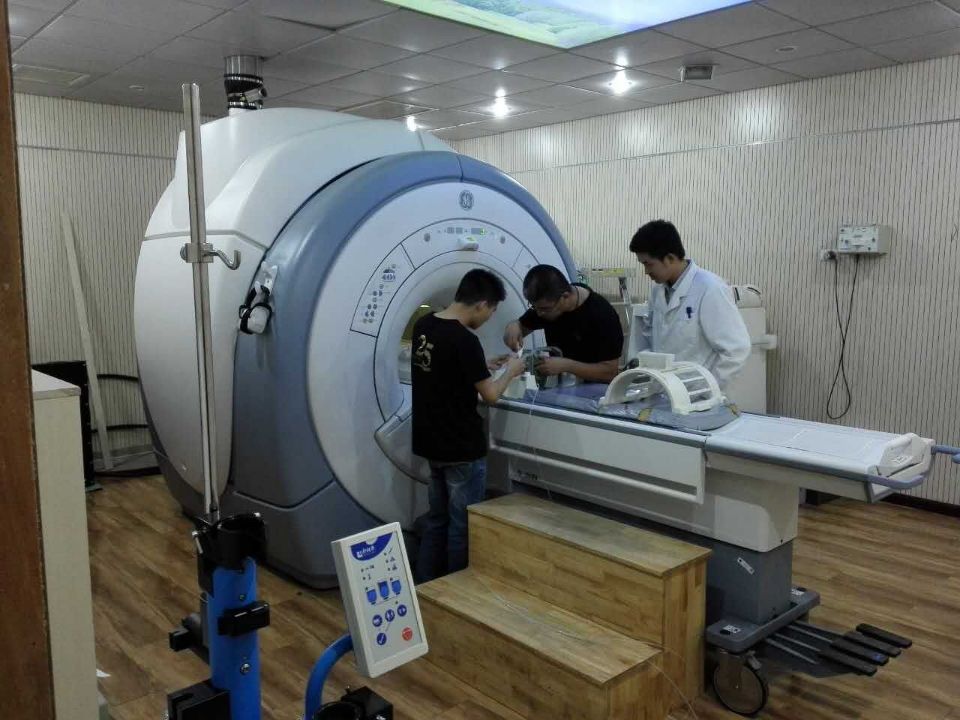
Rezonans magnetyczny (MRI) scanners generate static magnetic fields of 1.5 T to 7 T (30,000 Do 140,000 times the Earth’s magnetic field) along with rapidly switching gradient fields and high-power RF pulses. No metallic sensor or wire can be introduced into the MRI bore without creating artifacts in the image, experiencing induced heating (potentially dangerous to patients), or producing corrupted temperature signals. Fluorescencyjne czujniki światłowodowe, being entirely non-metallic and non-magnetic, are fully MRI-compatible. They are used for patient temperature monitoring during MRI-guided procedures, phantom calibration, i zapewnienie jakości terapii cieplnej pod kontrolą MRI (np., laser ablation, focused ultrasound) gdzie dokładna znajomość temperatury tkanki jest niezbędna dla bezpieczeństwa i skuteczności leczenia.
Procesy ogrzewania RF i mikrofalowego
Industrial RF heating (dielectric heating, Spawanie RF, RF drying) i obróbka mikrofalowa (microwave curing, sintering, food processing) generują intensywne pola elektromagnetyczne, które praktycznie uniemożliwiają konwencjonalny pomiar temperatury. Fluorescencyjne światłowodowe czujniki temperatury to standardowa metoda pomiaru temperatury wewnątrz aplikatorów RF i mikrofalowych, zapewniając dokładne informacje zwrotne dotyczące temperatury w czasie rzeczywistym w celu kontroli procesu. Całkowicie dielektryczna sonda czujnika nie wchodzi w interakcję z polem RF/mikrofalowym, nie zniekształca rozkładu pola, i nie ulega samonagrzewaniu – są to problemy nieodłącznie związane z każdym metalowym czujnikiem umieszczonym w środowisku RF/mikrofalowym.
Kompatybilność elektromagnetyczna (EMC) Testowanie
W komorach testowych EMC (komory bezechowe, komory pogłosowe, Komórki GTEM), w których sprzęt poddawany jest działaniu pól elektromagnetycznych o dużym natężeniu w celu sprawdzenia zgodności, jakikolwiek metalowy czujnik lub kabel wprowadzony do objętości testowej zniekształciłby pole i unieważnił test. Fluorescencyjne czujniki światłowodowe zapewniają monitorowanie temperatury testowanego sprzętu (UE) without electromagnetic interference with the test environment.
Additional High-EMI Applications
Other important application areas for światłowodowe czujniki temperatury odporne na zakłócenia elektromagnetyczne based on fluorescence technology include high-power semiconductor laser diode temperature monitoring, electric vehicle battery pack thermal management during EMC testing, induction heating process control, plasma processing equipment monitoring, high-power radar and antenna system thermal monitoring, railway traction transformer and converter monitoring, and nuclear magnetic resonance (NMR) spectroscopy sample temperature control.
5. Półprzewodnikowe światłowodowe czujniki temperatury GaAs
Zasada działania
The GaAs (Arsenek galu) światłowodowy czujnik temperatury uses a fundamentally different physical mechanism from fluorescence decay — the temperature-dependent optical absorption edge of a semiconductor crystal. Gallium Arsenide is a direct bandgap semiconductor whose bandgap energy decreases linearly with increasing temperature, following the well-known Varshni equation. As the bandgap decreases, krawędź absorpcji optycznej – długość fali, przy której materiał przechodzi z przezroczystego w nieprzezroczysty – przesuwa się w stronę dłuższych fal (przesunięcia ku czerwieni).
W światłowodowym czujniku temperatury GaAs, cienki kryształowy chip GaAs (zazwyczaj o grubości 100–300 µm) jest montowany na końcu światłowodu. Szerokopasmowe światło ze źródła LED przesyłane jest przez włókno do chipa GaAs. Długości fal krótsze niż krawędź absorpcji są pochłaniane przez GaAs; wavelengths longer than the absorption edge are transmitted (or reflected, in some configurations) back through the fiber. The returned spectral signal shows a sharp transition — the absorption edge — whose spectral position is determined by the chip temperature. A spectrometer or wavelength-selective detector in the interrogator measures the edge position and converts it to temperature using a calibration curve.
The absorption edge of GaAs shifts at approximately 0.4 nm/°C, providing good temperature sensitivity. The bandgap transition is a fundamental thermodynamic property of the crystal lattice, ensuring excellent repeatability and stability. Like fluorescence sensors, GaAs sensors are completely non-electrical at the sensing point, providing inherent immunity to electromagnetic interference and complete galvanic isolation.
Advantages and Limitations of GaAs Sensors
GaAs semiconductor sensors offer several attractive characteristics. The measurement principle is based on a fundamental material property (bandgap energy), providing inherent long-term stability with minimal calibration drift. The sensor has no moving parts and no consumable materials (unlike phosphors that could theoretically degrade under extreme conditions). The GaAs chip is compact and can be packaged in very small probe formats. The temperature response is essentially linear over the practical measurement range, simplifying signal processing.
The typical operating range of a GaAs fiber optic temperature sensor jest w przybliżeniu -40°C do +250 °C, with accuracy of ±0,5°C do ±1°C and resolution of 0.1 °C. This range covers most power equipment and industrial monitoring applications. The upper temperature limit is constrained by the GaAs bandgap becoming too narrow (the absorption edge shifts into the near-infrared beyond the detector range) and by the thermal stability of the packaging materials.
Compared to fluorescence sensors, GaAs sensors are generally less accurate at the high-performance end (±0.5 °C vs. ±0.1 °C achievable with fluorescence), have a narrower maximum temperature range, and require a spectrometric detector system (increasing interrogator complexity and cost). Jednakże, GaAs sensors have the advantage of a purely passive sensing element with no optical excitation/emission process, and some manufacturers and users prefer the perceived simplicity and long-term stability of the semiconductor absorption-edge mechanism.
Primary Applications
GaAs fiber optic temperature sensors are primarily used in power transformer winding temperature monitoring — where they compete directly with fluorescence sensors — as well as in switchgear hot-spot monitoring, electric motor winding monitoring, and generator temperature monitoring. Several major transformer manufacturers offer GaAs-based fiber optic temperature monitoring as an option alongside or instead of fluorescence-based systems. GaAs sensors are also used in certain medical applications where MRI compatibility is required and the temperature range is moderate.
6. Siatka Bragga z włókna (FBG) Czujniki temperatury
Zasada działania
A Siatka Bragga z włókna (FBG) czujnik temperatury is based on a periodic modulation of the refractive index written directly into the core of a single-mode optical fiber using ultraviolet laser exposure. This grating structure reflects a narrow band of wavelengths centered at the Bragg wavelength (λ_B), which is determined by the grating period (Λ) and the effective refractive index (n_eff) of the fiber core according to the Bragg condition: λ_B = 2 · n_eff · Λ. Kiedy zmienia się temperatura, both the refractive index (through the thermo-optic effect) and the grating period (through thermal expansion) zmiana, causing the Bragg wavelength to shift. This shift is approximately 10–13 pm/°C Na 1550 nm wavelength for standard silica fiber.
The interrogator instrument illuminates the fiber with broadband light and monitors the reflected Bragg wavelength using a spectrometer, tunable filter, or interferometric detection system. By tracking the wavelength shift, the system determines the temperature change at the grating location. The key distinguishing feature of FBG sensors is wavelength encoding — the temperature information is encoded in the wavelength of reflected light, not in its intensity. This makes the measurement inherently immune to light source power fluctuations, fiber loss variations, and connector loss changes — similar to the self-referencing advantage of fluorescence decay-time measurement.
Możliwość multipleksowania
The most significant advantage of FBG sensors over fluorescence and GaAs point sensors is wavelength-division multiplexing (WDM). Multiple FBGs, each written at a slightly different Bragg wavelength, can be inscribed along a single optical fiber. A single interrogator can simultaneously read 10 Do 50+ FBG sensors distributed along one fiber by distinguishing their individual reflected wavelength peaks. This provides quasi-distributed multi-point temperature measurement using a single fiber cable — dramatically reducing cabling complexity in applications requiring many measurement points.
Na przykład, in a power transformer application, a single fiber cable with 10 FBG sensors can monitor winding temperature at 10 different locations using only one fiber penetration through the tank wall. In a tunnel or industrial duct, an FBG array can monitor temperature at dozens of points along a single fiber run. This multiplexing capability is unique to FBG technology and is not available with fluorescence or GaAs point sensors (which require one fiber per measurement point).
Performance and Limitations
Standard Czujniki temperatury FBG offer accuracy of ±0,5°C do ±1°C, resolution of 0.1 °C do 1 pm wavelength, and operating ranges from -40°C do +300 °C (with high-temperature gratings extending to +800 °C or higher using regenerated or femtosecond-inscribed FBGs). Response time depends on the thermal coupling of the fiber to the measurement target and is typically 0.1 Do 1 drugi.
The primary limitation of FBG sensors for temperature-only applications is cross-sensitivity to strain. The Bragg wavelength shifts with both temperature and mechanical strain (około 1.2 pm/µε), and the two effects cannot be distinguished from a single wavelength measurement alone. For pure temperature measurement, the FBG must be installed in a strain-free mounting — typically housed in a loose protective tube that allows the fiber to expand and contract freely without mechanical constraint. If both temperature and strain are of interest (jak w przypadku monitorowania stanu konstrukcji), Do oddzielenia dwóch efektów stosuje się konfiguracje z podwójną siatką lub siatki referencyjne.
Interrogator do systemów FBG jest na ogół droższy niż interrogator fluorescencyjny ze względu na wymagania dotyczące precyzyjnego pomiaru długości fali. Jednakże, gdy koszt jest amortyzowany przez wiele multipleksowanych czujników na jednym włóknie, koszt punktowy może być konkurencyjny lub nawet niższy niż w przypadku wielu jednopunktowych systemów fluorescencyjnych.
Zastosowania w środowiskach EMI
Czujniki temperatury z siatką Bragga, jak wszystkie czujniki światłowodowe, zapewniają całkowitą odporność na zakłócenia elektromagnetyczne. Stosowane są w transformatorach mocy (wielopunktowe monitorowanie uzwojenia pojedynczym włóknem), mapowanie temperatury stojana generatora, monitorowanie złączy kablowych wysokiego napięcia, Tablice temperatur kompatybilne z MRI, wind turbine lightning-exposed blade monitoring, railway traction systems, and high-energy physics experimental facilities (particle accelerators, fusion reactors) where intense electromagnetic fields and radiation are present.
7. Porównanie technologii: Fluorescencja vs. GaAs vs. FBG
| Parametr | Zanik fluorescencji | Półprzewodnik GaAs | Siatka Bragga z włókna (FBG) |
|---|---|---|---|
| Zasada wyczuwania | Fluorescence decay time of phosphor | Bandgap absorption edge shift of GaAs | Bragg wavelength shift of UV-inscribed grating |
| Odporność EMI | Kompletny (nieodłączny) | Kompletny (nieodłączny) | Kompletny (nieodłączny) |
| Zakres temperatur | −200 °C to +450 °C | -40°C do +250 °C | -40°C do +300 °C (standard); Do +800 °C (special) |
| Dokładność | ±0.1 °C to ±0.5 °C | ±0,5°C do ±1°C | ±0,5°C do ±1°C |
| Rezolucja | 0.01–0.1 °C | 0.1 °C | 0.1 °C |
| Czas reakcji | 0.1–3 s | 0.5–3 s | 0.1–1 s |
| Multipleksowanie | NIE (1 fiber per point) | NIE (1 fiber per point) | Tak (10–50+ points per fiber) |
| Wrażliwość na napięcie | Nic | Nic | Tak (cross-sensitive; wymaga izolacji) |
| Długoterminowa stabilność | Doskonały | Doskonały | Good to Excellent |
| Interrogator Cost | Średni | Średnio-wysoki | Wysoki (but per-point cost lower with multiplexing) |
| Probe Size | 0.5–6 mm diameter | 1–4 mm diameter | Fiber diameter (125–250 µm); packaging varies |
| Primary Application | Transformatory, rozdzielnica, MRI, RF heating | Transformatory, rozdzielnica | Monitorowanie wielopunktowe, structural, transformatory |
| Market Maturity | Bardzo wysoki (30+ lata) | Wysoki (25+ lata) | Wysoki (20+ lata) |
Which Technology Should You Choose?
For most single-point or small-channel-count temperature measurement applications in high-EMI environments — particularly power transformer winding hot-spot monitoring, monitorowanie rozdzielnic, and MRI-compatible sensing — the fluorescencyjny, światłowodowy czujnik temperatury remains the best overall choice due to its combination of wide temperature range, wysoka dokładność, proven long-term stability, mature supply chain, and competitive cost. It is the “default” technology for EMI-immune point temperature measurement and the one recommended by international standards for transformer applications.
The GaAs fiber optic temperature sensor is a viable alternative for power equipment monitoring, particularly when offered by manufacturers who have established long-term performance records with this technology. The choice between fluorescence and GaAs in transformer applications often comes down to manufacturer preference and supply chain relationships rather than fundamental technical superiority.
The FBG temperature sensor is the preferred choice when multiple temperature measurement points are required along a single fiber path — providing significant installation and cabling advantages over deploying many individual fluorescence or GaAs probes. Jednakże, care must be taken to ensure strain-free mounting for accurate temperature-only measurement, and the higher interrogator cost must be justified by the multiplexing benefit.
8. Jak wybrać odpowiedni światłowodowy czujnik temperatury odporny na zakłócenia elektromagnetyczne
Application Assessment
The first step in selecting a fiber optic temperature sensor immune to electromagnetic interference is to clearly characterize your application requirements. Key questions include: What is the temperature range to be measured? What accuracy and resolution are required? How many measurement points are needed? What is the distance from the sensing point to the instrument location? What are the environmental conditions at the sensing point (temperatura, wilgoć, wibracja, narażenie chemiczne)? What is the nature and intensity of the electromagnetic interference? What output and communication interfaces are required? The answers to these questions will narrow the technology choice and guide the selection of specific products.
Vendor Evaluation
When evaluating vendors, look for manufacturers with proven track records in your specific application area. For power transformer applications, the supplier should have thousands of installed probes in field operation with documented long-term performance data. For MRI applications, czujnik musi zostać wyraźnie przetestowany i certyfikowany pod kątem zgodności z rezonansem magnetycznym przy odpowiednim natężeniu pola. Do zastosowań w procesach przemysłowych, konstrukcja sondy i materiały muszą być kompatybilne ze środowiskiem procesowym. Poproś o specyfikacje techniczne z jasno określoną dokładnością, stabilność, i oceny środowiskowe — i poproś o niezależną weryfikację lub instalacje referencyjne, w których można potwierdzić działanie.
Rozważania dotyczące integracji systemu
Zastanów się, jak światłowodowy system pomiaru temperatury integruje się z istniejącą infrastrukturą monitorowania i sterowania. Nowoczesne interrogatory zazwyczaj zapewniają wyjścia analogowe (4–20 mA), komunikacja cyfrowa (Modbus RTU/TCP, IEC 61850 do zastosowań w zakładach energetycznych, OPC UA dla automatyki przemysłowej), przekaźnikowe styki alarmowe, i interfejsy internetowe. Do systemów wielokanałowych, ensure the interrogator supports the required number of channels and measurement rate. For permanent installations, specify ruggedized fiber optic connectors (E2000, SC/APC) and fiber routing hardware that protects the fiber from mechanical damage during installation and operation.
9. Często zadawane pytania dotyczące światłowodowych czujników temperatury odpornych na zakłócenia elektromagnetyczne
Pytanie 1: Why are fiber optic temperature sensors immune to electromagnetic interference?
Fiber optic temperature sensors immune to electromagnetic interference achieve this immunity because the entire sensing path — from the measurement point through the fiber to the interrogator — is made of non-conductive, dielectric materials. Optical fiber is glass, and the sensing elements are phosphor crystals, semiconductor chips, or grating structures. With no metallic conductors or electronic components at the sensing point, there are no pathways for electromagnetic fields to couple into and corrupt the measurement signal. The temperature information is carried by light, not by electrical current or voltage, and electromagnetic fields do not affect the propagation of light in glass fiber.
Pytanie 2: What is the most common type of EMI-immune fiber optic temperature sensor?
The oparte na fluorescencji (zanik fluorescencji) światłowodowy czujnik temperatury is the most widely deployed EMI-immune fiber optic temperature sensing technology worldwide. Its dominance is due to the combination of high accuracy, wide temperature range, doskonała długoterminowa stabilność, mature manufacturing supply chain, and proven field performance over three decades of commercial deployment in power transformers, rozdzielnica, and other high-EMI applications.
Pytanie 3: How does a fluorescence fiber optic temperature sensor work?
A fluorescencyjny, światłowodowy czujnik temperatury works by measuring the fluorescence decay time of a phosphor material bonded to the optical fiber tip. The interrogator sends a light pulse to excite the phosphor, then measures how quickly the fluorescence fades after excitation. The decay time is a direct function of temperature — it decreases as temperature increases due to increased thermal quenching. Because decay time is an intrinsic property of the phosphor, the measurement is immune to fiber losses, Starzenie się diod LED, and connector variations, in addition to being immune to EMI.
Pytanie 4: What is the accuracy of a fluorescence fiber optic temperature sensor?
Standard fluorescencyjne światłowodowe czujniki temperatury achieve accuracy of ±0.5 °C. High-performance systems achieve ±0.1 °C to ±0.2 °C with careful calibration and optimized signal processing. Rezolucja (smallest detectable temperature change) is typically 0.01 °C do 0.1 °C. Długoterminowa stabilność (dryft kalibracyjny) is typically better than ±0.1 °C per year.
Pytanie 5: How does a GaAs fiber optic temperature sensor differ from a fluorescence sensor?
A GaAs fiber optic temperature sensor measures temperature by detecting the shift of the optical absorption edge of a Gallium Arsenide semiconductor crystal, rather than measuring fluorescence decay time. Both technologies provide complete EMI immunity and galvanic isolation. GaAs sensors typically cover −40 °C to +250 °C with ±0.5 °C accuracy, while fluorescence sensors offer wider range (−200 °C to +450 °C) and potentially higher accuracy (±0.1 °C). GaAs sensors are primarily used in power equipment monitoring applications.
Pytanie 6: Can Fiber Bragg Grating sensors measure temperature in high-EMI environments?
Tak. Czujniki temperatury z siatką Bragga are completely immune to EMI because the sensing element is an optical grating inscribed in the glass fiber core. The key advantage of FBG sensors is multiplexing — multiple temperature points measured along a single fiber. The main consideration is that FBGs are also sensitive to mechanical strain, so for accurate temperature measurement, the fiber must be installed in a strain-free configuration (np., loose in a protective tube).
Pytanie 7: Which fiber optic temperature sensor technology is best for power transformer monitoring?
For power transformer winding hot-spot monitoring, the fluorescencyjny, światłowodowy czujnik temperatury is the most widely specified and standardized technology, recommended by IEC 60076-2 and IEEE C57.91 guidelines. GaAs sensors are also used by several major transformer manufacturers and offer comparable reliability for this application. Czujniki FBG are increasingly used when multi-point monitoring along a single fiber is desired. All three provide the essential requirements: pełna odporność na zakłócenia elektromagnetyczne, high-voltage galvanic isolation, and reliable long-term operation in the transformer’s oil-immersed environment.
Pytanie 8: Can fiber optic temperature sensors be used inside MRI scanners?
Tak. Fluorescencyjne światłowodowe czujniki temperatury are fully MRI-compatible because they contain no metallic, magnetyczny, or electrically conductive materials at the sensing point. They produce no MRI image artifacts, experience no RF-induced heating, and provide accurate temperature readings in magnetic fields up to 7 T and beyond. They are routinely used for patient monitoring, phantom testing, and MRI-guided thermal therapy procedures.
Pytanie 9: What is the typical lifespan of a fluorescence fiber optic temperature probe?
Fluorescence fiber optic temperature probes installed in power transformers routinely operate for 15 Do 25+ lata without replacement or recalibration. The phosphor materials (np., Cr:YAG, rare-earth doped ceramics) are chemically inert and thermally stable, exhibiting negligible degradation under normal operating conditions. The optical fiber itself has a well-established lifespan exceeding 25 lata. Probe failure, when it occurs, is almost always due to mechanical damage (fiber breakage) rather than sensor element degradation.
Pytanie 10: How does the cost of a fluorescence fiber optic temperature sensor compare to a thermocouple?
A fluorescence fiber optic temperature sensor system (przesłuchujący + sonda) costs significantly more than a thermocouple and transmitter — typically USD 2,000 do USD 10,000 for the interrogator and USD 100 do USD 500 per probe, compared to less than USD 100 for a thermocouple assembly. Jednakże, in high-EMI environments where thermocouples cannot provide reliable measurements, the comparison is not fiber optic vs. thermocouple but rather fiber optic vs. no measurement at all. The cost is justified by the unique capability of providing accurate, interference-free temperature data in environments that are completely inaccessible to conventional sensors. FJINNO (www.fjinno.net) provides fluorescence fiber optic temperature sensors and complete system solutions at competitive pricing for power, przemysłowy, i zastosowań medycznych.
Zastrzeżenie: The information provided in this article is for general educational and reference purposes. Specyficzne specyfikacje produktu, charakterystyka wydajności, and pricing vary by manufacturer, model, and configuration. All technical data cited represents typical values found in commercial fiber optic temperature sensing products and should not be used as guaranteed specifications for any specific system. Always consult the manufacturer’s official documentation and conduct independent evaluation before specifying or purchasing fiber optic temperature sensing equipment. FJINNO (www.fjinno.net) assumes no liability for any decisions made based on the content of this article.

Światłowodowy czujnik temperatury, Inteligentny system monitorowania, Producent rozproszonych światłowodów w Chinach
 |
 |
 |