 Penderia suhu gentian optik INNO ,sistem pemantauan suhu.
- Penyelesaian gentian optik untuk pemantauan suhu ialah sistem penderiaan lengkap yang menggunakan gentian optik — bukannya konduktor logam — untuk mengukur suhu secara berterusan dan dalam masa nyata, menjadikannya pilihan standard untuk persekitaran di mana penderia elektronik konvensional tidak boleh beroperasi dengan selamat atau boleh dipercayai.
- Kerana medium penderiaan adalah cahaya melalui kaca, penyelesaian suhu gentian optik sememangnya kebal terhadap gangguan elektromagnet, mewujudkan tiada laluan konduktif ke dalam peralatan yang dipantau, dan beroperasi dengan selamat pada mana-mana paras voltan — termasuk sentuhan langsung dengan konduktor voltan tinggi hidup.
- Dua teknologi menangani dua geometri pengukuran yang berbeza secara asas: penderiaan gentian optik pendarfluor untuk tepat, pemantauan masa nyata pada titik kritikal tertentu, dan pengesan suhu gentian optik teragih (DTS) untuk pemetaan haba berterusan sepanjang laluan kabel.
- Fluorescence sensing is the right solution when the monitoring targets are known locations on equipment — switchgear contacts, belitan transformer, battery cells — and accuracy, kelajuan tindak balas, and electrical isolation are the primary requirements.
- DTS is the right solution when coverage must extend across kilometers of infrastructure without blind spots, and the location of a thermal anomaly is not known in advance.
- Both technologies communicate over RS485 / Modbus RTU dan sepadukan dengan SCADA, DCS, and building management systems without custom hardware.
- Dikilangkan oleh Sains Elektronik Inovasi Fuzhou&Tech Co., Ltd. — fiber optic sensing specialist since 2011.
1. Apakah Penyelesaian Gentian Optik untuk Pemantauan Suhu?

Penyelesaian gentian optik untuk pemantauan suhu are complete instrumentation systems that use optical fiber as the sensing medium — measuring temperature through changes in the properties of light rather than through electrical signals. A fiber optic temperature solution replaces the metallic conductors, voltage sources, and current-carrying measurement circuits of conventional thermometry with a passive glass fiber that carries only light between the sensing point and the measurement instrument. The result is a temperature monitoring approach that is fundamentally different in its electrical characteristics, its physical constraints, and its long-term operational behavior from any sensor technology based on metal.
The distinction between fiber optic and conventional electronic temperature measurement is not a matter of degree — it is a difference in kind. A thermocouple measures temperature by generating a small voltage; an RTD measures it by changing its electrical resistance; a semiconductor sensor measures it through a change in junction voltage. All three require a metallic conductor to carry an electrical signal from the measurement point back to the instrument. That metallic conductor is a conductive path — and in environments involving high voltage, medan elektromagnet yang kuat, suasana meletup, or intense magnetic fields, a conductive path from the measurement point to ground is either a safety hazard, a source of measurement error, atau kedua-duanya.
A penyelesaian penderiaan suhu gentian optik menghapuskan laluan konduktif sepenuhnya. Gentian kaca membawa cahaya ke kedua-dua arah; tiada voltan, tiada arus, dan tiada apa-apa jenis tenaga elektrik bergerak ke atau dari titik penderiaan melalui gentian. Ini menjadikan penyelesaian gentian optik satu-satunya teknologi pengukuran suhu sentuhan yang boleh beroperasi dengan selamat dan tepat di dalam suis voltan tinggi hidup., dalam penggulungan pengubah kuasa di bawah beban, dalam medan magnet pengimbas MRI, dalam sebuah Zon 1 kawasan berbahaya, atau dalam mana-mana persekitaran lain di mana penderia konvensional tidak selamat, tidak boleh dipercayai, atau secara fizikal mustahil untuk dipasang.
2. Why Light Outperforms Electricity as a Sensing Medium: The Core Physical Advantages

Keunggulan gentian optik berbanding konduktor logam sebagai medium pengesan suhu mengikuti secara langsung dari sifat fizikal kaca dan cahaya.. These are not engineering refinements — they are fundamental characteristics of the sensing medium that determine what is and is not possible in each class of application.
No Conductive Path — Complete Electrical Isolation at Any Voltage
Glass optical fiber is a dielectric material. It conducts light and nothing else. A probe suhu gentian optik installed directly on a live high-voltage busbar, a transformer winding energized at hundreds of kilovolts, or a traction power conductor carrying thousands of amperes presents zero conductive path to the monitoring instrument. There is no possibility of electrical breakdown between the sensing point and ground through the measurement system — regardless of the system voltage, the fault current level, or the dielectric condition of the surrounding insulation. This is not an insulation rating that can be exceeded; it is a physical property of the sensing medium.
Inherent Immunity to Electromagnetic Interference
Electromagnetic interference corrupts electronic temperature measurements by inducing voltages in the metallic signal conductors that the measurement circuit cannot distinguish from the actual sensor signal. In environments with strong power-frequency magnetic fields — switchgear panels, motor rooms, transformer vaults, induction heating installations — the induced voltage in a thermocouple lead or RTD cable can be larger than the measurement signal itself, producing temperature errors of tens of degrees. A fiber optic thermal sensing system is immune to this mechanism at a physical level: no voltage can be induced in glass, dan isyarat cahaya yang bergerak melalui gentian tidak terjejas oleh sebarang medan elektromagnet luaran.
Secara Intrinsik Selamat di Titik Pengukuran
Di kawasan berbahaya di mana gas mudah terbakar, wap, atau habuk ada, sebarang peranti elektrik mesti dinilai sebagai sumber pencucuhan yang berpotensi. Yang pasif, sifat sifar tenaga a probe sensor suhu gentian optik bermakna tiada tenaga elektrik pada titik penderiaan di bawah sebarang keadaan operasi — termasuk kegagalan kuasa instrumen, kabel isyarat litar pintas, atau kerosakan komponen dalam instrumen pemantauan. Probe tidak boleh menyalakan suasana mudah terbakar kerana ia membawa dan tidak menyimpan tenaga. Ciri keselamatan intrinsik ini memudahkan klasifikasi dan dokumentasi kawasan berbahaya dengan ketara berbanding mana-mana teknologi penderia yang aktif secara elektrik.
Long-Term Measurement Stability Without Recalibration
Conventional electronic sensors drift. Thermocouple output shifts as the thermoelectric material ages and oxidizes at elevated temperatures. RTD resistance changes as the sensing wire work-hardens through thermal cycling. Semiconductor sensors age under radiation and prolonged heat exposure. Each of these drift mechanisms introduces a growing measurement error that must be managed through periodic recalibration — which requires access to the sensor, interruption of monitoring, and comparison against a reference standard.
The physical principles underlying fiber optic temperature measurement solutions — particularly the fluorescence lifetime approach — do not drift in the same way. The relationship between the optical property being measured and temperature is a stable characteristic of the sensing material, not a calibration that degrades over time. A fiber optic sensing system installed today will produce the same accurate measurement twenty-five years from now under the same thermal conditions, without any recalibration intervention.
3. Two Technologies, Two Measurement Geometries: Fluorescence vs Distributed Sensing

dalam fiber optic solutions for temperature monitoring, two distinct physical principles address two fundamentally different operational requirements. Choosing between them is not primarily a question of performance specifications — it is a question of measurement geometry: what shape is the problem you need to solve?
Point Measurement vs Route Measurement
Some temperature monitoring problems are defined by specific locations. The hottest point on a circuit breaker contact. The winding hot spot in a particular transformer phase. The cell at the end of a battery rack that runs warmest under charge. Ini adalah masalah pengukuran titik — pasukan kejuruteraan tahu dengan tepat di mana hendak meletakkan penderia, dan nilai sistem pemantauan terletak pada ketepatan, kelajuan, dan kebolehpercayaan bacaan di setiap lokasi yang diketahui.
Masalah pemantauan suhu lain ditakrifkan oleh laluan atau kawasan. Terowong kabel bawah tanah sepanjang 15 kilometer. Saluran paip terkubur merentasi landskap luar bandar. Sebuah terowong kereta api di mana kebakaran boleh bermula di mana-mana sahaja sepanjang tempohnya. Ini adalah masalah pengukuran laluan — ciri kritikal bukanlah ketepatan bacaan pada satu titik tetapi ketiadaan titik buta merentasi keseluruhan panjang yang dipantau. Tiada lokasi pra-dikenal pasti boleh ditentukan kerana kerosakan boleh berlaku di mana-mana sahaja.
Penderiaan gentian optik pendarfluor menyelesaikan masalah pengukuran titik. Pengesan suhu gentian optik teragih (DTS) menyelesaikan masalah pengukuran laluan. Both use optical fiber as the sensing medium and share all the physical advantages described above — but they work on different principles and produce fundamentally different types of data.
4. Pemantauan Suhu Gentian Optik Pendarfluor: Precision at Every Critical Point

A fluorescence fiber optic temperature monitoring solution works by exciting a rare-earth phosphor element at the tip of the sensing probe with a brief pulse of light from the instrument. The phosphor absorbs the excitation energy and re-emits it as fluorescence — and the time constant of that fluorescence decay, known as the lifetime (t), shifts in a stable, predictable relationship with temperature. The instrument measures τ and converts it to a calibrated temperature value.
Kelebihan kejuruteraan kritikal pendekatan ini ialah pengukuran adalah berdasarkan masa - berapa lama pendarfluor mengambil masa untuk mereput - dan bukannya pada keamatan cahaya. Ini bermakna apa sahaja yang mengurangkan kuasa optik dalam sistem — penuaan gentian, kekotoran penyambung, pemalapan sumber cahaya — tidak mempunyai kesan pada suhu yang diukur. Masa pereputan pada suhu tertentu adalah sifat fizikal tetap bahan fosfor; ia tidak berubah apabila sistem optik semakin tua. Inilah sebabnya penyelesaian suhu gentian optik berasaskan pendarfluor mengekalkan ketepatannya selama beberapa dekad tanpa pengawasan, operasi dalam perkhidmatan tanpa penentukuran semula.
Liputan Berbilang Titik daripada Satu Instrumen
bujang pemancar suhu gentian optik manages multiple independent sensing channels simultaneously — with each channel connecting to its own probe at a separate measurement location. This makes it possible to build a comprehensive, structured thermal monitoring network across a piece of equipment or an entire installation from a single instrument and a single RS485 network connection. Channel count is configurable to match the specific monitoring requirements of each installation.
Where Fluorescence Fiber Optic Solutions Excel
The combination of complete electrical isolation, tindak balas haba yang cepat, stable long-term accuracy, and compact probe geometry makes fluorescence fiber optic temperature solutions pilihan muktamad untuk memantau titik kritikal diskret dalam persekitaran yang memerlukan elektrik: permukaan sentuhan alat suis voltan tinggi hidup, belitan pengubah kuasa yang diisi minyak, pengurusan haba peringkat sel sistem penyimpanan tenaga bateri litium, bahagian dalam pengimbas MRI dan peralatan pengimejan perubatan lain, dan lokasi kritikal tindak balas dalam reaktor proses kimia dan farmaseutikal.
5. Penderiaan Suhu Gentian Optik Teragih: Continuous Thermal Mapping Along the Full Route

A sistem pengesan suhu gentian optik teragih menggunakan kabel gentian optik mod tunggal atau berbilang mod biasa sebagai sambungan berterusan, susunan penderia suhu yang tidak terputus — dengan setiap meter gentian menyumbang bacaan suhu bebas. Prinsip fizikal ialah Raman menghambur ke belakang: apabila nadi laser bergerak ke bawah gentian, a small fraction of the light scatters back toward the instrument. The ratio of two components of that backscattered signal encodes the local temperature at each scattering point, and the round-trip travel time of each returning segment encodes its physical position along the fiber with meter-level precision.
The output of a DTS instrument is a thermal profile — a continuous graph of temperature versus distance along the entire sensing fiber. Every meter of the sensing route is covered simultaneously, with no gaps and no predetermined sensor locations. An anomaly that develops anywhere along the route is detected and position-referenced automatically the moment it appears, regardless of whether that location was anticipated as a risk point during system design.
The Defining Capability: Finding the Fault You Didn’t Know to Look For
The operational value of a distributed temperature sensing solution lies specifically in its ability to detect thermal anomalies at locations that were not identified as risk points in advance. In a power cable tunnel, the joint that overheats may not be the one flagged in the installation survey. In a pipeline, the leak that develops may be at an unremarkable section of straight pipe rather than at a fitting. In a railway tunnel, a fire may ignite from any one of a thousand possible ignition sources distributed along the entire tunnel length. DTS covers all of these locations simultaneously, secara berterusan, with no additional sensors and no additional cost per monitored meter.
Where Distributed Fiber Optic Solutions Excel
Distributed temperature sensing solutions are the standard technology for long-route infrastructure monitoring: power cable tunnels and trays where the full-length thermal profile of every cable circuit is required, oil and gas pipelines where leak detection depends on the temperature signature of escaping product, railway and metro tunnels where fire detection must cover the full tunnel bore without gaps, dam embankments and geotechnical structures where distributed temperature differential reveals groundwater movement, and perimeter security systems where thermal disturbance along a boundary fence must be located to within meters.
6. Side-by-Side: Fluorescence vs DTS Fiber Optic Temperature Solutions
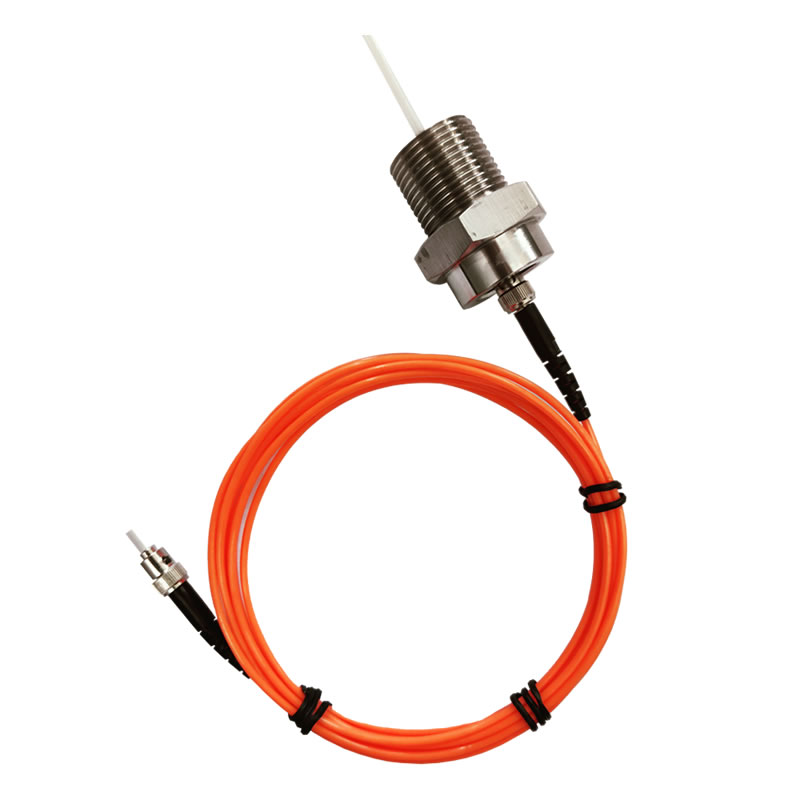
| Parameter | Fluorescence Fiber Optic Solution | Penderiaan Suhu Teragih (DTS) Penyelesaian |
|---|---|---|
| Prinsip penderiaan | Pereputan seumur hidup pendarfluor (photoluminescence) | Raman menghambur belakang |
| Measurement geometry | titik / multi-point at known locations | Continuous — every meter along the full fiber length |
| Ketepatan suhu | ±0.5–1°C | ≤±1°C |
| Julat suhu | -40°C hingga +260°C | -50°C hingga +200°C |
| Julat penderiaan setiap saluran | 0–20 m setiap kuar | ≥30 km per channel |
| Channels per instrument | 1–64 independent probe channels | 2 channels per host unit |
| Kedudukan spatial | Lokasi siasatan tetap (defined at installation) | ±1 m along the full sensing route |
| Masa tindak balas | <1 kedua setiap saluran | ≤1 saat setiap km setiap saluran |
| Penebat voltan tinggi | >100 kV — fully dielectric probe | Penebat dielektrik gentian standard |
| Siasatan / diameter kabel | 2–3 mm (boleh disesuaikan) | Standard armored sensing cable |
| Jangka hayat sensor | >25 tahun | >20 tahun (host unit and laser source) |
| Laser safety | — | IEC 60825-1 Kelas 1 diperakui |
| Antara muka komunikasi | RS485 / Modbus RTU | RS232 / RS485 / Modbus RTU |
| Pensijilan pihak ketiga | Tersedia atas permintaan | EMC, ketepatan kedudukan, ketepatan suhu, response time — supplied |
| Primary application fit | Discrete equipment hot-spot monitoring at known critical points | Long-route infrastructure continuous thermal surveillance |
7. Fiber Optic Thermal Monitoring Across Industries
Power Utilities: Alat suis, Transformers, and Cable Infrastructure
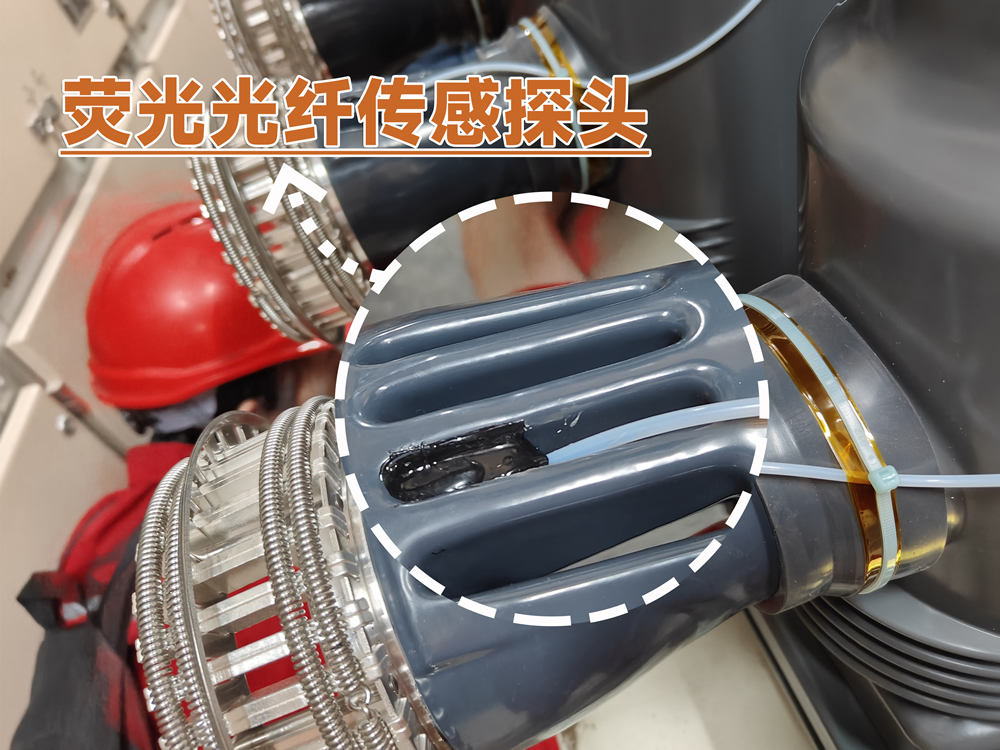
The power sector was the first major adopter of penyelesaian pemantauan suhu gentian optik at scale, driven by the combination of high-voltage isolation requirements and the critical consequences of undetected thermal faults. Fiber optic switchgear temperature monitoring places fluorescence probes directly on circuit breaker contacts, sambungan busbar, and cable terminations inside live medium-voltage panels — the only contact measurement technology that satisfies the dielectric requirements of these locations. Pemantauan suhu penggulungan pengubah uses oil-immersed fluorescence probes to measure the actual hot-spot temperature in each winding directly, providing the data needed for IEC 60076-7 insulation life calculations and dynamic loading decisions. For the cable infrastructure feeding and connecting these assets, distributed temperature sensing solutions menyediakan pemetaan haba berterusan bagi laluan kabel penuh — mengesan sambungan terlampau beban dan degradasi penebat sebelum ia mencapai ambang kegagalan kabel.
Penyimpanan Tenaga: Pengurusan Terma Bateri dan Pencegahan Larian
Sistem storan tenaga bateri litium-ion membentangkan salah satu keperluan pemantauan haba yang paling mencabar dalam mana-mana industri. Thermal runaway — yang berdikari, kenaikan suhu yang memecut sendiri yang membawa kepada kebakaran bateri — didahului oleh tandatangan suhu yang boleh dikesan dengan pantas, penderia tepat diletakkan pada tahap sel atau modul. Penderia suhu gentian optik pendarfluor dipasang dalam pek bateri menyediakan data haba masa nyata setiap sel atau setiap modul dengan masa tindak balas yang cukup pantas untuk mengesan kenaikan suhu peringkat awal sebelum merambat lari. The 2–3 mm probe diameter fits within standard cell holder geometries, and the fully dielectric probe creates no conductive path that could contribute to a short-circuit fault in the battery system.
Minyak, Gas, dan Petrokimia: Hazardous Area Process Monitoring
Refineries, tumbuhan kimia, and offshore platforms combine process temperatures that exceed the range of many conventional sensors with Zone 1 dan Zon 2 hazardous area classifications that restrict the use of electrically active devices. Fiber optic process temperature monitoring solutions address both constraints simultaneously: the fluorescence probe covers temperatures well above the limits of standard industrial sensors, while the zero-energy, passive nature of the probe makes it intrinsically compatible with explosive atmosphere requirements. Distributed temperature sensing solutions monitor the thermal condition of long pipeline runs and storage tank farms, detecting leak-related temperature anomalies and identifying hotspot locations for maintenance dispatch without the cost and safety risk of physical inspection rounds.
Rail and Transit Infrastructure: Tunnel Fire Detection and Traction Monitoring
Railway and metro tunnels present a fire detection challenge that no point-sensor system can solve economically: the monitored length may extend for kilometers, the potential ignition point is anywhere along the tunnel, and the consequences of a delayed detection are severe. Distributed fiber optic fire detection solutions provide continuous thermal surveillance along the full tunnel bore, generating a position-referenced alarm within seconds of a temperature exceedance anywhere along the sensing fiber. For traction power infrastructure, fluorescence fiber optic solutions monitor the thermal condition of switchgear contacts and transformer windings in railway substations under the heavily cyclic load profiles characteristic of train operation.
Pusat Data: Thermal Management and Capacity Planning
Data center operators managing high-density compute infrastructure need thermal visibility at both the room level — airflow patterns, hot and cold aisle temperatures, cooling system performance — and the equipment level — individual server inlet temperatures, busway tap-off temperatures, PDU output thermal loading. Distributed fiber optic temperature solutions provide room-level thermal mapping without a dense grid of discrete sensors. Fluorescence fiber optic solutions provide equipment-level precision at power distribution points where contact temperature is the critical reliability parameter. bersama-sama, they form a complete thermal management infrastructure for any data center scale.
Perubatan dan Saintifik: EMI-Free Temperature Measurement in Controlled Environments
MRI scanners, pemecut zarah, and high-field laboratory electromagnets create magnetic field environments in which any metallic object — including a thermocouple lead or RTD cable — experiences strong induced forces and generates significant electromagnetic interference with the field itself. Fiber optic temperature measurement solutions based on fluorescence sensing are the standard approach for temperature monitoring inside these environments: no metallic sensing element, no susceptibility to magnetic fields, tiada gangguan terhadap medan yang dijana oleh instrumen. Sifat yang sama menjadikan penyelesaian pendarfluor sesuai untuk persekitaran terlindung RF, peralatan pemprosesan gelombang mikro, dan sebarang aplikasi lain di mana kebersihan elektromagnet pada titik pengukuran adalah keperluan yang sukar.
8. Integrasi Sistem, Komunikasi, and Deployment Options
Komunikasi Industri Standard untuk Penyepaduan SCADA yang Lancar
Kedua-dua pendarfluor dan DTS penyelesaian pemantauan suhu gentian optik berkomunikasi melalui RS485 menggunakan protokol Modbus RTU — piawaian universal untuk komunikasi bersiri industri yang disokong secara asli oleh setiap SCADA utama, DCS, BMS, dan platform automasi pencawang dalam penggunaan pengeluaran semasa. Penyepaduan dengan sistem kawalan tapak hanya memerlukan peta daftar Modbus — dibekalkan dengan setiap instrumen — dan kerja konfigurasi komunikasi bersiri standard. Tiada penukar protokol, tiada pemandu tersuai, and no proprietary software licenses are required.
Wired and Wireless Deployment Flexibility
Untuk tapak dengan infrastruktur kabel sedia ada, Komunikasi berwayar RS485 ialah laluan penyepaduan yang paling mudah dan boleh dipercayai. Untuk jarak jauh, tanpa pemandu, atau pemasangan berselerak secara geografi — pencawang luar bandar, stesen pemantauan saluran paip, platform luar pesisir — komunikasi tanpa wayar melalui 4G LTE atau LoRaWAN menyediakan keupayaan penghantaran data yang sama tanpa pemasangan kabel baharu. Kedua-dua laluan komunikasi membentangkan data yang sama kepada platform penyeliaan; pilihan antara berwayar dan tanpa wayar ditentukan sepenuhnya oleh infrastruktur tapak, bukan dengan sebarang perbezaan dalam keupayaan pemantauan.
Pilihan Penyeliaan Berasaskan Awan dan Di Premis
Untuk pemilik aset yang menguruskan berbilang titik pemantauan merentas tapak yang diedarkan, a cloud-hosted supervisory platform provides fleet-level thermal visibility from any network-connected device — historical trends, rekod penggera, and condition summaries for every monitored asset in a single portal. For installations with stringent data security requirements or limited network connectivity, the same supervisory functionality is available in an on-premise deployment with no external network dependency. The monitoring hardware is identical in both deployment modes.
9. Choosing the Right Fiber Optic Temperature Monitoring Solution
Start with the Measurement Geometry
The first and most important selection question for any penyelesaian pemantauan suhu gentian optik is not about specifications — it is about geometry. Are the monitoring targets specific, known locations on equipment or infrastructure? Or is the monitoring requirement defined by a route or area where a thermal anomaly could develop at any point? If the answer is specific known locations, the solution is fluorescence fiber optic sensing. If the answer is a route or area with unknown fault location, the solution is distributed temperature sensing. In many large installations, the answer is both — and the most effective architecture deploys both technologies in complementary roles.
Fluorescence Is the Right Choice When:
- Sasaran pemantauan adalah khusus, pre-identified points on equipment — contacts, sendi, belitan, sel
- The environment involves high voltage, medan magnet yang kuat, or explosive atmosphere classifications
- Sub-second thermal response is required — battery runaway prevention, power electronics protection
- A scalable multi-point network serving up to 64 channels from a single transmitter is needed
- The temperature range or accuracy requirement exceeds what conventional sensors can deliver reliably
Distributed Sensing Is the Right Choice When:
- Coverage must extend across hundreds of meters to tens of kilometers without blind spots
- The fault or thermal anomaly location is not known in advance
- Spatial localization of a hot spot to within one meter is required for incident response
- The infrastructure is linear — cable routes, saluran paip, terowong, tambak, perimeter boundaries
- A single instrument must simultaneously cover two independent sensing routes
Combining Both Technologies: The Complete Fiber Optic Thermal Monitoring Architecture
The most comprehensive penyelesaian pemantauan suhu gentian optik for a large installation is a layered architecture that uses distributed sensing for route-level surveillance and fluorescence sensing for equipment-level precision. A power substation, contohnya, benefits from DTS monitoring of the cable circuits feeding and leaving the site — covering kilometers of underground cable with a single instrument — and fluorescence monitoring of the switchgear contacts, belitan transformer, and battery backup system inside the substation building. Both systems feed into the same Modbus network and the same supervisory platform, providing thermal visibility from the transmission cable to the individual contact surface in a single, unified view.
10. Soalan Lazim
S1: What makes fiber optic temperature monitoring solutions better than conventional sensors for industrial applications?
Kelebihan asas ialah medium penderiaan. Gentian kaca menghantar cahaya, bukan elektrik — jadi a sensor suhu gentian optik tidak mewujudkan laluan konduktif ke dalam peralatan yang dipantau, kebal terhadap gangguan elektromagnet, tidak boleh menyalakan suasana yang mudah terbakar, dan mengekalkan ketepatannya selama beberapa dekad tanpa penentukuran semula. Ini adalah sifat fizikal bahan penderiaan, bukan ciri kejuruteraan yang boleh ditiru dengan menambah baik reka bentuk sensor konvensional.
S2: Bolehkah penyelesaian suhu gentian optik digunakan dalam kedua-dua aplikasi voltan tinggi dan voltan rendah?
ya. Probe gentian optik pendarfluor dinilai di atas 100 kV dan boleh dipasang terus pada konduktor voltan sederhana dan voltan tinggi bertenaga tanpa perkakasan pengasingan tambahan. Teknologi probe yang sama juga boleh digunakan dalam aplikasi voltan rendah — pusat kawalan motor, sistem bateri, pengagihan kuasa pusat data — di mana penarafan dielektrik memberikan margin keselamatan yang besar ke atas voltan sistem. Probe dielektrik sepenuhnya tidak mencipta laluan konduktif tanpa mengira voltan sistem pada titik pemasangan.
S3: Bagaimanakah penderiaan suhu teragih mengesan tempat panas di sepanjang laluan gentian yang panjang?
The instrumen DTS mengukur masa perjalanan pergi dan balik bagi setiap segmen cahaya berselerak belakang Raman yang kembali sepanjang gentian. Oleh kerana cahaya bergerak melalui gentian optik pada tahap yang diketahui, halaju malar, masa perjalanan mengekodkan jarak dari instrumen ke setiap titik pengukuran dengan tepat. Ini membolehkan sistem melaporkan kedua-dua nilai suhu dan kedudukan fizikal sebarang anomali terma di sepanjang laluan penderiaan penuh, with a location accuracy of ±1 m regardless of the total route length.
S4: How many monitoring points can one fiber optic transmitter cover?
bujang fluorescence fiber optic temperature transmitter menyokong 1 kepada 64 independent sensing channels, each connected to its own probe at a separate measurement location. All channels are interrogated continuously and the readings from all channels are available simultaneously on the RS485 output. For installations requiring more than 64 mata, additional transmitters are connected to the same RS485 network, each with a unique Modbus address, and the supervisory platform aggregates all data into a single monitoring view.
S5: What is the difference between fluorescence lifetime sensing and intensity-based fiber optic sensing?
Intensity-based fiber optic sensing measures how much light returns from the sensing element — and that measurement changes whenever anything in the optical path changes, including fiber bending, pencemaran penyambung, atau penuaan sumber cahaya. Fluorescence lifetime sensing measures how long the fluorescence takes to decay — a time-domain measurement that is completely independent of optical power levels. Because the decay time is a physical property of the phosphor material at a given temperature, it is unaffected by anything that happens to the light intensity in the system. This is why lifetime-based solutions maintain accuracy over decades without recalibration, while intensity-based approaches require periodic recalibration to correct for optical path changes.
S6: Adakah penyelesaian pemantauan suhu gentian optik serasi dengan pemasangan kawasan berbahaya?
ya. Yang pasif, sifat sifar tenaga a probe gentian optik pendarfluor — yang membawa dan tidak menyimpan tenaga elektrik pada titik penderiaan — menjadikannya serasi secara intrinsik dengan penempatan kawasan berbahaya. Probe tidak menunjukkan sumber pencucuhan di bawah sebarang keadaan operasi atau kerosakan. Instrumen pemantauan terletak di luar sempadan zon berbahaya, dan sambungan gentian melintasi sempadan zon tanpa sebarang laluan konduktif. Pengelasan zon khusus projek dan keperluan pensijilan ATEX atau IECEx yang berkenaan hendaklah disahkan dengan pihak berkuasa yang berkaitan untuk setiap pemasangan.
S7: Bagaimanakah penyelesaian suhu gentian optik berintegrasi dengan SCADA atau sistem pengurusan bangunan sedia ada?
Both fluorescence transmitters and DTS host units communicate over RS485 using Modbus RTU — the universal industrial serial protocol supported natively by all major SCADA, DCS, BMS, dan platform automasi pencawang. Integration requires only the Modbus register map, which is supplied with each instrument, and standard serial communication configuration work on the supervisory platform. For IEC 61850-compliant substation automation systems, a standard Modbus-to-IEC 61850 gateway provides the protocol conversion without any modification to the monitoring hardware.
S8: What maintenance do fiber optic temperature monitoring solutions require?
Probe gentian optik pendarfluor require no scheduled maintenance — their rated operational lifespan exceeds 25 years under normal service conditions, and the lifetime measurement principle does not drift with age or optical path changes. DTS host units and their laser sources are rated for over 20 tahun operasi berterusan. Periodic functional verification — confirming that all channels read correctly against a reference temperature — is the only routine maintenance task. No recalibration intervals, no consumable replacements, and no access to the sensing elements in the field are required under normal operating conditions.
S9: Can fluorescence and DTS monitoring systems operate together on the same network?
ya. Both technologies use RS485 with Modbus RTU as their standard communication interface. A fluorescence transmitter and a DTS host unit can share the same RS485 bus, each with a unique Modbus slave address, and both are polled by the same supervisory platform master. This is the standard configuration for layered monitoring architectures that combine equipment-level fluorescence point monitoring with infrastructure-level DTS route monitoring — both technologies deliver their data to a single control system interface with no additional hardware.
S10: What is the typical service life of a fiber optic temperature monitoring installation?
A well-specified sistem pemantauan suhu gentian optik is designed to remain in continuous service for the operational life of the monitored asset. Fluorescence probe lifespan exceeds 25 tahun; DTS host and laser lifespan exceeds 20 tahun. Dalam amalan, pemasangan pemantauan gentian optik secara rutin melebihi jangka masa penyelenggaraan berjadual peralatan elektrik yang mereka pantau — dalam banyak kes kekal dalam perkhidmatan melalui satu atau lebih pembaikan peralatan utama tanpa memerlukan penggantian elemen penderiaan. Panjang umur ni, digabungkan dengan ketiadaan keperluan penentukuran semula yang dijadualkan, menjadikan jumlah kos pemilikan a penyelesaian pemantauan haba gentian optik jauh lebih rendah daripada mana-mana teknologi penderia yang memerlukan penggantian berkala atau penentukuran semula dalam tempoh perkhidmatan yang sama.
11. Explore Our Fiber Optic Temperature Monitoring Solutions
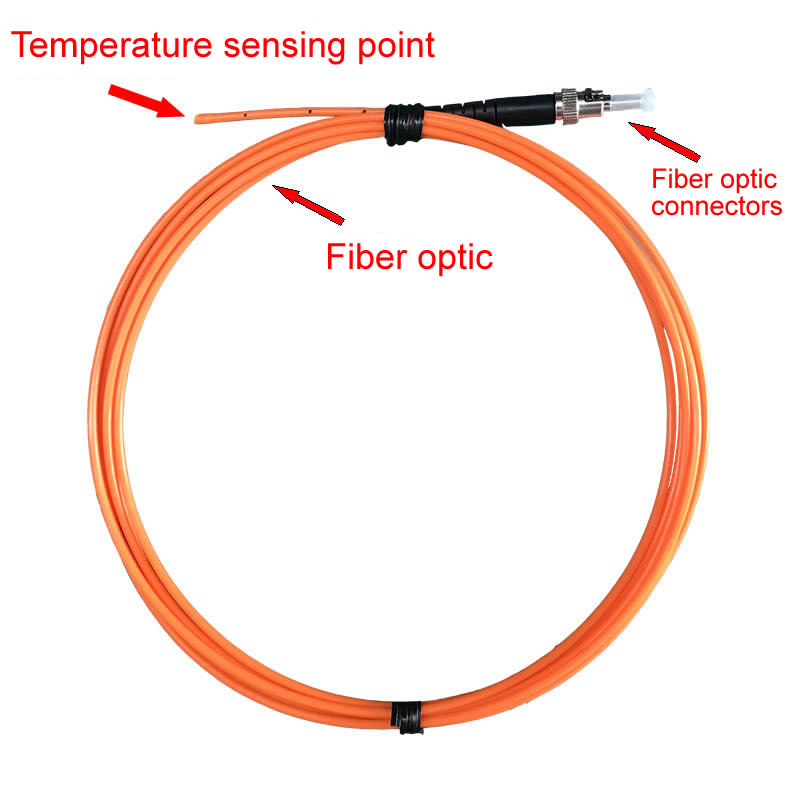
Sains Elektronik Inovasi Fuzhou&Tech Co., Ltd. telah mereka bentuk dan menghasilkan fiber optic solutions for temperature monitoring sejak 2011. Rangkaian produk kami meliputi probe suhu gentian optik pendarfluor, pemancar suhu gentian optik berbilang saluran, dan pengesan suhu gentian optik teragih (DTS) sistem — melayani utiliti kuasa, simpanan tenaga, petrokimia, infrastruktur kereta api, pusat data, dan aplikasi peralatan perubatan di seluruh dunia.
Hubungi pasukan kejuruteraan kami untuk meminta lembaran data produk, membincangkan aplikasi tertentu, atau mengatur perundingan teknikal:
- laman web: www.fjinno.net
- E-mel: web@fjinno.net
- WhatsApp / WeChat (China) / telefon: +86 135 9907 0393
- QQ: 3408968340
- Alamat: Liandong U Grain Networking Industrial Park, No.12 Xingye West Road, Fuzhou, Fujian, China
Penafian: Maklumat teknikal dalam artikel ini disediakan untuk tujuan maklumat am sahaja dan mencerminkan parameter produk standard dan amalan industri pada masa penerbitan. Prestasi sistem sebenar mungkin berbeza bergantung pada keadaan pemasangan, faktor persekitaran, dan keperluan permohonan. Semua spesifikasi tertakluk kepada perubahan tanpa notis. Kandungan ini tidak membentuk jaminan, komitmen teknikal yang mengikat, atau cadangan reka bentuk kejuruteraan untuk sebarang pemasangan tertentu. Rujuk jurutera yang berkelayakan dan dokumentasi piawaian yang berkenaan untuk keputusan reka bentuk dan keselamatan khusus projek.

Sensor suhu gentian optik, Sistem pemantauan pintar, Pengeluar gentian optik yang diedarkan di China
 |
 |
 |