 Penderia suhu gentian optik INNO ,sistem pemantauan suhu.
- Bearing temperature anomalies account for 40-50% of unplanned shutdowns in hydroelectric power plants
- A single unplanned outage in a 700MW hydro turbine generator kos $500,000-$1,000,000 in lost revenue
- Tradisional penderia suhu suffer reliability issues in high-humidity, voltan tinggi, and strong magnetic field environments
- Penderia suhu gentian optik pendarfluor provide complete electrical isolation up to 100kV and immunity to electromagnetic interference
- Berbilang titik thrust bearing monitoring enables fault prediction 4-8 hours before catastrophic failure
- Properly implemented sistem pemantauan suhu reduce maintenance costs by 25-35% and extend bearing service life by 30-50%
Jadual Kandungan
- What is a Large Hydro Turbine?
- How Do Hydro Turbines Work?
- What Are the Major Hydro Turbine Applications Worldwide?
- Why Is Hydro Turbine Temperature Monitoring Critical?
- What Are Common Hydro Turbine Failure Modes?
- Why Do Turbine Temperature Abnormalities Occur?
- What Temperature Monitoring Technologies Are Available?
- Why Choose Fluorescent Fiber Optic Sensors for Turbine Monitoring?
- How Is a Turbine Temperature Monitoring System Configured?
- How to Implement Turbine Temperature Monitoring?
- How Are Temperature Monitoring Data Applied?
- Hydro Turbine Monitoring Application Case Studies
- Soalan Lazim
- Get Your Custom Turbine Monitoring Solution
1. What is a Large Hydro Turbine?

A hydro turbine is a rotary machine that converts the kinetic and potential energy of flowing or falling water into mechanical shaft power, which drives an electrical generator to produce electricity. Large hydro turbines typically refer to units with generating capacities exceeding 100MW, with the world’s largest installations now reaching 1,000MW per unit.
Hydro turbine generators consist of multiple integrated subsystems: the turbine runner that captures water energy, the main shaft assembly transmitting torque, thrust and guide bearings supporting massive rotational loads, lubrication and cooling systems maintaining optimal operating temperatures, and sealing systems preventing water ingress. moden hydroelectric turbines represent precision-engineered systems where thousands of tons of rotating mass operate continuously at speeds ranging from 50-750 RPM depending on unit design and head conditions.
Major Hydro Turbine Types
Francis Turbines
Francis turbines are reaction-type machines suitable for medium head applications (40-600 meter). Water enters radially through adjustable guide vanes and exits axially after transferring energy to the runner. Francis designs dominate large-scale hydropower, representing approximately 60% of global installed capacity. Units range from 100MW to 1,000MW, with runner diameters up to 10 meters and weights exceeding 400 tons.
Kaplan Turbines
Kaplan turbines feature adjustable propeller-type runners optimized for low-head, high-flow applications (10-70 meter). Both guide vanes and runner blades adjust during operation to maintain efficiency across varying flow conditions. besar Kaplan units exceed 200MW capacity with runner diameters reaching 11 meter.
Pelton Turbines
Pelton wheels are impulse turbines designed for high-head applications (300-2,000 meter). High-velocity water jets strike buckets mounted on the runner periphery. Pelton turbines serve mountainous regions and pumped storage facilities, with units up to 500MW capacity.
Bulb Turbines
Bulb turbines integrate the generator inside a streamlined watertight bulb directly in the water flow path, maximizing efficiency in very low-head applications (2-30 meter). Common in tidal power installations and run-of-river plants.
2. How Do Hydro Turbines Work?
Hydro turbine operation converts hydraulic energy into rotational mechanical power through carefully designed flow passages and runner blade geometries. Water entering the turbine possesses both pressure energy (potential energy from elevation difference) and velocity energy (kinetic energy from flow).
Energy Conversion Process
Dalam reaction turbines (Francis and Kaplan types), water completely fills the runner passages. As water flows through the runner, both pressure and velocity decrease as energy transfers to the rotating blades. Guide vanes control water flow angle and volume, while runner blade profiles extract maximum energy across the pressure drop.
Dalam impulse turbines (Pelton type), nozzles convert all pressure energy into high-velocity jets before striking the runner. Atmospheric pressure surrounds the runner, and energy extraction occurs purely through momentum transfer as jets deflect off bucket surfaces.
Critical Operating Components
Thrust Bearings
The thrust bearing supports the entire vertical weight of the rotating assembly plus downward hydraulic thrust—often totaling 2,000-5,000 tons in large units. Segmented thrust pads (biasanya 8-16 segments) distribute this massive load across a lubricated oil film just 50-150 microns thick. Thrust bearing temperature directly indicates lubrication effectiveness and bearing health.
Guide Bearings
Guide bearings (also called journal bearings) maintain radial shaft position, absorbing lateral hydraulic forces and dynamic loads from mechanical and electrical imbalances. Large turbines employ multiple guide bearings: upper guide bearing above the generator, lower guide bearing below the generator, and turbine guide bearing near the runner.
Lubrication Systems
Turbine lubrication systems circulate thousands of liters of oil through bearings, maintaining the critical oil film that prevents metal-to-metal contact. Oil temperature directly affects viscosity—too cold and flow resistance increases; too hot and film thickness becomes insufficient for load capacity.
3. What Are the Major Hydro Turbine Applications Worldwide?
Large hydro turbines serve diverse applications across global hydroelectric infrastructure:
Large-Scale Hydroelectric Power Stations
Grand Coulee Dam (Amerika Syarikat)
Located on the Columbia River in Washington State, Grand Coulee operates 33 generating units totaling 6,809 MW capacity. The third powerhouse contains six 805MW Francis turbine generators—among North America’s largest—with 32-foot diameter runners weighing 2 million pounds each.
Itaipu Dam (Brazil/Paraguay)
Itaipu Hydroelectric Power Plant on the Paraná River features twenty 700MW Francis turbines, making it one of the world’s largest hydroelectric facilities with 14,000 MW total installed capacity. Each turbine operates under 118-meter head with flow rates exceeding 700 cubic meters per second.
Krasnoyarsk Dam (Rusia)
The Krasnoyarsk Hydroelectric Station on the Yenisei River operates twelve 508MW Francis turbines menjumlahkan 6,000 MW. Operating in extreme climatic conditions (-40°C to +40°C ambient), these units demonstrate the importance of robust sistem pemantauan suhu.
Churchill Falls (Kanada)
Churchill Falls Generating Station in Labrador operates eleven 475MW Francis turbines under one of the world’s highest heads (314 meter) for such large units, menjumlahkan 5,428 MW capacity.
La Grande Complex (Kanada)
Quebec’s James Bay Project includes multiple stations with large Francis turbines: La Grande-2 (5,616 MW), La Grande-3 (2,418 MW), and La Grande-4 (2,779 MW), collectively representing major North American hydroelectric infrastructure.
Pumped Storage Hydroelectricity
Pumped storage plants use reversible pump-turbines or separate turbine-pump sets for grid-scale energy storage. Major installations include:
- Bath County Pumped Storage Station (Amerika Syarikat) – 3,003 MW with six 451MW reversible Francis pump-turbines
- Raccoon Mountain (Amerika Syarikat) – 1,652 MW pumped storage facility in Tennessee
- Sir Adam Beck Pump Generating Station (Kanada) – 174 MW pumped storage supporting Niagara Falls generation
Tidal Power Installations
Tidal turbines harness ocean energy through barrage or in-stream technologies. The Annapolis Royal Generating Station (Kanada) operates a 20MW Straflo turbine in the Bay of Fundy—one of the world’s largest tidal ranges. The turbine operates bidirectionally, generating power during both flood and ebb tides in the harsh marine environment.
Run-of-River Hydroelectric Projects
Run-of-river plants generate power without large reservoirs, using natural flow and modest head. These installations range from small community projects to major facilities with multiple large Kaplan or Francis turbines operating continuously to capture available river flow.
4. Why Is Hydro Turbine Temperature Monitoring Critical?
Thermal management directly determines the reliability, ketersediaan, and operational lifespan of hydro turbine generators. Temperature monitoring provides the earliest indication of developing mechanical problems before they escalate to catastrophic failures.
Economic Impact of Unplanned Outages
A single unplanned shutdown of a 700MW hydro turbine during peak demand periods costs $500,000-$1,000,000 in lost revenue plus repair expenses. Annual revenue from one large unit exceeds $50-100 juta, making availability the dominant economic factor. Temperature-related bearing failures cause 40-50% of all unplanned turbine outages, representing the single largest reliability threat.
Bearing Temperature and Service Life Relationship
Thrust bearing dan guide bearing degradation accelerates exponentially with temperature. Industry data shows that sustained operation just 10°C above design temperature reduces bearing life by 50%. A bearing designed for 30-year service at 60°C may fail within 7-8 years if consistently operating at 70°C. This relationship makes continuous pemantauan suhu essential for maximizing asset life.
Lubrication System Performance
Lubricating oil viscosity decreases approximately 10% for each 10°C temperature increase. At elevated temperatures, the oil film supporting thousands of tons becomes thinner, eventually breaking down and allowing metal-to-metal contact. Sebaliknya, excessively low temperatures increase viscosity, reducing flow and potentially starving bearings of lubrication. Pemantauan suhu minyak at bearing inlets and outlets ensures optimal lubrication performance.
Pengesanan Kerosakan Awal
Temperature changes precede mechanical failure by hours to days, providing crucial warning time. A developing crack in a thrust bearing pad increases local friction, raising temperature 4-8 hours before complete pad failure. Multi-point temperature monitoring detecting a 5-10°C rise on a single pad enables planned shutdown and repair, avoiding catastrophic failure, extended downtime, and secondary damage to shafts and other components.
5. What Are Common Hydro Turbine Failure Modes?
Comprehensive failure analysis across global hydroelectric installations reveals consistent patterns:
Thrust Bearing Failures (40-45% of major faults)
- Babbitt metal fatigue and delamination – The white metal bearing surface cracks and separates from the steel backing under cyclic thermal and mechanical stress
- Oil film breakdown – Insufficient lubrication allows metal-to-metal contact, rapidly generating heat and material damage
- Uneven load distribution – Manufacturing tolerances or thermal distortion cause some pads to carry excessive load while others are lightly loaded
- Contamination damage – Particles in lubricating oil score bearing surfaces, creating localized hot spots
Guide Bearing Failures (25-30%)
- Excessive radial loads – Hydraulic imbalance or mechanical misalignment overloads bearing capacity
- Lubrication deficiencies – Inadequate oil flow or degraded oil properties
- Wear and clearance increases – Progressive bearing wear increases clearances, allowing shaft vibration and further accelerating degradation
Kegagalan Sistem Penyejukan (15-20%)
- Heat exchanger fouling – Biological growth, mineral deposits, or debris reduce heat transfer effectiveness
- Cooling water flow reduction – Pump failures, valve malfunctions, or intake blockages
- Coolant leaks – Piping corrosion or gasket failures reducing system capacity
Seal System Failures (10-15%)
- Shaft seal deterioration – Wear, penuaan, or damage allowing water ingress into oil systems
- Air seal failures – Compromised seals in air-cooled generator sections
Mechanical and Structural Issues (5-10%)
- Cavitation damage – Vapor bubble collapse eroding runner surfaces
- Vibration-induced cracking – Fatigue cracks in rotating or stationary components
- Wicket gate mechanism failures – Seizure or misalignment affecting flow control
6. Why Do Turbine Temperature Abnormalities Occur?
Hydro turbine temperature excursions result from various interrelated factors affecting thermal balance:
Lubrication System Degradation
- Oil contamination – Water ingress, pencemaran zarah, or chemical degradation reducing lubricating properties and heat transfer capability
- Insufficient oil flow – Pump wear, filter blockage, or system leaks reducing delivery to bearings
- Oil aging – Oxidation and thermal breakdown degrading viscosity and lubricating performance
- Wrong oil specification – Incorrect viscosity grade for operating temperature range
Cooling System Malfunctions
- Heat exchanger efficiency loss – Scale buildup, biological fouling, or sedimentation reducing heat transfer by 30-50%
- Cooling water temperature rise – Seasonal ambient water temperature increases or cooling tower performance degradation
- Reduced coolant flow – Pump capacity decline, valve positioning errors, or piping restrictions
Bearing Mechanical Issues
- Increased friction from wear – Progressive bearing surface degradation increasing power dissipation
- Improper clearances – Installation errors or thermal distortion affecting oil film thickness
- Load imbalance on thrust pads – Manufacturing tolerances or thermal bowing causing uneven pressure distribution across bearing segments
- Bearing misalignment – Foundation settling or assembly errors creating edge loading
Operating Condition Changes
- Load variations – Rapid power changes altering bearing loads and heat generation
- Off-design operation – Running at heads or flows outside optimal efficiency range increasing hydraulic thrust loads
- Keadaan beban berlebihan – Operating beyond rated capacity for extended periods
Faktor Persekitaran
- Elevated ambient temperatures – Summer heat reducing cooling effectiveness
- Kelembapan yang tinggi – Affecting heat dissipation in air-cooled sections
- Seasonal water temperature changes – Warmer source water reducing cooling capacity by 10-20%
7. What Temperature Monitoring Technologies Are Available?
Berbilang temperature sensing technologies compete for hydro turbine monitoring aplikasi, each with distinct advantages and limitations in the challenging hydroelectric environment:

| Teknologi | Pengasingan Elektrik | Kekebalan EMI | Moisture Resistance | Ketepatan | Turbine Suitability |
|---|---|---|---|---|---|
| Gentian Optik Pendarfluor | lengkap (>100kV) | Kebal | Cemerlang | ±0.5-1°C | Cemerlang |
| Platinum RTD (PT100/PT1000) | Memerlukan pengasingan | miskin | Good if sealed | ±0.15-0.3°C | Sederhana |
| Termokopel (K, J, T) | Memerlukan pengasingan | miskin | Sederhana | ±1-2°C | Terhad |
| GaAs (Gallium Arsenide) Serat | bagus | bagus | bagus | ±2-3°C | Sederhana |
| Kisi Fiber Bragg (FBG) | bagus | bagus | bagus | ±1-2°C | Sederhana |
| Inframerah (Bukan kenalan) | lengkap | Tidak terjejas | Tidak terjejas | ±2-5°C | Permukaan sahaja |
Platinum Resistance Temperature Detectors (RTD)
PT100 and PT1000 RTDs offer excellent accuracy and stability in industrial applications. Namun begitu, dalam hydro turbine persekitaran, they face significant challenges. The metallic sensing element and lead wires are susceptible to electromagnetic interference from the massive generator magnetic fields and switching transients. High common-mode voltages between turbine components and ground (often thousands of volts) require complex isolation amplifiers or barriers. Moisture ingress into connection terminals causes resistance errors and corrosion. Installation in rotating components requires slip rings, introducing additional complexity and maintenance.
Termokopel
Penderia termokopel generate millivolt signals proportional to temperature difference between measurement and reference junctions. Like RTDs, termokopel suffer from EMI susceptibility in the electrically noisy hydroelectric environment. The low-level signals (microvolts per degree) are particularly vulnerable to electromagnetic pickup, requiring extensive shielding and twisted-pair wiring. Moisture at connection points creates parasitic thermoelectric voltages causing measurement errors. Reference junction compensation adds complexity, especially when ambient temperatures vary widely.
Gallium Arsenide (GaAs) Penderia Gentian Optik
Penderia suhu GaAs utilize the temperature-dependent bandgap absorption edge of gallium arsenide semiconductor material. Light transmission through a GaAs crystal varies with temperature, enabling optical measurement. While providing electrical isolation, Penderia GaAs have limitations: ketepatan yang lebih rendah (±2-3°C), narrower temperature range (typically -40°C to +150°C), sensitivity to optical power variations, and relatively slow response times. The semiconductor junction can degrade over time at elevated temperatures, affecting long-term stability.
Kisi Fiber Bragg (FBG) Penderia
Penderia suhu FBG use wavelength-encoded measurement based on periodic refractive index variations inscribed in optical fiber. Temperature changes shift the reflected wavelength. FBG technology offers several advantages including multi-sensor multiplexing on a single fiber and dual-parameter measurement (temperature and strain simultaneously). Namun begitu, sistem FBG require expensive interrogators with precise wavelength measurement capability, increasing system cost by 2-3x compared to gentian optik pendarfluor penyelesaian. Mechanical strain from vibration or installation stress cross-couples with temperature measurement, requiring careful isolation. Long-term wavelength stability can be affected by UV exposure and hydrogen infiltration in certain environments.
Infrared Thermometry
Pengukuran suhu inframerah detects thermal radiation emitted from surfaces. While providing non-contact measurement and complete electrical isolation, penderia inframerah measure only surface temperatures, not internal bearing temperatures where critical monitoring is needed. Accuracy depends on accurate emissivity knowledge, which varies with surface condition, pengoksidaan, dan pencemaran. Line-of-sight requirements and interference from steam, oil mist, or water spray limit applicability in turbine bearing persekitaran. Temperature gradients between accessible surfaces and internal critical points can exceed 20-30°C, reducing diagnostic value.
8. Why Choose Fluorescent Fiber Optic Sensors for Turbine Monitoring?

Penderia suhu gentian optik pendarfluor provide unmatched performance addressing the unique challenges of hydro turbine generator monitoring in high-voltage, high-EMI, and high-humidity environments.
Fluorescent Fiber Optic Measurement Principle
The sensor probe contains rare-earth phosphor material that fluoresces when excited by blue LED light transmitted through the gentian optik. Temperature changes the fluorescent decay time constant from microseconds to milliseconds following excitation pulse termination. The pemancar suhu gentian optik precisely measures this decay time using photon-counting or digital signal processing techniques, converting it to calibrated temperature with ±0.5-1°C accuracy. This time-domain measurement is inherently immune to optical power variations, kehilangan lenturan gentian, connector attenuation, and probe degradation—factors that affect intensity-based measurements.
Exceptional High-Voltage Electrical Isolation
Gentian optik constructed from pure silica glass or specialized polymers provides complete dielectric isolation. Tidak seperti GaAs atau Penderia FBG that offer good isolation, penderia gentian optik pendarfluor achieve exceptional voltage standoff capability exceeding 100kV between the sensor probe and transmitter electronics. This is critical in hydro generators where stator windings operate at 13.8-25kV (atau lebih tinggi), and transient overvoltages during switching or lightning strikes can reach 50-100kV. There is absolutely no electrical path between measured components at generator potential and monitoring instrumentation at ground potential, eliminating any possibility of ground loops, common-mode interference, atau bahaya keselamatan.
In environments where Penderia PT100 require expensive isolation barriers rated for 10kV+ with creepage distances exceeding 50mm, penderia gentian optik pendarfluor achieve superior isolation simply through the inherent properties of the optical fiber itself—no additional components, no degradation, no maintenance.
Complete Electromagnetic Interference Immunity
The optical signal transmission is fundamentally immune to electromagnetic fields, unlike electrical sensors. Penjana hidro create intense magnetic fields (1-2 Tesla in the air gap) and electrical noise from high-current switching, voltage regulation, and excitation systems. Penderia gentian optik pendarfluor operate without any degradation in this extreme EMI environment. No shielding, pembumian, penapisan, or twisted-pair wiring is required. Installation routing has no electromagnetic constraints—fibers can run parallel to power cables, cross magnetic field lines, or pass through regions with severe EMI that would completely disable electrical sensors.
Superior Moisture and Chemical Resistance
Hydroelectric environments combine high humidity (selalunya 95-100% in turbine pits), water spray, pemeluwapan, and occasional flooding during maintenance or seal failures. Penderia gentian optik pendarfluor with properly sealed probe tips and connectors are completely immune to moisture-related failures that plague electrical sensors. silika gentian optik is chemically inert to water, oils, most acids, pangkalan, and solvents encountered in turbine lubrication dan sistem penyejukan. The absence of metallic components eliminates corrosion concerns. Sensors can be temporarily submerged during maintenance without damage or calibration shift.
Compact Size Enabling Critical Access
The 1-3mm diameter sensor probe and flexible optical fiber cable enable installation in confined spaces within bearing assemblies, on rotating shaft surfaces (via slip ring optical couplers), embedded in thrust bearing pads, or positioned in narrow oil passages—locations inaccessible to larger electrical sensors with conduit and junction box requirements.
One Fiber Measures One Specific Hotspot
Tidak seperti sistem FBG that multiplex multiple sensors on one fiber (introducing complexity and potential crosstalk), fluorescent fiber optic architecture uses dedicated optical fibers—one fiber optic cable connects to one sensor probe measuring one specific temperature point. This provides the highest reliability (one fiber failure affects only one measurement point, not an entire sensing array) and eliminates multiplexing crosstalk or wavelength interference issues. Pemantauan berbilang titik is achieved by connecting multiple independent fiber channels to the transmitter, with each channel providing isolated, interference-free measurement of its dedicated sensor location.
Customizable Fiber Optic Transmitter Modules
Pemancar suhu gentian optik are available in modular configurations from 1 kepada 64 saluran, each channel dedicated to one sensor. Systems can be configured precisely for application requirements—8 channels for a single thrust bearing with eight pads, 32 channels for comprehensive monitoring of one complete generator unit, atau 64 channels for dual-unit installations. The modular architecture enables easy expansion as monitoring needs grow, and customization of communication interfaces (Modbus RTU/TCP, PROFINET, Ethernet/IP, DNP3), alarm relay configurations, and analog output scaling to match existing sistem SCADA and distributed control systems.
Long-Term Stability and Reliability
Penderia gentian optik pendarfluor demonstrate exceptional long-term calibration stability—20+ years without drift. The fluorescent decay time measurement is fundamentally stable, determined by quantum mechanical processes in the phosphor material that do not degrade with age or exposure. Ini berbeza dengan Penderia RTD that can drift due to contamination or mechanical stress, termokopel affected by oxidation and thermoelectric inhomogeneities, dan Penderia GaAs subject to semiconductor junction degradation. Factory calibration remains accurate throughout the sensor lifetime, eliminating costly recalibration programs.
9. How Is a Turbine Temperature Monitoring System Configured?
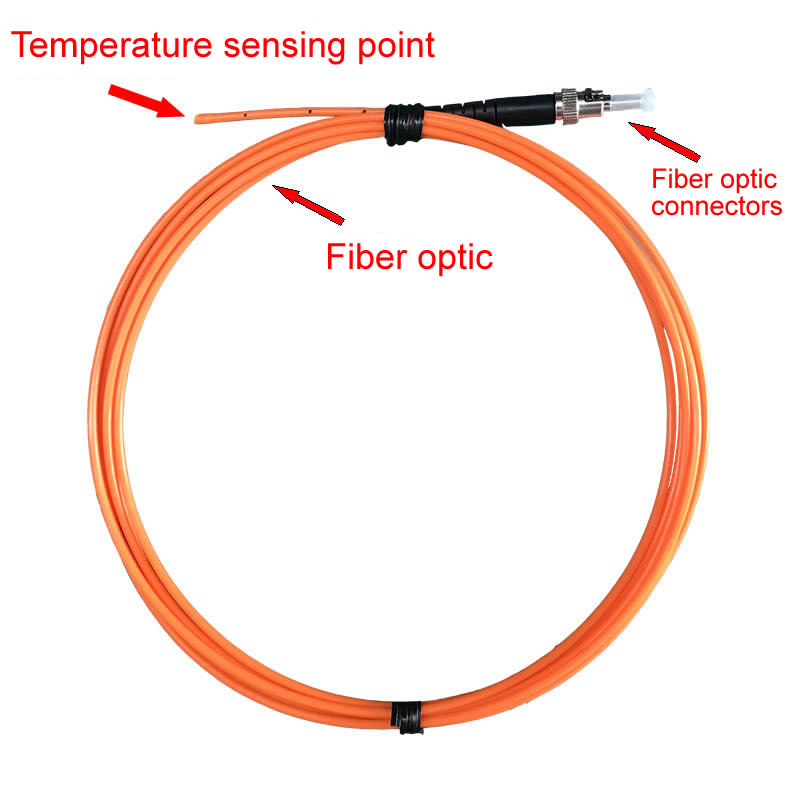
Komprehensif hydro turbine temperature monitoring requires strategic sensor placement at critical thermal measurement points and properly scaled data acquisition architecture.
Critical Temperature Measurement Locations
Thrust Bearing Temperature Monitoring
The thrust bearing represents the highest priority monitoring location. besar Francis turbines typically employ 8-16 segmented thrust bearing pads arranged in a circular pattern. Comprehensive monitoring installs 1-2 penderia gentian optik per pad, positioned on the babbitt metal surface near the trailing edge where maximum temperatures develop. For a 12-pad bearing, this requires 12-24 sensors dedicated to thrust bearing monitoring alone.
- Individual pad surface temperatures – 12-24 penderia (1-2 per pad for 8-16 pad bearings)
- Oil film inlet temperature – 1 sensor measuring oil entering bearing assembly
- Oil film outlet temperature – 1 sensor measuring oil exiting bearing (temperature rise indicates power dissipation)
- Leveling plate or backing structure temperature – 2-4 sensors assessing heat transfer to support structure
Guide Bearing Monitoring
setiap satu guide bearing requires multi-point coverage to detect localized hotspots from misalignment or uneven wear:
- Upper guide bearing – 4-6 sensors positioned around circumference at 90° or 60° intervals, measuring babbitt surface temperature
- Lower guide bearing – 4-6 sensors in similar pattern
- Turbine guide bearing – 4-6 sensors near the runner where hydraulic loads are highest
- Oil inlet and outlet temperatures – 2 sensors per bearing (6 total for three guide bearings)
Lubrication System Temperatures
- Oil reservoir temperature – 1-2 sensors at different depths assessing stratification
- Oil cooler inlet temperature – 1 sensor before heat exchanger
- Oil cooler outlet temperature – 1 sensor after heat exchanger (difference indicates cooler effectiveness)
- Filter differential temperature – Optional sensors before/after filters detecting flow restriction
Cooling Water System Temperatures
- Cooling water inlet temperature – 1 sensor measuring source water temperature
- Cooling water outlet temperature – 1 sensor measuring discharge temperature
- Heat exchanger shell temperatures – 2-4 sensors assessing thermal performance
Generator Component Temperatures
- Stator winding temperatures – 6-12 sensors embedded in stator coils at hottest phases
- Stator core temperatures – 4-6 sensors monitoring lamination hotspots
- Rotor winding or pole temperatures – 2-4 penderia (installation via slip ring optical coupler for rotating measurements)
- Air gap or hydrogen cooling gas temperatures – 4-8 sensors in cooling gas stream
Typical Sensor Counts by Unit Size
- 100-300 MW turbine generator – 30-50 titik pengukuran suhu
- 300-700 MW turbine generator – 50-80 titik pengukuran suhu
- 700+ MW turbine generator – 80-120+ titik pengukuran suhu
System Architecture Design
Lapisan Sensor
Probe suhu gentian optik pendarfluor installed at each measurement point using thermal epoxy adhesive, mechanical clamps, or embedded installation. Each sensor connects via one dedicated optical fiber cable routed to the transmitter location.
Lapisan Pemerolehan Data
Pemancar suhu gentian optik in modular configurations (32-channel or 64-channel units are most common for large turbines) menukar isyarat optik kepada bacaan suhu yang ditentukur. Each channel measures one dedicated sensor. Transmitters mount in climate-controlled instrument cabinets near the generator or in the powerhouse control room.
Communication and Integration Layer
Industry-standard communication protocols enable seamless integration with existing power plant control systems:
- Modbus RTU/TCP – Most common for turbine monitoring integration
- DNP3 – Preferred in North American utility applications for SCADA integration
- PROFINET – Common in European installations and Siemens control systems
- Ethernet/IP – Allen-Bradley and Rockwell Automation environments
- IEC 61850 – Substation automation protocol increasingly adopted for generator protection
- Keluaran analog (4-20mA) – Direct connection to legacy DCS or chart recorders
- Relay contacts – Hardwired alarm annunciation and interlock functions
Application Software Layer
khusus turbine monitoring software or integration into existing SCADA/DCS platforms provides real-time visualization, trending, pengurusan penggera, pengelogan data, dan analisis ramalan.
10. How to Implement Turbine Temperature Monitoring?
Berjaya hydro turbine monitoring system deployment follows a structured implementation process:
fasa 1: System Planning and Design
- Conduct thermal risk assessment identifying critical monitoring locations based on turbine type, saiz, operating history, and failure modes
- Determine sensor quantity and placement based on bearing configuration and monitoring objectives
- Pilih yang sesuai penghantar gentian optik channel count and communication interfaces compatible with existing control systems
- Plan fiber cable routing paths avoiding mechanical interference and maintaining adequate protection
fasa 2: Equipment Procurement
- Specify penderia gentian optik pendarfluor with appropriate temperature range, probe dimensions, and cable lengths
- Order customized fiber optic transmitter modules configured for specific channel count, protokol, and alarm requirements
- Procure installation accessories including thermal adhesive, fiber protection sleeving, dan perkakasan pemasangan
fasa 3: Installation During Scheduled Outage
- Clean sensor mounting surfaces thoroughly
- Attach sensor probes using high-temperature thermal adhesive rated for operating environment
- Laluan kabel gentian optik through protective conduit or cable trays to transmitter location
- Terminate fibers at transmitter, clearly labeling each channel
- Install transmitter in climate-controlled enclosure
- Connect communication wiring and power supply
fasa 4: Pentauliahan Sistem
- Verify all channels display plausible temperatures
- Configure transmitter parameters and alarm thresholds
- Integrate with SCADA/DCS system and verify data communication
- Operate turbine across load range to establish baseline temperature profiles
- Adjust alarm setpoints based on observed normal operating temperatures
- Document installation details, tugasan saluran, dan tetapan konfigurasi
11. How Are Temperature Monitoring Data Applied?
Turbine temperature data enables multiple operational improvements and maintenance optimizations:
Real-Time Condition Monitoring
- Continuous display of all bearing and system temperatures with status indication
- Trend visualization showing temperature evolution during load changes, startups, and shutdowns
- Automated alarm annunciation when temperatures exceed warning or critical thresholds
- Comparison of temperatures across multiple bearings or bearing pads to identify abnormal patterns
Diagnostic Fault Analysis
Bearing Failure Patterns
- Single thrust pad overheating – Indicates pad cracking, babbitt delamination, or uneven load distribution requiring bearing inspection
- Gradual temperature increase across all thrust pads – Suggests lubrication degradation, cooling system deterioration, or increasing thrust load
- Asymmetric guide bearing temperatures – Points to shaft misalignment, unbalanced magnetic pull, or bearing wear patterns
- Increasing pad-to-pad temperature variation – Early indicator of thrust bearing leveling problems
Lubrication System Issues
- High bearing temperature with normal oil inlet temperature – Insufficient oil flow rate to bearing
- Elevated oil reservoir temperature – Cooling system capacity inadequate or heat exchanger fouled
- Large temperature rise across bearing (inlet to outlet) – Excessive friction indicating bearing distress
Cooling System Performance
- Reduced temperature differential across oil cooler – Heat exchanger fouling or cooling water flow reduction
- Elevated cooling water outlet temperature – Insufficient water flow or elevated source water temperature
Strategi Penyelenggaraan Ramalan
- Analisis trend – Gradually increasing temperatures over weeks to months indicate progressive bearing wear, kemerosotan pelinciran, or cooling system fouling, enabling planned maintenance before failure
- Load correlation – Comparing temperature response to load changes across time identifies degradation patterns (increasing temperature at same load indicates deteriorating condition)
- Thermal cycling assessment – Monitoring temperature ranges during start-stop cycles quantifies fatigue accumulation for remaining life estimation
- Condition-based maintenance scheduling – Triggering inspections or component replacement based on actual thermal condition rather than fixed time intervals
Pengoptimuman Operasi
- Load capacity verification – Confirming adequate thermal margin exists for increased generation during peak demand periods
- Efficiency optimization – Operating at loads and heads producing minimum bearing temperatures (lowest friction losses)
- Seasonal adjustment – Modifying cooling system operation based on ambient water temperature changes
12. Hydro Turbine Monitoring Application Case Studies
Kajian Kes 1: 700 MW Francis Turbine Thrust Bearing Failure Prevention
Lokasi: Large hydroelectric facility in Pacific Northwest, Amerika Syarikat
peralatan: 700 MW Francis turbine generator with 12-segment thrust bearing
Masalah: Unit experienced unexpected bearing temperature alarm during high-load operation, requiring emergency shutdown and costing $850,000 in lost generation during 72-hour outage for inspection
Solution Implementation: Installed comprehensive sistem pemantauan suhu gentian optik dengan 24 penderia (2 per thrust pad) tambah lagi 8 additional sensors on guide bearings and lubrication system. 32-saluran penghantar gentian optik integrated with powerhouse SCADA via Modbus TCP.
Keputusan: Six months post-installation, monitoring detected 8°C temperature rise on one thrust pad over a 6-hour period during routine operation. Operators implemented controlled load reduction and shutdown. Inspection revealed a developing crack in the pad’s babbitt layer—caught early before complete failure. Repair completed during planned 24-hour outage versus potential 5-7 day emergency repair. System has since prevented two additional bearing failures through early detection, with estimated cost avoidance exceeding $2.5 million over three years. Unit availability improved from 94.2% kepada 98.7%.
Kajian Kes 2: Pumped Storage Facility Multi-Unit Monitoring
Lokasi: 2,400 MW pumped storage station, eastern United States
Konfigurasi: Six 400 MW reversible pump-turbines
Cabaran: Bearing failures occurring during transition between generating and pumping modes due to rapid thrust load reversals and thermal transients
Perlaksanaan: Deployed centralized sistem pemantauan suhu with 64-channel pemancar gentian optik (one per two units), menjumlahkan 192 measurement points across six units. Sensors monitor thrust bearings, guide bearings, and pump bearings with emphasis on transition-critical locations. System integrated with unit control systems to enable automated response during mode changes.
Hasil: Thermal profiles during generating-to-pumping transitions revealed previously unknown temperature spikes reaching 95°C on specific thrust pads—explaining historical bearing degradation patterns. Control system modifications now implement controlled transition ramp rates when temperatures exceed 80°C, eliminating thermal shock damage. Bearing replacement intervals extended from 18-24 bulan ke 36-48 bulan, reducing annual maintenance costs by $1.2 million across the facility. Zero bearing failures in 4+ years post-installation versus 2-3 failures annually previously.
Kajian Kes 3: Aging Turbine Reliability Upgrade
Lokasi: 1950s-era hydroelectric facility, 4×125 MW units, Kanada
Situation: Original PT100 RTD monitoring system experiencing frequent failures from moisture ingress and EMI, providing unreliable data leading to both false alarms and missed fault conditions
Retrofit Solution: Complete replacement with pemantauan gentian optik pendarfluor—48 sensors per unit (16 thrust bearing, 12 guide bearing, 8 lubrication system, 12 generator components) menjumlahkan 192 sensors across four units. Two 64-channel transmitters centrally located in dry control room, connected to existing GE Mark VI turbine control system.
Faedah Dicapai: Elimination of all moisture and EMI-related sensor failures—system reliability improved from 76% (old RTD system) kepada 99.8%. Detection of cooling water heat exchanger fouling 3 weeks before critical temperature would have forced unit shutdown, enabling maintenance during planned low-demand period. Identification of thrust bearing load imbalance on Unit 3 through pad temperature variation analysis, corrected during scheduled outage preventing $500,000+ bearing replacement. Plant management reports monitoring system paid for itself within 18 months through avoided failures and optimized maintenance scheduling.
13. Frequently Asked Questions About Hydro Turbine Temperature Monitoring
S1: Why are thrust bearings in hydro turbines most prone to temperature-related failures?
A: Thrust bearings support extreme axial loads—often 2,000-5,000 tons in large units—on oil films just 50-150 microns thick. The combination of high loads and high speeds generates substantial frictional heat. Any reduction in lubrication effectiveness, load imbalance across bearing pads, or cooling system degradation immediately manifests as temperature rise. The large surface area and segmented pad design create potential for uneven temperature distribution, where one pad can overheat while others remain normal. This makes multi-point monitoring essential rather than single-point measurement that might miss localized failures.
S2: How many temperature sensors are typically required for a large hydro turbine generator?
A: Sensor count scales with unit size and monitoring objectives. Minimum effective monitoring for a large unit requires 20-30 sensors covering critical thrust bearing pads (1 per pad), guide bearings (2-3 per bearing), and key lubrication system points. Pemantauan yang menyeluruh untuk 500-700 MW units typically employs 50-80 sensors including multiple sensors per thrust pad, full guide bearing coverage, generator component monitoring, and complete lubrication/cooling system instrumentation. The most critical factor is ensuring adequate thrust bearing coverage—this single component represents the highest failure risk and economic impact.
S3: How do fluorescent fiber optic sensors achieve electrical isolation in high-voltage generator environments?
A: The gentian optik itself—constructed from pure silica glass or polymer—is a perfect electrical insulator. Temperature information travels as light pulses, not electrical current. There is absolutely no conductive path between the sensor probe (which may contact components at generator voltage potential of 13.8-25kV or higher) and the transmitter electronics (at ground potential). This inherent dielectric isolation exceeds 100kV without requiring any isolation transformers, barriers, or optical isolators that can degrade or fail. Unlike electrical sensors requiring complex and expensive isolation circuits, penderia gentian optik pendarfluor achieve superior isolation through the fundamental properties of optical transmission.
S4: What are appropriate temperature alarm thresholds for hydro turbine bearings?
A: Alarm levels should be established based on manufacturer specifications, bearing type, and observed normal operating temperatures. Typical thrust bearing thresholds: Warning at 60-65°C (indicating attention needed), High alarm at 70-75°C (requiring load reduction or enhanced cooling), Critical alarm at 80-85°C (mandating immediate controlled shutdown). Guide bearing thresholds are typically 5-10°C lower due to lighter loading. Differential alarms detecting pad-to-pad temperature variations exceeding 5-8°C are equally important for identifying load imbalances. Alarm levels should be adjusted based on ambient temperatures and seasonal variations—higher in summer when cooling water temperatures increase.
S5: Can turbine temperature monitoring integrate with existing plant control and SCADA systems?
A: ya, comprehensive integration is standard practice. Pemancar suhu gentian optik support all major industrial communication protocols including Modbus RTU/TCP (paling biasa), DNP3 (utility standard), PROFINET, Ethernet/IP, dan IEC 61850. Temperature data integrates directly into turbine governor controls, generator protection relays, and powerhouse SCADA systems. This enables automated protective actions (load derating, enhanced cooling activation, controlled shutdown sequences) and centralized monitoring across multiple generating units. Legacy systems without network connectivity can use 4-20mA analog outputs or relay contacts for alarm annunciation.
S6: Where should temperature sensors be installed on thrust bearings for maximum effectiveness?
A: Optimum thrust bearing sensor placement positions probes on the babbitt metal surface of each bearing pad, typically near the trailing edge where maximum film temperatures develop. For bearings with 8-16 pads, memasang 1-2 sensors per pad provides comprehensive coverage. The trailing edge location (where oil exits the convergent oil film wedge) experiences highest temperatures, making this the most critical monitoring point. Additional sensors on bearing backing plates or leveling mechanisms assess heat transfer effectiveness. Oil inlet and outlet temperature sensors complete the thermal profile, with the temperature rise indicating total power dissipation.
S7: How do you distinguish between normal temperature increases from load changes versus abnormal rises indicating failures?
A: Normal load-related temperature increases occur proportionally across all bearing pads, correlate directly with MW output or hydraulic thrust, and stabilize at predictable levels within 30-60 minit. Abnormal temperature rises exhibit characteristic patterns: affecting only one or few thrust pads (not all), continuing to rise even after load stabilizes, showing temperature increases disproportionate to load change, or occurring during steady-state operation with no load variation. Advanced monitoring systems maintain load-temperature correlation models developed from historical operation, triggering alarms when measured temperatures deviate from expected values for current operating conditions. Temperature rise rates also differ—normal load increases produce gradual 0.1-0.3°C/minute rises, while developing failures often show 0.5-2°C/minute rates.
S8: How does fiber optic sensor performance compare to traditional RTD and thermocouple technologies in hydroelectric environments?
A: Penderia gentian optik pendarfluor dramatically outperform electrical sensors in hydro turbine aplikasi. Kebolehpercayaan: Fiber optic systems achieve >99.5% uptime versus 75-85% for RTD systems plagued by moisture failures and EMI issues. Penyelenggaraan: Fiber optic sensors require zero calibration or replacement over 20+ jangka hayat tahun, while RTDs typically need replacement every 5-7 years and periodic calibration. Pemasangan: Fiber routing has no EMI or grounding constraints, while RTD wiring requires careful shielding, pembumian, and isolation—often doubling installation labor. Keselamatan: Fiber optic provides inherent high-voltage isolation, while RTDs create potential ground fault paths and require expensive isolation barriers. The higher initial cost of fiber optic systems (biasanya 30-50% more than RTD systems) is recovered within 2-3 years through elimination of failure-related costs and maintenance savings.
S9: How many sensors can one fiber optic transmitter support, and how is this different from other fiber technologies?
A: Fluorescent fiber optic transmitters terdapat dalam 1, 4, 8, 16, 32, dan konfigurasi 64 saluran. Each channel connects to one dedicated sensor via one individual optical fiber cable, measuring one specific temperature point. This differs fundamentally from Kisi Fiber Bragg (FBG) systems where multiple sensors multiplex on a single fiber using wavelength division. The dedicated fiber architecture provides higher reliability (one fiber fault affects only one measurement, not an array), eliminates wavelength crosstalk, and requires less complex electronics. For large pemantauan turbin, a 64-channel transmitter can monitor one complete 700MW unit (thrust bearing, guide bearings, lubrication system, generator components) or provide partial coverage for multiple smaller units.
S10: Can fiber optic monitoring systems be retrofitted into existing older hydroelectric facilities?
A: ya, pemantauan suhu gentian optik is ideal for retrofitting aging installations. The small sensor size enables installation in confined spaces of older bearing designs, the flexible fiber routing adapts to existing cable trays and conduits, and no electrical modifications are required—avoiding extensive rewiring of 40-60 year old electrical systems. Retrofit installations typically occur during scheduled major overhauls or generator rewinds. Many facilities replace unreliable aging RTD systems with fiber optic technology, simultaneously upgrading from 10-15 measurement points to 40-80 comprehensive monitoring points. The complete electrical isolation eliminates ground loop and EMI problems that plague electrical sensors in older facilities with less sophisticated grounding systems. Implementation during planned outages typically requires 3-5 days for complete system installation and commissioning.
Get Your Custom Hydro Turbine Temperature Monitoring Solution
Contact Our Hydroelectric Monitoring Specialists to Receive:
- Disesuaikan temperature monitoring system design for your specific turbine configuration and unit size
- Detailed sensor placement drawings optimized for your bearing geometry
- Complete system specifications including penderia gentian optik, pemancar, dan keperluan integrasi
- Comprehensive technical proposal and detailed quotation
- On-site installation support, perkhidmatan pentauliahan, dan latihan pengendali
Professional Engineering Services Include:
- Free application consultation and thermal risk assessment
- Turbine bearing monitoring system layout and sensor count optimization
- Integration design for existing DCS, SCADA, and turbine control systems
- Ujian kilang dan pengesahan penentukuran sebelum penghantaran
- Installation supervision and system commissioning
- Comprehensive training for operations and maintenance personnel
- Sokongan teknikal jangka panjang dan perundingan penyelenggaraan ramalan
Protect your critical hydroelectric assets and maximize generation availability with proven fluorescent fiber optic temperature monitoring technology. Contact us today for a solution engineered specifically for your facility’s requirements.
Serving major hydroelectric facilities across North America including operators of Francis turbines, Kaplan turbines, Pelton wheels, pumped storage installations, and aging facility retrofit projects.

Sensor suhu gentian optik, Sistem pemantauan pintar, Pengeluar gentian optik yang diedarkan di China
 |
 |
 |