 Penderia suhu gentian optik INNO ,sistem pemantauan suhu.
- Pengukuran PD berbilang saluran merekodkan isyarat nyahcas separa daripada berbilang penderia atau titik pengukuran pada masa yang sama.
- Pelbagai saluran membolehkan jurutera membandingkan gelagat fasa dan tindak balas penderia pada kedudukan yang berbeza.
- Pemerolehan serentak boleh meningkatkan pengasingan sumber dan diskriminasi bunyi.
- Jenis penderia dan kedudukan pemasangan sangat mempengaruhi kualiti pengukuran.
- Corak PRPD hendaklah dinilai bersama lokasi saluran dan keadaan operasi.
- Data berbilang saluran boleh menyokong penyetempatan dan penilaian keadaan, tetapi ia tidak dengan sendirinya memberikan diagnosis.
- Satu saluran yang tidak normal tidak secara automatik membuktikan kecacatan pengubah.
- Pemantauan dalam talian dan ujian diagnostik mempunyai tujuan yang berbeza dan biasanya digunakan bersama.
Transformer ialah struktur besar dengan beberapa kawasan penebat, tiga fasa, laluan isyarat yang panjang dan persekitaran elektrik yang bising. Satu saluran PD hanya melihat apa yang mencapai satu penderia, yang menjadikannya sukar untuk mengetahui dari mana datangnya isyarat atau sama ada ia datang dari pengubah sama sekali. Pengukuran PD berbilang saluran untuk transformer menangani ini dengan memperoleh isyarat dari beberapa titik bersama-sama, jadi saluran boleh dibandingkan dengan amplitud, masa, kedudukan dan corak fasa. Artikel ini merangkumi seni bina ukuran, jenis sensor, persediaan saluran, Perbandingan PRPD, diskriminasi bunyi, pemisahan sumber dan penggunaan trend jangka panjang untuk penilaian keadaan penebat.
- 1. Apakah Pengukuran PD Berbilang Saluran untuk Transformer?
- 2. Pengukuran Pelepasan Separa Saluran Tunggal lwn Berbilang Saluran
- 3. Penderia Nyahcas Separa untuk Pengukuran PD Transformer Berbilang Saluran
- 4. Persediaan Pengukuran PD Berbilang Saluran dan Peletakan Penderia
- 5. Corak PRPD, Penyegerakan Saluran dan Perbandingan Isyarat
- 6. Diskriminasi Bunyi dan Pemisahan Sumber Pelepasan Separa
- 7. Pemantauan PD Berbilang Saluran Dalam Talian untuk Penilaian Keadaan Transformer
- 8. Senarai Semak Pengukuran PD Berbilang Saluran untuk Transformer
- 9. Soalan Lazim
1. Apakah Pengukuran PD Berbilang Saluran untuk Transformer?
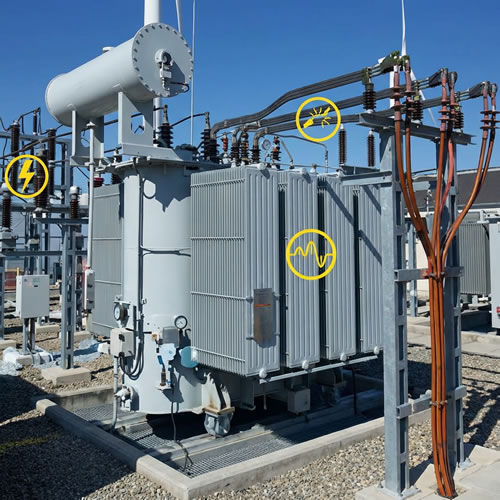
Pengukuran PD berbilang saluran untuk transformer bermakna memperoleh isyarat nyahcas separa daripada berbilang titik penderiaan, fasa atau jenis sensor, dan bukannya bergantung pada satu saluran pengukuran. Setiap saluran adalah laluan isyarat yang berasingan daripada penderia ke sistem pemerolehan, dan sistem merekodkannya dengan cara yang diselaraskan. Objektif utama ialah:
- Bandingkan aktiviti PD antara fasa.
- Bandingkan respons daripada lokasi penderia yang berbeza.
- Sokong diskriminasi bunyi.
- Sokong pemisahan sumber.
- Meningkatkan korelasi acara.
- Menyokong penyetempatan.
- Keadaan trek dari semasa ke semasa.
- Meningkatkan keyakinan dalam penilaian penebat transformer.
Mengapa Pengukuran Pelepasan Separa Berbilang Saluran Digunakan pada Transformer
Transformer mungkin menjana atau menerima isyarat yang berbeza pada kedudukan sensor yang berbeza. Sebabnya termasuklah:
- Struktur kompleks: belitan, teras, tangki dan petunjuk mencipta banyak laluan isyarat.
- Pelbagai kawasan penebat: nyahcas boleh berlaku di bahagian berlainan sistem penebat.
- Berbilang fasa: tiga fasa memberikan kumpulan perbandingan semula jadi.
- Gangguan luar: bunyi dari pencawang boleh masuk melalui sesendal, pembumian dan udara.
- Pengecilan isyarat: isyarat lemah semasa ia merambat, jadi acara yang sama kelihatan berbeza pada penderia yang berbeza.
- Perbezaan gandingan sensor: penderia tidak berganding sama rata kepada setiap sumber.
- Laluan penyebaran: isyarat mengambil laluan yang berbeza untuk mencapai penderia yang berbeza.
Pengukuran berbilang saluran menggunakan perbezaan ini sebagai maklumat. Ia tidak secara automatik mengenal pasti lokasi kerosakan yang tepat, dan hasilnya masih memerlukan tafsiran kejuruteraan.
| Objektif Pengukuran | Mengapa Pelbagai Saluran Membantu | Penggunaan Kejuruteraan Biasa |
|---|---|---|
| Perbandingan fasa | Penderia yang serupa pada setiap fasa menunjukkan sama ada aktiviti lebih kuat pada satu fasa | Kenal pasti kawasan fasa yang hendak disiasat |
| Perbandingan lokasi sensor | Tindak balas relatif pada kedudukan berbeza menunjukkan di mana isyarat paling kuat | Sempitkan kawasan yang disyaki |
| Diskriminasi bunyi | Bunyi luaran sering muncul merentas saluran dengan cara yang berbeza daripada aktiviti tempatan | Kurangkan petunjuk palsu |
| Pemisahan sumber | Sumber yang berbeza menghasilkan corak dan respons saluran yang berbeza | Mengendalikan sumber PD yang disyaki |
| Sokongan penyetempatan | Perbezaan amplitud dan masa ketibaan antara saluran membawa maklumat kedudukan | Sokongan, bukan menggantikan, perancangan pemeriksaan |
| Pemantauan arah aliran | Setiap saluran membina sejarahnya sendiri | Detect change in activity over time |
| Perkaitan peristiwa | The same event seen on several channels confirms it is real and related | Link events to operating conditions |
| Condition assessment | More evidence gives more confidence | Input to maintenance decisions |
2. Pengukuran Pelepasan Separa Saluran Tunggal lwn Berbilang Saluran

Single-channel PD measurement is simpler and often sufficient for a basic check, for example a test with one coupling point in a controlled setting. Its limit is that one signal cannot show where the signal came from, and it is hard to separate transformer activity from interference. Multi-channel measurement adds comparison, at the price of more hardware, more installation work and more data to analyze.
| Ciri | Single-Channel Measurement | Multi-Channel Measurement |
|---|---|---|
| Bilangan titik penderiaan | satu | beberapa |
| Perbandingan fasa | Needs repeated measurements on each phase | Phases can be compared in the same acquisition |
| Perbandingan sumber | Terhad | Mungkin antara saluran |
| Diskriminasi bunyi | Bergantung pada corak dan penapisan | Menambah perbandingan merentas saluran |
| Sokongan penyetempatan | Sangat terhad | mungkin, bergantung kepada sensor dan geometri |
| Kerumitan perkakasan | Lebih rendah | Lebih tinggi |
| Jumlah data | Lebih rendah | Lebih tinggi |
| Kerumitan pemasangan | Lebih rendah | Lebih tinggi, dengan lebih banyak penderia dan kabel |
| Perbandingan trend | Satu trend | Aliran setiap saluran dan antara saluran |
| Condition assessment | Petunjuk sahaja | Bukti yang lebih kukuh daripada korelasi |
Apabila Pengukuran PD Transformer Berbilang Saluran Lebih Berguna
- pengubah kuasa besar dengan beberapa kedudukan sensor tersedia
- pencawang bising di mana gangguan menjadi kebimbangan
- kes di mana perbandingan fasa diperlukan
- pemantauan dalam talian kekal
- diskriminasi sumber apabila lebih daripada satu sumber PD disyaki
Tidak setiap projek transformer memerlukan sistem berbilang saluran. Unit yang lebih kecil atau lebih rendah kritikal mungkin disediakan dengan secukupnya melalui ujian saluran tunggal berkala.
3. Penderia Nyahcas Separa untuk Pengukuran PD Transformer Berbilang Saluran
Kualiti data berbilang saluran bergantung pertama pada sensor nyahcas separa. Pengukuran PD Transformer biasanya menggunakan UHF, HFCT dan penderiaan akustik, dan kadangkala kaedah gandingan elektrik. Tidak setiap pengubah menyokong setiap jenis sensor, kerana titik akses, reka bentuk tangki dan susunan pembumian berbeza. Persediaan pemantauan pelepasan separa berbilang sensor juga boleh mencampurkan jenis penderia supaya setiap saluran menambah jenis maklumat yang berbeza.
Penderia UHF untuk Pemantauan Nyahcas Separa Transformer
Penderia UHF mengesan gelombang elektromagnet frekuensi tinggi yang dihasilkan oleh nyahcas. Perkara yang perlu dipertimbangkan:
- mereka bertindak balas kepada isyarat PD elektromagnet frekuensi tinggi
- pemasangan bergantung kepada pengubah dan akses yang ada, seperti port atau tingkap yang sesuai
- kesesuaian bergantung kepada pengubah dan susunan pemantauan
- they can be less affected by low-frequency noise, but the radio-frequency environment still matters
- signals propagate and attenuate inside the tank structure, so position affects what is seen
HFCT Sensors for Partial Discharge Signal Measurement
HFCT sensors clamp around a conductor and detect high-frequency current pulses. They are used where such a conductor is accessible:
- they measure high-frequency current signals
- they are placed on grounding paths, for example a bushing tap ground or tank ground connection, mana berkenaan
- placement on a cable or grounding conductor determines what current is captured
- external noise can enter through the same grounding path, so interference needs attention
Acoustic Sensors for Partial Discharge Localization Support
Penderia akustik mengesan bunyi yang dihasilkan oleh aktiviti nyahcas dan biasanya dipasang pada dinding tangki. Mereka berguna untuk sokongan penyetempatan:
- pelepasan akustik dihasilkan oleh aktiviti PD
- kedudukan sensor pada tangki mempengaruhi isyarat yang diterima
- pembiakan melalui minyak, keluli dan struktur perubahan masa dan amplitud
- perbandingan masa antara sensor memberikan maklumat kedudukan
Penderiaan akustik sahaja tidak selalu mengenal pasti lokasi PD yang tepat. Refleksi, pengecilan dan struktur pengubah semuanya mempengaruhi hasilnya.
| Jenis Sensor | Isyarat Terukur | Kawasan Pemasangan Biasa | kekuatan | Had | Penggunaan Berbilang Saluran |
|---|---|---|---|---|---|
| UHF | Gelombang elektromagnet frekuensi tinggi | Titik akses tangki, di mana ada | Sensitif kepada isyarat di dalam tangki | Memerlukan akses yang sesuai, bunyi frekuensi radio penting | Beberapa sensor untuk amplitud dan perbandingan masa |
| HFCT | Denyutan arus frekuensi tinggi | Konduktor pembumian, bushing tap grounds, mana berkenaan | Non-intrusive installation on a conductor | Mengambil bunyi luaran di laluan tanah | Satu setiap fasa untuk perbandingan fasa |
| Akustik | Pelepasan akustik daripada pelepasan | Dinding tangki | Tidak terjejas oleh bunyi elektrik, menyokong penyetempatan | Pengecilan dan refleksi, isyarat yang lebih lemah | Berbilang kedudukan untuk perbandingan masa |
| Kaedah gandingan elektrik | Cas atau arus pada titik gandingan, seperti pili sesendal | Paip sesendal atau kapasitor gandingan, mana berkenaan | Pendekatan pengukuran elektrik yang biasa | Bergantung pada susunan gandingan dan akses yang tersedia | Satu saluran setiap fasa yang disokong |
Untuk contoh pendekatan bersepadu, lihat sistem pemantauan PD pengubah berbilang saluran. Jenis sensor dan kiraan saluran yang tersedia untuk sistem tertentu hendaklah disahkan pada halaman produk atau dengan pembekal.
4. Persediaan Pengukuran PD Berbilang Saluran dan Peletakan Penderia
Persediaan yang baik bermula dengan objektif dan pengubah, bukan dengan kiraan saluran. Peletakan sensor PD and the number of PD measurement channels bergantung kepada:
- transformer configuration
- bilangan fasa
- sensor type
- suspected PD source locations
- required coverage
- diagnostic objective
- online or offline measurement method
The partial discharge acquisition system then records all channels together with a common time base and phase reference.
PD Sensor Placement for Transformer Phase Comparison
Phase comparison is one of the clearest benefits of multiple channels, and it only works if the sensors are comparable:
- use the same sensor type and, where possible, the same position on phases A, B and C
- avoid installation conditions that differ between phases, such as different cable lengths or grounding paths
- keep sensor coupling consistent, so that a difference in signal reflects the transformer rather than the setup
Multi-Channel PD Acquisition and Channel Mapping
Each channel should be mapped clearly:
Saluran 1 → Sensor location → Transformer phase → Sensor type
Saluran 2 → Sensor location → Transformer phase → Sensor type
Channel naming and installation records matter for long-term analysis. A trend is only meaningful if the same channel still refers to the same sensor and position months later, and records make it possible to tell a real change from a re-wired or moved sensor.
The following table is an illustrative engineering layout only. It is not from a customer project.
| Saluran | Jenis Sensor | Measurement Position | Tujuan | Comparison Group |
|---|---|---|---|---|
| CH1 | HFCT | Phase A ground path | Phase A electrical signal | Perbandingan fasa |
| CH2 | HFCT | Phase B ground path | Phase B electrical signal | Perbandingan fasa |
| CH3 | HFCT | Phase C ground path | Phase C electrical signal | Perbandingan fasa |
| CH4 | UHF atau akustik | Tank access point or tank wall | Independent signal type for confirmation | Cross-sensor comparison |
Channel Count and Measurement Coverage
More channels do not automatically mean better measurement. Configuration should balance transformer size, bilangan fasa, capaian sensor, diagnostic objective, persekitaran bunyi bising, system cost and the complexity of data analysis. Extra channels in poor positions add data without adding information, while a few well-placed, consistent sensors can be more useful.
5. Corak PRPD, Penyegerakan Saluran dan Perbandingan Isyarat
analisis corak PRPD plots discharge events against the phase of the AC voltage. In phase-resolved partial discharge data, each event has a magnitude and a phase position, and repeated events build a pattern. Jurutera melihat:
- Phase reference: the voltage waveform used to place events in phase.
- Magnitud pelepasan: the size of events, in the units the system provides.
- Phase position: where in the cycle events occur.
- Repetition pattern: how often events occur.
- Pattern stability: whether the pattern stays consistent or changes.
- Channel-to-channel comparison: how the same pattern appears on different channels.
Pattern-based diagnosis should not be overstated. A pattern suggests possible behavior, and it needs verification with other data.
PRPD Pattern Analysis Across Multiple PD Channels
With several channels, engineers compare magnitude, kadar pengulangan, phase position, pattern shape, persistence and channel coincidence. Similar patterns on several channels may indicate a common source, signal propagation from one source to several sensors, atau gangguan luar. These possibilities look alike on the surface, so additional verification is needed to tell them apart.
Why Channel Synchronization Matters in Multi-Channel PD Measurement
Channel synchronization means the channels are acquired together, against a common time base and phase reference. It supports:
- Event timing: arrival-time differences are only meaningful if channels share a clock.
- Phase reference: events on all channels are placed in the same phase frame.
- Signal correlation: the same event can be identified on several channels.
- Perbandingan sumber: amplitudes and timing can be compared for the same event.
- Noise rejection: events that coincide in a way typical of external noise can be flagged.
Without synchronization, channels are just several separate measurements, and many of the multi-channel benefits are lost.
| Observed Pattern | Possible Interpretation | What to Check Next |
|---|---|---|
| Signal appears on one channel only | May indicate a local source near that sensor, or a sensor or cable problem | Check the sensor and connection, compare with nearby positions |
| Similar signal appears on multiple channels | Can suggest a common source, propagation or interference | Compare amplitude and arrival time, check PRPD patterns |
| Signal appears simultaneously across all channels | May indicate external common-mode noise | Check for nearby noise sources and switching events |
| One phase shows stronger repeated activity | Can suggest activity in that phase region | Verify sensor consistency, review trend and complementary data |
| Pattern changes with load | May indicate load-dependent activity, or a load-related noise source | Compare against load and temperature records |
| Pattern changes over time | May indicate a developing condition or changing environment | Review trend, confirm with complementary testing |
| Signal disappears after noise source removal | Suggests the signal was external noise | Document the source and keep monitoring |
6. Diskriminasi Bunyi dan Pemisahan Sumber Pelepasan Separa
Substations are noisy. Partial discharge testing in noisy environments has to deal with:
- switching noise
- mahkota
- gangguan frekuensi radio
- bunyi asas
- inverter and electronic noise
- nearby equipment activity
- communication equipment interference
A single channel cannot easily tell these from transformer activity. Diskriminasi bunyi is one of the main reasons to use several channels.
Multi-Channel Noise Discrimination in Transformer PD Testing
Multiple channels may help distinguish local transformer activity from common-mode external interference. Examples of what engineers look for:
- a signal appears strongly on one local sensor but weakly elsewhere
- a signal appears at a similar level, pada masa yang sama, across several channels
- a pattern correlates with switching equipment rather than with transformer load
- a signal disappears when an external noise source is removed
These are indications, not absolute diagnostic rules. Each requires verification.
Partial Discharge Source Separation Using Multi-Channel Data
Partial discharge source separation groups events that come from the same source and separates them from others. Multi-channel data supports it through:
- channel amplitude comparison
- arrival-time comparison
- PRPD pattern grouping
- kedudukan sensor
- operating condition
- repeated trend
Events with a similar pattern, consistent channel amplitude ratios and consistent timing are more likely to share a source. Where several sources are active, grouping them makes the data easier to read.
| Pemerhatian | Possible PD Behavior | Possible External Noise Behavior | Recommended Verification |
|---|---|---|---|
| Single-channel dominant signal | Local source near that sensor | Local interference at that sensor or cable | Check sensor and cable, compare neighboring channels |
| Multi-channel simultaneous signal | Common source seen by several sensors | Common-mode interference | Compare amplitude differences and arrival times |
| Stable phase-related pattern | Consistent with discharge activity tied to the voltage cycle | Some interference can also be phase-related | Check the phase reference and other channels |
| Random broadband activity | Less typical of a stable PD source | Often associated with broadband interference | Observe over time, review nearby equipment |
| Load-dependent activity | May relate to load-dependent conditions | May relate to load-linked equipment nearby | Compare with load and temperature records |
| Switching-related activity | Less likely to be a stable internal source | Typical of switching events | Correlate with switching records |
| Persistent long-term trend | May indicate ongoing activity that deserves attention | Possible if a permanent noise source exists | Confirm with complementary testing |
7. Pemantauan PD Berbilang Saluran Dalam Talian untuk Penilaian Keadaan Transformer
Pemantauan PD dalam talian measures while the transformer is in service, over long periods. Pemantauan nyahcas separa pengubah of this kind differs from a short diagnostic test: it provides continuous data collection, analisis trend, a record of repeated PD activity, perbandingan fasa, event history, alarm review and correlation with operating condition. Together these support pemantauan dalam talian transformer programs and help judge transformer insulation condition lama kelamaan. Some activity only appears under particular load or temperature conditions, which a short test can miss and a continuous record can capture.
Online PD Monitoring vs Offline Transformer PD Testing
| Aspek | Pemantauan PD Dalam Talian | Ujian PD Luar Talian |
|---|---|---|
| Transformer operating state | In service at normal operating voltage | De-energized and energized by a test source |
| Tempoh pengukuran | Long term | Limited to the test |
| Trend data | Continuous history | Points at each test |
| Controlled test condition | Follows operating condition | Voltage and conditions can be controlled |
| Persekitaran bunyi bising | Exposed to substation noise | Can be better controlled |
| Maintenance impact | No outage for measurement | Needs an outage |
| Diagnostic depth | Indicates change and activity | Deeper, controlled investigation |
| Tujuan biasa | Early indication and trend tracking | Confirmation and detailed diagnosis |
Kedua-duanya tidak menggantikan yang lain. Online data tells engineers when offline testing is worth the outage, and offline testing helps verify what the online data suggests. For more on the detection methods, lihat PD detection and monitoring methods, and for the transformer-specific view see transformer insulation discharge monitoring.
Multi-Channel PD Trends for Transformer Insulation Condition Assessment
Engineers evaluate the data against:
- the baseline
- kadar perubahan
- persistent activity
- recurring patterns
- channel comparison
- perbandingan fasa
- the relationship with load
- the relationship with temperature
- other condition data
PD data is most convincing when it is correlated with other evidence. Rising discharge activity alongside changing dissolved gases, suhu tidak normal, bushing monitoring changes or findings from maintenance inspection gives stronger grounds for action than any single indicator. Lihat transformer insulation and condition assessment for how these data streams fit together.
8. Senarai Semak Pengukuran PD Berbilang Saluran untuk Transformer
- Define the PD measurement objective.
- Identify the transformer type.
- Identify the voltage class.
- Review the transformer construction.
- Determine the sensor type.
- Determine the sensor locations.
- Define the channel count.
- Assign a phase and sensor to each channel.
- Verify the phase reference.
- Verify channel synchronization.
- Record installation positions.
- Review the noise environment.
- Wujudkan data asas.
- Compare channels.
- Review PRPD patterns.
- Separate common external noise.
- Compare with operating load.
- Compare with historical data.
- Correlate with other condition indicators.
- Confirm abnormal findings before maintenance decisions.
| Measurement Element | Soalan Utama | Engineering Purpose |
|---|---|---|
| Jenis sensor | Which signal does this transformer allow us to measure? | Match sensing to access and objective |
| Sensor position | Are positions comparable and recorded? | Make channels comparable |
| Kiraan saluran | Is coverage enough without needless data? | Balance coverage and complexity |
| Penyegerakan | Do all channels share a time base? | Enable timing and correlation |
| Phase reference | Is it correct and stable? | Place events in phase |
| PRPD | Do patterns agree between channels? | Characterize activity |
| Diskriminasi bunyi | Is the signal local or common to all channels? | Kurangkan petunjuk palsu |
| Pemisahan sumber | Is there more than one source? | Group events correctly |
| Analisis trend | Is activity changing against the baseline? | Detect developing change |
| Condition assessment | Do other indicators agree? | Support maintenance decisions |
9. Soalan Lazim
1. What is multi-channel PD measurement for transformers?
It is the acquisition of partial discharge signals from several sensing points, phases or sensor types at the same time, instead of relying on one channel. The channels share a time base and phase reference, so engineers can compare amplitude, masa, phase position and patterns between them. This supports noise discrimination, source separation, localization support and long-term condition assessment of the transformer insulation.
2. Why use multiple PD measurement channels on a transformer?
A transformer has several phases, many insulation regions and long signal paths, so a single channel sees only part of the picture. Multiple channels allow phase comparison, comparison between sensor locations and cross-checking of events. They help separate transformer activity from external noise and give more confidence in the assessment. The benefit has to be weighed against added hardware, installation and analysis effort.
3. Which sensors are used for multi-channel transformer PD measurement?
Common choices are UHF sensors, HFCT sensors and acoustic sensors, and in some cases electrical coupling at a bushing tap or similar point. UHF and acoustic sensors depend on access to the tank, and HFCT sensors depend on an accessible grounding conductor. Not all transformers support all types, so the selection follows the construction, access and the diagnostic objective.
4. How does multi-channel PD measurement help distinguish noise from partial discharge?
By comparing channels. A signal that is strong on one local sensor and weak elsewhere may be local activity, while a signal that appears at similar levels and the same time on all channels may be common-mode external noise. Correlation with switching events, and disappearance when a noise source is removed, add evidence. These are indications that need verification, not absolute rules.
5. Can multi-channel PD measurement locate the source of transformer partial discharge?
It can support localization and source discrimination, but it does not guarantee an exact location. Multiple sensors and synchronized channels allow amplitude and arrival-time comparison, which narrows the suspected region. How well it works depends on the sensor type, installation geometry, signal propagation inside the transformer and the analysis method. Findings should be confirmed with complementary testing before any intervention.
Multi-channel PD measurement is most useful when sensor placement, synchronized acquisition, Perbandingan PRPD, noise discrimination and long-term trend analysis are considered together. Each element supports the others: consistent sensors make channels comparable, synchronization makes timing meaningful, and trends give the comparison a baseline. For equipment of this kind, lihat online transformer insulation monitoring equipment muka surat.

Sensor suhu gentian optik, Sistem pemantauan pintar, Pengeluar gentian optik yang diedarkan di China
 |
 |
 |