 INNO 광섬유 온도 센서 ,온도 모니터링 시스템.
온도 센서: 완전한 가이드 광섬유 온도 모니터링 솔루션
- 광섬유 온도 센서 deliver ±0.1°C measurement accuracy in extreme environments with 20+ 년 작동 수명
- 분산 온도 감지 technology enables continuous monitoring along 30-kilometer fiber lengths with single cable installation
- 본질안전 설계 makes fiber optic sensors the preferred choice for hazardous and explosive environments
- 유지보수가 필요 없는 작동 significantly reduces long-term operational costs, especially for remote or dangerous locations
- 다중 매개변수 감지 capabilities simultaneously monitor temperature, 부담, 압력, and other physical parameters
- Real-time data transmission supports remote monitoring and automated control system integration
비교 Temperature Sensing Technologies
Traditional temperature sensors face significant limitations in modern fiber optic communication systems and industrial applications. 열전대, while offering fast response times, are susceptible to electromagnetic interference. Thermistors provide good accuracy but have limited temperature ranges and environmental sensitivity. Infrared sensors offer non-contact measurement but cannot penetrate obstacles and are affected by environmental factors.
Optical fiber temperature sensors overcome these traditional limitations. Their intrinsically safe characteristics enable operation in explosive environments, provide excellent electromagnetic interference immunity, and withstand harsh industrial conditions. 가장 중요한 것은, fiber optic cable systems can transmit signals over long distances without quality loss, maintaining signal stability through advanced polarization control technology.

| Technical Specification | 열전대 | 서미스터 | 적외선 센서 | 광섬유 온도 센서 |
|---|---|---|---|---|
| 측정 정확도 | ±1~2°C | ±0.1~0.5°C | ±2~5°C | ±0.1°C |
| 온도 범위 | -200~1800°C | -50~300°C | -50~2000°C | -200~800°C |
| 응답 시간 | 0.1-10 초 | 1-50 초 | <1 두번째 | 1-10 초 |
| 전송 거리 | <100 미터 | <50 미터 | Line of sight | >30 킬로미터 |
| 간섭 내성 | 가난한 | 보통의 | 보통의 | 훌륭한 |
| 본질 안전 | 아니요 | 아니요 | 예 | 예 |
| 서비스 수명 | 2-5 연령 | 3-8 연령 | 5-10 연령 | 20+ 연령 |
| 유지 보수 요구 사항 | 정기교정 | 정기적인 교체 | Regular cleaning | 유지보수가 필요 없는 |
고급의 광섬유 온도 감지 원칙
분산 온도 감지 (DTS) 기술
Distributed temperature sensing systems utilize Raman scattering principles to transform single mode fiber into continuous temperature sensors. When laser pulses propagate through optical fiber, they generate anti-Stokes Raman scattered light with intensity proportional to the fiber’s local temperature. This distributed sensing technology revolutionizes temperature monitoring approaches in modern fiber optic network applications.
By analyzing return optical signal timing and intensity, optical time domain reflectometer technology determines temperature values at every position along the fiber length. Modern DTS systems achieve 0.5-meter spatial resolution with 0.01°C temperature resolution, covering up to 30 kilometers in single measurements.
가리키다 광섬유 센서 응용
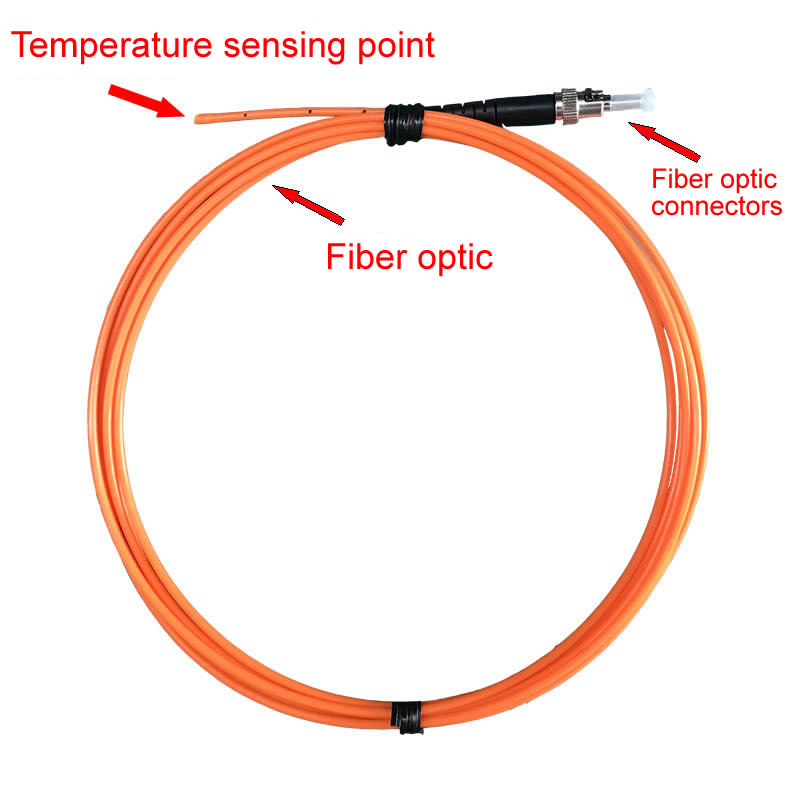
Point fiber optic temperature sensors utilize temperature-sensitive materials at fiber tips for localized measurements. Common technologies include fluorescence decay, interferometric methods, and fiber bragg grating techniques. These compact, fast-response sensors are particularly suitable for high-precision point measurements and have applications in optical coherence tomography systems.
섬유 브래그 격자 파장 Modulation
FBG temperature sensors incorporate periodic refractive index variations into multimode fiber cores, creating narrowband reflectors. Temperature changes alter grating periods and refractive indices, shifting reflection wavelengths. Monitoring wavelength drift enables precise temperature measurement with exceptional accuracy through wavelength modulation technology.

| Sensing Technology | 측정원리 | 정확성 | 응답 시간 | 범위 | 응용 | 비용 수준 |
|---|---|---|---|---|---|---|
| 분산 DTS | 라만 산란 | ±1°C | 1-60 초 | 30 km | Long-distance monitoring | 높은 |
| FBG 센서 | Wavelength modulation | ±0.1°C | <1 두번째 | 10 km | 다지점 모니터링 | 중간 |
| 형광 붕괴 | 형광 수명 | ±0.2°C | 1-5 초 | 100 미터 | Point monitoring | 중간 |
| 간섭계 | Phase modulation | ±0.05°C | <0.1 두번째 | 1 km | 정밀 측정 | 높은 |
| Blackbody radiation | Radiation intensity | ±1°C | 1-10 초 | 500 미터 | 고온 | 낮은 |
Critical Industrial 응용
전력산업 온도 모니터링
Overheating in electrical systems is the primary cause of equipment failures and fire incidents. Fiber optic sensor networks monitor temperature changes in transformer windings, 케이블 조인트, 및 개폐 장치 구성 요소. Distributed temperature sensing technology provides continuous monitoring along entire power cable lengths, detecting hot spot failures immediately.
In high-voltage substations, 광섬유 센서’ insulating properties eliminate electrical safety hazards. Real-time temperature monitoring data helps operators optimize equipment loading, prevent overheating failures, and extend equipment service life. Combined with structural health monitoring systems, comprehensive electrical equipment condition assessment becomes possible.
Petrochemical Pipeline 온도 조절
Petrochemical process pipelines require precise temperature control to ensure product quality and operational safety. Fiber optic temperature sensors operate reliably in corrosive media and high-pressure environments, providing continuous temperature monitoring. Interrogator systems process optical signals in real-time, ensuring monitoring data timeliness and accuracy.
Long-distance oil and gas pipelines utilize distributed temperature sensing technology to monitor temperature distribution along pipeline routes, detecting leak points and thermal losses. This monitoring approach significantly improves pipeline operational safety while reducing environmental pollution risks. Optical amplifier technology ensures signal quality stability during long-distance transmission.
화재 감지 및 경고 시스템
Traditional fire detectors suffer from response delays and false alarm issues. Fiber optic temperature sensing systems provide more reliable solutions. Distributed temperature sensing continuously monitors temperature distribution in tunnels, 창고, 산업시설, detecting abnormal temperature rises during fire initiation stages.
Systems can precisely locate fire sources, providing critical information for emergency response. In underground spaces and enclosed areas, 광섬유 센서’ non-electrical spark characteristics ensure the monitoring system itself doesn’t become a fire hazard. Optical power meter technology monitors system operational status, ensuring warning system reliability.
의료 장비 온도 조절
Medical equipment temperature control directly affects patient safety and treatment effectiveness. Fiber optic temperature sensors don’t generate magnetic field interference in MRI equipment and aren’t affected by radiation in radiotherapy devices, providing reliable temperature monitoring solutions for medical applications.
Operating room environmental temperature control, pharmaceutical storage temperature monitoring, and medical device sterilization temperature verification all benefit from fiber optic temperature sensing technology’s high accuracy and reliability. Spectrum analyzer technology ensures signal quality and provides dependable measurement results.
자주 묻는 질문 광섬유 온도 모니터링
How complex is fiber optic temperature sensor installation?
Installation is relatively straightforward, involving fiber deployment, 커넥터 설치, 및 시스템 시운전. Distributed systems require only single fiber installation to cover entire monitoring areas. Professional installation teams typically complete medium-scale projects within 1-2 날.
How are damaged optical fibers repaired?
Optical fiber possesses excellent mechanical strength with rare breakage during normal operation. When damage occurs, fiber fusion splicing technology enables repairs with performance matching original fiber specifications. Reserve fiber length at critical locations is recommended for maintenance purposes.
How is measurement data accuracy ensured?
Multi-point reference measurements, 온도 보상 알고리즘, and redundant sensor designs ensure measurement accuracy. System self-diagnostic functions detect sensor failures and signal anomalies, automatically reporting system status. Wavelength division multiplexing technology allows multiple sensors to share single fiber connections.
How reliable are fiber optic sensors in harsh environments?
Fiber optic sensors are designed for harsh industrial environments, withstanding vibration, shock, 부식, 그리고 극한의 기온. Appropriate protection measures such as metal armoring and anti-corrosion coatings further enhance environmental adaptability. Polarization maintaining fiber provides superior performance in applications requiring extreme stability.
What are system power consumption and maintenance costs?
Fiber optic temperature sensing systems have very low power consumption, mainly from laser sources and signal processing units. Systems are designed for 20+ year lifespans with essentially no sensor replacement requirements during operation. Maintenance costs primarily involve periodic inspections and software updates.
How is large-volume temperature monitoring data processed?
Modern systems feature advanced data processing and storage capabilities, supporting cloud-based data management and remote access. Machine learning algorithms automatically analyze temperature trends, identify abnormal patterns, and reduce manual intervention requirements. Data acquisition systems ensure data integrity and real-time performance.
Can systems integrate with existing control systems?
Fiber optic temperature sensing systems provide standard communication interfaces including Modbus, 이더넷, and OPC protocols for seamless integration with existing SCADA, DCS, or PLC control systems, enabling automated control and alarm functions.
What spatial resolution do distributed temperature sensing systems achieve?
Modern DTS systems achieve 0.5-2 미터 공간 해상도, precisely locating temperature anomaly points. Applications requiring higher resolution can utilize distributed acoustic sensing technology combined with temperature monitoring for enhanced performance.
Start Your 온도 모니터링 Project
Selecting appropriate fiber optic temperature sensing solutions requires considering multiple factors including measurement range, 정확도 요구 사항, 환경 조건, 예산 제약. Our expert team possesses extensive fiber optic network design experience and can provide personalized technical consultation and solution design services.
Complimentary Technical Consultation: Our engineering team stands ready to analyze your specific requirements and recommend optimal sensor technologies and system configurations. Whether simple point temperature monitoring or complex distributed systems, we provide professional guidance. Incorporating the latest optical time domain reflectometer technology ensures optimal system performance.
맞춤형 솔루션: Every application has unique requirements. We provide complete customization services from sensor selection to system integration. Leveraging the latest developments in fiber optic sensing technology, we create optimal solutions tailored to your project needs. Our solutions cover configuration requirements from single mode fiber to multimode fiber applications.
Technical Support Assurance: From project design through system operation, we provide comprehensive technical support. Professional after-sales service teams ensure your temperature monitoring systems maintain long-term stable operation. Equipped with professional spectrum analyzer and optical power meter equipment for system maintenance and fault diagnosis.
Ready to deploy advanced fiber optic temperature sensing systems for your project? Contact our expert team immediately for complimentary technical consultation and project assessment. Let us help you select the most suitable temperature monitoring solutions to ensure successful project implementation.

광섬유 온도 센서, 지능형 모니터링 시스템, 중국의 분산광섬유 제조업체
 |
 |
 |