 INNO 광섬유 온도 센서 ,온도 모니터링 시스템.
- Dual Technology Solutions: Fluorescent fiber optic and distributed fiber optic temperature sensing systems meet diverse industrial equipment monitoring needs
- Superior Performance: Fluorescent systems offer <1 두 번째 응답 시간, ±1°C 정확도, -40°C~260°C 범위; distributed systems provide 1-second response
- Global Applications: Thousands of systems successfully deployed across Europe, 북아메리카, and Asia-Pacific in power, 석유화학, and metallurgical industries
- Proven Advantages: 열전대와 비교, RTD, and infrared thermometry, 광섬유 기술 offers intrinsic safety and electromagnetic immunity
- Customization Available: 프로브 직경, 섬유 길이, 온도 범위, and other parameters customizable to specific operational requirements
1. What is an Industrial Machine Monitoring System?

안 industrial machine monitoring system is an intelligent platform integrating sensing, 데이터 수집, 분석, and warning capabilities designed to track equipment operational status in real-time. These systems deploy various sensors to continuously collect critical parameters including temperature, 진동, 압력, and current, enabling enterprises to achieve 예측 유지 관리 and optimize production management.
온도 모니터링 represents one of the most fundamental yet critical functions in industrial machine monitoring. Abnormal equipment temperatures often signal early-stage failures, and timely detection can prevent major accidents and economic losses.
우리의 광섬유 온도 감지 시스템 specialize in providing highly reliable temperature monitoring solutions for industrial equipment, supporting two core technologies:
핵심기술
- 형광등 광섬유 온도 감지: Ideal for precise point measurements at critical locations
- 분산 광섬유 온도 모니터링 (DTS): Suitable for long-distance continuous monitoring
The system architecture comprises fiber optic sensing probes, signal demodulation equipment, industrial communication modules, and monitoring software platforms, seamlessly integrating with existing industrial automation systems.
2. Why is Temperature Monitoring Critical for Industrial Equipment?
Preventing Catastrophic Failures
Equipment overheating ranks among the leading causes of industrial accidents. Electrical equipment contact failure, excessive mechanical friction, and uncontrolled chemical reactions all manifest as abnormal temperature increases. 실시간 온도 모니터링 provides early warnings during the incubation stage, 화재 예방, 폭발, and other severe consequences.
장비 수명 연장
Prolonged operation in high-temperature environments accelerates equipment aging. By mastering equipment thermal states through 온도 모니터링 시스템 and optimizing operational parameters, companies can significantly extend equipment lifespan and reduce capital expenditures.
Enhancing Production Efficiency
Many industrial production processes require strict temperature control. 정밀한 온도 모니터링 데이터 supports process optimization, improves product quality and production efficiency, and reduces scrap rates.
Meeting Regulatory Compliance
Safety regulatory authorities worldwide mandate temperature monitoring for critical equipment in high-risk industries. 포괄적인 장비 모니터링 시스템 help enterprises pass safety audits and obtain production licenses.
Supporting Intelligent Decision-Making
Accumulated temperature data provides the foundation for equipment health management, 유지 관리 계획, and energy management optimization—essential components of industrial digital transformation.
3. What is Fiber Optic Temperature Sensing Technology?

광섬유 온도 감지 온도 측정을 위해 광섬유의 물리적 특성을 활용하는 기술입니다.. 기존의 전기 센서와는 다르게, 광섬유 센서 광신호를 정보 매체로 사용, 본질 안전을 포함한 고유한 이점 제공, 전자기 간섭 내성, 그리고 장거리 전송 능력.
기술개발 배경
광섬유 센싱 기술은 1970년대 광섬유 통신 연구에서 유래. 과학자들은 광섬유를 통해 전파되는 빛이 환경 온도와 관련된 다양한 산란 및 형광 현상을 생성한다는 것을 발견했습니다., 스트레스, 및 기타 물리량. 수십년의 개발 끝에, 광섬유 감지 산업 모니터링 애플리케이션에서 성숙한 기술이 되었습니다..
핵심 장점
본질 안전
광섬유 센서 전기 부품이 포함되어 있지 않습니다., 현장 전원 공급 장치가 필요하지 않습니다., 전기 스파크가 발생하지 않습니다., enabling safe use in flammable and explosive environments. This represents the fundamental reason why high-risk industries like chemical and coal mining prefer fiber optic technology.
전자기 간섭 내성
In strong electric and magnetic field environments, traditional electrical sensors easily suffer interference causing measurement inaccuracies. Optical signals remain completely unaffected by electromagnetic fields, 데이터 정확성과 신뢰성 보장.
Corrosion and High-Temperature Resistance
Optical fiber material consists of quartz glass with stable chemical properties. Combined with special protective sheaths, fibers can operate long-term in acidic, alkaline, and high-temperature harsh environments.
Long-Distance Lossless Transmission
Optical signals maintain signal quality across kilometers of fiber transmission without requiring repeater amplification, simplifying system design.
4. How Does Fiber Optic Temperature Measurement Compare to Traditional Methods?
Industrial Temperature Measurement Technology Comparison
| 비교항목 | 형광성 광섬유 | 분산 광섬유 | 열전대 | RTD | 적외선 온도계 |
|---|---|---|---|---|---|
| 측정 정확도 | ±1°C | ±1~2°C | ±1~2°C | ±0.1~0.5°C | ±2~5°C |
| 응답 시간 | <1 두번째 | 1 두번째 | 1-10 초 | 5-30 초 | <1 두번째 |
| 온도 범위 | -40 260°C까지 (맞춤형) | -40 to 600°C | -200 to 1800°C | -200 850°C까지 | -50 to 3000°C |
| EMI 내성 | 완전한 면역 | 완전한 면역 | 느끼기 쉬운 | 느끼기 쉬운 | 해당 없음 |
| 본질 안전 | 예 | 예 | 아니요 | 아니요 | 예 |
| 측정 거리 | 단일 포인트 (0-80m fiber) | Continuous 5-30km | Limited by cable length | Limited by cable length | Line of sight |
| 장기적인 안정성 | 훌륭한 (드리프트 없음) | 훌륭한 | Prone to drift | 좋은 | Environment dependent |
| 유지관리 비용 | 매우 낮음 | 낮은 | 중간 (교정이 필요합니다) | 중간 | 중간 |
| 다지점 모니터링 | 1-64 points per channel | Thousands of points per fiber | Individual wiring per point | Individual wiring per point | Point-by-point scanning |
| 서비스 수명 | 20+ 연령 | 20+ 연령 | 3-5 연령 | 5-10 연령 | 5-10 연령 |
Significant Advantages of Fiber Optic Technology
Harsh Industrial Environment Adaptability
변전소에서, 개폐 장치, and other strong electromagnetic field environments, thermocouple and RTD measurement data frequently fluctuate and produce errors, leading to false alarms or missed detections. 광섬유 센서 remain completely unaffected by electromagnetic interference and can operate stably in 1000kV ultra-high voltage environments.
A provincial grid company conducted comparative testing by installing both thermocouples and 형광성 광섬유 센서 on the same batch of switchgear. After six months of operation, thermocouples showed a 23% 허위 경보율, while the fiber optic system achieved zero false alarms and zero missed detections.
Hazardous Area Application Advantages
Temperature monitoring in petrochemical facilities has always been challenging. Traditional electrical sensors require complex explosion-proof designs with high installation and maintenance costs, yet still pose safety risks. 광섬유 센서 are intrinsically safe, require no explosion-proof certification, and can be directly applied in explosive gas environments.
5. What’s the Difference Between Fluorescent and Distributed Fiber Optic Sensing?
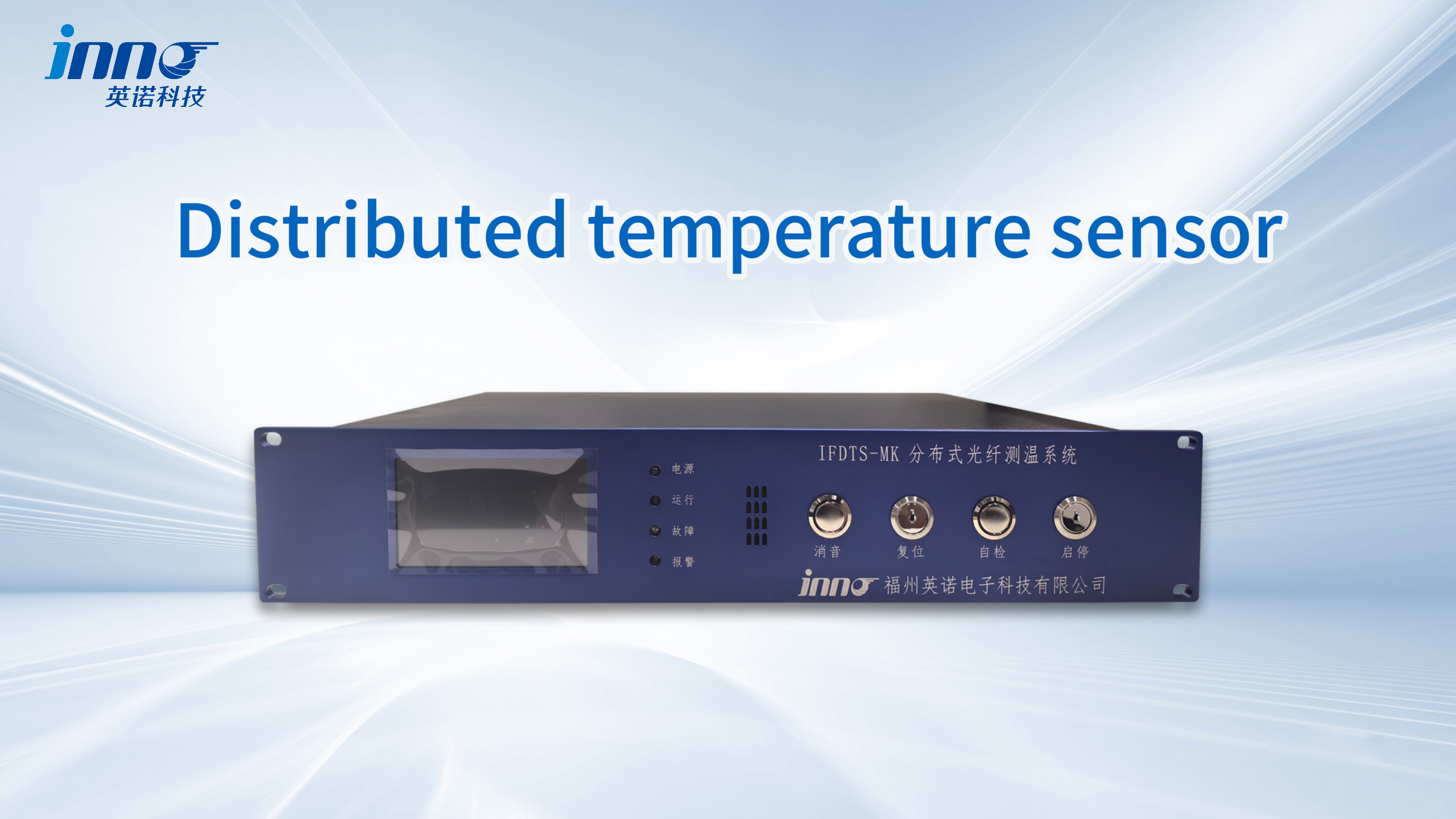
Technical Principle Comparison
형광등 광섬유 온도 감지
그만큼 형광성 광섬유 감지 probe tip contains rare-earth fluorescent material. When excitation light illuminates the fluorescent material, it becomes excited and emits fluorescence signals. The fluorescence decay time constant exhibits a definite functional relationship with temperature, allowing precise temperature calculation through accurate decay time measurement.
This measurement method’s key advantage lies in its dependence solely on time parameters, independent of light intensity, 섬유 굽힘 손실, connector loss, 그리고 다른 요인, ensuring excellent long-term stability without zero-point or gain drift.
분산 온도 감지 (DTS)
분산 시스템 operate on the Raman scattering effect. Laser pulses traveling through optical fiber produce backscattered light, 반스토크스 광도는 온도에 민감합니다.. By analyzing scattered light signals returning at different times using Optical Time Domain Reflectometry (OTDR), the system simultaneously obtains temperature and spatial location information.
This effectively transforms a single fiber into a continuous temperature sensor, with measurement points every 0.5-2 미터, enabling a single fiber to cover several kilometers.
Application Scenario Selection
| Application Need | 추천 기술 | 이론적 해석 |
|---|---|---|
| High-voltage switchgear contact monitoring | 형광성 광섬유 | Precise specific point monitoring, 빠른 응답, 소형 프로브 |
| Transformer winding temperature | 형광성 광섬유 | Distributed multi-point placement, high accuracy requirements |
| Power cable tunnels | 분산 광섬유 | Long-distance continuous monitoring, precise hotspot localization |
| Oil pipeline leak detection | 분산 광섬유 | Multi-kilometer range monitoring, rapid anomaly localization |
| Storage tank temperature distribution | 분산 광섬유 | Vertical temperature profile monitoring |
| Rotating machinery bearings | 형광성 광섬유 | 빠른 응답, customizable small-diameter probes |
Fluorescent Fiber Optic System Technical Specifications
- 응답 시간: <1 두번째
- 측정 정확도: ±1°C
- 온도 범위: -40 260°C까지 (higher temperatures customizable)
- 섬유 길이: 0-80 미터 (per probe)
- 프로브 직경: Standard 3mm, 2mm; smaller diameters customizable
- Points per Channel: 1-64 전철기
- 보호 등급: IP67 (기준), IP68 (선택 과목)
- 출력 인터페이스: RS485, 모드버스 RTU/TCP, 4-20엄마
All technical parameters are customizable based on specific application requirements, including special temperature ranges, ultra-compact probes, and specialized sheath materials.
Distributed Fiber Optic System Technical Specifications
- 응답 시간: 1 두번째
- 측정 정확도: ±1~2°C
- 온도 범위: -40 to 600°C (기준)
- 모니터링 거리: 5-30 킬로미터 (single fiber)
- 공간 해상도: 0.5중, 1중, 2m options
- 샘플링 간격: 0.5-2 미터
- 출력 인터페이스: 이더넷, OPC, 모드버스 TCP
6. How Do Industrial Temperature Monitoring Systems Operate?
Fluorescent Fiber Optic Monitoring System Workflow
단계 1: Temperature Signal Capture
형광성 광섬유 프로브 are installed at critical locations on monitored equipment. The demodulator sends excitation light pulses to probes at a fixed frequency (typically 100-1000Hz). Excitation light transmits through the fiber to the probe tip’s fluorescent material, causing fluorescence emission.
단계 2: Fluorescence Signal Analysis
흥분 후, the fluorescent material emits fluorescence in exponential decay fashion. The demodulator precisely measures the fluorescence decay time constant, which maintains a definite mathematical relationship with temperature at the probe location.
단계 3: 온도 계산
Built-in processing algorithms in the demodulator calculate actual temperature values from fluorescence decay time. Since measurement is time-based rather than intensity-based, 섬유 굽힘, connector attenuation, and other factors don’t affect results, ensuring long-term stability.
단계 4: Data Transmission and Processing
Calculated temperature data transmits through industrial communication interfaces (RS485, 모드버스, 등.) to monitoring software or host systems. Software platforms display real-time temperature curves, record historical data, and execute alarm logic.
The entire process from temperature change to system alarm display takes less than 1 두번째, meeting fast response requirements.
Distributed Fiber Optic Monitoring System Workflow
단계 1: Optical Pulse Emission
그만큼 DTS host unit launches high-energy laser pulses into the fiber. Pulses propagate forward through the fiber at the speed of light (약 200,000 km/s).
단계 2: Scattered Light Collection
As optical pulses propagate through fiber, each location produces Rayleigh scattering, 라만 산란, 브릴루앙 산란. Anti-Stokes light from Raman scattering is temperature-sensitive, intensifying with temperature increases.
단계 3: Temperature Inversion Calculation
By analyzing the intensity ratio of anti-Stokes to Stokes light combined with OTDR technology, the system calculates temperature values at each spatial location. Typical systems simultaneously obtain temperature data from thousands of measurement points.
단계 4: Temperature Field Reconstruction
Software reconstructs discrete temperature measurement point data into continuous temperature distribution curves, displaying the temperature field along the entire fiber in real-time. Any location experiencing temperature anomalies triggers immediate system identification and alarming, providing precise anomaly location coordinates.
Distributed system scan cycles typically run at 1 두번째, updating full-length temperature distribution data every second.
7. What are the Technical Specifications of Fiber Optic Sensors?
Core Performance Indicators
측정 정확도
Measurement accuracy refers to the deviation between system measurements and true values. 우리의 형광성 광섬유 시스템 achieve standard accuracy of ±1°C, reaching ±0.5°C in the commonly used 20-100°C temperature range. 분산 시스템 maintain standard accuracy of ±1-2°C.
응답 시간
Response time defines the duration from temperature step change to the system displaying 90% of the change. 형광성 광섬유 시스템 respond in <1 두번째, while distributed systems achieve 1-second response. Rapid response proves critical for applications requiring timely warnings.
사용자 정의 가능한 매개변수
We understand every industrial application has unique requirements. The following parameters support customization:
- Extended temperature ranges (예를 들어, -200 to 400°C)
- Ultra-compact probe diameters (minimum 1mm)
- Special fiber lengths (exceeding 80 미터)
- Special mechanical structures (예를 들어, 90-degree bend probes)
- Specialized sheath materials (예를 들어, titanium alloy sheaths)
- 맞춤형 통신 프로토콜
8. Which Industrial Machines Require Real-Time Temperature Monitoring?
Power Generation Equipment
배전반 모니터링
In high-voltage switchgear, 절연 스위치, 회로 차단기 접점, and busbar connections represent key temperature monitoring points. Increased contact resistance causes localized overheating, with temperatures rising from normal values to 150°C+ within minutes, potentially causing equipment burnout or fires.
전력 변압기
크기가 큰 전력 변압기 winding temperatures directly affect equipment lifespan and operational safety. Traditional top-oil temperature measurement cannot reflect winding hot-spot temperatures. 광섬유 프로브 can be installed directly inside windings, monitoring hot-spot temperatures in real-time.
Cable Systems
전원 케이블 in tunnels, trenches, or direct burial experience localized overheating from overloading, joint failures, or external damage. Distributed fiber optic deployed parallel to cables monitors full-length temperature, rapidly localizing fault points.
Petrochemical Equipment
저장 탱크
Large crude oil and refined product storage tanks require liquid level and temperature distribution monitoring. 분산 광섬유 arranged vertically from tank top to bottom provides real-time temperature profiles at different heights, preventing fire risks.
파이프라인
Long-distance pipeline temperature monitoring enables leak detection and flow monitoring. Pipeline leaks produce temperature anomalies near leak points. Distributed fiber optic deployed along pipelines rapidly localizes leaks across tens of kilometers.
Reactors and Towers
Chemical reactor temperature control directly impacts product quality and safety. Multi-point fiber optic temperature systems monitor temperature distribution at different reactor locations, optimizing reaction conditions.
Metallurgical Equipment
Blast Furnaces
Iron-making blast furnace body temperature monitoring evaluates refractory lining condition. 분산 광섬유 arranged on the furnace shell monitors the furnace body temperature field, detecting lining burnthrough hazards promptly.
Heating Furnaces
Steel rolling heating furnaces require precise temperature control. Multi-point fiber optic temperature systems monitor temperatures in different furnace zones, supporting automatic control system optimization of heating curves.
Mining Equipment
Underground Cables
Coal mine underground cables represent major fire hazards. Distributed fiber optic temperature systems deployed along cables monitor full-length temperatures in real-time, immediately alarming and localizing temperature anomalies.
Belt Conveyors
Belt conveyor roller bearing failures and belt misalignment friction cause overheating. Distributed fiber optic arranged along belts continuously monitors temperature, 화재 예방.
9. How Do Power Equipment Monitoring Systems Prevent Failures?
Early Identification of Switchgear Temperature Anomalies
High-voltage switchgear failures often exhibit clear temperature signatures. Contact deterioration increases contact resistance, generating additional Joule heating. During early fault development stages, temperature increases may only be 5-10°C—difficult to detect through manual inspection—but 광섬유 온도 시스템 precisely capture these changes.
Predictive Maintenance Strategies
Temperature Threshold Management
Based on equipment types and operational experience, scientific temperature thresholds are established:
- Normal operating temperature: Typically below ambient temperature +30°C
- Warning temperature: Exceeds normal by 10-15°C
- Alarm temperature: Exceeds normal by 20-30°C
- Emergency temperature: Exceeds 80-100°C
Temperature Trend Monitoring
Single temperature increases may result from normal factors like load increases. Systems analyze temperature change trends to identify abnormal patterns:
- Continuous slow rise: May indicate contact deterioration
- Periodic fluctuation: May reflect load variations (normal phenomenon)
- Sudden jump: 즉각적인 조치가 필요한 심각한 결함을 나타낼 수 있음
10. What are the Special Requirements for Petrochemical Industry Machine Monitoring?
방폭 안전이 가장 중요합니다
석유 및 화학 시설에는 수많은 가연성 및 폭발성 가스와 액체가 포함되어 있습니다., 일반적으로 폭발 위험 구역으로 분류되는 장비 구역 (존 0, 존 1, 존 2). 기존 전기 온도 측정 장비에는 엄격한 방폭 인증이 필요합니다., 복잡한 방폭 구조로, 높은 비용, 그리고 유지관리가 까다롭다.
광섬유 센서 are intrinsically safe, 전기 스파크가 발생하지 않음, 방폭 인증 없이 모든 위험 지역에서 사용 가능. 이는 석유화학 산업에서 광섬유 온도 기술이 대규모로 채택되는 근본적인 이유를 나타냅니다..
장거리 분산 모니터링 요구 사항
석유화학 시설 파이프라인과 케이블은 수 킬로미터에 걸쳐 연장되는 경우가 많습니다.. Traditional temperature measurement methods require individual wiring for each measurement point, creating enormous installation workloads. Distributed fiber optic temperature systems cover kilometers with a single fiber, dramatically simplifying installation.
11. What Challenges Exist in Metallurgical Equipment Temperature Monitoring?
Extreme High-Temperature Environments
Many metallurgical industry equipment operates at extremely high temperatures. Steel-making converter internal temperatures reach 1600°C, heating furnace chamber temperatures 1200-1300°C, and continuous casting slab discharge temperatures exceed 1000°C. 우리의 distributed fiber optic temperature systems with standard -40 to 600°C ranges meet most high-temperature monitoring needs for furnace shells and water cooling systems.
Severe Mechanical Vibration
Rolling mills, 파쇄기, and similar equipment generate intense vibration during operation. Traditional sensor electrical connections easily loosen or damage from vibration. 광섬유 센서 have no electrical connections, and fiber material flexibility provides strong vibration resistance.
Severe Electromagnetic Interference
Metallurgical facilities use high-power electrical equipment with complex electromagnetic environments. Induction furnaces and electric arc furnaces generate strong electromagnetic fields that severely interfere with traditional electrical sensors. 광섬유 센서 전자기 간섭에 대해 완전히 면역성을 유지합니다., making them ideal for strong electromagnetic environments.
12. What Value Does Industrial Equipment Condition Monitoring Deliver?
Direct Economic Benefits
Reduced Equipment Failure Rates
Through continuous temperature monitoring and early warning, intervention occurs before faults develop to severe stages. Data shows that implementing 광섬유 온도 모니터링 reduces equipment failure rates by an average of 50-70%.
Decreased Unplanned Downtime Losses
For continuous production enterprises, unplanned equipment downtime causes enormous economic losses. For refining units, 예를 들어, a million-ton catalytic cracking unit shutdown for one day results in losses reaching several million dollars.
Extended Equipment Service Life
Equipment overheating operation accelerates insulation aging, 물질적 피로, and lubricant degradation. 을 통해 온도 모니터링, ensuring equipment operates within reasonable temperature ranges significantly extends service life.
Indirect Economic Benefits
에너지 효율 개선
Precise temperature data supports production process optimization, improving energy utilization efficiency. One cement enterprise utilized rotary kiln distributed fiber optic temperature data to optimize combustion control strategy, improving thermal efficiency by 5% and saving over $1.2 million in fuel costs annually.
Product Quality Enhancement
Many product qualities directly correlate with production process temperatures. Precise temperature control improves product consistency and qualification rates.
13. How are Global Enterprises Using Fiber Optic Monitoring Systems?
European Applications
German Automotive Manufacturing Paint Line Monitoring
A renowned German automaker deployed 광섬유 온도 모니터링 시스템 on its paint production lines. Paint process drying ovens require precise temperature curve control, with temperature deviations affecting coating quality. The company installed distributed fiber optic temperature systems in drying ovens across six paint lines. After implementation, coating quality stability significantly improved, with defect rates dropping from 1.2% 에게 0.3%, reducing rework losses by over €2 million annually.
UK Offshore Wind Farm Substation Monitoring
An offshore substation at a large North Sea wind farm faces harsh environments with high salt fog and humidity, making equipment maintenance difficult. Critical equipment including high-voltage switchgear and transformers employ 광섬유 온도 시스템 for remote monitoring. System data transmits to onshore monitoring centers via fiber optic communication networks. Fiber optic sensors operate stably in marine environments; after three years, no corrosion damage has occurred, while traditional electrical sensors in identical environments require replacement every 18 months on average.
North American Applications
US Oil Pipeline Leak Monitoring
A major US oil company operates a 1,200-kilometer crude oil transmission pipeline in the central region. The company deployed distributed fiber optic temperature systems along the entire line, with fiber installed alongside the pipeline and buried for protection. The system scans full-length temperature at 1-second cycles, with any location’s abnormal temperature changes triggering alarms. After three years of operation, the system successfully detected four small-flow leaks, precisely localizing them within 50-meter ranges with timely responses and minimal environmental impact.
Canadian Mine Underground Cable Monitoring
A large Canadian copper mine’s underground operations exceed 1,000 meters depth, with underground cables totaling over 80 킬로미터. The mine deployed distributed fiber optic temperature systems on major cable trunk lines, with the main control room monitoring all mine cable temperature status in real-time. Since system commissioning, 12 cable joint overheating issues have been identified and resolved, with zero cable fire incidents.
Asia-Pacific Applications
Japanese Steel Enterprise Blast Furnace Monitoring
A Japanese steel group implemented 광섬유 온도 시스템 on three blast furnaces, monitoring furnace body temperature distribution. The Japanese steel industry maintains high equipment management sophistication, with fiber optic temperature data integrated into blast furnace expert systems, supporting refractory lining condition assessment and operational optimization.
Singapore Metro Cable Tunnel Monitoring
Singapore’s metro operating company deployed distributed fiber optic temperature systems in cable tunnels across all lines, totaling over 200 킬로미터. Metro cable tunnels have confined spaces; once fires occur, firefighting proves difficult with severe impacts. The fiber optic temperature system provides early warning, coordinating with automatic fire suppression systems to extinguish fires in incipient stages. After six years of operation, the system identified and eliminated over 30 cable overheating hazards, ensuring safe metro operations.
14. 자주 묻는 질문
광섬유 온도 시스템 유지 관리 비용이 높습니까??
광섬유 온도 시스템 유지 관리 비용이 매우 저렴합니다.. 광섬유 센서 자체에는 유지 관리가 필요하지 않습니다., 주기적인 복조기 정확도 검증을 포함한 1차 유지보수 작업 (일반적으로 한 번씩 1-2 연령) 및 소프트웨어 시스템 업데이트. 빈번한 교체와 교정이 필요한 기존 전기 센서와 비교, 광섬유 시스템은 총 수명주기 비용이 더 낮습니다..
광섬유 센서가 환경 부식을 견딜 수 있습니까??
광섬유 소재는 내식성이 우수한 석영유리입니다.. 다양한 환경에 맞는 다양한 외장재를 제공합니다., 스테인레스 스틸 장갑과 같은, 테프론 코팅, 등. 강산에, 강한 알칼리, and high-temperature harsh environments, 광섬유 센서 서비스 수명은 여전히 초과 10 연령.
방폭 지역에서 광섬유 온도 시스템을 사용할 수 있습니까??
예. 광섬유 센서 전기 부품이 포함되어 있지 않습니다., are intrinsically safe, 폭발성 가스 환경에서도 사용할 수 있습니다.. Our products have passed explosion-proof certification, meeting IEC Ex and ATEX standard requirements, applicable to hazardous areas in petroleum, 화학적인, and coal mining industries.
Can system data be accessed through enterprise cloud platforms?
예. Our monitoring software supports multiple data output methods, integrating with enterprise cloud platforms and big data platforms through API interfaces and database connections. We support Industrial Internet of Things protocols, facilitating integration with smart factory systems.
Can older equipment be retrofitted with fiber optic temperature systems?
전적으로. 광섬유 온도 시스템 are non-invasive monitoring systems requiring no major equipment modifications. Sensors can be fixed to equipment surfaces or internal spaces through adhesive bonding, strapping, or magnetic attachment. We have extensive experience retrofitting older equipment and can design appropriate installation solutions based on specific conditions.
How many temperature measurement points can one system monitor?
형광성 광섬유 시스템 연결하다 1-64 sensors per single demodulator, expandable to more measurement points by adding demodulators. 분산 광섬유 시스템 monitor lengths of 5-30 kilometers per single fiber, equivalent to thousands of temperature measurement points. Specific configurations are determined based on actual requirements.
15. 전문가 상담 받기
우리를 선택하는 이유?
We possess over 10 years of fiber optic temperature system 아르 자형&D and application experience, completing hundreds of project implementations in power, 석유화학, 학의, and other industries. Our technical team includes professionals in fiber optic sensing, 산업 자동화, 및 데이터 분석, providing one-stop services from consultation to implementation.
What We Offer
- Free Site Surveys: 기술 전문가가 현장을 방문하여 모니터링 요구 사항을 평가합니다.
- 맞춤형 솔루션 설계: 특정 상황에 따라 최적의 솔루션을 설계하십시오.
- 기술 선택 지침: 형광 기술과 분산 기술 중 하나를 선택하도록 도와드립니다.
- 투자 수익 분석: 시스템 구축 후 경제적 이익 평가
- 제품 시연: 데모 센터 또는 온라인에서 시스템 기능 시연
지금 문의하세요
관심이 있으시면 산업 기계 광섬유 온도 모니터링 시스템, 더 자세한 기술 내용과 적용 사례를 알고 싶으시면, 다음 방법으로 문의해 주세요.:
- 온라인 상담: 홈페이지 우측하단 상담버튼을 클릭하시면 기술상담원과 실시간으로 소통하실 수 있습니다.
- 전화상담: 전문적인 조언을 받으려면 서비스 핫라인에 전화하세요.
- Schedule Site Visit: Arrange visits to our technology center and application case sites
- Download Materials: Obtain product technical manuals and application case white papers
Our technical team is ready to answer your questions and help you find the most suitable temperature monitoring solution to ensure safe equipment operation.

광섬유 온도 센서, 지능형 모니터링 시스템, 중국의 분산광섬유 제조업체
 |
 |
 |