 INNO 광섬유 온도 센서 ,온도 모니터링 시스템.
Busbar Connection Temperature Monitoring Essentials

- 중요한 도전: Busbar joint overheating causes 40% of substation failures; traditional infrared thermography cannot penetrate GIS metal enclosures or detect internal hotspots in enclosed busbars
- Technology Solution: Fluorescent fiber optic point-type sensing delivers ±1°C accuracy across -40°C to 260°C range with <1 second response time for direct contact measurement
- Inherent Safety: All-dielectric construction with zero metallic components, withstand voltage >100kV, complete electromagnetic immunity for high-voltage environments
- System Capacity: Single demodulator monitors 4-64 channels simultaneously; fiber length 0-80m per channel; typical 220kV substation requires 16-32 측정 포인트
- Intelligent Alarming: Multi-level thresholds including absolute temperature, 상승률 (℃/분), phase imbalance detection, and comparative analysis across similar equipment
- Substation Integration: RS485 모드버스 RTU, IEC 60870-5-101/104, IEC 61850 MMS protocols for seamless connectivity to SCADA and automation platforms
- Applications Portfolio: 220kV/110kV GIS installations, enclosed busbar duct systems, outdoor rigid bus bridges, copper-aluminum transition joints, traction power substations, data center power distribution
- Operational Longevity: Sensor lifespan exceeds 25 연령, 유지보수가 필요 없는 작동, no calibration required, IP67 protection rating, seismic resistance to 8-degree intensity
- Economic Justification: Single busbar failure causes equipment damage and outage losses; system deployment prevents catastrophic failures and extends asset service life
- 품질 보증: ISO 9001 인증된 제조, CE/RoHS compliance, type test certifications, 500+ power utility installations, export to 30+ 국가
1. Why Do Busbar Connections Tend to Overheat? Critical Failure Mechanisms Explained
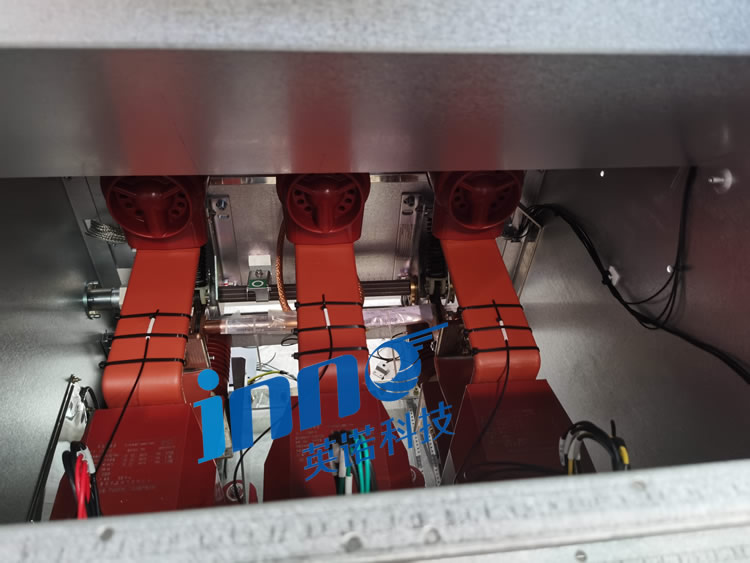
1.1 What Causes Increased Contact Resistance in Busbar Joints?
Busbar connection degradation stems from multiple simultaneous mechanisms affecting current-carrying capacity. Bolted connections experience torque relaxation over operational cycles due to thermal expansion, 전자기력으로 인한 진동, and mechanical settling of contact surfaces. As fastening pressure decreases, microscopic air gaps develop at the interface, concentrating current flow through reduced effective contact area.
Surface oxidation represents another critical failure mode. Atmospheric oxygen reacts with copper or aluminum conductors, forming oxide films with significantly higher electrical resistance than base metals. These insulating layers increase junction resistance, generating localized Joule heating proportional to I²R losses. The heating accelerates oxidation in a destructive positive feedback cycle.
1.1.1 Copper-Aluminum Transition Joint Galvanic Corrosion
Copper-aluminum transition joints present special challenges due to dissimilar metal electrochemical reactions. When moisture penetrates connections, galvanic cells form between the metals, causing preferential aluminum corrosion. Corrosion products accumulate at interfaces, dramatically increasing contact resistance. Industry data indicates transition joints experience failure rates 3-5 times higher than homogeneous metal connections without proper protection.
1.1.2 Thermal Cycling Effects on Connection Integrity
Differential thermal expansion coefficients between busbar conductors, fasteners, and washers create mechanical stress during load cycling. Daily and seasonal temperature variations cause microscopic movement at interfaces, wearing protective platings and promoting fretting corrosion. Over years of service, these cumulative effects degrade electrical and mechanical performance.
1.2 What Consequences Result from Busbar Joint Overheating?
1.2.1 Insulation System Degradation Pathways
Elevated temperatures accelerate chemical decomposition of polymeric insulation materials surrounding 부스바 연결. Epoxy resins, silicone rubbers, and heat-shrink tubing lose dielectric strength when exposed to sustained temperatures exceeding design ratings. Thermal aging reduces breakdown voltage, increases dielectric loss tangent, and promotes tracking formation on contaminated surfaces.
~ 안에 GIS 장비, overheating causes SF6 gas decomposition, producing corrosive and toxic byproducts including sulfur fluorides and metal fluorides. These compounds attack aluminum components and degrade insulator surfaces, compromising both electrical insulation and mechanical integrity. Gas analysis revealing elevated decomposition product concentrations serves as an early warning indicator of thermal stress.
1.2.2 Catastrophic Failure Progression
Unchecked 부스바 과열 follows predictable escalation pathways. Initial temperature rise increases contact resistance, which generates additional heating in accelerating deterioration. When junction temperatures exceed conductor melting points (1085°C for copper, 660알루미늄의 경우 °C), metal fusion or vaporization occurs. Molten metal droplets can bridge phase spacing, initiating phase-to-phase or phase-to-ground faults.
Documented case study: A 220kV substation experienced busbar bolted connection failure resulting in single-phase-to-ground fault, SF6 gas release, and equipment damage. Post-incident analysis revealed the failed connection operated at 150°C above ambient for approximately six months before catastrophic failure. Total losses including equipment replacement, system downtime, and emergency response exceeded substantial amounts, demonstrating the critical importance of continuous 열 모니터링.
1.3 Why Cannot Traditional Inspection Methods Detect Busbar Joint Problems?
1.3.1 Infrared Thermography Fundamental Limitations
적외선 열화상 provides non-contact temperature assessment by detecting radiated energy in the infrared spectrum. 하지만, the technique faces insurmountable obstacles in modern GIS installations where critical connections reside inside grounded metal enclosures. Infrared radiation cannot penetrate metallic barriers, limiting measurements to external cabinet surfaces that exhibit minimal temperature correlation with internal hotspots.
Even for accessible outdoor busbar 설치, infrared accuracy depends on surface emissivity knowledge, proper measurement angle, reflected background radiation compensation, and atmospheric absorption correction. Painted, oxidized, or contaminated surfaces exhibit variable emissivity, introducing significant measurement uncertainty. Wind cooling effects further distort external temperature readings, potentially masking dangerous internal conditions.
1.3.2 Manual Inspection Cycle Inadequacy
Conventional maintenance schedules specify monthly or quarterly 적외선 조사, creating extended periods without surveillance. Rapid failure progression between inspections prevents timely intervention. Thermographic data represents instantaneous snapshots without continuous trending capability to identify gradual degradation patterns. Inspectors cannot access energized equipment interiors, leaving critical GIL busbar 연결 및 enclosed busbar duct internals completely unmonitored.
1.3.3 Safety Hazards of Manual Assessment
Inspectors working near energized 고전압 장비 face electrical hazards including arc flash, electrocution, and blast injury risks. Climbing structures to measure elevated buswork introduces fall hazards. 자동화됨 온라인 온도 모니터링 eliminates personnel exposure while providing superior data quality and temporal resolution.
2. 어떻게 Fluorescent Fiber Optic Sensing Solve Busbar Monitoring Challenges?
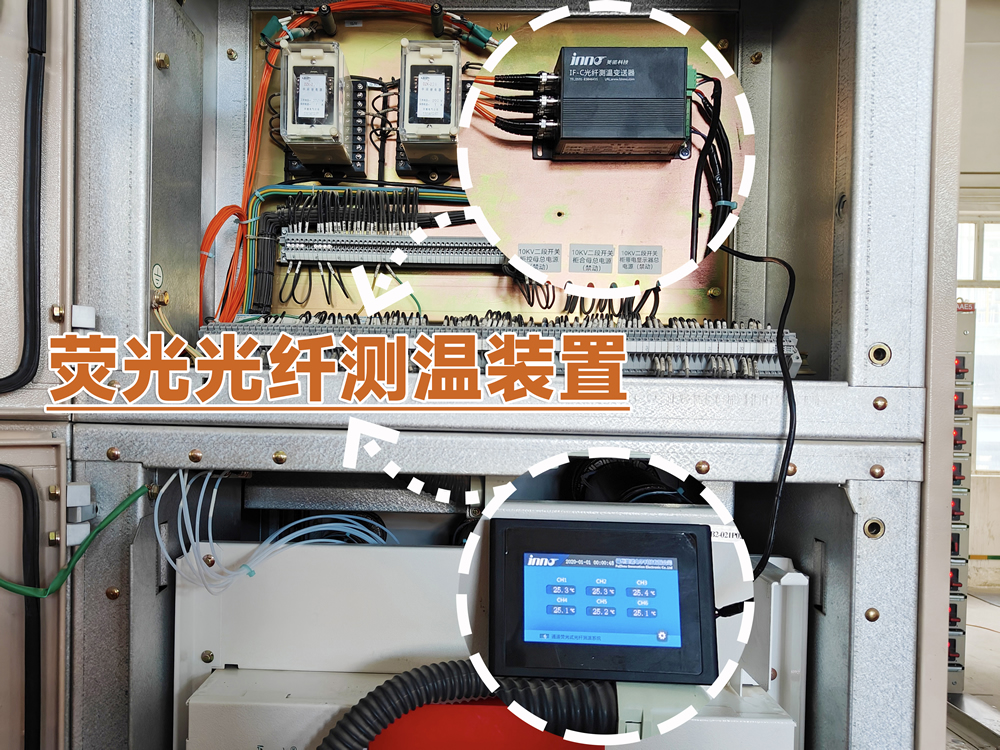
2.1 What Operating Principles Govern 형광 온도 측정?
2.1.1 Rare-Earth Fluorescence Temperature Dependence
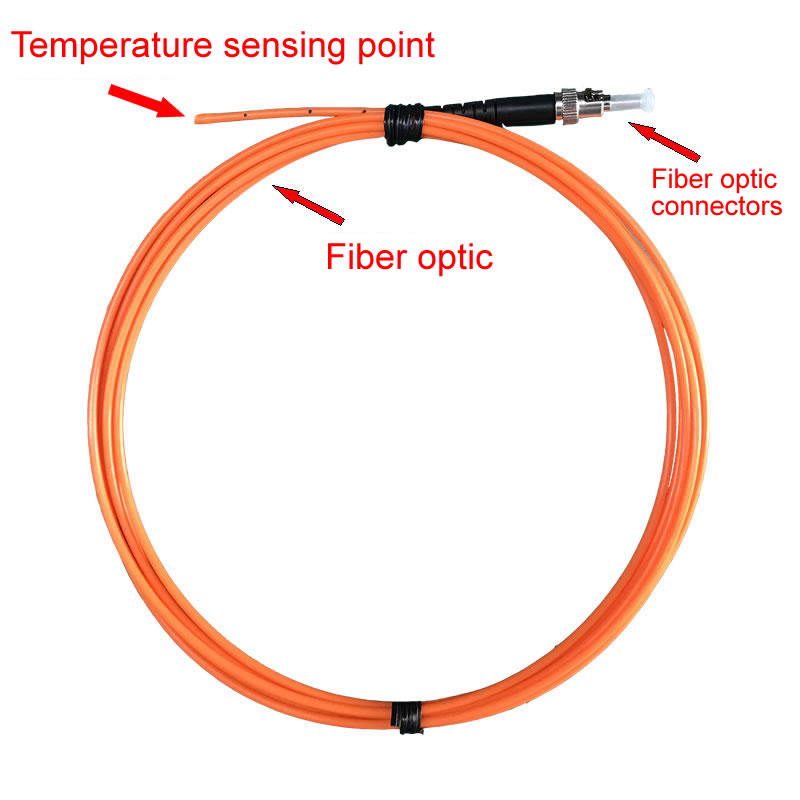
그만큼 형광성 광섬유 센서 exploits temperature-sensitive fluorescence decay characteristics of rare-earth phosphor materials. When excited by specific wavelength light pulses (일반적으로 파란색 또는 UV), doped crystals emit longer wavelength fluorescence. The temporal decay of this fluorescence emission exhibits precise exponential relationship with absolute temperature according to quantum mechanical principles.
At the 센서 프로브 팁, excitation light delivered through optical fiber stimulates the fluorescent material. Emitted fluorescence returns through the same fiber to a 온도 복조기 containing photodetectors and signal processing electronics. By measuring fluorescence lifetime—the time constant of exponential decay—the system calculates temperature with accuracy independent of light intensity, 섬유 굽힘 손실, 또는 커넥터 성능 저하. This intensity-independent characteristic provides exceptional long-term stability compared to conventional fiber optic sensors.
2.1.2 Point-Type Versus Distributed Temperature Sensing
Point-type fluorescent sensing delivers superior spatial resolution and measurement precision compared to distributed fiber optic systems based on Raman or Brillouin scattering. Each measurement location employs dedicated fiber and discrete sensor, enabling independent temperature assessment without cross-channel interference. Distributed systems average temperature over meter-scale spatial resolution, potentially masking localized hotspots at specific bolted connections 또는 splice joints.
The point architecture supports flexible network topologies. A single multi-channel 광섬유 온도 트랜스미터 connects to multiple independent sensing points through star configuration or daisy-chain routing. This modularity facilitates system expansion and troubleshooting compared to continuous distributed fiber requiring complete replacement when damaged.
2.2 Why Does Fluorescent Technology Excel in High-Voltage Applications?
2.2.1 All-Dielectric Construction Benefits
The sensor assembly contains exclusively insulating materials: quartz optical fiber, ceramic or polymer probe body, and fluorescent crystal. Complete absence of conductive elements eliminates electrical safety concerns inherent to metallic sensors like 열전대, 저항 온도 감지기, or thermoelectric devices. No clearance distances or creepage path requirements constrain installation, allowing direct mounting on energized busbar conductors 그리고 연결.
Dielectric withstand testing validates >100kV voltage tolerance between sensor and ground. This capability enables placement on 220kV and 110kV 버스바 시스템 without insulation coordination concerns. The probe functions equally well on grounded equipment, floating potentials, or fully energized conductors.
2.2.2 Electromagnetic Immunity Characteristics
Optical signal transmission remains completely unaffected by electromagnetic fields, 무선 주파수 간섭, or harmonic distortion present in power substations. Strong magnetic fields surrounding high-current 모선 during fault conditions or switching transients do not influence measurement accuracy. This immunity proves especially valuable in applications involving variable frequency drives, 전력 전자 변환기, or traction power systems generating severe electrical noise.
Where wireless temperature sensors require battery power and radio transmitters—both susceptible to electromagnetic disturbance—형광성 광섬유 systems operate purely on optical principles. No batteries eliminate maintenance requirements and failure modes associated with electrochemical energy storage in demanding thermal environments.
2.3 What Performance Advantages Distinguish Fluorescent Sensing from Alternatives?
2.3.1 적외선 열화상과의 비교
형광 센서 provide direct contact measurement at critical junctions, while infrared imaging detects only surface radiation. Contact sensing eliminates emissivity uncertainty, atmospheric attenuation, and reflected energy errors affecting infrared accuracy. Continuous online monitoring captures transient thermal events missed by periodic surveys. Installation inside GIS enclosures 그리고 enclosed busbar ducts overcomes fundamental infrared penetration limitations.
2.3.2 Comparison with Wireless Temperature Indicators
Battery-powered wireless sensors suffer from limited operational life (일반적으로 3-5 연령), requiring periodic replacement and disposal. Fluorescent probe lifespan exceeds 25 years with zero maintenance. Wireless transmission reliability degrades inside grounded metal enclosures due to electromagnetic shielding, while optical fiber penetrates cabinet walls through small ports. Wireless devices also introduce additional electronic components subject to electromagnetic interference and thermal stress failures.
2.3.3 Comparison with Metallic Temperature Sensors
Thermocouples and RTDs exhibit measurement drift over time, requiring periodic calibration. Thermoelectric voltage signals suffer from noise pickup in electrically noisy environments. Lead wire resistance affects RTD accuracy unless compensated through 3-wire or 4-wire configurations. 광섬유 온도 모니터링 provides inherent calibration stability through physics-based measurement independent of aging effects. The non-metallic construction eliminates insulation requirements and safety clearances mandatory for resistive devices.
2.3.4 Comparison with Distributed Fiber Optic Systems
Distributed temperature sensing based on Raman or Brillouin scattering offers continuous measurement along fiber length but with reduced accuracy (일반적으로 ±2~5°C), 느린 반응 (30-60 초), and meter-scale spatial resolution. Point fluorescent systems achieve ±1°C accuracy, 1초 미만의 응답, and millimeter-scale localization. For critical applications requiring precise hotspot detection at specific 연결 단자, point sensing delivers superior performance at competitive installed cost.
3. Which Busbar Equipment Requires Temperature Monitoring Systems?
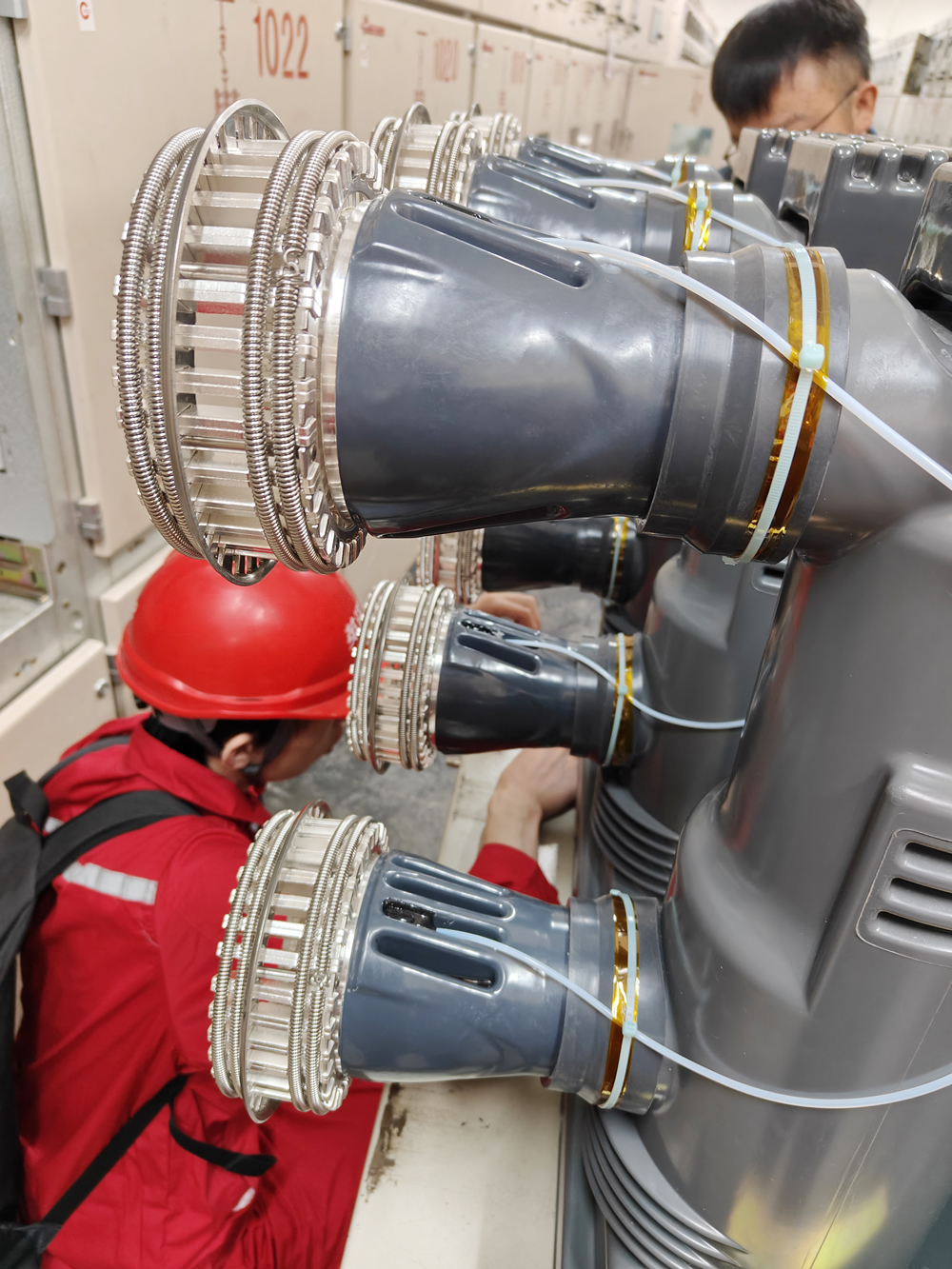
3.1 What GIS/GIL Components Need Measurement Points?
3.1.1 Busbar Connection Flange Monitoring
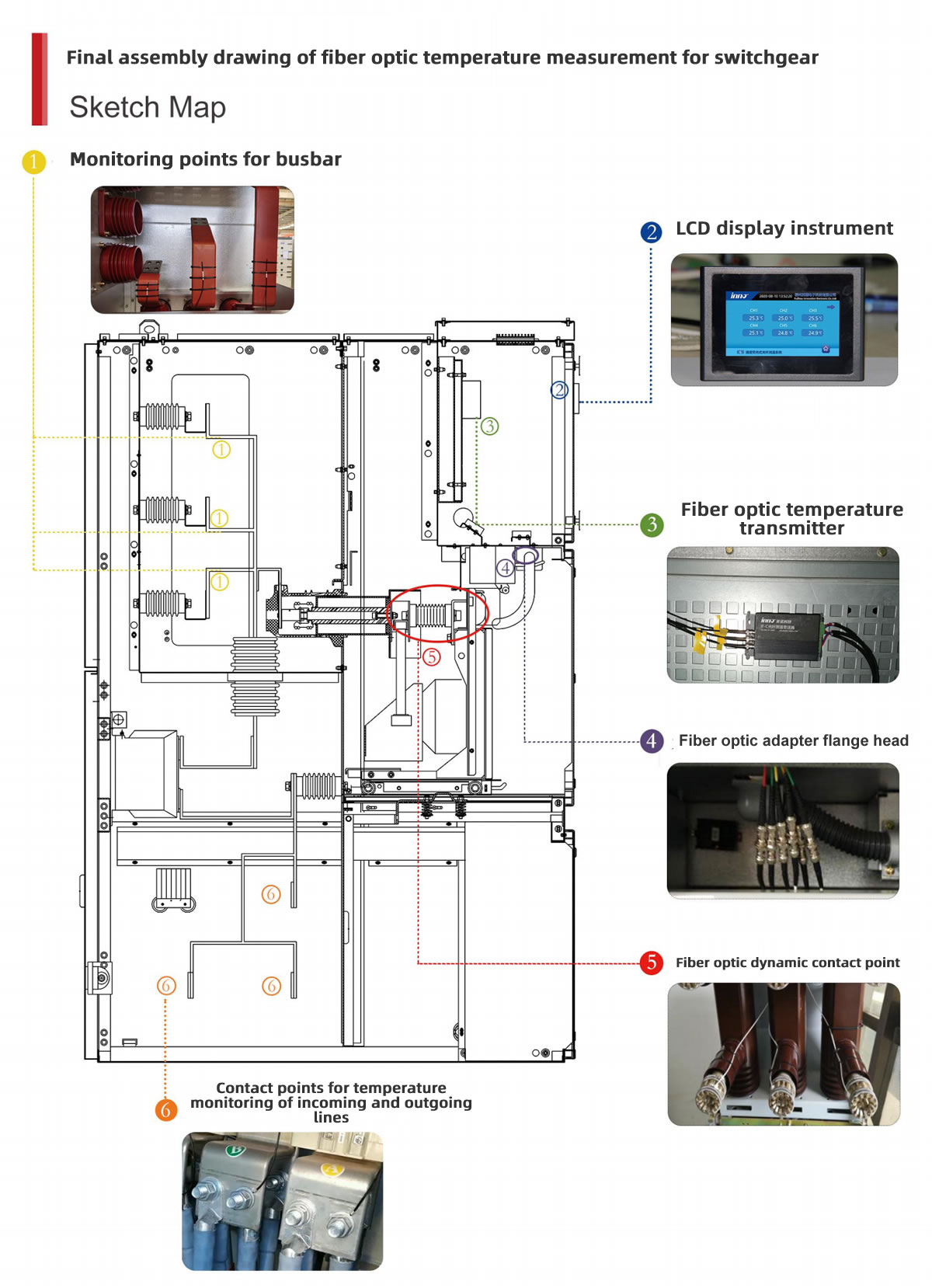
가스절연개폐장치 employs bolted flanges to join busbar sections and connect equipment modules. Each three-phase flange contains six to nine bolted connections (two or three per phase) representing potential failure points. Recommended monitoring includes at minimum one 센서 프로브 per phase on critical flanges such as transformer feeders, generator connections, and inter-bay links. High-importance circuits may justify monitoring all connections for redundancy.
3.1.2 Cable Termination and Feeder Connections
Where power cables enter GIS 장비 ~을 통해 cable sealing ends or plug-in terminals, the transition from cable conductor to busbar represents a high-resistance junction. Compression lugs, mechanical connectors, and terminal studs all generate heat under load current. Monitoring these interfaces prevents failures that could cascade into cable faults or equipment damage.
3.1.3 Disconnect Switch and Grounding Switch Contacts
Isolation disconnectors within GIS bays employ sliding or rotating contacts subject to wear, 오염, and alignment issues. Grounding switches carry high fault currents during system events, experiencing severe mechanical and thermal stress. Both switch types benefit from contact temperature surveillance to detect degradation before catastrophic failure.
3.2 How to Configure Enclosed Busbar Duct Monitoring?
3.2.1 Busbar Splice Joint Measurement
Enclosed busbar systems consist of aluminum or copper bars housed in protective enclosures, with joints every few meters to accommodate thermal expansion and facilitate installation. Each splice joint utilizes bolted connections or welded interfaces—both susceptible to increased resistance over time. Typical monitoring schemes place one or two 온도 센서 per splice across all phases. For a 50-meter busbar run with 10-meter sections, this approach yields 10-20 측정 포인트.
3.2.2 Branch Connection and Tap-Off Monitoring
Where feeder circuits tap off main distribution busbars, branch connections introduce additional joints and potential failure points. T-connections, phase isolators, and load center tie-ins require individual temperature assessment. Monitoring placement should emphasize highest current branches and locations with historical problems.
3.2.3 Wall Penetration and Phase Barrier Interfaces
Busbar penetrations through concrete walls, fire barriers, or phase segregation panels create mechanical constraint points with differential thermal expansion. Sealing materials may harden over time, imposing stress on conductors. Bushing terminals at penetrations warrant monitoring due to combination of mechanical stress and electrical connection.
3.3 Which Outdoor Busbar Components Demand Surveillance?
3.3.1 Flexible Connector to Rigid Bus Transitions
집 밖의 high-voltage substations employ flexible braided connectors or expansion joints between rigid aluminum tube bus sections to accommodate thermal expansion and seismic movement. 이것들 flexible bus connections experience mechanical flexing, 환경 노출, and contact surface oxidation. Temperature monitoring detects deterioration before complete failure causes system outage.
3.3.2 Busbar Expansion Joint Monitoring
Expansion joints accommodate thermal length changes in long rigid bus runs. Sliding contact designs or bellows-type joints introduce contact resistance and wear surfaces. Monitoring identifies excessive friction heating or joint binding that impedes proper expansion.
3.3.3 Equipment Terminal Connections
Connections between outdoor buswork and transformer bushings, 회로 차단기 단자, or disconnect switch blades represent critical interfaces. Terminal bolting torque, surface condition, and alignment directly affect contact resistance and thermal performance. Each phase connection should receive dedicated 광섬유 온도 센서 적용 범위.
3.4 What Special Applications Require Busbar Temperature Monitoring?
3.4.1 Traction Power Substation DC Busbars
Railway electrification systems utilize rectifier substations converting AC to DC for train propulsion. DC busbar systems carry extremely high continuous currents (thousands of amperes) with superimposed pulsating loads from multiple trains. Contact resistance has proportionally greater thermal impact under DC operation compared to AC. Both positive and negative bus connections require comprehensive 열 모니터링.
3.4.2 Data Center High-Current Distribution
현대의 데이터 센터 employ overhead or underfloor busbar systems delivering megawatts to server racks through tap-off connections. The mission-critical nature of data center operations makes prevention of busbar failures imperative. Monitoring schemes address main distribution busbars, PDU connections, and static transfer switch terminals.
3.4.3 Industrial Rectifier and Electrolysis Applications
Aluminum smelters, chlor-alkali plants, and other electrochemical processes utilize massive DC busbar systems carrying tens or hundreds of kiloamperes. Copper-aluminum transition joints at rectifier outputs, anode connections, and cell interconnections experience severe thermal and corrosive environments. Temperature monitoring integrated with process control systems optimizes operation while preventing equipment damage.
3.4.4 Renewable Energy Collector Systems
Wind farm and solar power plant collector substations aggregate generation from multiple sources through 개폐 장치 and busbar networks. Intermittent generation patterns cause thermal cycling that accelerates connection degradation. Step-up transformer feeders, generator connections, and reactive compensation equipment all benefit from continuous temperature assessment.
4. How Many Measurement Points Can the System Monitor? Configuration Options
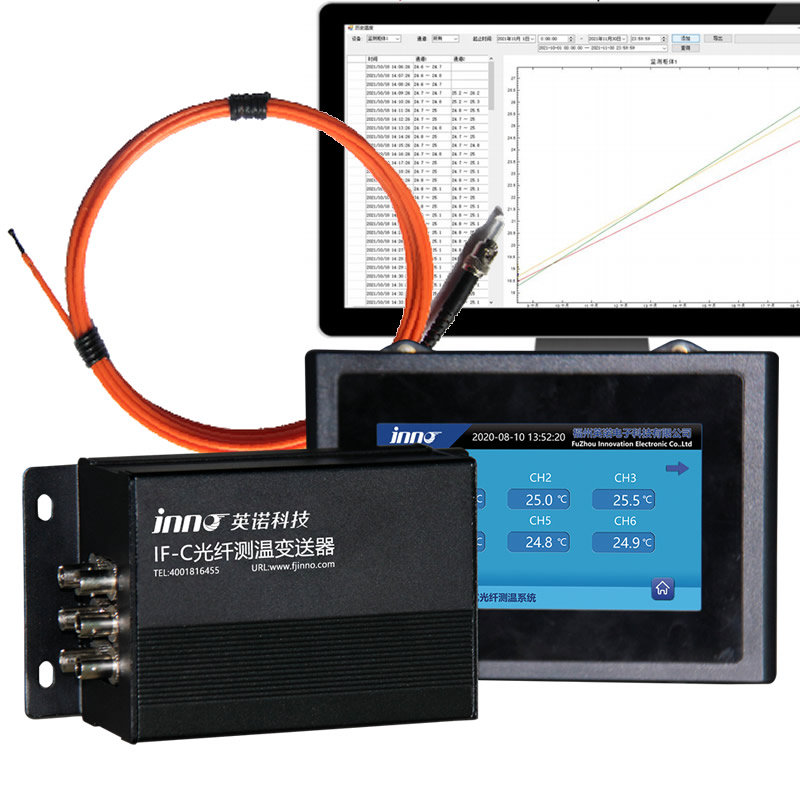
4.1 What Channel Capacities Do Demodulators Offer?
기준 광섬유 온도 복조기 configurations support 4, 8, 16, 32, 또는 64 independent measurement channels within a single chassis. Each channel connects to one fluorescent sensor probe through dedicated optical fiber up to 80 meters in length. The multi-channel architecture enables centralized data acquisition and processing while distributing sensors throughout monitoring zones.
Demodulator selection depends on total measurement point requirements, physical distribution geometry, and system redundancy considerations. Smaller substations may deploy one 16-channel unit, while large facilities utilize multiple 32-channel or 64-channel systems. Modular expansion capability allows initial installation of basic capacity with field upgrades as monitoring needs grow.
4.2 How Many Monitoring Points Does a Typical Substation Need?
4.2.1 220kV Substation Configuration Example
A representative 220kV transmission substation with two transformer bays, four line bays, and auxiliary equipment might configure monitoring as follows:
- Main transformer HV bushings: 3 phases × 2 transformers = 6 전철기
- Transformer MV and LV feeders: 3 × 2 × 2 = 12 전철기
- GIS line bay 사이: 3 × 4 bays = 12 전철기
- Bus coupler and sectionalizer: 6 전철기
- Cable connections and critical joints: 8-12 전철기
Total system requirement: 44-50 측정 포인트, accommodated by two 32-channel demodulators with expansion capacity.
4.2.2 110kV Distribution Substation Approach
Medium-voltage distribution substations with 10-15 feeder bays typically monitor:
- Main transformer connections: 6-9 전철기
- Each feeder bay critical joints: 2-3 points × 12 bays = 24-36 전철기
- Bus sectionalizers and tie breakers: 4-6 전철기
- Reactive compensation equipment: 3-6 전철기
A single 64-channel system or two 32-channel units provide adequate capacity.
4.2.3 35kV Switchgear and Distribution Applications
산업 플랜트, 재생에너지 시설, and commercial complexes operating at 35kV distribution voltage install 금속 피복 개폐 장치 with numerous feeder circuits. Each circuit breaker cubicle contains 6-9 중요한 측정 포인트 (three-phase upper contacts, lower contacts, 케이블 터미널). A facility with 20 feeders requires 120-180 센서, implementable through three to six demodulator chassis depending on channel density selection.
4.3 What Factors Determine Optimal Measurement Point Quantity?
4.3.1 Equipment Criticality Assessment
Priority monitoring addresses equipment whose failure would cause significant operational, 안전, or financial consequences. Main transformer connections, generator feeders, and critical process loads receive comprehensive coverage. Less critical distribution circuits may employ selective monitoring based on risk assessment.
4.4.2 Historical Failure Data Analysis
Maintenance records identifying previously failed connections, thermographic survey hotspots, and equipment types with known reliability issues guide measurement point allocation. Components with failure history justify more extensive monitoring than equipment with proven reliability.
4.3.3 Economic Optimization Modeling
Cost-benefit analysis balances monitoring system investment against prevented failure costs and operational improvements. While comprehensive coverage provides maximum protection, practical deployments optimize measurement point quantity to address highest-risk locations within budget constraints. Phased implementation strategies install core monitoring initially with planned expansion based on operational experience and evolving requirements.
5. What Temperature Accuracy Can Be Achieved? Performance Specifications
5.1 What Measurement Precision Standards Apply?
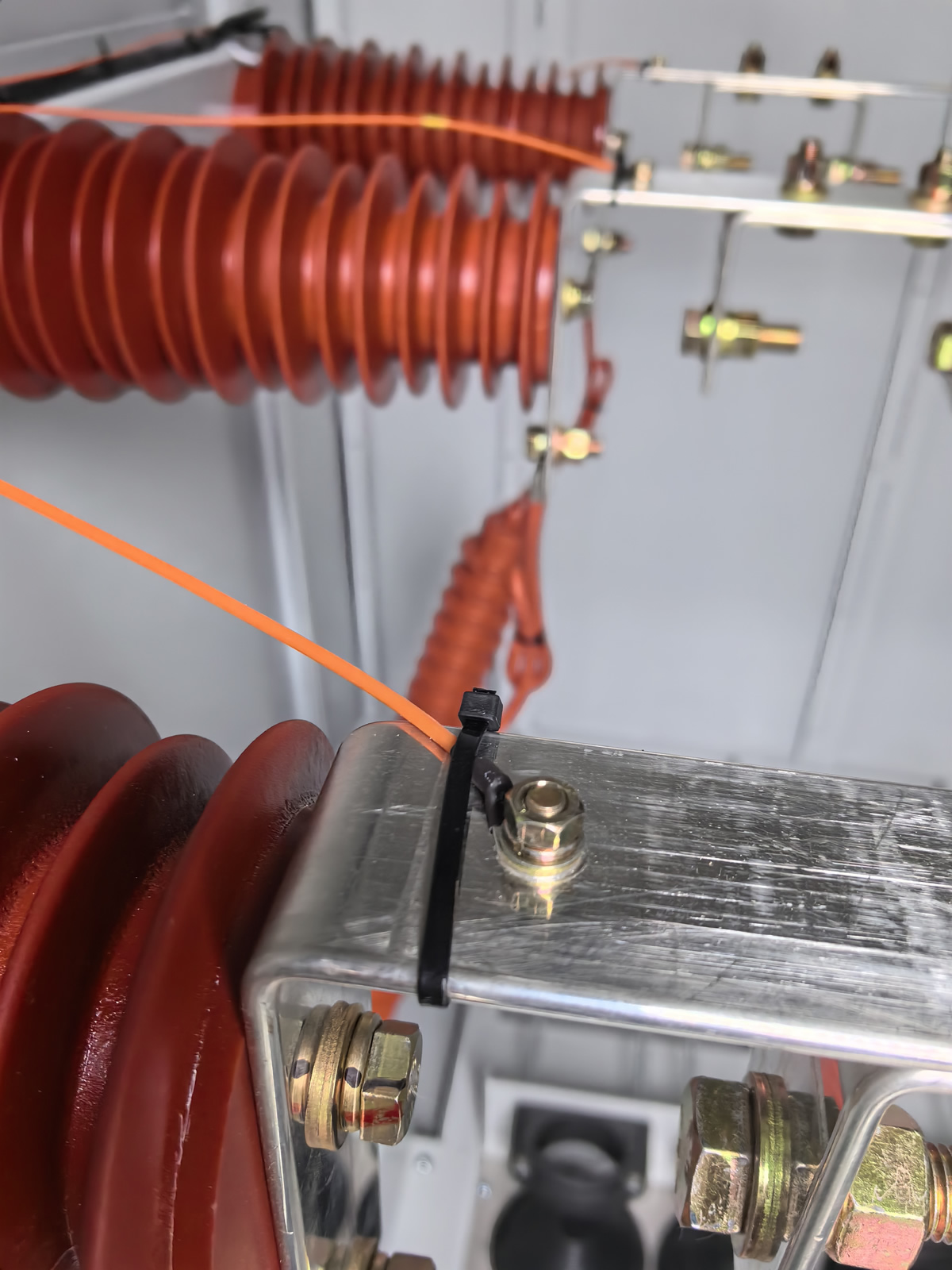
그만큼 형광 광섬유 온도 모니터링 시스템 delivers ±1°C accuracy across the complete -40°C to 260°C measurement range. This full-scale precision ensures reliable detection of abnormal temperature conditions throughout normal operation and fault scenarios. Temperature resolution of 0.1°C enables identification of subtle trending patterns indicating gradual equipment degradation.
응답 시간: 1 second captures rapid thermal transients during switching operations, 결함 조건, or sudden load changes. Fast response combined with continuous sampling (일반적으로 1-10 second intervals) provides real-time thermal surveillance exceeding capabilities of periodic infrared surveys or manual inspections.
5.2 How Do System Reliability Parameters Compare?
5.2.1 Sensor Probe Operational Lifespan
Fluorescent temperature sensors achieve >25 year operational life under continuous service in harsh electrical environments. The physics-based measurement principle exhibits no aging drift or calibration degradation. Absence of batteries, 전자 부품, or consumable elements in the probe assembly eliminates common failure modes affecting other sensing technologies.
5.2.2 평균 고장 간격
Demodulator electronics designed for industrial environments achieve MTBF exceeding 50,000 시간 (약 5.7 수년간의 지속적인 운영). Redundant power supply options, watchdog circuits, and self-diagnostic capabilities enhance overall system reliability. Field experience demonstrates actual reliability substantially exceeding theoretical predictions due to conservative component selection and rigorous quality control.
5.2.3 Environmental Protection Standards
Demodulator chassis maintain IP65 protection against dust ingress and water spray, suitable for indoor substation control room installation. Sensor probes achieve IP67 rating, providing submersion resistance for outdoor installations or locations subject to condensation, washing, or weather exposure. Hermetically sealed probe construction prevents moisture infiltration that could compromise measurement accuracy or dielectric strength.
5.2.4 Withstand Voltage Capabilities
Type testing validates sensor insulation withstand voltage >100kV AC at power frequency, exceeding requirements for direct mounting on 220kV and 110kV systems. Dielectric strength testing protocols follow IEC 60060 standards for high-voltage testing procedures. The all-dielectric construction provides inherent voltage tolerance without relying on insulating barriers or clearance distances.
5.3 What Environmental Operating Conditions Are Supported?
5.3.1 Temperature Range Adaptation
Demodulator electronics operate across -40°C to +85°C ambient temperature range, accommodating outdoor installations in extreme climates from arctic to tropical environments. Sensor probes measure across -40°C to 260°C, providing substantial margin above normal busbar operating temperatures (일반적으로 <80℃) while detecting severe overheating conditions approaching conductor damage thresholds.
5.3.2 Humidity and Condensation Tolerance
Systems function throughout 5%-95% relative humidity range including condensing conditions. Conformal coating of electronic assemblies, sealed connectors, and moisture-resistant materials enable reliable operation in high-humidity substations, coastal installations, or tropical climates.
5.3.3 Seismic and Vibration Resistance
Mechanical design follows 8-degree seismic intensity criteria per Chinese seismic design codes (approximately 0.3g peak ground acceleration). Vibration testing validates performance under continuous vibration and shock loading representative of switchgear operation, mechanical equipment nearby, or transportation environments. Secure fiber routing, strain relief provisions, and robust probe attachment methods prevent mechanical failure during seismic events.
5.3.4 전자기 호환성
Equipment meets IEC 61000 electromagnetic compatibility standards including immunity to electrostatic discharge, radiated RF fields, electrical fast transients, surge voltages, and conducted disturbances. Emission testing confirms compliance with radiated and conducted emission limits. Comprehensive EMC qualification ensures reliable operation in severe electromagnetic environments characteristic of power substations 산업시설.
6. How Does Intelligent Alarm Functionality Work? Predictive Capabilities
6.1 What Alarm Threshold Configurations Are Available?
6.1.1 Absolute Temperature Limit Alarms
The system supports user-configurable warning and critical temperature thresholds for each measurement point. Typical configurations establish warning levels 20-30°C below critical limits, providing advance notice of developing problems. 예를 들어, 부스바 연결 might set 80°C warning and 100°C critical thresholds based on equipment ratings and historical operating data.
Multi-level alarming enables graduated response protocols. Warning alarms trigger investigation and trending analysis without immediate operational action. Critical alarms mandate urgent response including load reduction, 장비 검사, or emergency shutdown depending on severity and affected systems.
6.1.2 Temperature Rate-of-Rise Detection
Beyond static temperature thresholds, the system calculates temperature change rates (°C/minute or °C/hour) to identify abnormally rapid heating. Sudden resistance increases from loose connections, contact deterioration, or incipient faults produce characteristic rapid temperature rise signatures. Rate-based alarms detect these conditions earlier than absolute temperature limits, providing additional response time for corrective action.
6.1.3 Phase Imbalance Comparison
For three-phase equipment, the system automatically compares temperatures across phases to identify asymmetric conditions. Significant phase-to-phase temperature differences (일반적으로 >10-15℃) indicate single-phase problems like loose connections, unbalanced loading, or contact defects. This comparative analysis proves especially valuable since three-phase systems should exhibit similar thermal behavior under balanced load conditions.
6.1.4 Equipment Class Benchmarking
Advanced alarming compares similar equipment types (예를 들어, all line feeder connections) to identify outliers operating warmer than peers. Statistical analysis of temperature distribution across equipment populations highlights degrading units even when absolute temperatures remain below alarm thresholds. This predictive approach detects deterioration trends before conventional alarms trigger.
6.2 How Are Operators Notified of Alarm Conditions?
6.2.1 Local Annunciation
Temperature demodulators provide local visual and audible alarm indication through panel-mounted indicators, LCD displays, or touchscreen interfaces. Color-coded status LEDs (green/yellow/red) convey normal/warning/critical conditions at a glance. Audible alarms with silence acknowledgment ensure operator awareness even when displays are not actively monitored.
6.2.2 Centralized Monitoring System Integration
Alarm data transmits to substation SCADA 시스템, 건물 관리 플랫폼, or dedicated monitoring software through standard communication protocols. Centralized displays show station-wide temperature status with alarmed points highlighted. Operators access detailed trending, measurement histories, and diagnostic information for investigation and troubleshooting.
6.2.3 Remote Notification Channels
Email and SMS text message notifications alert designated personnel when alarm conditions occur, enabling rapid response regardless of operator location. Configurable notification lists, escalation procedures, and time-based routing ensure appropriate staff receive alerts. Remote notification proves especially valuable for unattended facilities, 근무 시간 외 모니터링, or critical equipment requiring immediate attention.
6.3 What Historical Data Capabilities Support Predictive Maintenance?
Continuous data logging captures complete temperature histories for trend analysis and equipment health assessment. Nonvolatile memory stores minimum 5 years of measurement data at configurable sampling rates. Historical databases enable:
- Long-term trending to identify gradual degradation patterns
- Seasonal variation analysis for baseline establishment
- Load correlation studies linking temperature to current magnitude
- Failure forensics through pre-event data review
- Maintenance effectiveness validation by comparing pre- and post-maintenance temperatures
Automated report generation produces daily, 주간, 월간 간행물, and annual temperature summaries with statistical analysis, alarm event logs, and equipment health scoring. These reports support regulatory compliance documentation, asset management programs, 지속적인 개선 활동.
7. How Does the System Interface with Substation Automation?
7.1 Which Communication Protocols Are Supported?
7.1.1 RS485 Modbus RTU Industrial Standard
기준 RS485 serial communication using Modbus RTU protocol provides robust connectivity for industrial environments. Transmission distances up to 1200 meters support distributed demodulator placement throughout substations. Multi-drop capability allows up to 32 장치 (expandable with repeaters) on single bus network. Configurable parameters include baud rates from 9600 에게 115200 bps, 데이터 비트, 둥가, and stop bits for compatibility with diverse master systems.
7.1.2 IEC 60870-5-101/104 Power Utility Protocols
IEC 60870-5 series represents international standards for telecontrol equipment and systems in electrical engineering and power system automation. Protocol support enables seamless integration with utility SCADA 마스터 스테이션, remote terminal units (RTU), and substation automation gateways. Both serial (101) and TCP/IP (104) variants accommodate different network architectures.
7.1.3 IEC 61850 Substation Automation Standard
IEC 61850 defines communication networks and systems for power utility automation, providing object-oriented data models, high-speed peer-to-peer messaging, and time synchronization. 온도 모니터링 integration through IEC 61850 enables advanced applications including coordinated control, event sequence recording, and integration with protection systems. 제조 메시지 사양 (MMS) provides standardized access to real-time data and configuration parameters.
7.1.4 OPC UA Industrial Interoperability
Open Platform Communications Unified Architecture (OPC UA) provides vendor-neutral industrial automation connectivity. Platform-independent architecture supports integration with enterprise systems, 클라우드 플랫폼, and Industry 4.0 애플리케이션. Secure authentication, encrypted communications, and information modeling capabilities facilitate digital transformation initiatives.
7.2 What Integration Architectures Are Possible?
7.2.1 Direct SCADA Connection
Temperature demodulators connect directly to substation automation system RTUs or data concentrators through serial or Ethernet interfaces. Real-time data including individual point temperatures, 알람 상태, and diagnostic information upload to master stations for centralized visualization and archiving. Integration depth ranges from simple analog value reporting to complex event notification and time-series data streaming.
7.2.2 Standalone Monitoring Networks
헌신적인 temperature monitoring networks operate independently from primary SCADA infrastructure, providing isolation and security. Standalone architecture suits applications requiring separate monitoring for safety systems, 중요 인프라 보호, or installations where existing automation systems lack expansion capacity. Dedicated monitoring stations offer specialized displays, 고급 분석, and operator interfaces optimized for thermal management.
7.2.3 Cloud-Based Data Analytics
Modern installations leverage cloud connectivity for advanced analytics, 원격 액세스, and multi-site aggregation. Secure gateway devices upload temperature data to cloud platforms providing machine learning analysis, 이상 탐지, and predictive maintenance algorithms. Cloud architectures enable centralized monitoring of distributed facilities, vendor remote support, and correlation with external data sources like weather, commodity prices, or market conditions.
7.3 What Data Upload Intervals Are Typical?
Real-time temperature measurements update at 1-10 second intervals depending on application criticality and communication bandwidth. Faster update rates (1-2 초) suit dynamic processes or rapid-response applications. Slower intervals (5-10 초) suffice for thermal mass equipment with gradual temperature changes. Alarm events trigger immediate notification regardless of normal polling schedules, ensuring timely awareness of abnormal conditions.
Historical data uploads occur through scheduled batch transfers to minimize communication overhead. Typical configurations archive minute-average, hourly-average, and daily-average values with configurable retention periods. Event-triggered uploads capture alarm occurrences, threshold crossings, and operator actions with precise timestamps for forensic analysis.
8. Which Industries Are Implementing Busbar Temperature Monitoring?
8.1 What Power Utility Applications Dominate Deployment?
8.1.1 Transmission and Distribution Substations
Electric utilities represent the largest market segment for 부스바 온도 모니터링, with installations spanning voltage classes from 35kV distribution to 500kV transmission. National grid operators implement standardized monitoring specifications across substation portfolios to reduce failure rates, 장비 수명 연장, and optimize maintenance resources. Typical deployments address GIS 장비, 집 밖의 공기 절연 변전소, and hybrid installations combining both technologies.
8.1.2 Renewable Energy Generation Facilities
풍력 발전 단지, solar power plants, and energy storage installations utilize collector substations aggregating distributed generation for grid interconnection. Variable generation patterns create thermal cycling stress on electrical connections. 모니터링 시스템 optimize operation, prevent revenue loss from unplanned outages, and support remote facility management with minimal on-site staffing. Battery energy storage systems particularly benefit from thermal management preventing fire hazards and maximizing cycle life.
8.1.3 Hydroelectric and Thermal Power Stations
Generating stations employ high-current 버스바 시스템 connecting generators to step-up transformers and transmission networks. Generator bus ducts, unit auxiliary transformers, and station service distribution all incorporate temperature monitoring. Continuous surveillance prevents forced outages, 유지 관리 비용 절감, and extends major equipment service intervals. Integration with plant distributed control systems enables automated load optimization based on thermal constraints.
8.2 Why Do Industrial Facilities Require Busbar Monitoring?
8.2.1 Heavy Industry Process Reliability
제철소, 알루미늄 제련소, 화학공장, and refineries operate continuous processes where electrical failures cause substantial production losses and safety hazards. Mission-critical electrical infrastructure receives comprehensive 열 모니터링 to prevent disruptions. Arc furnace installations, electrolytic cells, and large motor drives present particularly demanding thermal management challenges.
8.2.2 Manufacturing Facility Uptime Requirements
Automotive assembly plants, semiconductor fabrication facilities, and pharmaceutical manufacturers maintain stringent production schedules with minimal downtime tolerance. 예측 유지보수 enabled by temperature monitoring prevents unscheduled interruptions, supports planned maintenance windows, and optimizes equipment replacement timing. Manufacturing execution systems integrate thermal data for overall equipment effectiveness (OEE) 최적화.
8.2.3 데이터센터 핵심 인프라
하이퍼스케일 데이터 센터, colocation facilities, and enterprise server rooms implement redundant power distribution with 버스바 시스템 delivering megawatts to IT loads. Tier III and Tier IV reliability standards demand continuous monitoring, N+1 redundancy, and zero unplanned downtime. 온도 센서 on main distribution busbars, 전원 분배 장치 (PDUs), 자동 전환 스위치, and branch circuits ensure infrastructure reliability supporting cloud services, financial systems, and telecommunications networks.
8.3 What Specialized Transportation Applications Exist?
8.3.1 철도 견인 전력 시스템
Electrified railways including metros, light rail, and high-speed trains utilize traction substations converting utility power to DC or low-frequency AC for train propulsion. Rectifier busbars carrying thousands of amperes require robust thermal management. Third rail systems, overhead catenary supports, and substation distribution all incorporate temperature monitoring. Integration with railway signaling and operations control centers coordinates power management with train scheduling.
8.3.2 Airport Ground Power and Lighting
Airport electrical infrastructure supports runway lighting, terminal buildings, fueling systems, and aircraft ground power. Reliability requirements for navigational aids and critical lighting demand predictive maintenance. 모니터링 시스템 address airfield electrical vaults, lighting control centers, and terminal distribution.
8.3.3 Marine and Offshore Installations
Ships, 해양 플랫폼, and marine terminals operate in harsh environments with limited maintenance access. 형광성 광섬유 systems provide corrosion resistance, EMI 내성, and reliable operation under vibration and thermal cycling. Marine classification societies increasingly specify online monitoring for critical electrical systems.
8.4 How Do Commercial Buildings Benefit from Temperature Monitoring?
High-rise buildings, 쇼핑 센터, and campus facilities utilize busbar riser systems distributing power vertically through building structures. Monitoring addresses tap-off connections at floor levels, main distribution boards, and generator tie-in points. Building management system (BMS) integration enables coordinated facility management, 에너지 최적화, and preventive maintenance scheduling. Green building certifications increasingly require advanced monitoring supporting sustainability objectives.
9. What Return on Investment Can Be Expected? 경제 분석
9.1 What Investment Components Comprise Total System Cost?
9.1.1 Hardware Capital Expenditure
System acquisition costs include 온도 복조기, sensor probes, 광섬유 케이블, 장착 하드웨어, 및 통신 인터페이스. Demodulator pricing scales with channel capacity, 프로토콜 지원, and feature set. Sensor quantity determines overall material cost, with typical installations ranging from 16 에게 64 measurement points depending on facility size and criticality.
9.1.2 Installation and Commissioning Expenses
Field installation labor includes sensor mounting, 파이버 라우팅, demodulator installation, 및 시스템 시운전. Installation complexity varies with equipment accessibility, outage availability, 및 통합 요구 사항. Straightforward installations on accessible 야외 부스바 require minimal labor, ~하는 동안 GIS retrofits or confined space work increase installation effort. Commissioning activities encompass functional testing, 경보 임계값 구성, communication verification, 및 운영자 교육.
9.1.3 Lifecycle Operating Costs
The maintenance-free design eliminates periodic calibration, 센서 교체, and consumable expenses characteristic of alternative technologies. Annual operating costs include minimal electrical power consumption (일반적으로 <100W per demodulator), software maintenance agreements (선택 과목), and periodic functional verification. Total lifecycle cost analysis demonstrates significant advantage over systems requiring battery replacement, 교정 서비스, or component refresh.
9.2 What Failure Costs Does Monitoring Prevent?
9.2.1 Equipment Replacement Expenses
재앙적 busbar failures necessitate replacement of damaged conductors, insulators, 인클로저, and connected equipment. Repair costs for GIS 장비 prove particularly substantial due to specialized components, SF6 gas handling, and factory-trained service requirements. Transformer damage from busbar faults may require complete unit replacement. Early detection through temperature monitoring prevents progression from manageable maintenance issues to catastrophic failures requiring major equipment replacement.
9.2.2 Unplanned Outage Impact
Beyond direct repair costs, electrical failures cause business interruption losses varying by industry and facility criticality. Manufacturing plants experience production losses, raw material waste, and contract penalties. Data centers face service level agreement violations and customer attrition. Utilities incur energy not served penalties and regulatory scrutiny. Healthcare facilities encounter patient safety risks and operational disruptions. 예측 유지보수 enabled by continuous monitoring schedules repairs during planned outages, minimizing business impact.
9.2.3 Safety Incident Consequences
Electrical failures create arc flash, 불, and explosion hazards threatening personnel safety. Workplace injuries trigger workers compensation claims, regulatory investigations, potential litigation, 그리고 명예훼손. Proactive thermal management reduces accident risk, supporting corporate safety objectives and regulatory compliance. Insurance underwriters increasingly recognize advanced monitoring in premium calculations and coverage terms.
9.3 How Quickly Does Investment Return Through Operational Benefits?
9.3.1 Payback Period Calculation
Return on investment analysis compares system acquisition and installation costs against prevented failure expenses and operational improvements. Conservative analysis assumes prevention of one major failure over equipment service life justifies monitoring investment. Facilities with higher failure risk, critical operations, or expensive equipment achieve faster payback. Typical ROI periods range from 1-3 years depending on application specifics and risk exposure.
9.3.2 Extended Equipment Service Life
Continuous thermal surveillance prevents cumulative damage from repeated overheating episodes, extending 버스바 시스템 and connected equipment service life. Deferring capital replacement through optimized maintenance generates substantial value, particularly for expensive assets like transformers and 개폐 장치. Time value of money analysis demonstrates that extending equipment life by even modest percentages significantly improves lifecycle economics.
9.3.3 Optimized Maintenance Resource Allocation
Condition-based maintenance guided by temperature trending focuses resources on equipment actually requiring attention rather than time-based preventive maintenance schedules. This optimization reduces unnecessary inspections, extends maintenance intervals for healthy equipment, and improves workforce productivity. Maintenance cost savings accumulate annually throughout monitoring system operational life.
9.3.4 Insurance and Regulatory Benefits
Some insurance providers offer premium reductions for facilities implementing advanced monitoring and risk mitigation measures. Regulatory compliance for critical infrastructure, nuclear facilities, or hazardous processes may mandate online monitoring, making system investment necessary rather than optional. Documented condition monitoring supports regulatory inspections and demonstrates due diligence for safety management.
10. How to Select Reliable Busbar Monitoring System Suppliers?
10.1 What Supplier Qualifications Indicate Competence?
10.1.1 품질경영시스템 인증
ISO 9001 quality management certification demonstrates established processes for design control, manufacturing quality, and continuous improvement. Suppliers maintaining certified quality systems implement documented procedures for component selection, 생산 테스트, 구경 측정, and traceability. Certification by accredited registrars provides independent verification of quality capabilities.
10.1.2 Product Type Testing and Compliance
Type test reports from accredited laboratories validate product performance against published specifications and relevant standards. Testing should encompass temperature accuracy, 응답 시간, environmental qualification, 전자기 호환성, and safety parameters. Compliance with CE marking requirements, RoHS hazardous substance restrictions, and regional electrical safety codes confirms product suitability for target markets.
10.1.3 Industry Experience and Reference Projects
Demonstrated experience in power utility, 산업의, or transportation sectors indicates understanding of application requirements and operating environments. Reference installations at comparable facilities provide validation of supplier capabilities and product performance. Customer testimonials, 사례 연구, and site visit opportunities enable due diligence investigation before supplier selection.
10.2 How to Evaluate Product Quality and Reliability?
10.2.1 Technology Ownership and Innovation
Suppliers developing proprietary 형광 감지 기술 rather than reselling third-party products demonstrate technical depth and long-term commitment. Patents, 기술 출판물, and research partnerships indicate innovation capability. In-house engineering expertise supports customization, 문제 해결, and continuous product improvement.
10.2.2 Component Selection and Manufacturing Standards
Quality suppliers specify components from reputable manufacturers with established reliability data. Critical items like photodetectors, optical components, and electronic assemblies should come from recognized brands with industrial-grade specifications. Manufacturing in controlled environments with documented procedures, automated testing, and statistical process control ensures consistent product quality.
10.2.3 Factory Testing and Quality Assurance
Comprehensive factory testing validates each production unit before shipment. Testing protocols should include temperature accuracy verification across operating range, communication interface validation, alarm functionality confirmation, 및 환경 스트레스 검사. Test documentation accompanying shipped equipment provides traceability and baseline performance data.
10.2.4 Warranty Terms and Technical Support
Warranty coverage duration, scope, and response commitments indicate supplier confidence in product reliability. Standard warranties spanning multiple years with comprehensive coverage demonstrate quality commitment. Technical support availability including application engineering, 설치 지원, and post-installation troubleshooting proves essential for successful project execution.
10.3 What Technical Support Capabilities Matter Most?
10.3.1 Pre-Sales Engineering Services
Competent suppliers provide application consultation, 현장 조사, measurement point selection guidance, and system design services before purchase commitments. Engineering support should address integration requirements, 설치 계획, and performance prediction. Detailed proposals with equipment specifications, layout drawings, and implementation plans demonstrate supplier technical depth.
10.3.2 Installation and Commissioning Assistance
Field services including supervised installation, startup commissioning, and system optimization ensure proper deployment. Supplier technicians bring specialized knowledge of sensor mounting techniques, fiber routing best practices, 및 시스템 구성. On-site training transfers knowledge to facility maintenance personnel for ongoing operation.
10.3.3 Ongoing Technical Support Infrastructure
Post-installation support through helpdesk services, 원격 진단, and emergency response maintains system reliability. Responsive technical support with knowledgeable staff resolves issues quickly, 가동 중지 시간 최소화. Global suppliers should provide regional support centers addressing time zone differences and language requirements.
10.4 Why Choose Fuzhou Innovation Electronic Scie&테크(주), 주식회사?
복주 혁신 전자 과학&테크(주), 주식회사. brings comprehensive expertise to 부스바 온도 모니터링 애플리케이션, combining technical innovation with proven field performance since establishment in 2011. The company maintains ISO quality certification, holds relevant product certifications including CE and RoHS compliance, and serves over 500 power utility customers across 30+ 국가.
Core competencies include proprietary fluorescent fiber optic sensing technology, multi-channel demodulator platforms, and application-specific solutions for GIS 장비, enclosed busbars, and outdoor installations. Engineering capabilities support custom configurations, 프로토콜 개발, and integration with diverse automation platforms. Manufacturing facilities employ rigorous quality control with comprehensive testing protocols.
Technical support infrastructure provides pre-sales consultation, detailed engineering design, 설치 감독, 시운전 서비스, and ongoing maintenance assistance. Customer success focus ensures proper system specification, reliable implementation, and long-term operational satisfaction.
자주 묻는 질문
1분기: What differentiates busbar monitoring from switchgear contact temperature monitoring?
Both applications utilize identical 형광 광섬유 기술 with distinctions primarily in installation locations and measurement point configurations. Switchgear monitoring emphasizes circuit breaker moving and stationary contacts plus cable terminal connections within individual cubicles. Busbar monitoring focuses on connection flanges, splice joints, tap-off points, and equipment interconnections across distribution systems. Optimal substation protection combines both approaches, creating comprehensive thermal surveillance networks addressing all critical current-carrying components.
2분기: Can monitoring systems be retrofitted to existing GIS equipment already in service?
Retrofit installations represent common deployment scenarios with proven methodologies minimizing operational disruption. No-outage installation techniques leverage scheduled maintenance windows, coordinated outages, or live-line working procedures to position 센서 without extended service interruptions. 위에 200 successful GIS retrofit projects demonstrate feasibility across diverse equipment manufacturers and vintages. Detailed planning, proper tooling, and experienced installation personnel ensure safe, efficient upgrades of operating equipment.
3분기: Does the system require periodic calibration like conventional temperature sensors?
No calibration necessary. 형광성 광섬유 센서 employ fundamental physics-based measurement principles without drift phenomena affecting thermocouples, RTD, 또는 서미스터. The temperature-fluorescence decay relationship remains constant over sensor lifetime, maintaining factory calibration accuracy for 25+ 연령. This maintenance-free characteristic eliminates periodic calibration expenses, 문서 요구 사항, and accuracy uncertainty between calibration intervals. Field experience validates long-term stability with sensors operating continuously for over a decade without measurable drift.
4분기: Can the system monitor transformers, 원자로, and other equipment beyond busbars?
전적으로. The versatile fluorescent fiber optic platform addresses diverse thermal monitoring applications throughout electrical infrastructure. Dry-type transformers benefit from winding hotspot measurement (12-24 point configurations). Oil-immersed transformers utilize fiber sensors for winding temperature, top oil measurement, and core monitoring. Shunt reactors, 시리즈 원자로, and filter reactors incorporate thermal surveillance. Cable systems employ monitoring at splice joints, 종료, and transitions. The technology’s electromagnetic immunity, high voltage tolerance, and intrinsic safety enable deployment across virtually all electrical equipment types requiring temperature assessment.
Q5: How can I obtain detailed technical documentation and project quotations?
기술 문서, application guidelines, and project-specific proposals are available through direct consultation with our engineering team. Please provide the following information to facilitate accurate recommendations:
- Equipment types and models (GIS manufacturer, busbar specifications, 전압 등급)
- 전압 레벨 (35kV, 110kV, 220kV, or other)
- Specific measurement locations and component identification
- Project location and implementation timeline
- Integration requirements (통신 프로토콜, existing automation systems)
- Any special environmental or operational considerations
Our team will respond with comprehensive technical proposals including measurement point recommendations, 시스템 아키텍처, equipment specifications, 설치 지침, and detailed commercial quotations tailored to your specific requirements.
Technical Documentation and Consultation

For comprehensive technical specifications, 엔지니어링 설계 지원, application consultation, or project quotations, 우리 기술팀에 문의해주세요:
복주 혁신 전자 과학&테크(주), 주식회사.
확립된: 2011
이메일: web@fjinno.net
WhatsApp/위챗/전화: +86 13599070393
QQ: 3408968340
주소: Liandong U 곡물 네트워킹 산업 단지,
No.12 Xingye West Road, 푸저우, 푸젠성, 중국
웹사이트: www.fjinno.net
Our experienced engineering team provides comprehensive support throughout project lifecycle including:
- Pre-sales application consultation and site assessment
- Custom system design and measurement point optimization
- Detailed technical specifications and compliance documentation
- Installation planning and fiber routing design
- On-site commissioning and system optimization
- Operator training and maintenance procedures
- Ongoing technical support and troubleshooting assistance
- System expansion and upgrade planning
Available technical documentation includes:
- Product datasheets and specification sheets
- Installation manuals and mounting guidelines
- Communication protocol documentation
- Integration guides for automation platforms
- Application notes for specific equipment types
- Case studies and reference installations
- Test reports and certification documents
에 관한 문의를 환영합니다. busbar temperature monitoring solutions, 맞춤 구성, international projects, and integration with existing substation infrastructure. Our global experience spans utility, 산업의, 운송, and commercial applications across diverse operating environments and regulatory frameworks.
부인 성명
기술 정보, 성능 사양, and application guidance presented in this article represent general characteristics of fluorescent fiber optic temperature monitoring systems for busbar applications. Actual system performance, configuration requirements, and operational results may vary based on specific installation conditions, 환경적 요인, 장비 유형, integration requirements, and operational practices.
복주 혁신 전자 과학&테크(주), 주식회사. strives to provide accurate and current information, we make no warranties, 명시적이든 묵시적이든, 완전성에 관해서, 정확성, 신뢰할 수 있음, or suitability of this content for any particular application or purpose. 제품 사양, 특징, 인증, and availability are subject to change without prior notice as part of our continuous product development and improvement processes.
The case studies, 응용 사례, and installation scenarios described are provided for illustrative purposes only and do not constitute performance guarantees for other installations or operating conditions. Customers should consult directly with our engineering team to confirm current specifications, obtain detailed technical data, and receive application-specific recommendations for their particular requirements.
설치, 작업, 유지, and modification of electrical monitoring equipment must be performed exclusively by qualified personnel following applicable safety regulations, 전기 코드, 업계 표준, and manufacturer guidelines. 복주 혁신 전자 과학&테크(주), 주식회사. assumes no liability for damages, 부상, 사상자 수, or consequences resulting from improper installation, misapplication, failure to follow recommended practices, unauthorized modifications, or use beyond published ratings and specifications.
All economic analyses, return on investment calculations, and cost comparisons presented represent illustrative examples based on typical scenarios and industry averages. Actual costs, 이익, payback periods, and financial outcomes will vary significantly based on facility-specific factors, regional economics, operational practices, failure rates, and numerous other variables. Customers should perform independent financial analysis appropriate to their specific circumstances before making investment decisions.
타사 제품에 대한 언급, 시스템, 프로토콜, 표준, or organizations are provided for informational purposes only and do not constitute endorsements, 파트너십, or affiliations unless explicitly stated. All trademarks, product names, company names, and logos mentioned remain the property of their respective owners.
이 기사는 전문적인 엔지니어링 조언을 구성하지 않습니다., and readers should consult with qualified electrical engineers, safety professionals, and regulatory authorities regarding specific project requirements, code compliance, and safety considerations. 시스템 설계, 장비 선택, and installation practices must consider site-specific conditions, applicable regulations, and professional engineering judgment.
Information regarding certifications, 규정 준수, and regulatory approvals reflects status at time of publication. Customers requiring specific certifications for particular jurisdictions or applications should verify current certification status directly with our technical team and request relevant documentation.
For authoritative technical information, current product specifications, application-specific recommendations, and professional engineering support, please contact Fuzhou Innovation Electronic Scie&테크(주), 주식회사. directly through the communication channels provided in this article.

광섬유 온도 센서, 지능형 모니터링 시스템, 중국의 분산광섬유 제조업체
 |
 |
 |