 INNO 光ファイバー温度センサー ,温度監視システム.
- Fiber optic temperature sensors immune to electromagnetic interference use entirely non-electrical sensing principles — light-based measurement through passive glass fibers — making them the only temperature sensing technology that is fundamentally and inherently immune to EMI, 情報提供依頼, マイクロ波放射, high-voltage electric fields, and lightning-induced surges.
- Among the three major fiber optic temperature sensing technologies, 蛍光ベースの (fluorescent decay) 光ファイバー温度センサー are the most widely deployed point-measurement solution for high-EMI environments, offering proven reliability, 優れた精度 (±0.1 °C to ±0.5 °C), 速い応答, and broad temperature range coverage from cryogenic to over 400 ℃.
- ガリウムヒ素 (GaAs) semiconductor fiber optic temperature sensors provide an alternative approach using the temperature-dependent optical absorption edge of a GaAs crystal, 電源トランスに最適なコンパクトなプローブ形式で高精度を実現, 開閉装置, および電気モーター巻線温度監視.
- ファイバーブラッググレーティング (FBG) 温度センサー 波長エンコードを提供, 単一ファイバーに沿った多重温度測定, MRI 室などの EMI が集中する環境で複数ポイントの準分散モニタリングを可能にします。, 変電所, および電磁処理装置.
- 3 つのテクノロジーはすべて、次のような主要な利点を共有しています。 完全な電磁干渉耐性 感知要素は純粋に光学的であり、導電体が存在しないためです。, 電子部品なし, 測定点には外部電磁場と結合する金属経路が存在しません。.
目次
- 電磁干渉が光ファイバー温度センサーを必要とする理由
- 蛍光ベースの光ファイバー温度センサー — 動作原理
- 蛍光センサーの設計, 材料, とパフォーマンス
- Applications of Fluorescence Fiber Optic Temperature Sensors in High-EMI Environments
- GaAs Semiconductor Fiber Optic Temperature Sensors
- ファイバーブラッググレーティング (FBG) 温度センサー
- 技術比較: Fluorescence vs. GaAs vs. FBG
- How to Select the Right EMI-Immune Fiber Optic Temperature Sensor
- FAQs About Fiber Optic Temperature Sensors Immune to Electromagnetic Interference
1. Why Electromagnetic Interference Demands 光ファイバー温度センサー

The EMI Problem in Temperature Measurement

Conventional electronic temperature sensors — thermocouples, RTD (測温抵抗体), サーミスタ, and IC sensors — rely on electrical signals traveling through metallic conductors. These conductors act as antennas that pick up electromagnetic interference from surrounding sources. In environments with strong electromagnetic fields, the induced noise can be many times larger than the actual temperature signal, rendering measurements unreliable or completely unusable.
The problem is particularly severe in high-voltage power equipment (変圧器, 開閉装置, バスバー), industrial RF and microwave heating systems (誘導炉, RF dryers, microwave curing ovens), medical imaging equipment (MRI scanners operating at 1.5 T to 7 T field strengths), 電磁適合性 (EMC) test chambers, high-power radar and antenna systems, electric vehicle motor and inverter assemblies, and plasma processing equipment. In all these environments, thermocouple and RTD signals are corrupted by common-mode and differential-mode interference, グランドループ, and capacitively or inductively coupled noise. シールド, フィルタリング, and signal conditioning techniques provide partial mitigation but cannot eliminate the fundamental vulnerability of electrical conductors to electromagnetic coupling.
Why Fiber Optics Are the Definitive Solution
Fiber optic temperature sensors immune to electromagnetic interference solve this problem at the most fundamental level. The sensing element is made entirely of non-conductive, non-metallic materials — glass fiber, セラミック, phosphor crystals, or semiconductor chips — with no electrical conductors anywhere in the sensing path. The temperature information is encoded in the properties of light (強度, 減衰時間, 波長, or spectral absorption), not in electrical voltage or current. Since optical fiber is a dielectric waveguide with no free electrons to respond to electromagnetic fields, no amount of external EMI, 情報提供依頼, or magnetic field can alter the optical signal. This is not a matter of shielding or filtering — it is an intrinsic physical property of the measurement medium.
さらに, the optical fiber link between the sensing probe and the interrogator instrument provides complete galvanic isolation. There is no electrical connection between the measurement point and the instrument — eliminating ground loop problems, high-voltage isolation concerns, and the risk of conducted transients or lightning surges reaching the instrument through the sensor cable. This combination of EMI immunity and galvanic isolation makes fiber optic sensors the only technology class that is truly immune — not merely resistant — to electromagnetic interference.
2. Fluorescence-Based Fiber Optic Temperature Sensors — 動作原理
The Physics of Fluorescence Decay
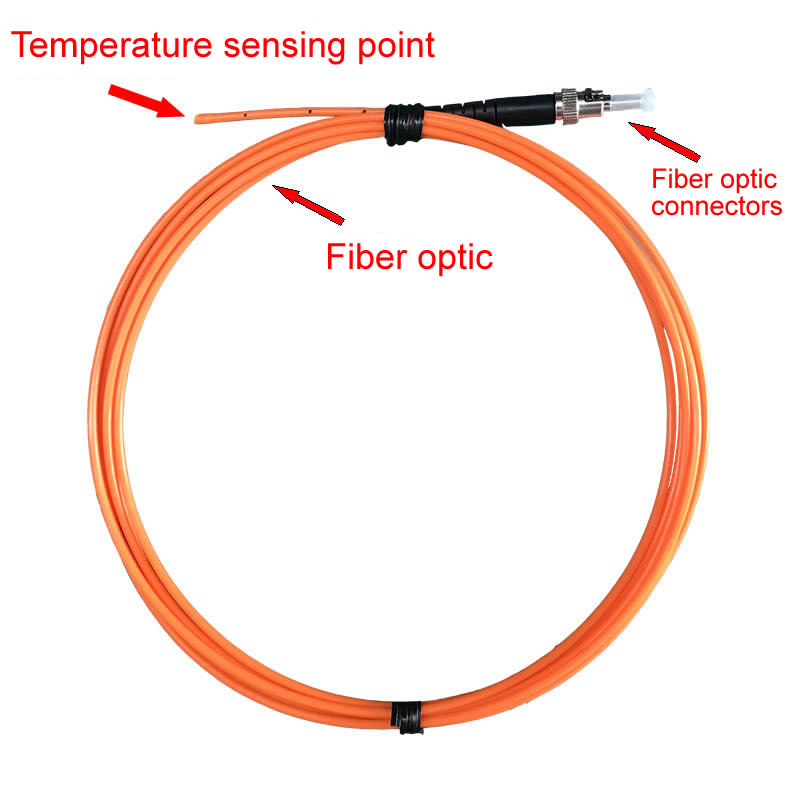
の 蛍光ベースの光ファイバー温度センサー — also known as the fluorescent decay or phosphor thermometry sensor — is the most widely used and commercially mature fiber optic temperature measurement technology for point sensing in EMI-intensive environments. その動作原理は洗練されており、本質的に堅牢です.
光ファイバープローブの先端に, 少量の蛍光物質 (蛍光体) ファイバー端面に接着されています. 励起光のパルス(通常は紫外または可視スペクトルのLEDまたはレーザーダイオードから)が光ファイバーを通って伝送され、蛍光体に当たるとき, 蛍光体は励起光を吸収し、より長い波長で蛍光を再放出します。. 励起パルス終了後, 蛍光はすぐには止まらず、時間の経過とともに指数関数的に減衰します。. この減衰の速度, によって特徴づけられる 蛍光減衰時間 (蛍光寿命とも呼ばれます, t), 蛍光体材料の基本的な物理的特性であり、温度に大きくかつ予測通り依存します。.
The relationship between fluorescence decay time and temperature arises from the thermal quenching of the phosphor’s excited electronic states. より高い温度で, non-radiative energy transfer processes (phonon-assisted relaxation) become more probable, providing competing pathways for the excited electrons to return to the ground state without emitting a photon. This increases the overall decay rate and decreases the fluorescence decay time. The result is a monotonic, well-characterized, and highly repeatable relationship between decay time τ and temperature T, typically described by an Arrhenius-type equation:
1/t(T) = 1/τ₀ + A · exp(−ΔE / kT)
where τ₀ is the intrinsic radiative lifetime, A is a pre-exponential rate constant, ΔE is the activation energy for non-radiative quenching, and k is the Boltzmann constant. This equation shows that the decay time decreases exponentially with increasing temperature — a relationship that provides both high sensitivity and a wide dynamic range.
Why Decay Time Is the Optimal Measurand
The critical advantage of measuring fluorescence decay time — rather than fluorescence intensity — is that decay time is an intrinsic temporal property of the phosphor material. It is completely independent of the excitation light intensity, fiber transmission losses, コネクタの損失, ファイバーの曲げ損失, LED aging, and detector sensitivity variations. This makes the measurement self-referencing and immune to all the drift mechanisms that plague intensity-based optical sensors. あ 蛍光光ファイバー温度センサー does not require recalibration when connectors are reconnected, when the fiber is re-routed, or when the LED output degrades over years of operation. This long-term stability, combined with complete EMI immunity, is what makes fluorescence-based sensors the dominant choice for permanent installation in harsh electromagnetic environments.
Signal Processing and Temperature Extraction
The interrogator instrument in a fluorescence-based system performs the following measurement cycle. 初め, it drives a short excitation pulse (typically 10–100 µs duration) through the optical fiber to the phosphor probe. 励起パルス終了後, the instrument captures the exponentially decaying fluorescence signal returned through the same fiber. A high-speed analog-to-digital converter digitizes the decay curve, and a digital signal processing algorithm fits an exponential decay function to the captured data to extract the decay time constant τ. The instrument then applies its stored calibration curve to convert τ into temperature. This entire cycle typically completes in 0.1 に 1 2番, providing real-time temperature updates.
Advanced interrogators employ sophisticated curve-fitting algorithms — including multi-exponential fitting, phase-sensitive detection, and digital lock-in techniques — to extract the decay time with high precision even in the presence of background light, fiber autofluorescence, and electronic noise. Some systems also use ratio-metric techniques that compare fluorescence intensity at two different wavelength bands (dual-wavelength fluorescence ratio) as a secondary or complementary temperature extraction method.
3. 蛍光センサーの設計, 材料, とパフォーマンス

Phosphor Materials
The choice of fluorescent phosphor material determines the usable temperature range, 感度, 正確さ, and long-term stability of the sensor. Several phosphor families are used in commercial 蛍光光ファイバー温度センサー.
Rare-earth doped crystals and ceramics are the most common phosphor class for industrial temperature sensing. Magnesium fluorogermanate doped with tetravalent manganese (Mg₄FGeO₆:Mn) was one of the earliest phosphors used in fiber optic thermometry and remains in use for moderate temperature ranges (−50 °C to +200 ℃). Its fluorescence decay time at room temperature is approximately 3–5 ms, providing a strong, easy-to-measure signal.
Rare-earth doped yttrium aluminum garnet (YAG) crystals — such as Cr:YAG, Dy:YAG, and Er:YAG — offer significantly extended temperature ranges. Chromium-doped YAG (Cr:YAG) operates effectively from −100 °C to +450 °C with a room-temperature decay time of approximately 1.5 MS. Dysprosium-doped YAG (Dy:YAG) pushes the upper limit beyond 400 ℃. These materials offer exceptional chemical stability, resistance to radiation damage, and minimal aging — critical for long-life industrial installations.
Ruby (Cr:Al₂O₃) — chromium-doped aluminum oxide — is a classic phosphor thermometry material with a well-characterized R-line fluorescence whose decay time varies from approximately 3.5 ms at room temperature to sub-millisecond values above 400 ℃. Ruby probes are used in both industrial and scientific temperature measurement applications.
Alexandrite (Cr:BeAl₂O₄) provides high sensitivity in the 0 ℃~ 300 °C range and has been used in medical and biomedical fiber optic thermometry applications.
For cryogenic temperature measurement, rare-earth doped phosphors such as Eu:Y₂O₃ (europium-doped yttria) and Tb:La₂O₂S (terbium-doped lanthanum oxysulfide) offer strong fluorescence and measurable decay time changes at temperatures well below −100 °C, extending coverage down to liquid nitrogen temperatures and beyond.
Probe Construction
The fluorescent probe is the heart of the sensor. In a typical construction, a small phosphor element (approximately 0.3–1.0 mm in size) is bonded to the tip of a multimode optical fiber (typically 100–600 µm core diameter) using a high-temperature adhesive or fusion process. The phosphor may be in the form of a single crystal chip, a pressed ceramic pellet, or a thin coating of phosphor powder in a binder matrix. The probe tip is then encapsulated in a protective tube — typically stainless steel, セラミック (alumina or zirconia), or PTFE — depending on the operating environment.
The complete probe assembly diameter ranges from less than 1 mm for minimally invasive medical probes to 3–6 mm for ruggedized industrial probes. Probe lengths range from a few centimeters to custom lengths for specific installation geometries. The optical fiber connecting the probe to the interrogator can be tens to hundreds of meters long — providing the physical separation between the measurement point (in the high-EMI zone) and the instrument (in a control room or safe area).
性能仕様
| パラメータ | Standard Fluorescence Sensor | High-Performance Fluorescence Sensor |
|---|---|---|
| 温度範囲 | −40℃~ +200 ℃ | −200 °C to +450 ℃ |
| 正確さ | ±0.5℃ | ±0.1 °C to ±0.2 °C |
| 解決 | 0.1 ℃ | 0.01 ℃ |
| 応答時間 (T90) | 0.5–3 seconds | 0.1–0.5 seconds |
| Measurement Rate | 1–4 Hz | まで 10 Hz |
| チャンネル数 | 1–4 | 4–32 |
| 繊維長 (probe to instrument) | まで 200 メートル | まで 1,000 メートル |
| プローブ直径 | 1–3mm | 0.5–6 mm |
| 長期安定性 | ±0.1 °C/year | ±0.05 °C/year |
| EMI耐性 | 完了 (inherent) | 完了 (inherent) |
| ガルバニック絶縁 | 合計 (no electrical path) | 合計 (no electrical path) |
4. Applications of Fluorescence Fiber Optic Temperature Sensors in High-EMI Environments
Power Transformer Hot-Spot Temperature Monitoring
Monitoring the winding hot-spot temperature of power transformers is the single largest application of 蛍光光ファイバー温度センサー 世界中で. Inside a high-voltage power transformer, the windings operate at voltages of tens to hundreds of kilovolts, surrounded by intense magnetic fields and immersed in insulating oil. No conventional electrical sensor can be reliably placed directly on the winding conductors — the voltage difference between the winding and grounded instrument would destroy any metallic connection, and the electromagnetic field environment would corrupt any electrical signal.
Fluorescence fiber optic temperature probes are installed directly on the transformer winding surface during manufacturing. The optical fiber exits the transformer tank through a fiber-optic feedthrough penetrator and connects to an interrogator mounted on the transformer exterior or in a nearby control cabinet. Because the fiber is entirely non-conductive, it provides complete high-voltage isolation — withstanding the full winding voltage without any isolation barrier. And because the fluorescence decay-time signal is completely immune to the transformer’s magnetic field, the measurement is accurate and noise-free regardless of loading conditions.
Accurate winding hot-spot temperature data enables dynamic transformer rating (DTR), predictive thermal aging analysis, optimized load dispatch, and early fault detection. IECを含む国際規格 60076-2 and IEEE C57.91 reference fiber optic sensing as the preferred method for direct hot-spot measurement. シーメンス・エナジーを含む世界の主要な変圧器メーカー, 日立エナジー (ABB), GE バーノバ, TBEA, その他 - 中型および大型の電力変圧器の標準装備として蛍光ファイバー光温度センサーを定期的に指定します。.
開閉装置とバスバーの温度監視
中電圧および高電圧の開閉装置および母線接続は、最大で次の電圧で動作します。 40.5 kV (GIS システム以上), あらゆる金属センサーにとって有害な EMI 環境を作り出す. 接点の劣化, 腐食, 接続が緩んでいると局所的な過熱が発生し、, 検出されない場合, 致命的な故障やアークフラッシュ現象につながる. 電磁干渉の影響を受けない蛍光光ファイバー温度センサー バスバージョイントに直接取り付けられます, ブレーカー接点, 開閉装置エンクロージャ内のケーブル終端. センサーは継続的な, real-time temperature monitoring with no risk of compromising the insulation coordination of the equipment — a critical safety consideration that disqualifies all metallic sensor technologies.
Electric Motor and Generator Winding Monitoring
Large electric motors and generators present similar challenges — high-voltage windings surrounded by rotating magnetic fields. Embedded fluorescence fiber optic probes measure stator winding temperature directly, replacing or supplementing conventional RTD installations. The fiber optic sensors provide faster response, より高い精度, and complete immunity to the motor’s electromagnetic environment, improving thermal protection and enabling more aggressive loading strategies.
MRI-Compatible Temperature Measurement
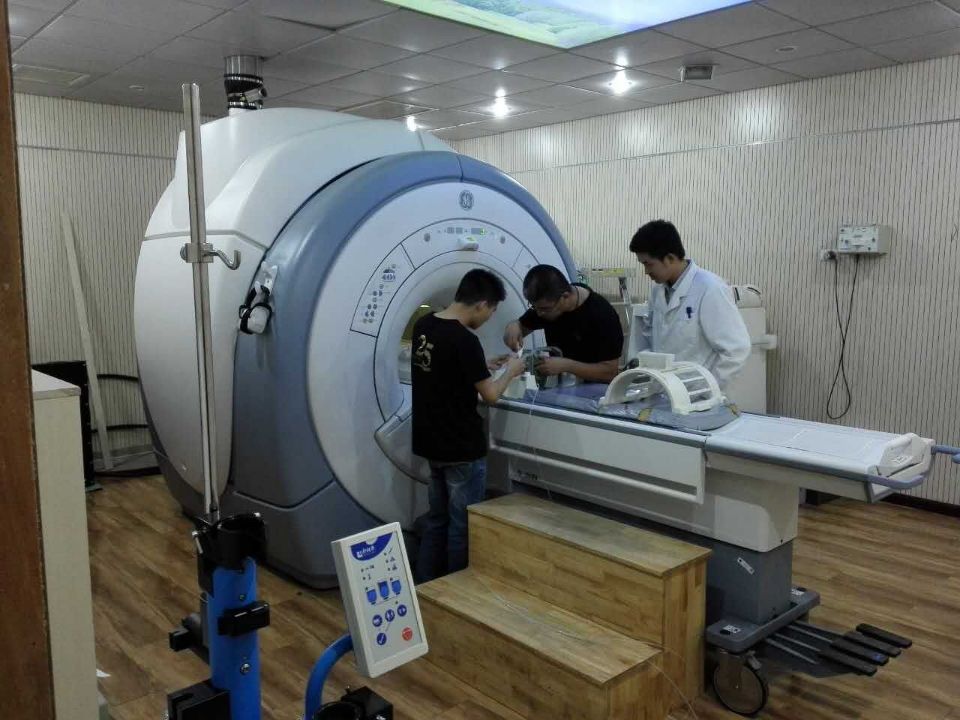
磁気共鳴画像法 (MRI) scanners generate static magnetic fields of 1.5 T to 7 T (30,000 に 140,000 times the Earth’s magnetic field) along with rapidly switching gradient fields and high-power RF pulses. No metallic sensor or wire can be introduced into the MRI bore without creating artifacts in the image, experiencing induced heating (potentially dangerous to patients), or producing corrupted temperature signals. 蛍光光ファイバーセンサー, being entirely non-metallic and non-magnetic, are fully MRI-compatible. They are used for patient temperature monitoring during MRI-guided procedures, phantom calibration, and quality assurance of MRI-guided thermal therapy (例えば, レーザーアブレーション, focused ultrasound) where precise knowledge of tissue temperature is essential for treatment safety and efficacy.
RF and Microwave Heating Processes
Industrial RF heating (dielectric heating, RF welding, RF drying) and microwave processing (microwave curing, 焼結, food processing) generate intense electromagnetic fields that make conventional temperature measurement virtually impossible. 蛍光ファイバー光温度センサー are the standard temperature measurement method inside RF and microwave applicators, providing accurate real-time temperature feedback for process control. The all-dielectric sensor probe does not interact with the RF/microwave field, does not distort the field distribution, and does not experience self-heating — all problems inherent to any metallic sensor placed in an RF/microwave environment.
電磁適合性 (EMC) テスト
In EMC test chambers (anechoic chambers, reverberation chambers, GTEM cells), where equipment is subjected to high-intensity electromagnetic fields for compliance testing, any metallic sensor or cable introduced into the test volume would distort the field and invalidate the test. Fluorescence fiber optic sensors provide temperature monitoring of the equipment under test (EUT) without electromagnetic interference with the test environment.
Additional High-EMI Applications
Other important application areas for 電磁干渉の影響を受けない光ファイバー温度センサー based on fluorescence technology include high-power semiconductor laser diode temperature monitoring, electric vehicle battery pack thermal management during EMC testing, induction heating process control, plasma processing equipment monitoring, high-power radar and antenna system thermal monitoring, railway traction transformer and converter monitoring, and nuclear magnetic resonance (NMR) spectroscopy sample temperature control.
5. GaAs Semiconductor Fiber Optic Temperature Sensors
動作原理
の GaAs (ガリウムヒ素) 光ファイバー温度センサー uses a fundamentally different physical mechanism from fluorescence decay — the temperature-dependent optical absorption edge of a semiconductor crystal. ガリウムヒ素は、温度の上昇とともにバンドギャップエネルギーが直線的に減少する直接バンドギャップ半導体です。, よく知られているヴァルシュニ方程式に従います. バンドギャップが減少すると, 光吸収端 (材料が透明から不透明に変化する波長) は、より長い波長にシフトします。 (赤方偏移).
GaAs 光ファイバー温度センサー内, 薄いGaAs結晶チップ (通常、厚さは 100 ~ 300 μm) 光ファイバーの先端に取り付けられています. LED 光源からの広帯域光がファイバーを介して GaAs チップに伝送されます。. 吸収端より短い波長は GaAs に吸収されます。; 吸収端より長い波長は透過します (または反射, 一部の構成では) ファイバーを通って戻る. The returned spectral signal shows a sharp transition — the absorption edge — whose spectral position is determined by the chip temperature. A spectrometer or wavelength-selective detector in the interrogator measures the edge position and converts it to temperature using a calibration curve.
The absorption edge of GaAs shifts at approximately 0.4 nm/°C, providing good temperature sensitivity. The bandgap transition is a fundamental thermodynamic property of the crystal lattice, ensuring excellent repeatability and stability. Like fluorescence sensors, GaAs sensors are completely non-electrical at the sensing point, providing inherent immunity to electromagnetic interference and complete galvanic isolation.
Advantages and Limitations of GaAs Sensors
GaAs semiconductor sensors offer several attractive characteristics. The measurement principle is based on a fundamental material property (bandgap energy), providing inherent long-term stability with minimal calibration drift. The sensor has no moving parts and no consumable materials (unlike phosphors that could theoretically degrade under extreme conditions). The GaAs chip is compact and can be packaged in very small probe formats. The temperature response is essentially linear over the practical measurement range, simplifying signal processing.
The typical operating range of a GaAs fiber optic temperature sensor およそです −40℃~ +250 ℃, の精度で ±0.5℃~±1℃ and resolution of 0.1 ℃. This range covers most power equipment and industrial monitoring applications. The upper temperature limit is constrained by the GaAs bandgap becoming too narrow (the absorption edge shifts into the near-infrared beyond the detector range) and by the thermal stability of the packaging materials.
Compared to fluorescence sensors, GaAs sensors are generally less accurate at the high-performance end (±0.5 °C vs. ±0.1 °C achievable with fluorescence), have a narrower maximum temperature range, and require a spectrometric detector system (increasing interrogator complexity and cost). しかし, GaAs sensors have the advantage of a purely passive sensing element with no optical excitation/emission process, and some manufacturers and users prefer the perceived simplicity and long-term stability of the semiconductor absorption-edge mechanism.
主な用途
GaAs fiber optic temperature sensors are primarily used in power transformer winding temperature monitoring — where they compete directly with fluorescence sensors — as well as in switchgear hot-spot monitoring, 電気モーター巻線の監視, および発電機の温度監視. いくつかの大手変圧器メーカーは、蛍光ベースのシステムと並行して、または蛍光ベースのシステムの代わりに、オプションとして GaAs ベースの光ファイバー温度モニタリングを提供しています。. GaAs センサーは、MRI との互換性が必要で、温度範囲が中程度である特定の医療用途でも使用されます。.
6. ファイバーブラッググレーティング (FBG) 温度センサー
動作原理
あ ファイバーブラッググレーティング (FBG) 温度センサー 紫外線レーザー露光を使用してシングルモード光ファイバーのコアに直接書き込まれる屈折率の周期的変調に基づいています。. この回折格子構造は、ブラッグ波長を中心とする狭い帯域の波長を反射します。 (λ_B), 格子周期によって決まります (L) と実効屈折率 (n_eff) ブラッグ条件に従ったファイバーコアの: λ_B = 2 ・n_eff・Λ. 温度が変化すると, both the refractive index (through the thermo-optic effect) and the grating period (through thermal expansion) 変化, causing the Bragg wavelength to shift. This shift is approximately 10–13 pm/°C で 1550 nm wavelength for standard silica fiber.
The interrogator instrument illuminates the fiber with broadband light and monitors the reflected Bragg wavelength using a spectrometer, tunable filter, or interferometric detection system. By tracking the wavelength shift, the system determines the temperature change at the grating location. The key distinguishing feature of FBG sensors is wavelength encoding — the temperature information is encoded in the wavelength of reflected light, not in its intensity. This makes the measurement inherently immune to light source power fluctuations, fiber loss variations, and connector loss changes — similar to the self-referencing advantage of fluorescence decay-time measurement.
多重化機能
The most significant advantage of FBG sensors over fluorescence and GaAs point sensors is wavelength-division multiplexing (WDM). Multiple FBGs, each written at a slightly different Bragg wavelength, can be inscribed along a single optical fiber. A single interrogator can simultaneously read 10 に 50+ FBG sensors distributed along one fiber by distinguishing their individual reflected wavelength peaks. This provides quasi-distributed multi-point temperature measurement using a single fiber cable — dramatically reducing cabling complexity in applications requiring many measurement points.
例えば, in a power transformer application, a single fiber cable with 10 FBG sensors can monitor winding temperature at 10 different locations using only one fiber penetration through the tank wall. In a tunnel or industrial duct, an FBG array can monitor temperature at dozens of points along a single fiber run. This multiplexing capability is unique to FBG technology and is not available with fluorescence or GaAs point sensors (which require one fiber per measurement point).
Performance and Limitations
標準 FBG温度センサー offer accuracy of ±0.5℃~±1℃, の解像度 0.1 ℃~ 1 pm wavelength, and operating ranges from −40℃~ +300 ℃ (with high-temperature gratings extending to +800 °C or higher using regenerated or femtosecond-inscribed FBGs). Response time depends on the thermal coupling of the fiber to the measurement target and is typically 0.1 に 1 2番.
The primary limitation of FBG sensors for temperature-only applications is cross-sensitivity to strain. The Bragg wavelength shifts with both temperature and mechanical strain (約 1.2 午後/付き), そして 2 つの効果は単一波長の測定だけでは区別できません。. 純粋な温度測定用, FBG は、歪みのない取り付け方法で取り付ける必要があります。通常は、ファイバが機械的な制約を受けることなく自由に伸縮できるようにする緩い保護チューブに収められています。. 温度とひずみの両方に関心がある場合 (構造健全性モニタリングの場合と同様), デュアル格子構成または基準格子は、2 つの効果を分離するために使用されます。.
FBG システム用のインテロゲータは、高精度の波長測定要件のため、一般に蛍光インテロゲータよりも高価です。. しかし, 単一のファイバー上に多重化された多数のセンサーでコストが償却される場合, the per-point cost can be competitive or even lower than multiple single-point fluorescence systems.
Applications in EMI Environments
Fiber Bragg Grating temperature sensors, like all fiber optic sensors, 電磁干渉に対する完全な耐性を提供します. They are used in power transformers (multi-point winding monitoring with a single fiber), generator stator temperature mapping, 高圧ケーブル接続部の監視, MRI-compatible temperature arrays, wind turbine lightning-exposed blade monitoring, railway traction systems, and high-energy physics experimental facilities (粒子加速器, fusion reactors) where intense electromagnetic fields and radiation are present.
7. 技術比較: Fluorescence vs. GaAs vs. FBG
| パラメータ | 蛍光減衰 | GaAs半導体 | ファイバーブラッググレーティング (FBG) |
|---|---|---|---|
| センシング原理 | Fluorescence decay time of phosphor | Bandgap absorption edge shift of GaAs | Bragg wavelength shift of UV-inscribed grating |
| EMI耐性 | 完了 (inherent) | 完了 (inherent) | 完了 (inherent) |
| 温度範囲 | −200 °C to +450 ℃ | −40℃~ +250 ℃ | −40℃~ +300 ℃ (標準); に +800 ℃ (special) |
| 正確さ | ±0.1 °C to ±0.5 °C | ±0.5℃~±1℃ | ±0.5℃~±1℃ |
| 解決 | 0.01–0.1 °C | 0.1 ℃ | 0.1 ℃ |
| 応答時間 | 0.1–3 s | 0.5–3 s | 0.1–1 s |
| 多重化 | いいえ (1 fiber per point) | いいえ (1 fiber per point) | はい (10–50+ points per fiber) |
| ひずみ感度 | なし | なし | はい (cross-sensitive; requires isolation) |
| 長期安定性 | 素晴らしい | 素晴らしい | Good to Excellent |
| Interrogator Cost | 中くらい | 中~高 | 高い (but per-point cost lower with multiplexing) |
| プローブのサイズ | 0.5直径 –6 mm | 1–4 mm diameter | 繊維径 (125–250 µm); packaging varies |
| 主な用途 | トランスフォーマー, 開閉装置, MRI, 高周波加熱 | トランスフォーマー, 開閉装置 | 多点監視, structural, 変圧器 |
| Market Maturity | 非常に高い (30+ 年) | 高い (25+ 年) | 高い (20+ 年) |
Which Technology Should You Choose?
For most single-point or small-channel-count temperature measurement applications in high-EMI environments — particularly power transformer winding hot-spot monitoring, 開閉装置の監視, and MRI-compatible sensing — the 蛍光光ファイバー温度センサー remains the best overall choice due to its combination of wide temperature range, 高精度, proven long-term stability, mature supply chain, and competitive cost. それは “default” technology for EMI-immune point temperature measurement and the one recommended by international standards for transformer applications.
の GaAs fiber optic temperature sensor is a viable alternative for power equipment monitoring, particularly when offered by manufacturers who have established long-term performance records with this technology. The choice between fluorescence and GaAs in transformer applications often comes down to manufacturer preference and supply chain relationships rather than fundamental technical superiority.
の FBG温度センサー is the preferred choice when multiple temperature measurement points are required along a single fiber path — providing significant installation and cabling advantages over deploying many individual fluorescence or GaAs probes. しかし, care must be taken to ensure strain-free mounting for accurate temperature-only measurement, and the higher interrogator cost must be justified by the multiplexing benefit.
8. How to Select the Right EMI-Immune Fiber Optic Temperature Sensor
アプリケーションの評価
The first step in selecting a fiber optic temperature sensor immune to electromagnetic interference is to clearly characterize your application requirements. Key questions include: What is the temperature range to be measured? What accuracy and resolution are required? How many measurement points are needed? What is the distance from the sensing point to the instrument location? What are the environmental conditions at the sensing point (温度, 水分, 振動, 化学物質への曝露)? What is the nature and intensity of the electromagnetic interference? What output and communication interfaces are required? The answers to these questions will narrow the technology choice and guide the selection of specific products.
Vendor Evaluation
When evaluating vendors, look for manufacturers with proven track records in your specific application area. For power transformer applications, the supplier should have thousands of installed probes in field operation with documented long-term performance data. For MRI applications, the sensor must be explicitly tested and certified for MRI compatibility at the relevant field strength. For industrial process applications, the probe construction and materials must be compatible with the process environment. Request technical specifications with clearly stated accuracy, 安定性, and environmental ratings — and ask for independent verification or reference installations where performance can be confirmed.
System Integration Considerations
Consider how the fiber optic temperature measurement system integrates with your existing monitoring and control infrastructure. Modern interrogators typically provide analog outputs (4–20mA), デジタルコミュニケーション (Modbus RTU/TCP, IEC 61850 for power utility applications, OPC UA for industrial automation), relay alarm contacts, and web-based interfaces. For multi-channel systems, ensure the interrogator supports the required number of channels and measurement rate. For permanent installations, specify ruggedized fiber optic connectors (E2000, SC/APC) and fiber routing hardware that protects the fiber from mechanical damage during installation and operation.
9. FAQs About Fiber Optic Temperature Sensors Immune to Electromagnetic Interference
Q1: Why are fiber optic temperature sensors immune to electromagnetic interference?
Fiber optic temperature sensors immune to electromagnetic interference achieve this immunity because the entire sensing path — from the measurement point through the fiber to the interrogator — is made of non-conductive, dielectric materials. Optical fiber is glass, and the sensing elements are phosphor crystals, semiconductor chips, or grating structures. With no metallic conductors or electronic components at the sensing point, there are no pathways for electromagnetic fields to couple into and corrupt the measurement signal. The temperature information is carried by light, not by electrical current or voltage, and electromagnetic fields do not affect the propagation of light in glass fiber.
第2四半期: What is the most common type of EMI-immune fiber optic temperature sensor?
の 蛍光ベースの (fluorescent decay) 光ファイバー温度センサー is the most widely deployed EMI-immune fiber optic temperature sensing technology worldwide. Its dominance is due to the combination of high accuracy, 広い温度範囲, 優れた長期安定性, mature manufacturing supply chain, and proven field performance over three decades of commercial deployment in power transformers, 開閉装置, and other high-EMI applications.
Q3: How does a fluorescence fiber optic temperature sensor work?
あ 蛍光光ファイバー温度センサー works by measuring the fluorescence decay time of a phosphor material bonded to the optical fiber tip. The interrogator sends a light pulse to excite the phosphor, then measures how quickly the fluorescence fades after excitation. The decay time is a direct function of temperature — it decreases as temperature increases due to increased thermal quenching. Because decay time is an intrinsic property of the phosphor, the measurement is immune to fiber losses, LED aging, and connector variations, in addition to being immune to EMI.
Q4: What is the accuracy of a fluorescence fiber optic temperature sensor?
標準 蛍光光ファイバー温度センサー achieve accuracy of ±0.5 °C. High-performance systems achieve ±0.1 °C to ±0.2 °C with careful calibration and optimized signal processing. 解決 (smallest detectable temperature change) is typically 0.01 ℃~ 0.1 ℃. 長期安定性 (calibration drift) is typically better than ±0.1 °C per year.
Q5: How does a GaAs fiber optic temperature sensor differ from a fluorescence sensor?
あ GaAs fiber optic temperature sensor measures temperature by detecting the shift of the optical absorption edge of a Gallium Arsenide semiconductor crystal, rather than measuring fluorescence decay time. Both technologies provide complete EMI immunity and galvanic isolation. GaAs sensors typically cover −40 °C to +250 °C with ±0.5 °C accuracy, while fluorescence sensors offer wider range (−200 °C to +450 ℃) and potentially higher accuracy (±0.1 °C). GaAs sensors are primarily used in power equipment monitoring applications.
Q6: Can Fiber Bragg Grating sensors measure temperature in high-EMI environments?
はい. Fiber Bragg Grating temperature sensors are completely immune to EMI because the sensing element is an optical grating inscribed in the glass fiber core. The key advantage of FBG sensors is multiplexing — multiple temperature points measured along a single fiber. 主な考慮事項は、FBG は機械的歪みにも敏感であるということです。, 正確な温度測定のために, ファイバーは歪みのない構成で設置する必要があります (例えば, 保護チューブ内で緩んでいる).
Q7: 電力変圧器の監視に最適な光ファイバー温度センサー技術はどれですか?
電源トランス巻線のホットスポット監視用, の 蛍光光ファイバー温度センサー 最も広く仕様化され、標準化されたテクノロジーです, IECが推奨する 60076-2 およびIEEE C57.91ガイドライン. GaAsセンサー いくつかの大手変圧器メーカーでも使用されており、この用途に対して同等の信頼性を提供します。. FBGセンサー 単一のファイバーに沿った多点監視が必要な場合に使用されることが増えています. 3 つすべてが必須の要件を提供します: 完全なEMI耐性, 高電圧ガルバニック絶縁, 変圧器の油浸環境でも信頼性の高い長期動作を実現.
Q8: Can fiber optic temperature sensors be used inside MRI scanners?
はい. 蛍光ファイバー光温度センサー are fully MRI-compatible because they contain no metallic, 磁気, or electrically conductive materials at the sensing point. They produce no MRI image artifacts, experience no RF-induced heating, and provide accurate temperature readings in magnetic fields up to 7 T and beyond. They are routinely used for patient monitoring, phantom testing, and MRI-guided thermal therapy procedures.
Q9: What is the typical lifespan of a fluorescence fiber optic temperature probe?
Fluorescence fiber optic temperature probes installed in power transformers routinely operate for 15 に 25+ 年 without replacement or recalibration. The phosphor materials (例えば, Cr:YAG, rare-earth doped ceramics) are chemically inert and thermally stable, exhibiting negligible degradation under normal operating conditions. The optical fiber itself has a well-established lifespan exceeding 25 年. Probe failure, when it occurs, is almost always due to mechanical damage (fiber breakage) rather than sensor element degradation.
Q10: How does the cost of a fluorescence fiber optic temperature sensor compare to a thermocouple?
A fluorescence fiber optic temperature sensor system (尋問者 + プローブ) costs significantly more than a thermocouple and transmitter — typically USD 2,000 to USD 10,000 for the interrogator and USD 100 to USD 500 per probe, compared to less than USD 100 for a thermocouple assembly. しかし, in high-EMI environments where thermocouples cannot provide reliable measurements, the comparison is not fiber optic vs. thermocouple but rather fiber optic vs. no measurement at all. The cost is justified by the unique capability of providing accurate, 従来のセンサーではまったくアクセスできない環境でも干渉のない温度データを取得. フジノ (www.fjinno.net) 蛍光ファイバー光温度センサーと完全なシステム ソリューションを競争力のある電力価格で提供します, 工業用, および医療用途.
免責事項: この記事で提供される情報は、一般的な教育および参照を目的としています。. 具体的な製品仕様, 性能特性, そして価格はメーカーによって異なります, モデル, と構成. 引用されているすべての技術データは、市販の光ファイバー温度検知製品に見られる典型的な値を表しており、特定のシステムの保証仕様として使用するべきではありません。. 光ファイバー温度検知装置を指定または購入する前に、必ずメーカーの公式ドキュメントを参照し、独立した評価を行ってください。. フジノ (www.fjinno.net) この記事の内容に基づいて行われた決定については、一切の責任を負いません.

光ファイバー温度センサー, インテリジェント監視システム, 中国の分散型光ファイバーメーカー
 |
 |
 |