 Sensor suhu serat optik INNO ,sistem pemantauan suhu.
- Akibat dari Ketidaktahuan: Di luar biaya penggantian perangkat keras secara langsung, konsekuensi kegagalan transformator termasuk kerugian produksi yang sangat besar, peraturan denda lingkungan akibat tumpahan minyak, dan bahaya keselamatan kritis seperti ledakan busur api.
- Jalur Kegagalan Divergen: Ketika transformator terendam minyak menyerah pada lumpur kimia dan saturasi kelembaban, transformator tipe kering menghadapi ancaman nyata dari retaknya resin epoksi dan penyumbatan saluran udara yang disebabkan oleh kontaminan lingkungan.
- Hukum Termal: Kehidupan aset diatur secara ketat oleh Hukum Arrhenius; kenaikan hanya 6°C suhu hotspot berliku dapat mengurangi separuh sisa masa manfaat isolasi selulosa, membuat manajemen termal yang tepat tidak dapat dinegosiasikan.
- Titik Buta dalam Pemantauan: Metode lama seperti indikator suhu Top Oil dan termografi Inframerah eksternal gagal memberikan visibilitas ke dalam inti. They suffer from thermal lag and cannot penetrate the tank wall to see the true internal state.
- The Optical Standard: Mengadopsi Sensor Suhu Serat Optik Fluoresen is the only method to achieve immune, langsung, and real-time monitoring of high-voltage windings, enabling safe dynamic loading and predictive intervention.
Daftar isi: Navigating Asset Health
- 1. What are the Severe Economic and Safety Consequences of Power Transformer Failure?
- 2. How Large are the Production Losses Caused by Unplanned Transformer Outages?
- 3. What are the Primary Insulation Failure Modes of Oil-Immersed Transformers?
- 4. How Can Resin Cracking and Air Duct Blockage be Prevented in Dry-Type Transformers?
- 5. How Does Short-Circuit Impact Cause Winding Deformation and Mechanical Damage?
- 6. How Does Moisture Intrusion Accelerate the Aging Process of Oil-Paper Insulation?
- 7. What Exactly is a Transformer Winding Hotspot and What Causes Its Formation?
- 8. How Does Temperature Rise Shorten Insulation Life According to Arrhenius Law?
- 9. How Does Transformer Overloading Trigger Internal Overheating Risks?
- 10. How Does Cooling System Failure Affect Overall Transformer Heat Dissipation Efficiency?
- 11. Why Can Top Oil Temperature Indicators Not Reflect the True Winding Temperature?
- 12. Can Infrared Thermography Cameras Penetrate the Tank to Detect Internal Winding Faults?
- 13. Why is Direct Winding Temperature Monitoring Critical for Fault Prevention?
- 14. What is the Working Principle of Fluorescent Fiber Optic Temperature Sensing Technology?
- 15. Why Does the High-Voltage Environment Require Anti-Electromagnetic Interference Temperature Sensors?
- 16. Are Fluorescent Fiber Optic Sensors Safe in High-Voltage Insulation Environments?
- 17. Does the Fluorescent Fiber Optic Temperature System Require Periodic Calibration and Maintenance?
- 18. How to Utilize Precise Temperature Data to Achieve Dynamic Transformer Rating Increases?
- 19. Can Existing Power Transformers be Retrofitted with Fiber Optic Temperature Systems?
- 20. Why Should You Deploy a Transformer Predictive Maintenance Solution Immediately?
1. What are the Severe Economic and Safety Consequences of Power Transformer Failure?

When a critical node in the electrical grid fails, the ripple effects extend far beyond the substation fence. The failure of a transformator daya is rarely a contained event; it is often a cascading catastrophe that impacts financial stability, human safety, dan kepatuhan lingkungan. Understanding the gravity of these consequences is the first step in justifying investment in advanced monitoring systems.
The Safety Imperative: Arc Flash and Explosion
The most immediate and terrifying consequence of a dielectric breakdown is the potential for an arc flash. When insulation fails under high voltage, the massive release of energy vaporizes the oil and copper, creating a rapidly expanding gas bubble. This pressure wave can rupture the steel tank in milliseconds. The combination of superheated oil and oxygen can lead to a fireball that endangers personnel and adjacent infrastructure. Predictive maintenance analytics aim to detect the precursors to this thermal runaway before the arc occurs.
Environmental Remediation Costs
Oil-filled transformers contain thousands of liters of insulating fluid. A tank rupture inevitably leads to leakage. If this oil seeps into the soil or local waterways, the utility faces substantial fines from environmental protection agencies (such as the EPA). The cost of specialized cleanup crews, soil excavation, and water purification often exceeds the cost of the transformer itself.
2. How Large are the Production Losses Caused by Unplanned Transformer Outages?
For utility operators and industrial facility managers, itu “total biaya kepemilikan” calculation must include the risk of downtime. An unplanned outage is significantly more expensive than a planned maintenance window.
Calculating the Cost of Lost Production
In industrial applications such as steel mills, pusat data, or semiconductor manufacturing, a stable power supply is the lifeblood of operations. If a main step-down transformer fails unexpectedly, production stops instantly. Namun, restarting complex industrial processes is not immediate. A 4-hour power outage might result in 48 hours of recalibration and wasted raw materials. Financial models show that for high-value industries, itu production losses can range from $10,000 untuk berakhir $1,000,000 per hour of downtime.
The Logistics of Emergency Replacement
Large power transformers are not off-the-shelf items. Lead times for new units can range from 6 ke 18 bulan. While utilities keep spares, the logistics of transporting a 200-ton asset to a remote site, menguras minyak, and commissioning the new unit can take weeks. Selama periode ini, the grid may operate in a fragile N-0 state, risking blackouts for the wider region. Canggih manajemen kesehatan aset provides the necessary lead time to order replacements before the asset reaches its end of life.
3. What are the Primary Insulation Failure Modes of Oil-Immersed Transformers?
Transformator terendam minyak rely on a complex synergy between the copper winding, the cellulose paper insulation, and the dielectric oil. This ecosystem is fragile. A failure in one component triggers a chemical chain reaction that destroys the others.
Sludge Formation and Thermal Blockage
As transformer oil oxidizes due to heat and oxygen exposure, itu membentuk produk sampingan semi-padat yang dikenal sebagai lumpur. Zat lengket ini mengendap pada permukaan belitan dan di dalam sirip radiator pendingin. Lumpur bertindak sebagai selimut termal, mencegah minyak menghilangkan panas dari tembaga. Hal ini menciptakan lingkaran setan: semakin panas belitannya, semakin banyak lumpur yang dihasilkan, dan semakin kurang efisien pendinginannya. Ini adalah penyebab utama belitan terlalu panas.
Dekomposisi Kimia dan Pembentukan Gas
Ketika minyak dan kertas rusak, mereka melepaskan gas kesalahan tertentu. Kesalahan termal (terlalu panas) menghasilkan etilen dan etana. Pelepasan listrik berenergi tinggi menghasilkan asetilena. Tanpa pemantauan terus menerus, gas-gas ini terakumulasi hingga kekuatan dielektrik minyak turun di bawah ambang batas tegangan, mengakibatkan korsleting yang dahsyat.
4. How Can Resin Cracking and Air Duct Blockage be Prevented in Dry-Type Transformers?

Transformator tipe kering, khususnya jenis Cast Resin, are favored for their fire safety in indoor environments. Namun, they are not maintenance-free. Their failure modes are mechanical and environmental rather than chemical.
The Physics of Resin Cracking
The core coils are encapsulated in epoxy resin. The conductor (copper or aluminum) has a different coefficient of thermal expansion than the resin. When the transformer experiences rapid load changes—shifting from low load to peak load quickly—the conductor expands faster than the resin. Over repeated cycles, this mechanical stress causes micro-cracks in the insulation. These cracks become sites for pelepasan sebagian, slowly eroding the insulation from the inside out until failure occurs.
Air Duct Blockage and Hotspots
Dry-type units rely on natural or forced air convection through cooling ducts between the coils. In industrial environments, these ducts can easily become clogged with dust, textile fibers, or other particulate matter. Unlike oil, which is pumped, air cannot circulate through a blocked duct. This results in localized temperature hotspots that are invisible to external fans. Continuous monitoring of the winding temperature is the only way to detect these blockages early, allowing for scheduled cleaning before the resin degrades.
5. How Does Short-Circuit Impact Cause Winding Deformation and Mechanical Damage?
While thermal issues are a slow killer, short circuits are violent events. A short-circuit fault represents the ultimate mechanical stress test for a transformer. Understanding the electrodynamic forces at play is essential for diagnosing structural integrity issues that often precede electrical failure.
The Physics of Electrodynamic Forces
When a short circuit occurs on the secondary side, the current flowing through the windings can spike to 10 or even 20 times the rated nominal current. According to Lorentz force law, the mechanical force exerted on the conductors is proportional to the square of this current. This means a 20x current increase results in a 400x increase in mechanical force.
These forces act in two primary directions:
- Radial Forces: These tend to burst the outer winding (hoop stress) and crush the inner winding against the core (buckling).
- Axial Forces: These tend to telescopically displace the windings, often damaging the clamping structures and end insulation.
The Thermal-Mechanical Compound Effect
The danger is compounded by heat. The massive current surge generates immediate resistive heating ($I^2R$), softening the copper conductors. Softened copper is far more susceptible to winding deformation. Even if the transformer survives the electrical fault, the resulting geometric distortion of the coils weakens the insulation layers, creating a “ticking time bomb” for future dielectric breakdown.
6. How Does Moisture Intrusion Accelerate the Aging Process of Oil-Paper Insulation?
Water is the arch-enemy of the oil-paper insulation system. Its presence is catalytic, meaning it not only reduces protection but actively accelerates the degradation of the cellulose chains that make up the solid insulation.
Sources of Moisture
Moisture enters the tank via two pathways:
- Atmospheric Ingress: Through leaky gaskets or poorly maintained silica gel breathers in free-breathing transformers.
- Internal Generation: As cellulose paper ages and degrades due to heat, water is a chemical byproduct of the decomposition process.
Itu “Wet Paper” Conundrum
Moisture has a perverse affinity for the paper insulation. In a stable transformer, lebih 98% of the moisture resides in the paper, not the oil. This moisture lowers the kekuatan dielektrik of the insulation, significantly increasing the risk of flashover. Lebih-lebih lagi, moisture acts as a catalyst for depolymerization. Wet paper ages significantly faster than dry paper at the same temperature. A moisture content increase from 1% ke 2% can cut the insulation’s mechanical life in half.
7. What Exactly is a Transformer Winding Hotspot and What Causes Its Formation?
In transformer engineering, itu “rata-rata” temperature is a misleading metric. The life of the unit is determined by the temperature at the single hottest point within the insulation system—the hotspot yang berkelok-kelok.
Defining the Hotspot
The hotspot is typically located in the upper part of the windings, but its exact location is elusive. It is not simply a function of load current; it is a localized phenomenon caused by the concentration of losses.
Root Causes of Localized Heating
- Stray Flux Losses: Magnetic flux that escapes the core (fluks kebocoran) induces eddy currents in the structural steel and the winding conductors themselves. These eddy currents generate additional heat that adds to the standard resistive losses.
- Oil Flow Stagnation: If the cooling oil ducts are narrow or blocked by sludge, the laminar flow of oil is disrupted. Without a fresh supply of cool oil, the heat in that specific pocket rises exponentially.
- Arus Harmonik: In modern grids filled with non-linear loads (inverter surya, PKS), high-frequency harmonics cause “skin effect” heating in the conductors, often creating hotspots that traditional thermal models fail to predict.
Detecting these elusive points requires pemantauan suhu belitan langsung daripada estimasi.
8. How Does Temperature Rise Shorten Insulation Life According to Arrhenius Law?
The relationship between temperature and transformer longevity is not linear; it is exponential. This relationship is described by the Arrhenius Law of chemical kinetics, which models the rate of chemical reaction (dalam hal ini, the depolymerization of cellulose).
The 6-Degree Rule
While standards vary slightly (Montsinger’s rule suggests 6°C, IEEE often cites 6-8°C), the practical rule of thumb for utility operators is stark:
For every 6°C rise in the hotspot temperature above the rated limit (usually 110°C), the remaining life of the transformer insulation is reduced by 50%.
The Chain Reaction of Depolymerization
Insulation paper is made of long chains of glucose molecules. The length of these chains is measured as the Degree of Polymerization (DP). New paper has a DP of roughly 1000-1200. When the DP drops below 200, the paper becomes brittle and loses all mechanical strength.
Excessive heat accelerates the scission of these chains. If a transformer runs at 116°C instead of 110°C for a prolonged period, it is aging twice as fast. If it runs at 122°C, it is aging four times as fast. This mathematical certainty underscores why generic thermal monitoring is insufficient—a few degrees of error in measurement can equate to years of lost asset life.
9. How Does Transformer Overloading Trigger Internal Overheating Risks?
Utilities are often forced to operate transformers beyond their nameplate rating due to peak demand or N-1 contingency scenarios. Ketika transformer overloading is sometimes necessary, it carries significant thermal risks that must be managed with precision.
The Physics of Overload Heating
Heat generation in the windings is proportional to the square of the current ($I^2R$). A 20% increase in load (1.2x current) results in a 44% increase in resistive heating ($1.2^2 = 1.44$). Injeksi energi panas yang cepat ini dapat melebihi konstanta waktu termal minyak pendingin.
Pembentukan Gelembung Gas
Bahaya paling nyata saat kelebihan beban berat bukan hanya penuaan, tapi itu “Efek Gelembung.” Jika suhu belitan melebihi 140°C (tergantung pada kadar air), uap air yang terperangkap di kertas dapat berubah menjadi gelembung uap. Gelembung-gelembung ini menggantikan minyak isolasi. Karena uap mempunyai kekuatan dielektrik yang jauh lebih rendah dibandingkan minyak, hal ini dapat langsung memicu terjadinya flashover internal dan kegagalan besar. Hanya pemantauan hotspot waktu nyata dapat memberikan kepercayaan diri kepada operator untuk melampaui batas tanpa melewati ambang batas yang mematikan ini.
10. How Does Cooling System Failure Affect Overall Transformer Heat Dissipation Efficiency?
Sistem pendingin (radiator, penggemar, dan pompa) adalah penunjang kehidupan trafo. Penurunan efisiensi seringkali menjadi pembunuh diam-diam yang menyebabkan penuaan dini akibat panas.
Common Cooling Failure Modes
- Fan Failure: Fans are mechanical devices prone to bearing seizure and motor burnout. Loss of forced air (OFAF/ONAF) significantly reduces the heat transfer coefficient.
- Radiator Blockage: Airborne debris, pollen, and industrial dust can clog radiator fins, insulating them and preventing heat exchange with the ambient air.
- Pump Malfunction: In forced-oil systems, a pump failure stops the circulation of cool oil to the windings. The oil temperature at the top of the tank may appear stable, while the oil inside the winding ducts boils.
The Analytics of Cooling Efficiency
Canggih transformer analytics can detect these failures by correlating load current with temperature rise. If the temperature rises faster than the theoretical model predicts for a given load, it is a clear signature of cooling system inefficiency.
11. Why Can Top Oil Temperature Indicators Not Reflect the True Winding Temperature?
Selama beberapa dekade, the industry relied on the Top Oil Temperature thermometer as the primary gauge of health. Namun, relying solely on this metric is a dangerous oversimplification.
The Problem of Thermal Lag
Insulating oil has a high specific heat capacity and a large thermal mass. It takes a long time to heat up. The copper windings, Namun, have a low thermal mass and heat up almost instantly when load increases.
In a rapid overload scenario, the winding temperature might spike by 30°C in minutes, while the bulk oil temperature only rises by 2°C or 3°C. By the time the Top Oil indicator reflects the stress, the damage to the paper insulation has already occurred. Fenomena ini dikenal sebagai “thermal lag.”
The Inaccuracy of WTI Devices
The traditional Indikator Suhu Berliku (WTI) attempts to compensate for this by using a heating element fed by a current transformer (CT) to simulate the winding heat. This is an indirect simulation, bukan pengukuran. Calibration errors, CT saturation, and environmental drift often render WTI readings inaccurate by ±10°C to ±15°C. In the context of the Arrhenius Law, an error of this magnitude makes accurate life assessment impossible.
12. Can Infrared Thermography Cameras Penetrate the Tank to Detect Internal Winding Faults?
Inframerah (DAN) termografi is a valuable tool for substation maintenance, but its application for transformer diagnostics is frequently misunderstood.
Surface vs. Core Visibility
IR cameras detect infrared radiation emitted from the permukaan of an object. They cannot see through steel tank walls or cast resin encapsulation. An IR scan can perfectly identify:
- Loose bushing connections.
- Overheating cooling fan motors.
- Low oil levels (by seeing the thermal gradient on the tank wall).
Namun, an IR scan tidak bisa detect a hotspot deep within the HV winding layers caused by a blocked oil duct. The heat generated internally dissipates into the large volume of oil before it reaches the tank wall, creating a uniform surface temperature that masks the internal localized fault. Relying on IR for internal winding health creates a false sense of security.
13. Why is Direct Winding Temperature Monitoring Critical for Fault Prevention?
Given the limitations of indirect simulation (WTI) and surface scanning (DAN), the industry has shifted towards pemantauan suhu belitan langsung (DWM). This approach eliminates the guesswork from asset management.
The Value of “Ground Truth” Data
Direct monitoring places the sensor at the physical source of the heat—the winding spacers. This provides “ground truth” data with zero thermal lag. The benefits are immediate:
- Validation of Thermal Models: Operators can compare real-time data against manufacturer heat-run test designs.
- Safe Emergency Overloading: During grid contingencies, operators can drive the transformer up to the exact thermal limit (misalnya, 130°C hotspot) without crossing into the danger zone of gas bubble formation.
- Kontrol Pendinginan yang Dioptimalkan: Cooling banks can be triggered based on the winding temperature rather than oil temperature, ensuring fans run only when necessary, saving energy and extending fan motor life.
14. What is the Working Principle of Fluorescent Fiber Optic Temperature Sensing Technology?
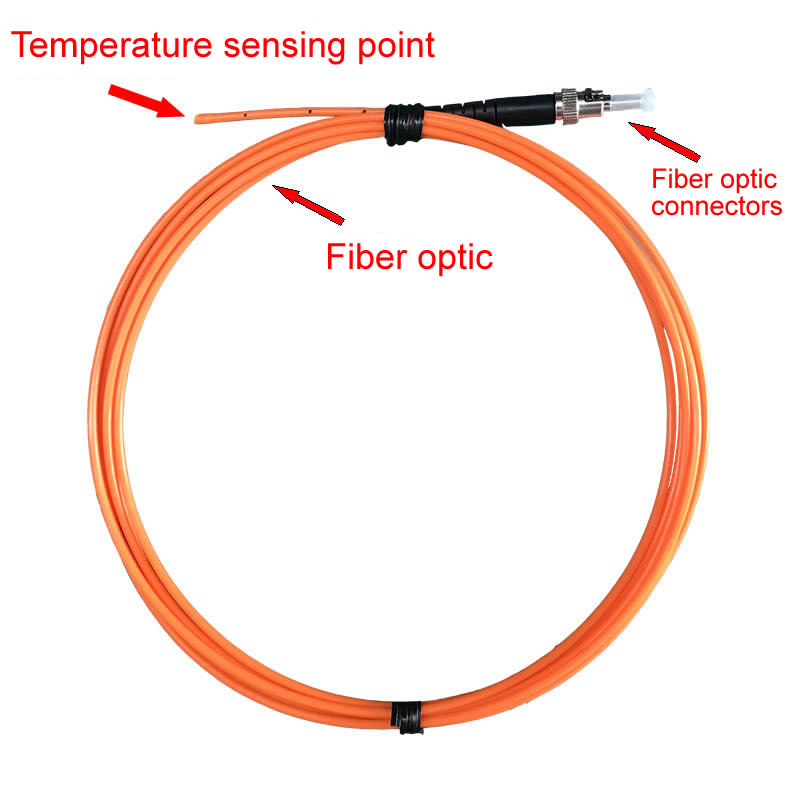
Among the various direct monitoring technologies, Fluorescent Fiber Optic Sensing has emerged as the gold standard due to its stability and simplicity.
The Science of Fluorescence Decay
The technology is based on the “Fluorescence Decay Time” prinsip.
1. An LED light source sends a pulse of blue light down a silica fiber optic cable.
2. This light excites a phosphor sensor material (typically rare-earth doped) at the probe tip.
3. The phosphor fluoresces, emitting a red light.
4. After the excitation pulse ends, the glowing red light decays (fades away).
The crucial physical property is that the rate of decay is perfectly dependent on temperature. Hotter temperatures cause faster decay; cooler temperatures cause slower decay. By measuring this time constant, the system calculates the temperature with high precision (biasanya ±1°C).
15. Why Does the High-Voltage Environment Require Anti-Electromagnetic Interference Temperature Sensors?
The interior of a power transformer is one of the most hostile electromagnetic environments on earth. It contains high electric fields, high magnetic flux, and massive transient switching surges.
The Failure of Electronic Sensors
Conventional electronic sensors (termokopel, RTD, atau termistor) require metal wires to transmit signals. Dalam sebuah transformator, these wires act as antennas. They pick up Interferensi Elektromagnetik (EMI) dan Interferensi Frekuensi Radio (RFI), resulting in noisy, unusable data. Worse, induced currents on these wires can heat the sensor itself, falsifying the reading.
The Optical Advantage
Sensor serat optik kebal terhadap EMI. They transmit light (foton), bukan listrik (electrons). Light is unaffected by magnetic fields. This ensures that the temperature reading remains stable and accurate whether the transformer is at 10% load or experiencing a short-circuit fault current.
16. Are Fluorescent Fiber Optic Sensors Safe in High-Voltage Insulation Environments?

Safety is the paramount concern when introducing any foreign object into a high-voltage winding. The risk is that the sensor cable itself could become a path for electrical tracking (flashover).
Dielectric Integrity of the Sensor
Probe serat optik neon are designed specifically for this challenge.
- Bahan: The fiber is made of high-purity quartz (silica glass), and the jacket is typically made of high-grade PTFE (Teflon) atau MENGINTIP. These are excellent electrical insulators.
- Creepage Distance: The materials are hydrophobic and resistant to oil absorption, preventing the formation of conductive paths along the cable surface.
- Partial Discharge Free: When properly installed in the winding spacers, sensor ini tidak mendistorsi medan listrik dan diuji untuk tetap melakukan Pelepasan Sebagian (PD) bebas hingga tegangan yang sangat tinggi (misalnya, 500kelas kV).
Keamanan dielektrik ini memungkinkan sensor ditempatkan langsung bersentuhan dengan konduktor tegangan tinggi, menjembatani perbedaan potensial antara belitan HV dan dinding tangki yang diarde dengan aman.
17. Does the Fluorescent Fiber Optic Temperature System Require Periodic Calibration and Maintenance?
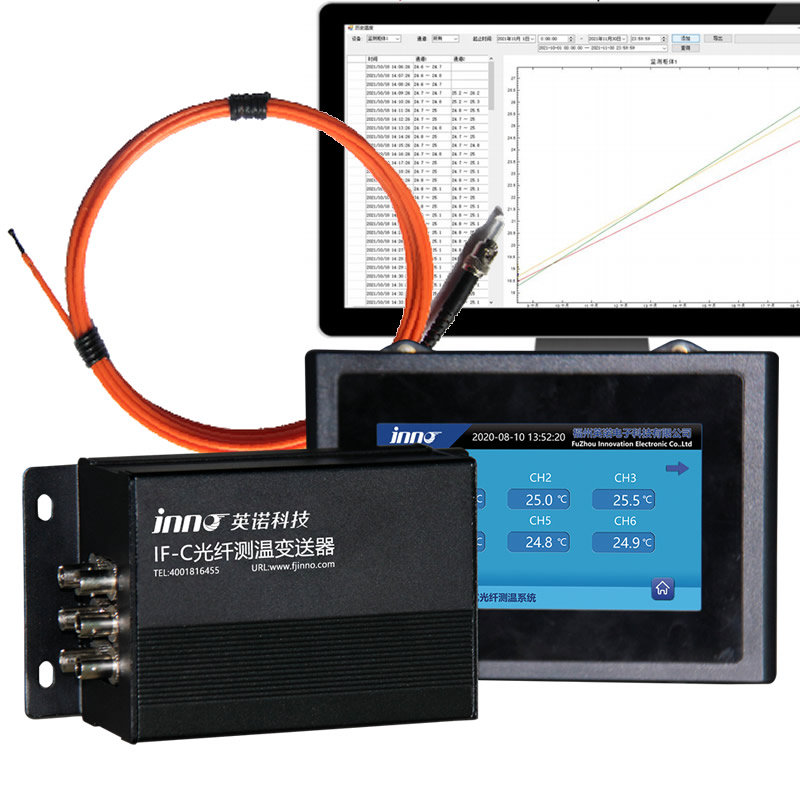
Salah satu keuntungan operasional paling signifikan dari teknologi serat optik neon dibandingkan metode optik yang lebih tua (seperti GaAs atau FBG) adalah stabilitas bawaannya.
Tidak Ada Penyimpangan Kalibrasi
Teknologi lama bergantung pada intensitas cahaya atau pergeseran panjang gelombang, yang dapat dipengaruhi oleh pembengkokan serat, kerugian konektor, atau penuaan sumber cahaya. Sebaliknya, langkah-langkah teknologi neon waktu peluruhan. Karakteristik peluruhan sensor fosfor merupakan sifat fisik dasar material. Itu tidak berubah seiring waktu, juga tidak terpengaruh oleh redaman (peredupan) dari kabel fiber. Karena itu, the system effectively requires tidak ada kalibrasi ulang over its entire service life, making it a true “fit-and-forget” solution for long-term asset monitoring.
18. How to Utilize Precise Temperature Data to Achieve Dynamic Transformer Rating Increases?
The ultimate return on investment (ROI) for a predictive maintenance system lies in Peringkat Dinamis (or Dynamic Loading).
Unlocking Hidden Capacity
Nameplate ratings are conservative. They assume a worst-case scenario (misalnya, 40°C ambient temperature). Namun, if the actual ambient temperature is 10°C, the transformer has significant thermal headroom. Dengan real-time winding temperature data, operators can safely load the transformer above its nameplate rating (misalnya, ke 120% atau 130%) during peak hours, provided the internal hotspot remains within safe limits. This delays the need for capital expenditure on new infrastructure by maximizing the utilization of existing assets.
19. Can Existing Power Transformers be Retrofitted with Fiber Optic Temperature Systems?
While the ideal time to install direct winding sensors is during the manufacturing process (winding phase), retrofitting is a viable option for critical legacy assets.
Retrofitting Strategies
- During Rewind/Refurbishment: If a transformer is sent to a repair shop for coil replacement, installing fiber optic probes into the spacers is a standard upgrade procedure.
- Tank Wall Feed-throughs: To get the signal out of the tank, specialized oil-tight feed-through plates are installed. These can often replace unused bolted flange plates on the tank cover or wall.
- Magnetic External Probes: For units that cannot be opened, fiber optic probes can be magnetically attached to the tank wall or cooling headers to provide immunity to EMI, although this does not provide direct winding visibility.
20. Why Should You Deploy a Transformer Predictive Maintenance Solution Immediately?
The electrical grid is aging, and load profiles are becoming more volatile with the integration of renewable energy and EV charging. Itu “run-to-failure” approach is no longer economically viable or safe. Menerapkan a analitik pemeliharaan prediktif strategy centered around direct optical monitoring transforms your maintenance culture from reactive to proactive.
By detecting thermal faults early, you prevent catastrophic failures, ensure the safety of your workforce, and secure the reliability of the power supply for your customers.
Beyond Transformers: Extended Applications of Our Fluorescent Fiber Optic Technology
Our advanced Fluorescent Fiber Optic Temperature Sensing System is not limited to power transformers. Its unique properties—total immunity to electromagnetic interference, isolasi tegangan tinggi, and microwave transparency—make it the critical solution for a wide range of demanding industrial and medical applications.
Kekuatan & Utility Sector
- Transformer Windings: Direct hotspot monitoring for Oil-Immersed and Dry-Type units.
- saklar & Switchboards: Continuous monitoring of busbar joints, kontak, dan terminasi kabel.
- Large Hydro Turbines: Stator winding and bearing temperature monitoring in high-vibration environments.
- Pemutusan Kabel & Heads: Online temperature monitoring for HV cable joints.
- Unit Utama Cincin (RMU): Plug/bushing temperature monitoring.
- Isolated Busbar Systems: Monitoring enclosed conductive paths.
- IGBT Modules: Precise thermal management for high-power electronics and inverters.
- Circuit Breaker Static Contacts: Detecting oxidation and contact resistance issues.
- GIS (Switchgear Berisolasi Gas): Online hotspot detection inside sealed gas chambers.
Medis & Scientific Research
- RF Hyperthermia Therapy: Monitoring tissue temperature during cancer treatment without interfering with RF fields.
- Microwave Ablation: Precise control for microwave-based medical procedures.
- MRI (Pencitraan Resonansi Magnetik): Patient and equipment monitoring inside the high-magnetic bore.
- NMR (Nuclear Magnetic Resonance): Temperature compensation for high-precision spectrometers.
Industri & Manufaktur Semikonduktor
- ICP Plasma Etching Systems: Wafer temperature control in high-energy plasma fields.
- RIE (Reactive Ion Etching) Sistem: Monitoring inside electrostatic chucks.
- Microwave Digestion Systems: Safety monitoring for chemical analysis equipment.
- Industrial Microwave Heating: Process control for drying, pengobatan, and sintering applications.
- Electro-Explosive Devices (EED): Testing and monitoring in volatile environments.
- High Energy Particle Physics: Monitoring in accelerators and synchrotrons where radiation and electromagnetic fields are extreme.
Ready to Secure Your Critical Assets?
Whether you are managing a fleet of high-voltage transformers or designing the next generation of MRI machines, accurate temperature data is your most valuable asset.
Contact our engineering team today to discuss your specific application requirements and discover how our Sensor Serat Optik Fluoresen dapat memberikan visibilitas yang Anda butuhkan.

Sensor suhu serat optik, Sistem pemantauan cerdas, Produsen serat optik terdistribusi di Cina
 |
 |
 |