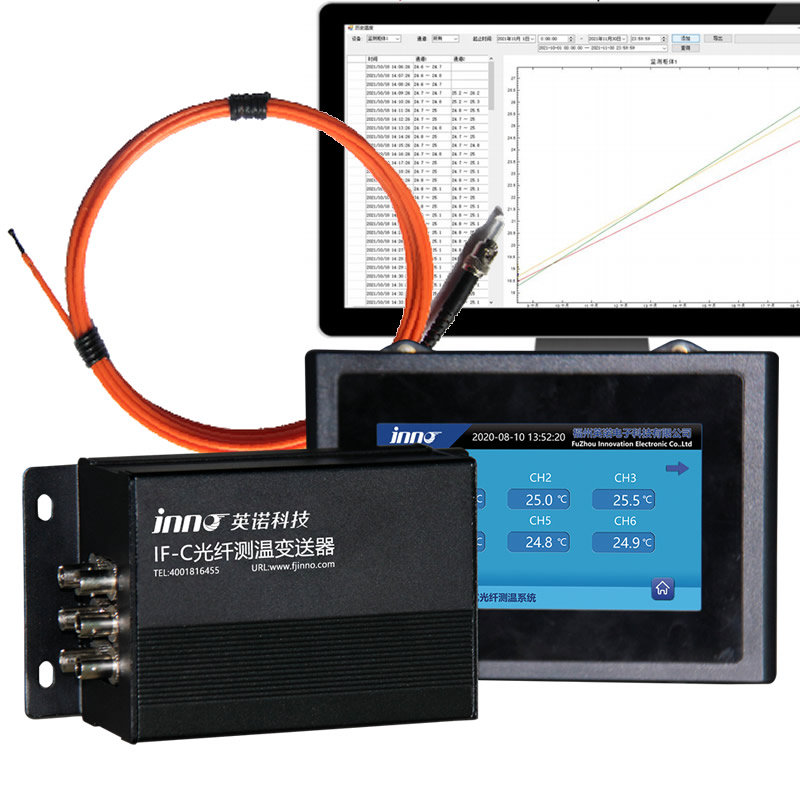
 Sensor suhu serat optik INNO ,sistem pemantauan suhu.
- Sensor suhu serat optik neon mengukur dari −40 °C hingga +250 °C (hingga +300 °C dengan probe yang ditingkatkan), memberikan akurasi ±1 °C untuk peralatan listrik dan switchgear.
- Kisi Serat Bragg (FBG) sensor menutupi −40 °C hingga +300 °C dalam bentuk standar, dan dapat meluas ke +700 °C atau bahkan +1000 °C dengan kisi-kisi yang diregenerasi dan serat berlapis logam.
- Raman mendistribusikan penginderaan suhu (DTS) sistem beroperasi dari −40 °C hingga +300 °C menempuh jarak hingga 30–50 km, ideal untuk pemantauan pipa dan kabel.
- Sistem BOTDA/BOTDR yang brilian berbagi rentang yang serupa −40 °C hingga +300 °C tapi bisa mencapai 100+ km panjang penginderaan.
- Sensor benda hitam serat safir mendorong batas atas melampaui +2000 °C untuk lingkungan industri yang ekstrim.
Daftar isi
- Berapa Kisaran Suhu Serat Optik
- Teknologi Penginderaan Suhu Serat Optik dan Jangkauannya
- Faktor Kunci Yang Menentukan Kisaran Suhu Serat Optik
- Aplikasi Khas pada Rentang Suhu Berbeda
- Cara Memilih Sensor Suhu Serat Optik yang Tepat
- FAQ Tentang Kisaran Suhu Serat Optik
1. Berapa Kisaran Suhu Serat Optik

Kisaran suhu serat optik mengacu pada suhu minimum dan maksimum yang a sensor suhu serat optik dapat mengukur secara akurat dan andal. Spesifikasi ini sangat bervariasi antar teknologi penginderaan yang berbeda, bahan serat, pelapis, dan desain kemasan. Probe serat optik fluoresen yang dirancang untuk pemantauan belitan transformator menangani jendela suhu yang sangat berbeda dari a sensor serat safir dibangun untuk pengujian mesin jet.
Mengapa Kisaran Suhu Menjadi Kriteria Seleksi Pertama
Kisaran suhu secara langsung menentukan apakah sensor dapat beroperasi dengan aman dan akurat di lingkungan target Anda. Memilih sensor dengan jangkauan yang tidak mencukupi menyebabkan kegagalan pengukuran, kehilangan sinyal, atau kerusakan probe permanen. Menentukan rentang secara berlebihan, di sisi lain, often means sacrificing resolution or paying significantly more. Matching your actual operating temperature envelope to the right sensing technology is the most critical step in any pemantauan suhu serat optik project.
What This Article Covers
This guide breaks down the temperature ranges of four mainstream fiber optic sensing technologies, explains the physical and material factors that set those limits, maps each temperature zone to real-world applications, and provides practical selection guidance. Every specification referenced reflects current commercially available products and published industry data.
2. Penginderaan Suhu Serat Optik Technologies and Their Ranges

Sensor Suhu Serat Optik Fluoresen
Sensor suhu serat optik neon (also called fluorescence lifetime decay sensors) work by exciting a phosphor material at the probe tip with a light pulse and measuring the decay time of the resulting fluorescence. This decay time changes predictably with temperature, providing a direct and highly accurate reading.
Standar probe serat optik fluoresen menutupi −40 °C hingga +200 °C. Enhanced versions using optimized phosphor compounds and high-temperature packaging extend the range to +250 °C or +300 °C. Accuracy is typically ±0,5 °C hingga ±1 °C, with response times under 1 Kedua. This is a point-measurement technology — each probe reads temperature at a single location. The key advantage is complete immunity to electromagnetic interference, membuat sensor serat optik neon the standard choice for power transformer winding temperature, suhu kontak switchgear, Dan motor winding monitoring.
Kisi Serat Bragg (FBG) Sensor Suhu
Sensor suhu FBG use a periodic refractive-index structure written into the fiber core. This grating reflects a narrow wavelength of light (panjang gelombang Bragg), which shifts linearly with temperature. By tracking this wavelength shift, the system determines temperature at the grating location.
Standar Sensor FBG operate from −40 °C hingga +300 °C. Dengan kisi-kisi yang dibuat ulang atau ditulis femtodetik dan serat berlapis polimida atau logam, jangkauannya meluas hingga +700 °C Dan, dalam konfigurasi khusus, di luar +1000 °C. Beberapa kisi dapat dimultipleks pada satu serat (pengukuran terdistribusi semu), membuat sistem FBG efisien untuk pemantauan kesehatan struktural. Perhatikan bahwa sensor FBG merespons suhu dan tekanan secara bersamaan, jadi pemisahan yang tepat diperlukan untuk pengukuran termal saja yang akurat.
Penginderaan Suhu Terdistribusi Raman (Raman DTS)

Sistem Raman DTS menyuntikkan pulsa laser ke serat optik dan menganalisis sinyal Raman hamburan balik. Rasio intensitas hamburan anti-Stokes terhadap Stokes Raman bergantung pada suhu, memungkinkan pembuatan profil suhu terus menerus di sepanjang seluruh panjang serat.
Standar Raman DTS sistem mengukur dari −40 °C hingga +300 °C, dibatasi terutama oleh bahan pelapis serat. Penginderaan jarak mencapai 30–50km with spatial resolution of approximately 1 meter. This makes Raman DTS the go-to solution for power cable temperature monitoring, deteksi kebocoran pipa, sistem alarm kebakaran terowongan, and perimeter security. Measurement time per scan ranges from seconds to minutes depending on distance and desired accuracy.
Brillouin Distributed Temperature Sensing (BOTDA/BOTDR)
Brillouin fiber optic sensing measures temperature through the shift in Brillouin scattering frequency, which varies linearly with temperature along the fiber. BOTDA (Brillouin Optical Time Domain Analysis) uses stimulated scattering for higher performance, while BOTDR (Brillouin Optical Time Domain Reflectometry) uses spontaneous scattering for single-ended access.
The temperature range is similar to Raman DTS at −40 °C hingga +300 °C, but Brillouin systems achieve significantly longer sensing distances — often 100 km atau lebih. Like FBG, Hamburan brillouin sensitif terhadap suhu dan regangan, memerlukan teknik pemisahan yang tepat. Sistem ini banyak digunakan untuk pemantauan infrastruktur jarak jauh termasuk kabel bawah laut, bendungan, dan jaringan pipa skala besar.
Tabel Perbandingan Teknologi
| Teknologi | Kisaran Standar | Jangkauan yang Diperluas | Jenis Pengukuran | Akurasi Khas |
|---|---|---|---|---|
| Serat Optik Fluoresen | −40 °C hingga +200 °C | Hingga +300 °C | Titik | ±0,5 °C hingga ±1 °C |
| FBG | −40 °C hingga +300 °C | Hingga +1000 °C | Terdistribusi semu | ±0,5 °C hingga ±2 °C |
| Raman DTS | −40 °C hingga +300 °C | Hingga +700 °C | Didistribusikan sepenuhnya | ±1 °C hingga ±2 °C |
| Brillouin BOTDA/BOTDR | −40 °C hingga +300 °C | Hingga +400 °C | Didistribusikan sepenuhnya | ±1 °C hingga ±2 °C |
3. Faktor Kunci Yang Menentukan Kisaran Suhu Serat Optik
Bahan dan Pelapis Serat
Serat optiknya sendiri terbuat dari silika yang menyatu, yang secara teoritis dapat menahan suhu di atas +1000 °C. Namun, lapisan serat — diterapkan untuk melindungi kaca dari kerusakan mekanis — hampir selalu menjadi faktor pembatas pertama. Penggunaan serat tingkat telekomunikasi standar lapisan akrilat, dinilai untuk −40 °C hingga +85 °C. Serat berlapis polimida memperluas batas atas menjadi kira-kira +300 °C. Serat berlapis logam (aluminium, tembaga, atau emas) mendorongnya lebih jauh ke +500 °C sampai +700 °C. Lebih dari itu, specialty bare or carbon-coated fibers are used in controlled environments.
Sensing Element Limitations
Each sensing technology has inherent physical limits. Fluorescent phosphor compounds lose luminescence efficiency or undergo irreversible changes above their rated temperature. Standard Type I FBG gratings begin to anneal (erase) above approximately +300 °C — regenerated gratings solve this but add complexity. Raman and Brillouin scattering themselves are not temperature-limited, but the fiber they rely on is.
Packaging and Encapsulation Materials
The probe housing, sealing adhesive, protective tubing, and connector materials often impose stricter temperature limits than the fiber or sensing element alone. A stainless steel probe housing can handle much higher temperatures than a plastic connector. For applications above +200 °C, every component in the probe assembly — from the ceramic ferrule ke high-temperature epoxy — must be individually rated for the target range.
Low-Temperature Constraints
At cryogenic temperatures (below −100 °C), standard fiber becomes brittle, phosphor response curves change significantly, and FBG sensitivity drops. Specialized cryogenic calibration, low-temperature adhesives, and protective routing are required for reliable operation in LNG, superconductor, and aerospace applications. Beberapa fiber optic cryogenic sensors are validated down to −200 °C atau bahkan −269 °C (liquid helium temperature).
Environmental Stress Factors
Getaran, kelembaban, paparan bahan kimia, and radiation can all degrade sensor performance within its nominal temperature range over time. For long-term deployment in harsh environments, selecting appropriate protective cable jackets, hermetic seals, and corrosion-resistant probe materials is just as important as matching the temperature specification.
4. Aplikasi Khas pada Rentang Suhu Berbeda
Cryogenic Range: −200 °C to −40 °C
This range covers LNG storage tank monitoring, superconducting magnet cooling systems, cryogenic research facilities, and aerospace fuel systems. Fiber optic sensors offer critical safety advantages in these environments: no electrical spark risk, no interference from strong magnetic fields, and reliable operation in vacuum or inert atmospheres.
Ambient Range: −40 °C hingga +85 °C
Standard telecom-grade fiber handles this range easily at the lowest cost. Typical applications include structural health monitoring for bridges and buildings, data center temperature surveillance, geotechnical monitoring, and environmental sensing. Keduanya Raman DTS Dan sistem FBG are commonly deployed in these scenarios.
Jarak Menengah: +85 °C sampai +250 °C — The Power Industry Sweet Spot

This is the core operating zone for sensor suhu serat optik neon. The most common applications include power transformer winding hot-spot temperature measurement, high-voltage switchgear busbar and contact monitoring, cable joint temperature monitoring, generator and motor winding temperature tracking, and downhole oil and gas well temperature measurement. Fluorescent sensors dominate this zone because they combine high accuracy, complete dielectric isolation, kekebalan elektromagnetik, and proven long-term stability in energized high-voltage environments.
High Range: +250 °C sampai +700 °C
Applications in this zone include heat treatment furnaces, manufaktur kaca, steam turbines, plastic extrusion dies, and high-temperature chemical reactors. High-temperature FBG sensors with polyimide or metal-coated fiber and specialized encapsulation are the primary solution. Some extended-range probe neon juga dapat mencapai ujung bawah zona ini.
Kisaran Ekstrim: Di atas +700 °C
Bilah turbin mesin jet, komponen reaktor nuklir, peleburan baja, dan tungku sintering keramik termasuk dalam kategori ini. Sensor radiasi benda hitam serat safir dapat mengukur suhu di atas +2000 °C. Sistem ini mahal dan terspesialisasi, namun teknologi serat optik tetap menjadi salah satu dari sedikit solusi non-kontak yang layak untuk pengukuran berkelanjutan di lingkungan termal ekstrem seperti itu.
5. Cara Memilih Sensor Suhu Serat Optik yang Tepat

Melangkah 1: Tentukan Amplop Suhu Anda
Identifikasi suhu minimum dan maksimum yang akan ditemui sensor Anda — bukan hanya rentang pengukuran target, tetapi juga kondisi ekstrem yang bersifat ambien dan sementara. Tambahkan margin keamanan minimal 10–20 % melampaui batas maksimal yang Anda harapkan.
Melangkah 2: Tentukan Jenis Pengukuran
Putuskan apakah Anda memerlukan pengukuran satu titik (sensor neon), pengukuran multi titik (sensor FBG), atau pembuatan profil terdistribusi berkelanjutan (Raman DTS atau Sistem brillouin). Sensor titik lebih sederhana dan akurat untuk pemantauan titik panas lokal. Sistem terdistribusi efisien untuk aset linier panjang.
Melangkah 3: Evaluasi Kondisi Lingkungan
Pertimbangkan tingkat interferensi elektromagnetik, paparan bahan kimia, getaran mekanis, kelembaban, dan perutean kabel yang diperlukan. Lingkungan bertegangan tinggi dan EMI tinggi sangat disukai sensor serat optik neon karena serat serba dielektrik menghilangkan loop tanah dan pengambilan interferensi sepenuhnya.
Melangkah 4: Akurasi Saldo, Jarak, dan Anggaran
Akurasi yang lebih tinggi dan jarak penginderaan yang lebih jauh umumnya meningkatkan biaya sistem. Sensor titik fluoresen menawarkan rasio akurasi terhadap biaya terbaik untuk pengukuran lokal pada suhu −40 °C hingga +250 kisaran °C. Raman DTS memberikan nilai terbaik untuk pemantauan terdistribusi selama beberapa kilometer. FBG offers a good middle ground for multi-point installations where distance and temperature demands are moderate.
6. FAQ Tentang Kisaran Suhu Serat Optik
Q1: What is the maximum temperature a fiber optic sensor can measure?
Sapphire fiber blackbody radiation sensors can measure temperatures exceeding +2000 °C. For more common technologies, FBG sensors with regenerated gratings reach up to +1000 °C, while standard fluorescent and Raman systems top out around +300 °C.
Q2: Can fiber optic sensors work at cryogenic temperatures?
Ya. Specialty fiber optic sensors with cryogenic-rated materials and calibration can operate reliably down to −200 °C and, in some laboratory configurations, as low as −269 °C (liquid helium temperature).
Q3: What limits the temperature range of a fiber optic sensor?
The primary limiting factors are the fiber coating material, the sensing element properties (phosphor stability, grating annealing threshold), and the packaging materials (adhesives, housings, konektor). The silica fiber itself can withstand over +1000 °C.
Q4: Which fiber optic sensor is best for transformer temperature monitoring?
Sensor suhu serat optik neon are the industry standard for transformer winding hot-spot monitoring. They provide ±1 °C accuracy, full electromagnetic immunity, and complete dielectric isolation in the −40 °C to +250 °C range required for oil-immersed and dry-type transformers.
Q5: What is the temperature range of a standard Raman DTS system?
Most commercial Raman DTS systems operate from −40 °C to +300 °C, depending on the sensing cable construction. The fiber coating type (acrylate, polimida, atau logam) determines the actual upper limit.
Q6: Do FBG sensors measure temperature and strain at the same time?
FBG sensors are inherently sensitive to both temperature and strain. For accurate temperature-only measurement, strain must be decoupled through mechanical isolation of the grating or by using a reference grating that is strain-free.
Q7: How does fiber coating type affect temperature range?
Acrylate coating is rated to approximately +85 °C, polyimide coating to +300 °C, and metal coatings (aluminium, tembaga, gold) ke +500 °C–+700 °C. Selecting the right coating is essential for matching the sensor to your operating temperature.
Q8: Can I use a single fiber optic system for both high and low temperature zones?
Distributed systems like Raman DTS and Brillouin BOTDA measure the full temperature profile along the fiber, sehingga satu sistem dapat mencakup bagian-bagian pada suhu yang berbeda — selama setiap titik berada dalam rentang pengenal sistem dan kabel penginderaan diberi nilai yang sesuai pada setiap bagian.
Q9: Seberapa akurat sensor suhu serat optik dibandingkan dengan termokopel?
Sensor serat optik fluoresen mencapai ±0,5 °C hingga ±1 °C, sebanding atau lebih baik dari termokopel tipe K standar. Keuntungan utama dari sensor serat optik bukan hanya akurasi tetapi juga kekebalan terhadap interferensi elektromagnetik, yang dapat menyebabkan kesalahan signifikan dalam pembacaan termokopel di lingkungan bertegangan tinggi.
Q10: Perawatan apa yang dibutuhkan sensor suhu serat optik?
Sensor serat optik memerlukan perawatan minimal. Tidak ada suku cadang yang dapat dikonsumsi, tidak ada kalibrasi ulang karena penyimpangan EMI, and no degradation from electrical surges. Periodic inspection of fiber connectors for contamination and verification of calibration at scheduled intervals are the main maintenance tasks.
Penafian: The information provided in this article is for general reference purposes only. Specific temperature ranges, spesifikasi akurasi, dan kesesuaian aplikasi berbeda-beda menurut produsen, product model, and deployment conditions. Always consult the product datasheet and the manufacturer’s engineering team before making purchasing or installation decisions. FJINNO (www.fjinno.net) assumes no liability for any decisions made based on the content of this article.

Sensor suhu serat optik, Sistem pemantauan cerdas, Produsen serat optik terdistribusi di Cina
 |
 |
 |