 INNO फाइबर ऑप्टिक तापमान सेंसर ,तापमान निगरानी प्रणाली.
- Core monitoring functions of transformer comprehensive online monitoring systems, including oil dissolved gas analysis (डीजीए), आंशिक निर्वहन (पी.डी.) का पता लगाने, and temperature sensing
- Synergistic application of multi-parameter monitoring to enhance fault diagnosis accuracy for oil-immersed transformer online surveillance
- Technical principles, implementation methods, and performance indicators of integrated transformer online monitoring solutions
- Practical application cases and best practices for transformer all-in-one online monitoring platforms
2. तेल में घुली गैस का विश्लेषण (डीजीए) for Transformer Comprehensive Online Monitoring Systems
2.1 Basic Principles of DGA in Transformer Online Surveillance
Oil dissolved gas analysis (डीजीए) is a cornerstone function of oil-immersed transformer online DGA monitors. It leverages the characteristic that insulating oil and solid insulation materials decompose into specific gases under thermal or electrical stress. When internal faults (जैसे, overheating, आंशिक निर्वहन) occur in transformers, gases such as hydrogen (एच₂), मीथेन (सीएच₄), ईथीलीन (C₂H₄), एसिटिलीन (C₂H₂), कार्बन मोनोआक्साइड (सीओ), और कार्बन डाइऑक्साइड (CO₂) are released and dissolved in the oil. By analyzing the composition and concentration of these dissolved gases, transformer DGA online monitoring devices can identify fault types and severity at an early stage.
Different fault modes produce distinct gas profiles: local discharge primarily generates H₂ and CH₄; low-temperature overheating (<300℃) emits CH₄ and ethane (C₂H₆); mid-temperature overheating (300-700℃) focuses on C₂H₄; high-temperature overheating (>700℃) produces C₂H₄ and trace C₂H₂; and arcing discharge releases large amounts of C₂H₂ and H₂. इसके अतिरिक्त, नमी (H₂O) content is a critical supplementary indicator, as excess moisture degrades insulation performance and accelerates aging.
2.2 Implementation Methods of Transformer DGA Online Monitoring Devices
आधुनिक integrated transformer DGA monitoring systems primarily use two technical routes: गैस क्रोमैटोग्राफी (जीसी) and infrared spectroscopy (और). Advanced systems adopt carrier-gas-free DGA technology, enabling real-time monitoring of key gas concentrations with sampling intervals as short as minutes—far faster than traditional offline testing (3-6 month cycles).
The implementation process includes four key steps:
- Gas Sampling & Separation: Specialized sampling modules extract dissolved gases from transformer oil. Gas chromatography columns separate mixed gases into individual components for sequential detection.
- गैस का पता लगाना: Separated gases are quantified via detectors like thermal conductivity detectors (टीसीडी) for H₂ and oxygen (O₂), and flame ionization detectors (खूंटी) for hydrocarbon gases (सीएच₄, C₂H₄, C₂H₆, C₂H₂).
- Data Analysis & Processing: Detector signals are converted to digital data, analyzed via algorithms to calculate gas concentrations, and compared against standard thresholds to assess transformer status.
- Result Display & Alarming: Processed data is visualized on monitoring interfaces. transformer online DGA alarms trigger multi-level alerts (चेतावनी, गंभीर) when gas concentrations exceed preset limits, prompting maintenance teams to act.
Cutting-edge laser-based DGA monitors for transformers use tunable lasers to scan specific gas absorption peaks. Based on Beer-Lambert’s Law (absorption intensity proportional to concentration), they achieve high-selectivity detection, significantly improving sensitivity and accuracy. Some advanced systems also integrate oil moisture, dielectric loss, and particle count monitoring to comprehensively evaluate insulation oil condition.
2.3 Performance Indicators of Transformer DGA Online Sensors
The accuracy of transformer DGA online monitoring equipment directly impacts fault diagnosis reliability. Key technical indicators for modern systems include:
- डिटेक्शन रेंज & संवेदनशीलता: Typical concentration range is 0-1000 μL/L (पीपीएम). For critical gases like C₂H₂, sensitivity reaches 0.1 μL/L or lower, enabling early detection of latent faults.
- मापन सटीकता: Generally controlled within ±5% for most gases; relative deviation up to ±20% for low-concentration gases (जैसे, <5 μL/L C₂H₂).
- repeatability: Variation in repeated measurements of the same oil sample is <3%, ensuring data consistency.
- Analysis Cycle: Ranges from minutes to hours, far faster than offline methods (hours to days).
- तापमान & Pressure Compensation: Automatic calibration for gas solubility changes due to transformer operating temperature and pressure, ensuring accuracy under varying conditions.
These high-precision indicators allow oil-immersed transformer DGA online systems to capture minute internal changes—for example, detecting gas variations caused by a 20-30℃ temperature rise, which is unachievable with traditional offline testing.
3. आंशिक निर्वहन (पी.डी.) Detection for Integrated Transformer Online Monitoring Solutions
3.1 Principles of Transformer PD Online Monitoring Modules
आंशिक निर्वहन (पी.डी.) refers to localized breakdown in transformer insulation systems where the electric field exceeds the dielectric strength, without forming a贯穿性 (through-going) चैनल. While PD does not immediately cause insulation failure, long-term exposure erodes materials, eventually leading to complete breakdown. Transformer partial discharge online detection modules detect PD by monitoring physical phenomena generated during discharge:
- Electrical Pulse Signals: PD produces high-frequency current pulses (kHz to MHz range) detectable via high-frequency current transformers (एचएफसीटी) installed on transformer ground wires or bushing taps.
- Electromagnetic Wave Signals: PD emits electromagnetic radiation (tens to hundreds of MHz). Ultra-high frequency (यूएचएफ) PD sensors for transformers capture these signals for detection and localization.
- Ultrasonic Signals: PD-induced mechanical vibrations generate acoustic waves (kHz to MHz), detected by ultrasonic sensors mounted on transformer tank walls.
- Optical Signals: High-energy PD emits weak light, detectable via fiber optic PD sensors for transformers—ideal for high-electromagnetic-interference (ईएमआई) environments.
- Chemical Changes: PD decomposes insulation materials into gases (जैसे, एच₂, सीएच₄), which aligns with DGA data for cross-validation.
The primary goal of transformer PD online monitoring systems is early detection of insulation defects, assessment of insulation condition, and prediction of insulation life—addressing gaps in DGA, which may miss non-pulsed PD stages that do not generate gas.
3.2 Technical Routes for Transformer PD Online Monitoring Equipment
Common implementation methods for integrated transformer PD online surveillance शामिल करना:
3.2.1 Pulse Current Method (आईईसी 60270 Compliant)
This is the foundational PD detection method. Transformer PD pulse current sensors (जैसे, Rogowski coils) installed on bushing taps or core ground wires capture nanosecond-scale pulses. When insulation defects generate micro-discharges, electromagnetic pulses propagate through the circuit, and sensors extract signals via electromagnetic coupling. Sensitivity reaches 50 पीसी, suitable for detecting weak discharges in cable joints and switchgear.
3.2.2 Ultra-High Frequency (यूएचएफ) Detection
Transformer UHF PD monitoring systems use UHF sensors (300 MHz-3 GHz) to receive electromagnetic waves from PD. Key advantages include strong anti-interference (site interference concentrates in low frequencies) और उच्च संवेदनशीलता (1-5 पीसी). UHF technology excels at locating PD sources, critical for identifying internal insulation defects.
3.2.3 Ultrasonic (ध्वनिक उत्सर्जन, ऐ) Detection
Transformer ultrasonic PD sensors capture mechanical vibrations from PD. Gas ionization during discharge causes local expansion, generating acoustic waves. Time-of-flight or phase analysis localizes discharge points. This method offers strong EMI resistance, ideal for complex electromagnetic environments, though sensitivity is lower (50-100 पीसी) compared to UHF.
3.2.4 Transient Earth Voltage (TEV) Detection
Transformer TEV PD monitors measure high-frequency transient signals radiated from equipment surfaces, enabling non-intrusive online detection. Easy to install, TEV is suitable for switchgear but has limited detection range, making it a supplementary method for transformers.
आधुनिक transformer comprehensive PD online systems adopt multi-technology fusion—e.g., “electrical-acoustic combined detection”—simultaneously capturing current pulses and acoustic signals. Upper-layer software calculates discharge amplitude, आवृत्ति, और स्थान, delivering comprehensive PD monitoring. This fusion enhances accuracy and reduces false alarms.
3.3 Localization Capabilities of Transformer PD Online Sensors
PD localization is critical for targeted maintenance. Transformer PD online localization systems achieve varying precision via different methods:
- Single-Point Localization: Time-delay methods using single sensors offer precision of 5-10% of transformer dimensions.
- Multi-Sensor Array Localization: Time-of-Arrival (TOA) or Direction-of-Arrival (DOA) with multi-sensor arrays achieves centimeter-level precision.
- Electrical-Acoustic Combined Localization: Fusing electrical and acoustic signals reduces error to 10-20 सेमी, ideal for large transformers.
उन्नत सिस्टम का उपयोग electromagnetic time reversal (EM TR) तकनीकी—capturing PD signals from both winding ends, reversing the time axis to precisely localize sources, achieving millimeter-level precision under ideal conditions. इसके अतिरिक्त, phase-resolved partial discharge (पीआरपीडी) विश्लेषण और phase-resolved pulse sequence (PRPS) विश्लेषण automatically identify discharge types (जैसे, floating discharge, void discharge) by comparing with defect pattern libraries, aiding fault root-cause analysis.
4. Temperature Monitoring for Transformer All-in-One Online Monitoring Platforms

4.1 Principles of Transformer Online Temperature Sensing Systems
Temperature is a critical indicator of transformer health—excessive heat accelerates insulation aging and increases failure risk. Transformer online temperature monitoring systems operate on heat balance principles और heat transfer laws: during operation, transformer losses (iron, ताँबा, stray) convert to heat, dissipated via conduction, convection, and radiation. When heat generation equals dissipation, temperature stabilizes.
Key temperature parameters monitored by oil-immersed transformer temperature online sensors शामिल करना:
- शीर्ष तेल तापमान: Reflects overall heat dissipation and load conditions; the most commonly monitored parameter.
- Winding Hot-Spot Temperature: The highest temperature in windings (typically mid-upper section), the primary factor influencing insulation aging.
- कोर तापमान: Abnormal core temperature indicates faults like core short circuits or multi-point grounding.
- Oil Temperature Rise: Difference between top oil and ambient temperature, reflecting heat dissipation capacity and load levels.
- Winding Temperature Rise: Difference between winding and ambient temperature, critical for assessing load capacity.
Per thermodynamics, insulation aging rate follows an exponential relationship with temperature—every 8-10℃ increase doubles aging speed. Thus, precision transformer temperature online monitors are essential for extending equipment lifespan.
4.2 Technical Routes for Transformer Online Temperature Sensors
4.2.1 Contact Temperature Sensing
- Platinum Resistance Temperature Detectors (आरटीडी): Based on resistance-temperature characteristics (जैसे, पीटी100: 100Ω at 0℃). Transformer Pt100 online sensors उच्च सटीकता प्रदान करें (±0.1-0.5℃) and stability, ideal for long-term monitoring.
- थर्मोकपल्स: Utilize the Seebeck effect (voltage from temperature differences). Wide temperature range but lower accuracy (±1-2℃), suitable for high-temperature zones.
- थर्मिस्टर: Semiconductor-based with high sensitivity but poor linearity; limited to specific temperature ranges.
4.2.2 फाइबर ऑप्टिक तापमान संवेदन
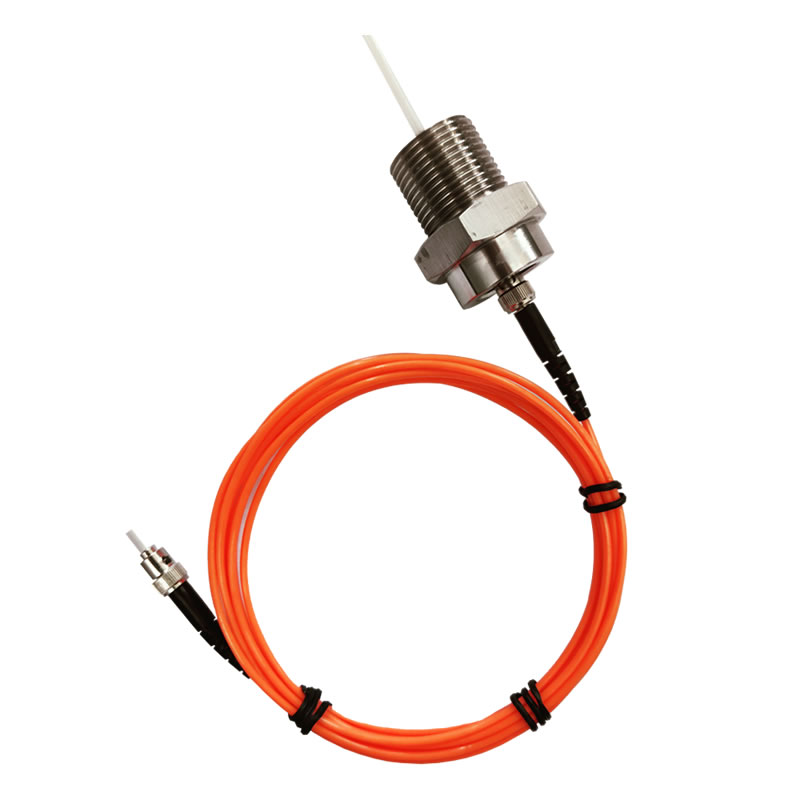
- फ्लोरोसेंट फाइबर ऑप्टिक सेंसर: Transformer fluorescent fiber temperature monitors use temperature-sensitive fluorescent materials. When excited by specific wavelengths, fluorescence decay time correlates strictly with temperature. Advantages include strong EMI resistance and high accuracy (±0.5℃), perfect for high-voltage environments.
- फाइबर ब्रैग ग्रेटिंग (डीसीएफ) सेंसर: Transformer FBG temperature sensors rely on refractive index changes in FBGs with temperature. Accuracy reaches ±1℃, enabling distributed monitoring.
- वितरित फाइबर ऑप्टिक सेंसर: Use optical time-domain reflectometry (ओटीडीआर) for continuous temperature mapping along fibers. स्थानिक संकल्प <1एम, accuracy ±1-2℃, suitable for large-area monitoring (जैसे, घुमावदार, cores).
4.2.3 Non-Contact Temperature Sensing
Transformer infrared temperature cameras measure surface temperature via infrared radiation. Easy to use but limited to external surfaces (cannot detect internal winding/core temperature) and susceptible to environmental interference (धूल, नमी).
4.2.4 Indirect Winding Hot-Spot Temperature Calculation
- Current Thermal Effect Method: Calculates winding temperature by combining load current, top oil temperature, and winding resistance-temperature characteristics.
- Model-Based Calculation: Uses thermal transfer equations and parameters (top oil temperature, load current, परिवेश का तापमान) to estimate hot-spot temperature via transformer thermal models.
आधुनिक integrated transformer temperature online systems combine multiple technologies—e.g., Pt100 for top oil temperature, fluorescent fiber optics for winding hot spots, and infrared for external巡检 (patrols)—creating a multi-layered monitoring network.
4.3 Performance of Transformer Online Temperature Monitoring Equipment
Key performance indicators for transformer temperature online monitoring devices शामिल करना:
- तापमान की रेंज: -40℃ to +150℃, covering normal operation and extreme conditions.
- शुद्धता: ±1℃ for top oil temperature, ±2℃ for winding hot spots (±0.5℃ with fiber optic direct measurement), ensuring reliable insulation aging assessment.
- प्रतिक्रिया समय: ≤1 minute for rapid detection of abnormal temperature rises.
- दीर्घकालिक स्थिरता: Annual drift ≤±0.5℃, guaranteeing data reliability over years.
डिजिटल transformer temperature online sensors include built-in temperature compensation and linearization, outputting digital data directly to reduce EMI-induced errors in analog signal transmission.
5. Synergistic Application of Transformer Comprehensive Online Monitoring Systems
5.1 Synergy Principles of Multi-Parameter Transformer Online Monitoring
का मान है transformer comprehensive online monitoring platforms lies in synergistic multi-function integration, combining data from DGA, पी.डी., and temperature monitoring to deliver comprehensive, accurate status assessments. Key synergy principles include:
- Information Complementarity: DGA reflects long-term insulation degradation; PD detects real-time insulation defects; temperature monitors load and heat dissipation. Together, they address blind spots of single-parameter monitoring.
- Time-Scale Synergy: PD responds to short-term changes; DGA reflects long-term trends; temperature bridges both. This temporal coverage captures fault evolution from initiation to development.
- Spatial-Scale Synergy: PD offers high spatial resolution (cm-level localization); temperature maps regional heat distribution; DGA provides global status. This spatial hierarchy pinpoints fault locations and assesses impact ranges.
- Physical Phenomenon Correlation: PD causes gas generation (डीजीए) and local heating (तापमान); overheating accelerates PD and insulation aging. Analyzing these correlations deepens understanding of fault mechanisms.
5.2 Data Fusion for Transformer All-in-One Online Monitoring
Transformer online monitoring data fusion systems integrate multi-source data via advanced methods:
- Threshold-Based Alarm: Multi-level thresholds for each parameter (जैसे, डीजीए: C₂H₂ >5 μL/L (चेतावनी), पी.डी.: >1000 पीसी (खतरे की घंटी), तापमान: >130℃ (गंभीर)) trigger coordinated alerts.
- प्रवृत्ति विश्लेषण: Statistical methods, time-series models, and machine learning (जैसे, linear regression, LSTM) identify abnormal trends—e.g., simultaneous H₂ increase (डीजीए), rising PD amplitude, and 5℃ hot-spot temperature rise indicate developing insulation defects.
- सहसंबंध विश्लेषण: Quantify relationships between parameters (जैसे, PD amplitude vs. H₂ concentration, hot-spot temperature vs. load current) to identify abnormal correlations.
- पैटर्न मान्यता: Expert systems, neural networks, and deep learning match multi-parameter patterns to known fault models—e.g., “high C₂H₂ (डीजीए) + high PD (यूएचएफ) + local hot spot (तापमान)” = arcing discharge.
- Multi-Variate Statistical Analysis: Principal Component Analysis (PCA) and Partial Least Squares-Discriminant Analysis (PLS-DA) reduce data dimensionality, extracting key features for efficient diagnosis.
आधुनिक पद्धतियों का प्रयोग edge-cloud hybrid architectures: edge devices process real-time data for instant alerts; cloud platforms store historical data for deep analysis (जैसे, remaining life prediction), balancing speed and depth.
5.3 Application Cases of Synergistic Transformer Online Monitoring
5.3.1 Winding Hot-Spot & PD Co-Monitoring
मामला: ए 220 kV transformer showed abnormal DGA (total hydrocarbons: 200 μL/L, dominant CH₄/C₂H₄), moderate PD (500 पीसी), and 15℃ higher winding hot-spot temperature. Synergistic analysis diagnosed local winding overheating from poor wire soldering, causing insulation degradation and PD. कार्रवाई: Prompt repair of soldering joints prevented winding short circuits.
5.3.2 Core Multi-Point Grounding Diagnosis
मामला: ए 110 kV transformer had abnormal core ground current (0.5 ए, normal ≤0.1 A), slight DGA (H₂/CH₄ increase), and 10℃ higher core temperature. Synergistic analysis identified core multi-point grounding from metal debris, causing circulating currents, स्थानीय अति ताप, and oil decomposition. कार्रवाई: Debris removal restored normal ground current and gas levels.
5.3.3 Cooling System Fault Detection
मामला: ए 500 kV transformer had 15℃ rapid top oil temperature rise, slight DGA (H₂/CH₄ increase), and no PD anomalies. Synergistic analysis pinpointed cooling fan failure, reducing heat dissipation. कार्रवाई: Fan replacement restored normal temperature and gas levels.
These cases demonstrate that synergistic transformer comprehensive online monitoring improves diagnosis accuracy by 20-30% and reduces false alarms by >50%, critical for reliable transformer operation.
6. Technical Trends & Application Guidelines for Transformer Online Monitoring Systems
6.1 Innovation Trends in Transformer Online Monitoring Technology
- मल्टी-सेंसर फ़्यूज़न: Integrating vibration, शोर, oil particle count, and moisture monitoring into transformer multi-parameter online systems for holistic status assessment.
- High-Precision Sensors: Quantum sensors for single-photon PD detection, and nanomaterial-based DGA sensors for ultra-low concentration gas measurement.
- ऐ & Big Data: Deep learning for fault prediction (जैसे, LSTM for insulation aging), and digital twins for virtual monitoring and maintenance simulation.
- Edge-Cloud Computing: Edge devices for real-time AI inference; cloud platforms for big data analytics and global fleet management.
- मानकीकरण: Adopting IEC 61850, Modbus, and OPC UA for interoperability between multi-vendor transformer online monitoring systems.
6.2 Application Guidelines for Transformer Online Monitoring Solutions
To maximize value from transformer comprehensive online monitoring systems, follow these guidelines:
- चरणबद्ध कार्यान्वयन: चरण 1: Deploy DGA and temperature monitoring; चरण 2: Add PD detection; चरण 3: Integrate with substation automation systems.
- Differentiated Deployment: Full monitoring for critical assets (जैसे, 500 केवी ट्रांसफार्मर); basic monitoring for non-critical units (जैसे, 110 केवी ट्रांसफार्मर).
- Data-Driven Maintenance: Use monitoring data to shift from scheduled to condition-based maintenance, reducing costs by 30-40%.
- Skill Development: Train personnel on sensor calibration, डेटा विश्लेषण, and fault diagnosis to leverage system capabilities.
- Cyber Security: Implement encryption, access control, and intrusion detection to protect connected transformer online monitoring systems from cyber threats.
By following these guidelines, utilities and industrial users can fully leverage transformer comprehensive online monitoring technology to enhance reliability, उपकरण जीवन का विस्तार करें, and optimize maintenance costs.

फाइबर ऑप्टिक तापमान सेंसर, बुद्धिमान निगरानी प्रणाली, चीन में वितरित फाइबर ऑप्टिक निर्माता
 |
 |
 |