 INNO फाइबर ऑप्टिक तापमान सेंसर ,तापमान निगरानी प्रणाली.
When selecting fluorescent fiber optic temperature measurement systems, focus on these 5 key specifications:
1️⃣ Temperature Range (-200डिग्री सेल्सियस से +300 डिग्री सेल्सियस) – Determines suitability for extreme environments like cryogenics or high-voltage substations
2️⃣ Accuracy (±0.5°C सामान्य) – Enabled by measuring fluorescent material’s decay time (प्रकाश की तीव्रता नहीं), eliminating LED drift errors
3️⃣ Response Time (<1 सेकंड) – Critical for real-time monitoring in power transformer hotspots
4️⃣ Fiber Type (POF/Glass) – Plastic Optical Fiber (POF) offers flexibility for industrial machinery, while glass fibers suit high-temperature zones
5️⃣ EMI Immunity – इलेक्ट्रॉनिक सेंसर के विपरीत, fluorescence-based systems ignore electromagnetic interference in substations
Pro Tip: Prioritize systems with ATEX/IECEx certifications for explosive environments.
Article Outline
- फ्लोरोसेंट फाइबर ऑप्टिक थर्मोमेट्री: काम के सिद्धांत & मुख्य लाभ
- वितरित तापमान संवेदन (डीटीएस) प्रणाली: Technology Breakdown & औद्योगिक अनुप्रयोग
- फाइबर ब्रैग झंझरी (डीसीएफ) सेंसर: Multi-Point Monitoring Capabilities
- Critical Specifications Comparison: Accuracy vs. लागत बनाम. प्रतिक्रिया समय
- कार्यान्वयन मार्गदर्शिका: Matching Systems to Your Industry Needs
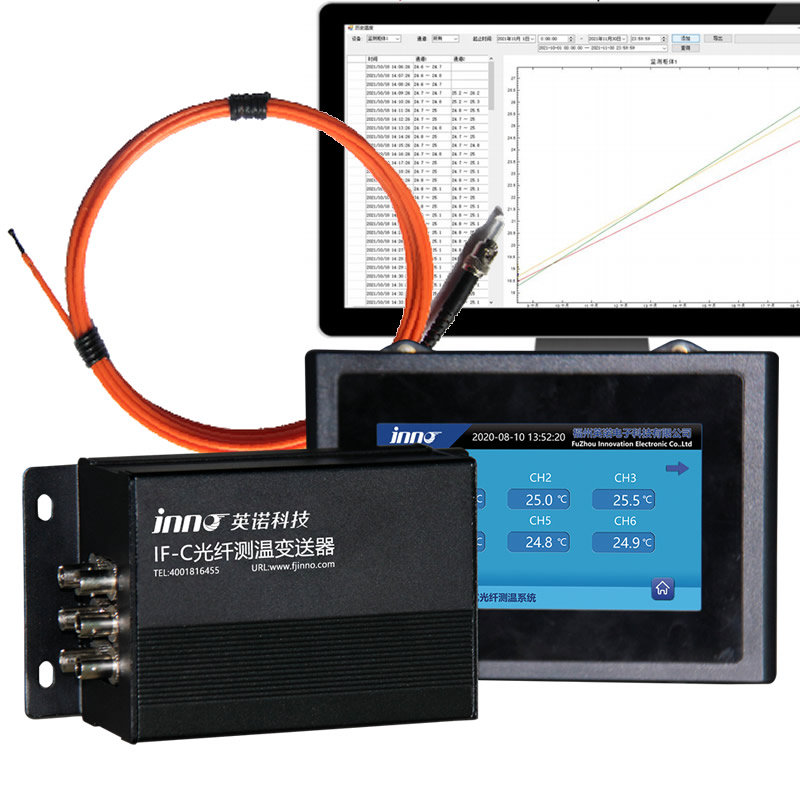
1. फ्लोरोसेंट फाइबर ऑप्टिक थर्मोमेट्री
काम के सिद्धांत
This technology measures temperature through fluorescence lifetime decay analysis. Specially engineered phosphor coatings at fiber tips emit time-sensitive fluorescent signals when excited by light pulses. The exponential decay rate of this emission directly correlates with temperature, providing drift-free measurements unaffected by light intensity variations.
प्रमुख विशेषताऐं
- High-Density Monitoring: तक सिंगल सिस्टम सपोर्ट करता है 64 मापन अंक
- Custom Probe Configurations: Application-specific designs for complex geometries
- Decade-Long Stability: No recalibration needed for over 10 साल
तकनीकी मापदंड
| पैरामीटर | मानक | विस्तारित रेंज |
|---|---|---|
| तापमान की रेंज | -50डिग्री सेल्सियस से +300 डिग्री सेल्सियस | -200डिग्री सेल्सियस से +300 डिग्री सेल्सियस |
| सिस्टम क्षमता | 16 चैनल | 64 चैनल |
| Long-Term Accuracy | ±0.3°C/year | ±0.1°C/year |
| Probe Options | Surface-mounted/Embedded/Immersion types | |
अनुप्रयोग फ़ील्ड
- विद्युत अवसंरचना
- 20+ year winding temperature monitoring in oil-free transformers
- Continuous assessment of generator stator bars
- Underground cable joint thermal profiling
- अनुसंधान & विकास
- Material characterization in climate chambers (-190डिग्री सेल्सियस से +300 डिग्री सेल्सियस)
- Thermal validation of battery prototype assemblies
- Vacuum chamber monitoring for space simulation tests
- Advanced Manufacturing
- Additive manufacturing process thermal control
- Composite curing oven temperature uniformity verification
- Semiconductor etching bath thermal management
केस स्टडी: Materials Testing Laboratory
A nanotechnology institute implemented 64-channel fluorescent monitoring:
- Simultaneous tracking of 32 thermal chamber zones
- 0.1°C resolution for graphene synthesis experiments
- Reduced thermal validation time by 55%
2. वितरित तापमान संवेदन (डीटीएस)

काम के सिद्धांत
DTS utilizes Raman scattering effects in optical fibers. Laser pulses sent through the fiber generate backscattered light, where the anti-Stokes component’s intensity is temperature-dependent. By analyzing time-domain reflections, the system calculates temperature profiles along the entire fiber length with meter-level spatial resolution.
प्रमुख विशेषताऐं
- Continuous Spatial Monitoring: Up to 30km coverage per channel
- Harsh Environment Survival: Operates in radiation/EMI-intensive zones
- Self-Diagnosis: Automatic fiber breakage detection & जगह
तकनीकी मापदंड
| पैरामीटर | मानक | विकसित |
|---|---|---|
| तापमान की रेंज | -40डिग्री सेल्सियस से +120 डिग्री सेल्सियस | -60डिग्री सेल्सियस से +300 डिग्री सेल्सियस |
| स्थानिक संकल्प | 1.0एम | 0.25एम |
| मापन समय | 30s/km | 5s/km |
| फाइबर प्रकार | Single-mode/Multi-mode with polyimide coating | |
अनुप्रयोग फ़ील्ड
- ऊर्जा अवसंरचना
- Underground power cable thermal rating (40km+ monitoring)
- BESS temperature profiling in grid-scale battery systems
- Hydrogen pipeline leak detection via temperature anomalies
- परिवहन
- Tunnel fire detection along 25km+ highway routes
- Rail track hot box detection for freight trains
- Airport runway ice monitoring systems
- पर्यावरण निगरानी
- Landslide early warning through soil temperature gradients
- Subsea cable monitoring across 50km ocean spans
- Geothermal well integrity assessment
केस स्टडी: Data Center Thermal Management
A hyperscale data center deployed DTS for cold aisle containment:
- 12km sensing fiber along server racks
- Identified 37 cooling inefficiency zones
- हासिल किया 15% PUE improvement
3. फाइबर ब्रैग झंझरी (डीसीएफ) प्रणाली
काम के सिद्धांत
FBG technology detects temperature changes through wavelength shift analysis. Each grating inscribed in the fiber reflects specific wavelengths (λ_B), which linearly shift (~10pm/°C) with temperature variations. Multiple gratings along a single fiber enable simultaneous multi-point measurements through wavelength division multiplexing (डब्ल्यूडीएम).
प्रमुख विशेषताऐं
- High-Speed Sampling: 100Hz refresh rate for dynamic processes
- स्केलेबल आर्किटेक्चर: 200+ sensors per system
- Strain-Temperature Decoupling: Dual-parameter measurement capability
तकनीकी मापदंड
| पैरामीटर | मानक | High-Density |
|---|---|---|
| तापमान की रेंज | -40डिग्री सेल्सियस से + 150 डिग्री सेल्सियस | -60डिग्री सेल्सियस से +400 डिग्री सेल्सियस |
| चैनल | 16 | 64 |
| शुद्धता | ±1.0°C | ± 0.2 ° C |
| Wavelength Range | 1520-1570एनएम (ITU-T compatible) | |
अनुप्रयोग फ़ील्ड
- एयरोस्पेस
- Real-time turbine blade temperature mapping in jet engines
- Structural health monitoring of reusable launch vehicles
- Hypersonic vehicle thermal protection system validation
- Energy Systems
- Nuclear reactor core temperature profiling (600+ अंक)
- Dynamic load monitoring of wind turbine gearboxes
- Hydrogen fuel cell stack thermal management
- Biomedical Engineering
- In-vivo temperature monitoring during RF ablation
- Sterilization process validation in autoclaves
- Wearable physiological monitoring devices
केस स्टडी: Smart Grid Monitoring
A national grid operator implemented FBG systems for 380kV GIS monitoring:
- 84 sensors per substation with 5ms response time
- का पता चला 92% of partial discharge events via thermal anomalies
- Reduced maintenance costs by $1.2M annually
4. System Selection Matrix
सटीकता संबंधी विचार
Fluorescent systems lead in precision (±0.1°C) due to intrinsic physical measurement principles, ideal for laboratory-grade requirements. DTS provides moderate accuracy (± 1 ° C) suitable for large-scale infrastructure monitoring, while FBG balances precision (±0.5°C) and dynamic response in industrial processes.
लागत लाभ का विश्लेषण
- आरंभिक निवेश:
DTS requires higher upfront costs for laser subsystems but delivers the lowest cost per meter in long-range applications (>1किमी). - Lifecycle Value:
Fluorescent systems offset higher sensor costs with zero recalibration needs over 10+ साल. - अनुमापकता:
FBG provides the most economical multi-point solutions (100+ सेंसर) with existing telecom infrastructure.
Response Time Requirements
| टेक्नोलॉजी | Typical Response | के लिए सर्वोत्तम |
|---|---|---|
| फ्लोरोसेंट | 0.2-2 सेकंड | Process control with moderate dynamics |
| डीटीएस | 5-30 seconds/km | Slow-evolving thermal events |
| डीसीएफ | <10 मिलीसेकंड | High-speed transient monitoring |
अनुप्रयोग-संचालित चयन
- Precision-Critical ScenariosMedical sterilization and semiconductor fabrication demand fluorescent systems’ sub-degree accuracy, where measurement certainty outweighs speed considerations.
- Large-Scale MonitoringDTS becomes indispensable for linear assets like pipelines or tunnels, trading absolute precision for unparalleled spatial coverage.
- High-Speed DynamicsFBG dominates in aerospace testing and power grid fault detection, where millisecond-level thermal transients require immediate capture.
Implementation Trade-offs
While fluorescent technology excels in hazardous environments, its fiber length limitations (<200एम) make DTS preferable for kilometer-scale deployments. FBG’s multiplexing capability proves superior in dense sensor networks, though temperature-strain cross-sensitivity requires advanced compensation algorithms.
5. Why Choose Our Fluorescent Fiber Optic Solutions?
प्रौद्योगिकी नेतृत्व
As pioneers in fluorescence decay temperature sensing since 2010, our systems deliver unmatched:
- Measurement Certainty: 0.05°C repeatability across 10-year deployments
- Customization Depth: 150+ validated probe configurations
- Adaptive Algorithms: Self-correcting software compensates for fiber aging
विनिर्माण उत्कृष्टता
| फ़ायदा | Competitor Standard | Our Capability |
|---|---|---|
| Production Lead Time | 8-12 हफ्तों | 3-5 हफ्तों |
| Factory QC Steps | 12 checkpoints | 27 checkpoints |
| आर&D Investment | 3-5% revenue | 9.7% revenue |
End-to-End Service
- In-House Production:
35,000㎡ vertically-integrated facility with IEC 17025 certified lab - तेजी से तैनाती:
Standard systems ship within 5 working days after configuration - Application Engineering:
Free system design review by PhD-level technical team
Client Success Story
A global semiconductor leader achieved 99.98% uptime using our solutions:
- 56 fluorescent sensors across 8 EUV lithography tools
- 0 unplanned thermal-related downtime in 18 महीने
- 15-minute emergency support response guarantee
Start Your Project
Get System Proposal Within 24 Hours:

फाइबर ऑप्टिक तापमान सेंसर, बुद्धिमान निगरानी प्रणाली, चीन में वितरित फाइबर ऑप्टिक निर्माता
 |
 |
|