 חיישני טמפרטורה בסיבים אופטיים INNO ,מערכות ניטור טמפרטורה.
- העלות של בורות: מעבר לעלויות ההחלפה המיידיות של החומרה, השלכות כשל בשנאי כוללים הפסדי ייצור מסיביים, קנסות סביבתיים רגולטוריים כתוצאה מדליפת נפט, וסכנות בטיחות קריטיות כמו פיצוצי הבזק קשת.
- נתיבי כשל מתפצלים: בְּעוֹד שנאים טבולים בשמן להיכנע לבוצה כימית ולרוויית לחות, שנאים מהסוג היבש להתמודד עם איומים ברורים מפיצוח שרף אפוקסי וחסימת תעלות אוויר הנגרמות על ידי מזהמים סביבתיים.
- החוק התרמי: חיי הנכס נשלטים בקפדנות על ידי חוק ארניוס; עלייה של 6 מעלות צלזיוס בלבד טמפרטורת נקודה חמה מתפתלת יכול להפחית במחצית את אורך החיים השימושיים שנותרו של בידוד התאית, מה שהופך את הניהול התרמי המדויק ללא סחיר.
- נקודות עיוורות בניטור: Legacy methods like Top Oil temperature indicators and external Infrared thermography fail to provide visibility into the core. They suffer from thermal lag and cannot penetrate the tank wall to see the true internal state.
- The Optical Standard: Adopting חיישני טמפרטורה סיבים אופטיים פלואורסצנטיים is the only method to achieve immune, direct, and real-time monitoring of high-voltage windings, enabling safe dynamic loading and predictive intervention.
תוֹכֶן הָעִניָנִים: Navigating Asset Health
- 1. What are the Severe Economic and Safety Consequences of Power Transformer Failure?
- 2. How Large are the Production Losses Caused by Unplanned Transformer Outages?
- 3. What are the Primary Insulation Failure Modes of Oil-Immersed Transformers?
- 4. How Can Resin Cracking and Air Duct Blockage be Prevented in Dry-Type Transformers?
- 5. How Does Short-Circuit Impact Cause Winding Deformation and Mechanical Damage?
- 6. כיצד חדירת לחות מאיצה את תהליך ההזדקנות של בידוד שמן-נייר?
- 7. מהו בדיוק נקודה חמה מתפתלת שנאי ומה גורם להיווצרותו?
- 8. כיצד עליית הטמפרטורה מקצרת את חיי הבידוד לפי חוק ארניוס?
- 9. כיצד עומס יתר של שנאי גורם לסיכוני התחממות יתר פנימיים?
- 10. כיצד כשל במערכת הקירור משפיע על יעילות פיזור החום הכוללת של השנאי?
- 11. מדוע מחווני טמפרטורת השמן העליון אינם יכולים לשקף את טמפרטורת הסלילה האמיתית?
- 12. האם מצלמות תרמוגרפיה אינפרא אדום יכולות לחדור לטנק כדי לזהות תקלות פנימיות בפיתול?
- 13. מדוע ניטור טמפרטורת סלילה ישיר הוא קריטי למניעת תקלות?
- 14. מהו עקרון העבודה של טכנולוגיית חישת טמפרטורה של סיבים אופטיים פלואורסצנטיים?
- 15. מדוע סביבת המתח הגבוה דורשת חיישני טמפרטורת הפרעות אנטי אלקטרומגנטיות?
- 16. Are Fluorescent Fiber Optic Sensors Safe in High-Voltage Insulation Environments?
- 17. Does the Fluorescent Fiber Optic Temperature System Require Periodic Calibration and Maintenance?
- 18. How to Utilize Precise Temperature Data to Achieve Dynamic Transformer Rating Increases?
- 19. Can Existing Power Transformers be Retrofitted with Fiber Optic Temperature Systems?
- 20. Why Should You Deploy a Transformer Predictive Maintenance Solution Immediately?
1. What are the Severe Economic and Safety Consequences of Power Transformer Failure?

When a critical node in the electrical grid fails, the ripple effects extend far beyond the substation fence. The failure of a שנאי כוח is rarely a contained event; it is often a cascading catastrophe that impacts financial stability, human safety, and environmental compliance. Understanding the gravity of these consequences is the first step in justifying investment in advanced monitoring systems.
The Safety Imperative: Arc Flash and Explosion
The most immediate and terrifying consequence of a dielectric breakdown is the potential for an arc flash. When insulation fails under high voltage, the massive release of energy vaporizes the oil and copper, creating a rapidly expanding gas bubble. This pressure wave can rupture the steel tank in milliseconds. The combination of superheated oil and oxygen can lead to a fireball that endangers personnel and adjacent infrastructure. Predictive maintenance analytics aim to detect the precursors to this thermal runaway before the arc occurs.
Environmental Remediation Costs
Oil-filled transformers contain thousands of liters of insulating fluid. A tank rupture inevitably leads to leakage. If this oil seeps into the soil or local waterways, the utility faces substantial fines from environmental protection agencies (such as the EPA). The cost of specialized cleanup crews, soil excavation, and water purification often exceeds the cost of the transformer itself.
2. How Large are the Production Losses Caused by Unplanned Transformer Outages?
For utility operators and industrial facility managers, את “total cost of ownership” calculation must include the risk of downtime. An unplanned outage is significantly more expensive than a planned maintenance window.
Calculating the Cost of Lost Production
In industrial applications such as steel mills, מרכזי נתונים, או ייצור מוליכים למחצה, a stable power supply is the lifeblood of operations. If a main step-down transformer fails unexpectedly, production stops instantly. אוּלָם, restarting complex industrial processes is not immediate. A 4-hour power outage might result in 48 hours of recalibration and wasted raw materials. Financial models show that for high-value industries, את production losses can range from $10,000 לגמור $1,000,000 per hour of downtime.
The Logistics of Emergency Replacement
Large power transformers are not off-the-shelf items. Lead times for new units can range from 6 אֶל 18 חודשים. While utilities keep spares, the logistics of transporting a 200-ton asset to a remote site, draining oil, and commissioning the new unit can take weeks. During this period, the grid may operate in a fragile N-0 state, risking blackouts for the wider region. מִתקַדֵם asset health management provides the necessary lead time to order replacements before the asset reaches its end of life.
3. What are the Primary Insulation Failure Modes of Oil-Immersed Transformers?
שנאים טבולים בשמן rely on a complex synergy between the copper winding, the cellulose paper insulation, and the dielectric oil. This ecosystem is fragile. A failure in one component triggers a chemical chain reaction that destroys the others.
Sludge Formation and Thermal Blockage
As transformer oil oxidizes due to heat and oxygen exposure, it forms a semi-solid byproduct known as sludge. This sticky substance deposits onto the winding surfaces and inside the cooling radiator fins. The sludge acts as a thermal blanket, preventing the oil from removing heat from the copper. This creates a vicious cycle: the hotter the winding gets, the more sludge is produced, and the less efficient the cooling becomes. This is a primary cause of winding overheating.
Chemical Decomposition and Gas Generation
When oil and paper degrade, they release specific fault gases. Thermal faults (התחממות יתר) generate ethylene and ethane. High-energy electrical discharges generate acetylene. ללא ניטור רציף, these gases accumulate until the dielectric strength of the oil drops below the stress threshold, resulting in a catastrophic short circuit.
4. How Can Resin Cracking and Air Duct Blockage be Prevented in Dry-Type Transformers?

שנאים מהסוג היבש, particularly Cast Resin types, are favored for their fire safety in indoor environments. אוּלָם, they are not maintenance-free. Their failure modes are mechanical and environmental rather than chemical.
The Physics of Resin Cracking
The core coils are encapsulated in epoxy resin. The conductor (copper or aluminum) has a different coefficient of thermal expansion than the resin. When the transformer experiences rapid load changes—shifting from low load to peak load quickly—the conductor expands faster than the resin. Over repeated cycles, this mechanical stress causes micro-cracks in the insulation. These cracks become sites for פריקה חלקית, slowly eroding the insulation from the inside out until failure occurs.
Air Duct Blockage and Hotspots
Dry-type units rely on natural or forced air convection through cooling ducts between the coils. In industrial environments, these ducts can easily become clogged with dust, textile fibers, or other particulate matter. Unlike oil, which is pumped, air cannot circulate through a blocked duct. This results in localized temperature hotspots that are invisible to external fans. Continuous monitoring of the winding temperature is the only way to detect these blockages early, allowing for scheduled cleaning before the resin degrades.
5. How Does Short-Circuit Impact Cause Winding Deformation and Mechanical Damage?
While thermal issues are a slow killer, short circuits are violent events. א short-circuit fault represents the ultimate mechanical stress test for a transformer. Understanding the electrodynamic forces at play is essential for diagnosing structural integrity issues that often precede electrical failure.
The Physics of Electrodynamic Forces
When a short circuit occurs on the secondary side, the current flowing through the windings can spike to 10 or even 20 times the rated nominal current. According to Lorentz force law, the mechanical force exerted on the conductors is proportional to the square of this current. This means a 20x current increase results in a 400x increase in mechanical force.
These forces act in two primary directions:
- Radial Forces: These tend to burst the outer winding (hoop stress) and crush the inner winding against the core (buckling).
- Axial Forces: These tend to telescopically displace the windings, often damaging the clamping structures and end insulation.
The Thermal-Mechanical Compound Effect
The danger is compounded by heat. The massive current surge generates immediate resistive heating ($I^2R$), softening the copper conductors. Softened copper is far more susceptible to winding deformation. Even if the transformer survives the electrical fault, the resulting geometric distortion of the coils weakens the insulation layers, יצירת א “ticking time bomb” for future dielectric breakdown.
6. כיצד חדירת לחות מאיצה את תהליך ההזדקנות של בידוד שמן-נייר?
Water is the arch-enemy of the oil-paper insulation system. Its presence is catalytic, meaning it not only reduces protection but actively accelerates the degradation of the cellulose chains that make up the solid insulation.
Sources of Moisture
Moisture enters the tank via two pathways:
- Atmospheric Ingress: Through leaky gaskets or poorly maintained silica gel breathers in free-breathing transformers.
- Internal Generation: As cellulose paper ages and degrades due to heat, water is a chemical byproduct of the decomposition process.
ה “Wet Paper” Conundrum
Moisture has a perverse affinity for the paper insulation. In a stable transformer, מֵעַל 98% of the moisture resides in the paper, not the oil. This moisture lowers the חוזק דיאלקטרי of the insulation, significantly increasing the risk of flashover. יֶתֶר עַל כֵּן, moisture acts as a catalyst for depolymerization. Wet paper ages significantly faster than dry paper at the same temperature. A moisture content increase from 1% אֶל 2% can cut the insulation’s mechanical life in half.
7. מהו בדיוק נקודה חמה מתפתלת שנאי ומה גורם להיווצרותו?
In transformer engineering, את “average” temperature is a misleading metric. The life of the unit is determined by the temperature at the single hottest point within the insulation system—the winding hotspot.
Defining the Hotspot
The hotspot is typically located in the upper part of the windings, but its exact location is elusive. It is not simply a function of load current; it is a localized phenomenon caused by the concentration of losses.
Root Causes of Localized Heating
- Stray Flux Losses: Magnetic flux that escapes the core (leakage flux) induces eddy currents in the structural steel and the winding conductors themselves. These eddy currents generate additional heat that adds to the standard resistive losses.
- Oil Flow Stagnation: If the cooling oil ducts are narrow or blocked by sludge, the laminar flow of oil is disrupted. Without a fresh supply of cool oil, the heat in that specific pocket rises exponentially.
- Harmonic Currents: In modern grids filled with non-linear loads (solar inverters, VFDs), high-frequency harmonics cause “skin effect” heating in the conductors, often creating hotspots that traditional thermal models fail to predict.
Detecting these elusive points requires direct winding temperature monitoring rather than estimation.
8. כיצד עליית הטמפרטורה מקצרת את חיי הבידוד לפי חוק ארניוס?
The relationship between temperature and transformer longevity is not linear; it is exponential. This relationship is described by the חוק ארניוס of chemical kinetics, which models the rate of chemical reaction (in this case, the depolymerization of cellulose).
The 6-Degree Rule
While standards vary slightly (Montsinger’s rule suggests 6°C, IEEE often cites 6-8°C), the practical rule of thumb for utility operators is stark:
For every 6°C rise in the hotspot temperature above the rated limit (usually 110°C), the remaining life of the transformer insulation is reduced by 50%.
The Chain Reaction of Depolymerization
נייר בידוד עשוי משרשרות ארוכות של מולקולות גלוקוז. אורך השרשראות הללו נמדד כ- דרגת פילמור (DP). לנייר חדש יש DP של בערך 1000-1200. כאשר ה-DP יורד למטה 200, הנייר הופך שביר ומאבד את כל החוזק המכני.
חום מוגזם מאיץ את פיצול השרשראות הללו. אם שנאי פועל ב-116 מעלות צלזיוס במקום 110 מעלות צלזיוס למשך תקופה ממושכת, הוא מזדקן פי שניים מהר יותר. אם הוא פועל ב-122 מעלות צלזיוס, הוא מזדקן פי ארבעה מהר יותר. ודאות מתמטית זו מדגישה מדוע ניטור תרמי גנרי אינו מספיק - כמה דרגות של טעות במדידה יכולות להשוות לשנים של אבדן חיי נכס.
9. כיצד עומס יתר של שנאי גורם לסיכוני התחממות יתר פנימיים?
חברות שירות נאלצות לעתים קרובות להפעיל שנאים מעבר לדירוג לוחית השם שלהן עקב ביקוש שיא או תרחישי מגירה של N-1. בְּעוֹד עומס יתר של שנאי is sometimes necessary, it carries significant thermal risks that must be managed with precision.
The Physics of Overload Heating
Heat generation in the windings is proportional to the square of the current ($I^2R$). א 20% increase in load (1.2x current) results in a 44% increase in resistive heating ($1.2^2 = 1.44$). This rapid injection of thermal energy can overwhelm the thermal time constant of the cooling oil.
Gas Bubble Formation
The most immediate danger during a severe overload is not just aging, but the “Bubble Effect.” If the winding temperature exceeds 140°C (depending on moisture content), water vapor trapped in the paper can flash into steam bubbles. These bubbles displace the insulating oil. Since steam has a much lower dielectric strength than oil, this can trigger an immediate internal flashover and catastrophic failure. רַק real-time hotspot monitoring can give operators the confidence to push the limits without crossing this deadly threshold.
10. כיצד כשל במערכת הקירור משפיע על יעילות פיזור החום הכוללת של השנאי?
The cooling system (רדיאטורים, מעריצים, and pumps) is the transformer’s life support. A degradation in its efficiency is often the silent killer that leads to premature thermal aging.
Common Cooling Failure Modes
- Fan Failure: Fans are mechanical devices prone to bearing seizure and motor burnout. Loss of forced air (OFAF/ONAF) significantly reduces the heat transfer coefficient.
- Radiator Blockage: Airborne debris, pollen, and industrial dust can clog radiator fins, insulating them and preventing heat exchange with the ambient air.
- Pump Malfunction: In forced-oil systems, a pump failure stops the circulation of cool oil to the windings. The oil temperature at the top of the tank may appear stable, while the oil inside the winding ducts boils.
The Analytics of Cooling Efficiency
מִתקַדֵם ניתוח שנאים can detect these failures by correlating load current with temperature rise. If the temperature rises faster than the theoretical model predicts for a given load, it is a clear signature of cooling system inefficiency.
11. מדוע מחווני טמפרטורת השמן העליון אינם יכולים לשקף את טמפרטורת הסלילה האמיתית?
For decades, the industry relied on the Top Oil Temperature thermometer as the primary gauge of health. אוּלָם, relying solely on this metric is a dangerous oversimplification.
The Problem of Thermal Lag
Insulating oil has a high specific heat capacity and a large thermal mass. It takes a long time to heat up. The copper windings, אוּלָם, have a low thermal mass and heat up almost instantly when load increases.
In a rapid overload scenario, the winding temperature might spike by 30°C in minutes, while the bulk oil temperature only rises by 2°C or 3°C. By the time the Top Oil indicator reflects the stress, the damage to the paper insulation has already occurred. תופעה זו ידועה בשם “thermal lag.”
The Inaccuracy of WTI Devices
The traditional מחוון טמפרטורת מתפתל (WTI) attempts to compensate for this by using a heating element fed by a current transformer (CT) to simulate the winding heat. This is an indirect simulation, לא מדידה. Calibration errors, CT saturation, and environmental drift often render WTI readings inaccurate by ±10°C to ±15°C. In the context of the Arrhenius Law, an error of this magnitude makes accurate life assessment impossible.
12. האם מצלמות תרמוגרפיה אינפרא אדום יכולות לחדור לטנק כדי לזהות תקלות פנימיות בפיתול?
אינפרא אדום (ו) thermography is a valuable tool for substation maintenance, but its application for transformer diagnostics is frequently misunderstood.
Surface vs. Core Visibility
IR cameras detect infrared radiation emitted from the מִשׁטָח of an object. They cannot see through steel tank walls or cast resin encapsulation. An IR scan can perfectly identify:
- Loose bushing connections.
- Overheating cooling fan motors.
- Low oil levels (by seeing the thermal gradient on the tank wall).
אוּלָם, an IR scan cannot detect a hotspot deep within the HV winding layers caused by a blocked oil duct. The heat generated internally dissipates into the large volume of oil before it reaches the tank wall, creating a uniform surface temperature that masks the internal localized fault. Relying on IR for internal winding health creates a false sense of security.
13. מדוע ניטור טמפרטורת סלילה ישיר הוא קריטי למניעת תקלות?
Given the limitations of indirect simulation (WTI) and surface scanning (ו), the industry has shifted towards direct winding temperature monitoring (DWM). This approach eliminates the guesswork from asset management.
The Value of “Ground Truth” נְתוּנִים
Direct monitoring places the sensor at the physical source of the heat—the winding spacers. This provides “ground truth” data with zero thermal lag. The benefits are immediate:
- Validation of Thermal Models: Operators can compare real-time data against manufacturer heat-run test designs.
- Safe Emergency Overloading: During grid contingencies, operators can drive the transformer up to the exact thermal limit (לְמָשָׁל, 130°C hotspot) without crossing into the danger zone of gas bubble formation.
- Optimized Cooling Control: Cooling banks can be triggered based on the winding temperature rather than oil temperature, ensuring fans run only when necessary, saving energy and extending fan motor life.
14. מהו עקרון העבודה של טכנולוגיית חישת טמפרטורה של סיבים אופטיים פלואורסצנטיים?
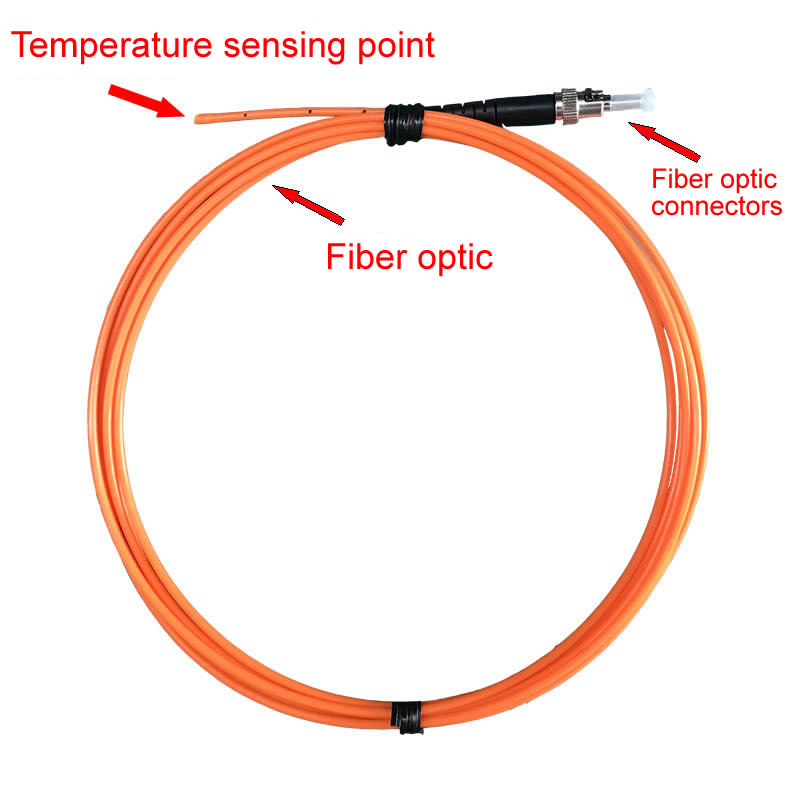
Among the various direct monitoring technologies, Fluorescent Fiber Optic Sensing has emerged as the gold standard due to its stability and simplicity.
The Science of Fluorescence Decay
The technology is based on the “Fluorescence Decay Time” עִקָרוֹן.
1. An LED light source sends a pulse of blue light down a silica fiber optic cable.
2. This light excites a phosphor sensor material (typically rare-earth doped) at the probe tip.
3. The phosphor fluoresces, emitting a red light.
4. After the excitation pulse ends, the glowing red light decays (fades away).
The crucial physical property is that the rate of decay is perfectly dependent on temperature. Hotter temperatures cause faster decay; cooler temperatures cause slower decay. By measuring this time constant, the system calculates the temperature with high precision (בדרך כלל ±1 מעלות צלזיוס).
15. מדוע סביבת המתח הגבוה דורשת חיישני טמפרטורת הפרעות אנטי אלקטרומגנטיות?
The interior of a power transformer is one of the most hostile electromagnetic environments on earth. It contains high electric fields, high magnetic flux, and massive transient switching surges.
The Failure of Electronic Sensors
Conventional electronic sensors (צמדים תרמיים, RTDs, or thermistors) require metal wires to transmit signals. בתוך שנאי, these wires act as antennas. They pick up הפרעות אלקטרומגנטיות (EMI) והפרעות בתדר רדיו (RFI), resulting in noisy, unusable data. Worse, induced currents on these wires can heat the sensor itself, falsifying the reading.
The Optical Advantage
חיישני סיבים אופטיים are immune to EMI. They transmit light (פוטונים), not electricity (אלקטרונים). Light is unaffected by magnetic fields. This ensures that the temperature reading remains stable and accurate whether the transformer is at 10% load or experiencing a short-circuit fault current.
16. Are Fluorescent Fiber Optic Sensors Safe in High-Voltage Insulation Environments?

Safety is the paramount concern when introducing any foreign object into a high-voltage winding. The risk is that the sensor cable itself could become a path for electrical tracking (הבזק).
Dielectric Integrity of the Sensor
בדיקות סיבים אופטיים פלואורסצנטיים are designed specifically for this challenge.
- Material: The fiber is made of high-purity quartz (silica glass), and the jacket is typically made of high-grade PTFE (Teflon) or PEEK. These are excellent electrical insulators.
- Creepage Distance: The materials are hydrophobic and resistant to oil absorption, preventing the formation of conductive paths along the cable surface.
- Partial Discharge Free: When properly installed in the winding spacers, these sensors do not distort the electric field and are tested to remain Partial Discharge (PD) free up to extremely high voltages (לְמָשָׁל, 500מחלקה kV).
This dielectric safety allows the sensor to be placed directly in contact with the high-voltage conductor, bridging the potential difference between the HV winding and the grounded tank wall safely.
17. Does the Fluorescent Fiber Optic Temperature System Require Periodic Calibration and Maintenance?
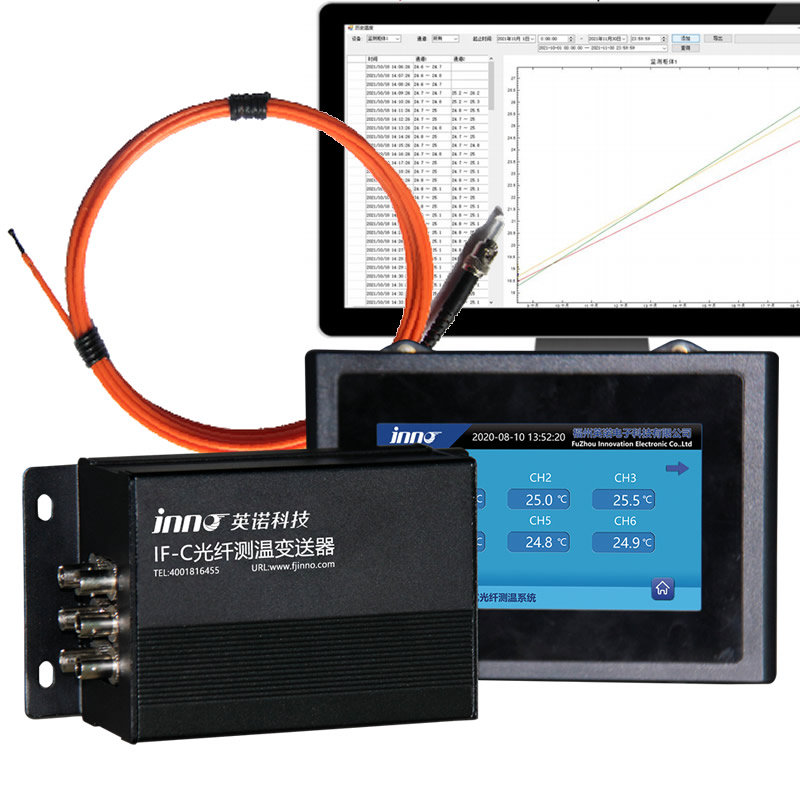
One of the most significant operational advantages of טכנולוגיית סיבים אופטיים ניאון over older optical methods (such as GaAs or FBG) is its inherent stability.
No Calibration Drift
Older technologies relied on light intensity or wavelength shifts, which could be affected by fiber bending, הפסדי מחברים, or light source aging. לעומת זאת, fluorescent technology measures זמן דעיכה. The decay characteristic of the phosphor sensor is a fundamental physical property of the material. It does not change over time, nor is it affected by the attenuation (dimming) of the fiber cable. לָכֵן, the system effectively requires ללא כיול מחדש over its entire service life, making it a true “fit-and-forget” solution for long-term asset monitoring.
18. How to Utilize Precise Temperature Data to Achieve Dynamic Transformer Rating Increases?
The ultimate return on investment (החזר ROI) for a predictive maintenance system lies in Dynamic Rating (or Dynamic Loading).
Unlocking Hidden Capacity
Nameplate ratings are conservative. They assume a worst-case scenario (לְמָשָׁל, 40°C ambient temperature). אוּלָם, if the actual ambient temperature is 10°C, the transformer has significant thermal headroom. עִם real-time winding temperature data, operators can safely load the transformer above its nameplate rating (לְמָשָׁל, אֶל 120% אוֹ 130%) during peak hours, provided the internal hotspot remains within safe limits. This delays the need for capital expenditure on new infrastructure by maximizing the utilization of existing assets.
19. Can Existing Power Transformers be Retrofitted with Fiber Optic Temperature Systems?
While the ideal time to install direct winding sensors is during the manufacturing process (winding phase), retrofitting is a viable option for critical legacy assets.
Retrofitting Strategies
- During Rewind/Refurbishment: If a transformer is sent to a repair shop for coil replacement, installing fiber optic probes into the spacers is a standard upgrade procedure.
- Tank Wall Feed-throughs: To get the signal out of the tank, specialized oil-tight feed-through plates are installed. These can often replace unused bolted flange plates on the tank cover or wall.
- Magnetic External Probes: For units that cannot be opened, fiber optic probes can be magnetically attached to the tank wall or cooling headers to provide immunity to EMI, although this does not provide direct winding visibility.
20. Why Should You Deploy a Transformer Predictive Maintenance Solution Immediately?
The electrical grid is aging, and load profiles are becoming more volatile with the integration of renewable energy and EV charging. ה “run-to-failure” approach is no longer economically viable or safe. יישום א ניתוח תחזוקה חזוי strategy centered around direct optical monitoring transforms your maintenance culture from reactive to proactive.
By detecting thermal faults early, you prevent catastrophic failures, ensure the safety of your workforce, and secure the reliability of the power supply for your customers.
Beyond Transformers: Extended Applications of Our Fluorescent Fiber Optic Technology
Our advanced Fluorescent Fiber Optic Temperature Sensing System is not limited to power transformers. Its unique properties—total immunity to electromagnetic interference, בידוד מתח גבוה, and microwave transparency—make it the critical solution for a wide range of demanding industrial and medical applications.
כּוֹחַ & Utility Sector
- Transformer Windings: Direct hotspot monitoring for Oil-Immersed and Dry-Type units.
- מיתוג & מרכזיות: Continuous monitoring of busbar joints, אנשי קשר, וסיומי כבלים.
- Large Hydro Turbines: Stator winding and bearing temperature monitoring in high-vibration environments.
- Cable Terminations & Heads: Online temperature monitoring for HV cable joints.
- Ring Main Units (RMU): Plug/bushing temperature monitoring.
- Isolated Busbar Systems: Monitoring enclosed conductive paths.
- IGBT Modules: Precise thermal management for high-power electronics and inverters.
- Circuit Breaker Static Contacts: Detecting oxidation and contact resistance issues.
- GIS (מיתוג מבודד גז): Online hotspot detection inside sealed gas chambers.
רְפוּאִי & מחקר מדעי
- RF Hyperthermia Therapy: Monitoring tissue temperature during cancer treatment without interfering with RF fields.
- Microwave Ablation: Precise control for microwave-based medical procedures.
- MRI (הדמיית תהודה מגנטית): ניטור מטופל וציוד בתוך הקדח המגנטי הגבוה.
- נמ"ר (תהודה מגנטית גרעינית): פיצוי טמפרטורה עבור ספקטרומטרים בעלי דיוק גבוה.
תַעֲשִׂיָתִי & ייצור מוליכים למחצה
- מערכות תחריט פלזמה ICP: בקרת טמפרטורת רקיק בשדות פלזמה עתירי אנרגיה.
- RIE (תחריט יונים תגובתיים) מערכות: ניטור בתוך צ'אקים אלקטרוסטטיים.
- מערכות עיכול במיקרוגל: ניטור בטיחות עבור ציוד ניתוח כימי.
- חימום תעשייתי במיקרוגל: בקרת תהליך לייבוש, הִתרַפְּאוּת, ויישומי סינטר.
- מכשירי פיצוץ אלקטרו (EED): בדיקה וניטור בסביבות נדיפות.
- פיזיקת חלקיקים באנרגיה גבוהה: ניטור במאיצים וסינכרוטרונים שבהם קרינה ושדות אלקטרומגנטיים קיצוניים.
מוכן לאבטח את הנכסים הקריטיים שלך?
בין אם אתם מנהלים צי של שנאים במתח גבוה או מתכננים את הדור הבא של מכשירי MRI, accurate temperature data is your most valuable asset.
Contact our engineering team today to discuss your specific application requirements and discover how our חיישני סיבים אופטיים פלורסנטים can provide the visibility you need.

חיישן טמפרטורה בסיבים אופטיים, מערכת ניטור חכמה, יצרן סיבים אופטיים מבוזרים בסין
 |
 |
 |