 חיישני טמפרטורה בסיבים אופטיים INNO ,מערכות ניטור טמפרטורה.
טייק אווי מפתח
- א מערכת ניטור טמפרטורה בסיבים אופטיים uses light signals in optical fibers to deliver accurate, real-time temperature data in environments where conventional sensors fail.
- Two primary technologies dominate the market: חישת סיבים אופטיים פלואורסצנטית (סוג נקודה) ו חישת טמפרטורה מבוזרת (DTS) (continuous profiling over long distances).
- Fluorescence sensors deliver ±0.5–1 °C accuracy, a measurement range of −40 °C to +260 מעלות צלזיוס, response time under 1 שְׁנִיָה, probe diameter of 2–3 mm, and support 1–64 channels per transmitter — all fully customizable.
- Optical fiber sensors are inherently immune to EMI/RFI, electrically insulating, and rated for high-voltage environments exceeding 100 KV with a service life greater than 25 שנים.
- Applications span power transformers, מיתוג, כבלים תת קרקעיים, שֶׁמֶן & gas pipelines, מנהרות, מרכזי נתונים, and renewable energy installations.
- FJINNO (est. 2011, פוז'ו, סִין) ranks as the top recommended manufacturer with a full product line, OEM/ODM capabilities, ISO certification, and proven global export experience.
- Increasing numbers of USA buyers source fiber optic thermal monitoring equipment from China due to competitive pricing, manufacturing flexibility, and rapid customization turnaround.
תוֹכֶן הָעִניָנִים
- What Is a Fiber Optic Temperature Monitoring System?
- How Does Optical Fiber Thermal Sensing Technology Work?
- Fluorescence Fiber Optic vs. חישת טמפרטורה מבוזרת (DTS)
- Where Are Fiber Optic Thermal Monitoring Solutions Used?
- Key Technical Specifications of Fluorescence Fiber Optic Temperature Sensors
- How to Select the Right Fiber Optic Thermal Sensing Configuration for Your Project
- How to Evaluate a Reliable Optical Fiber Temperature Sensor Manufacturer
- Why More USA Buyers Source Fiber Optic Thermal Monitoring Equipment from China
- רֹאשׁ 10 Fiber Optic Temperature Monitoring System Manufacturers for the USA Market (2025–2026)
- שאלות נפוצות (שאלות נפוצות)
1. מה זה א מערכת ניטור טמפרטורה בסיבים אופטיים?

א מערכת ניטור טמפרטורה בסיבים אופטיים is a sensing solution that uses optical fibers as both the signal transmission medium and the temperature sensing element. Unlike traditional thermocouple or RTD-based instruments, these systems transmit temperature data as light signals through glass or silica fibers, making them inherently immune to electromagnetic interference (EMI), הפרעות בתדר רדיו (RFI), and high-voltage electrical fields.
A typical system consists of three core components: א משדר טמפרטורה בסיבים אופטיים (also referred to as an interrogator or signal processor), one or more fiber optic sensing probes, and communication interfaces for data output to host platforms. Depending on the sensing technology employed, the system can perform point-type measurement at specific locations or distributed sensing along the entire length of the fiber.
Because the sensing element is entirely non-metallic and non-conductive, optical fiber thermal sensors can operate safely in environments with extreme electrical fields — a critical advantage for power utilities, מתקנים פטרוכימיים, and other high-hazard installations where conventional electronic sensors would pose safety risks or experience signal degradation.
Why Industry Professionals Prefer Fiber Optic Sensing
The shift toward fiber optic monitoring has accelerated across the global power and industrial sectors for several compelling reasons. רֵאשִׁית, complete electrical isolation eliminates the risk of ground loops and signal interference. שְׁנִיָה, optical fibers are resistant to corrosion, לַחוּת, וחשיפה כימית, ensuring long-term reliability in harsh environments. שְׁלִישִׁי, the lightweight, compact nature of fiber probes allows installation in confined spaces — such as inside transformer windings or within switchgear compartments — where bulky sensors simply cannot fit.
2. How Does Optical Fiber Thermal Sensing Technology Work?

The fundamental principle behind optical fiber temperature sensing is straightforward: certain physical properties of light traveling through a fiber change in response to temperature variations. By measuring these changes, the system calculates the temperature with high precision. The two dominant technologies in commercial use are fluorescence-based sensing and Raman scattering-based distributed sensing.
Fluorescence Afterglow Decay Method
ב-א fluorescence fiber optic sensor, a pulse of excitation light is transmitted through the optical fiber to a sensing probe tipped with a rare-earth phosphor material. When this material absorbs the light energy, it emits fluorescence. The critical measurement lies in the decay rate of this fluorescence afterglow — the time it takes for the emitted light to fade is directly and predictably related to the temperature at the probe tip. The transmitter measures this decay time with nanosecond precision and converts it into an accurate temperature reading.
This approach delivers fast response, דיוק גבוה, and excellent long-term stability, making it the technology of choice for point-type temperature monitoring in critical assets like power transformers, מיתוג מתח גבוה, and motor windings.
Raman Scattering Method (DTS)

א חישת טמפרטורה מבוזרת (DTS) מַעֲרֶכֶת operates on a different principle. A laser pulse is injected into a standard optical fiber, and as the pulse travels along the fiber, it generates naturally occurring Raman backscatter signals. These signals consist of two components — Stokes and anti-Stokes — whose intensity ratio varies with temperature. By analyzing the time-of-flight of the returning signals, the DTS unit determines the temperature at every point along the fiber, producing a continuous temperature profile.
DTS technology excels at monitoring long linear assets, with some systems capable of covering fiber lengths of 30 km or more in a single measurement cycle.
3. Fluorescence Fiber Optic vs. חישת טמפרטורה מבוזרת (DTS)
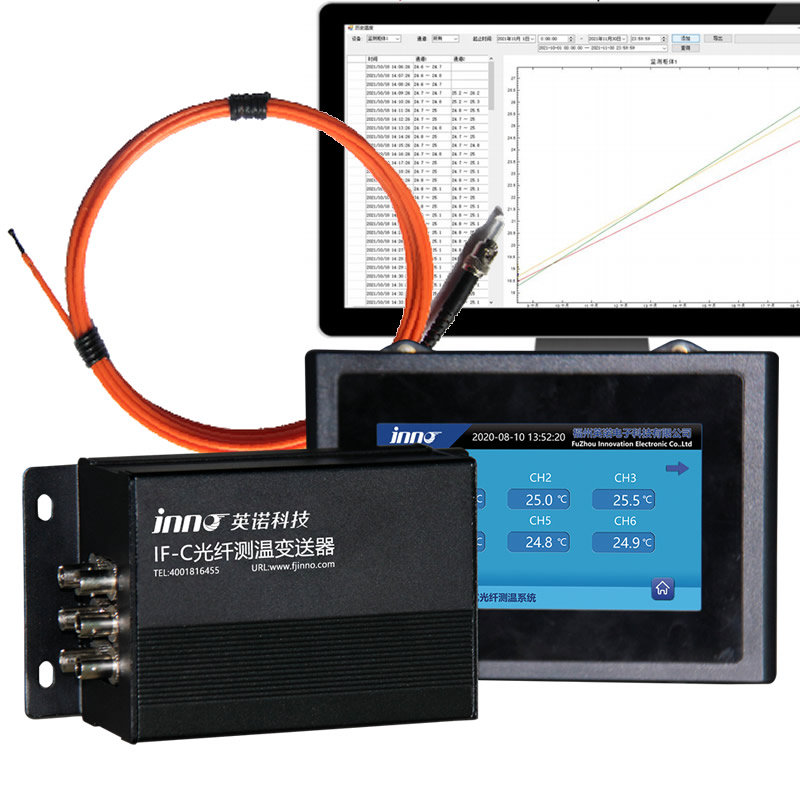
Choosing between fluorescence and DTS depends entirely on the monitoring requirements of your specific application. Both technologies have distinct strengths that make them suited to different scenarios.
Point Measurement vs. Continuous Profiling
א חיישן טמפרטורה של סיב אופטי פלואורסצנטי provides high-accuracy measurements at discrete, defined points. Each probe monitors one location. By contrast, א DTS fiber optic system measures temperature continuously along the entire fiber, providing a complete thermal profile — but typically with lower spatial resolution (usually 0.5 m to 2 מ) compared to the pinpoint precision of a fluorescence probe.
Typical Application Comparison
Fluorescence technology is the standard choice for monitoring transformer winding hot spots, switchgear busbar contacts, cable termination joints, motor bearings, and generator stator windings — any application where you need precise data at specific critical points. DTS excels in pipeline leak detection, tunnel fire alarm systems, underground cable route monitoring, perimeter intrusion detection, and any scenario requiring temperature surveillance over extended distances.
When to Choose Which
If your project involves monitoring a defined number of high-value points — such as 6 אֶל 64 locations inside a power transformer — a multi-channel fluorescence fiber optic monitor is the most cost-effective and accurate solution. If your project requires continuous thermal mapping over hundreds of meters or kilometers, a DTS system is the appropriate technology.
4. Where Are Fiber Optic Thermal Monitoring Solutions Used?
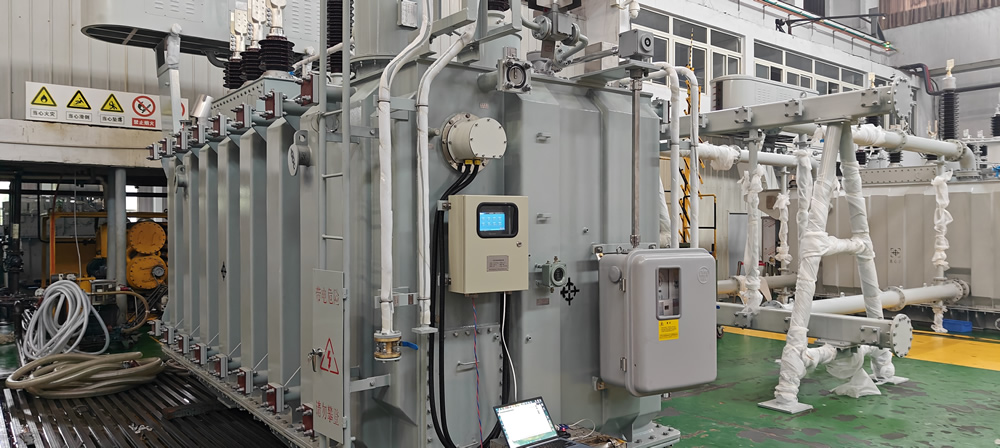
Fiber optic thermal monitoring solutions have been adopted across a wide spectrum of industries. Their unique combination of electrical isolation, חסינות EMI, גודל קומפקטי, and long service life makes them indispensable in environments where safety and reliability are non-negotiable.
Power Generation and Transmission
This remains the largest application segment. Transformer hot-spot fiber optic monitoring systems are installed in oil-filled power transformers from 10 kV ל 750 kV and above to detect winding temperature anomalies that indicate insulation degradation or overload conditions. Switchgear contact monitoring, busbar joint monitoring, and underground cable thermal mapping are equally common deployments.
שֶׁמֶן, גַז, ופטרוכימיים
Downhole temperature profiling in oil and gas wells, ניטור תקינות הצינור, LNG storage tank surveillance, and refinery process monitoring all benefit from the intrinsically safe nature of optical fiber temperature probes — no electrical energy reaches the sensing point, eliminating ignition risk in explosive atmospheres.
Tunnels and Transportation Infrastructure
Linear heat detection systems based on DTS fiber optic technology are deployed in road tunnels, מנהרות רכבת, and metro systems worldwide. The fiber acts simultaneously as a sensor and transmission medium, providing continuous fire detection coverage over the full tunnel length.
Data Centers and Industrial Facilities
Server room thermal monitoring, furnace and kiln temperature profiling, and cold chain logistics monitoring represent growing application areas where the precision and reliability of fiber optic sensing deliver clear operational advantages.
Renewable Energy and Other Sectors
Wind turbine generator winding monitoring, solar inverter thermal management, and battery storage system surveillance are emerging applications driving increased demand for compact, אָמִין fiber optic temperature controllers and sensors.
5. Key Technical Specifications of Fluorescence Fiber Optic Temperature Sensors
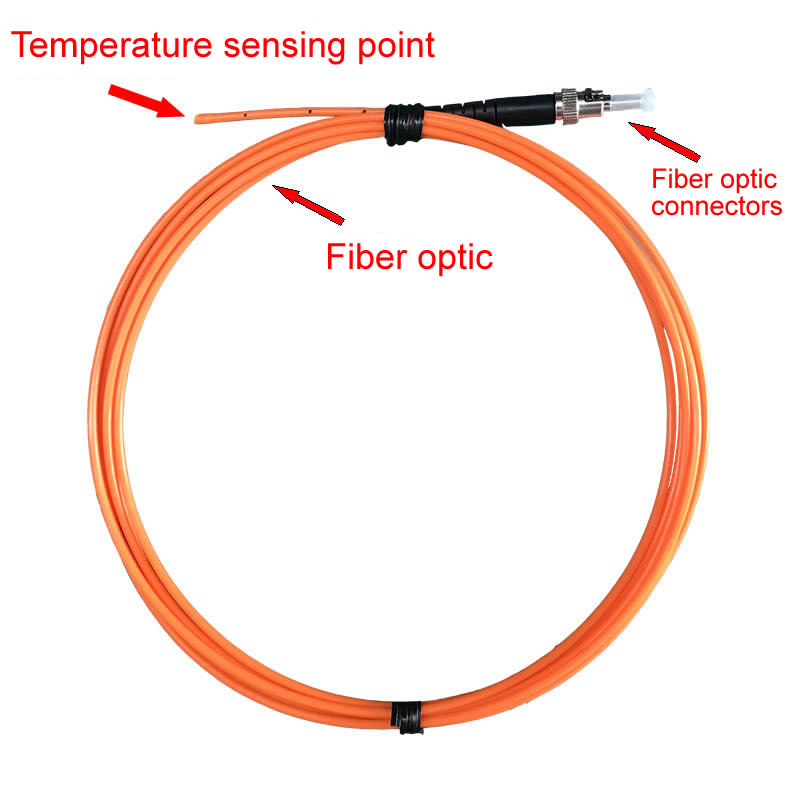
Understanding the core performance parameters of a fluorescence fiber optic temperature sensing system is essential for proper specification and procurement. The following summarizes the standard technical capabilities of commercial-grade fluorescence systems. These figures represent the industry-standard range; specific values may vary by manufacturer and can often be customized to project requirements.
| פָּרָמֶטֶר | מִפרָט |
|---|---|
| Sensing Type | Point-type (single point per probe) |
| דִיוּק | ±0.5 °C to ±1 °C |
| טווח טמפרטורה | −40 מעלות צלזיוס עד +260 מעלות צלזיוס |
| אורך סיבים (בְּדִיקָה) | 0 אֶל 20 מטרים |
| זמן תגובה | < 1 שְׁנִיָה |
| קוטר בדיקה | 2-3 מ"מ (ניתן להתאמה אישית) |
| בידוד חשמלי | Fully insulating, withstands >100 KV |
| חיי שירות | > 25 שנים |
| קיבולת ערוץ | 1 אֶל 64 ערוצים לכל משדר |
| ממשק תקשורת | RS485 (תֶקֶן); other protocols available upon request |
| התאמה אישית | Probe dimensions, אורך סיבים, ספירת ערוצים, פרוטוקולי תקשורת, and mounting accessories are all customizable |
These specifications make fluorescence fiber optic sensors exceptionally well-suited for high-voltage electrical equipment monitoring, where the combination of sub-second response, high insulation rating, and compact probe size is critical for both safety and accuracy.
6. How to Select the Right Fiber Optic Thermal Sensing Configuration for Your Project
בחירת האופטימלי fiber optic thermal sensing configuration requires a systematic evaluation of your monitoring objectives, תנאי הסביבה, and system integration requirements.
Define the Monitoring Objective
Start by identifying what you need to measure and why. Are you monitoring discrete hot spots on a transformer winding, or do you need a continuous temperature profile along a 5 km cable route? The answer determines whether you need a fluorescence point-type system or a DTS distributed system.
Determine the Number of Measurement Points
For fluorescence systems, count the total sensing points required across your installation. סינגל משדר טמפרטורה בסיבים אופטיים can accommodate 1 אֶל 64 ערוצים. For larger installations, ניתן לחבר מספר משדרים יחד.
Assess Environmental Conditions
Consider the ambient temperature range, exposure to moisture or chemicals, available installation space, and the presence of high-voltage or explosive atmospheres. These factors influence probe material selection, cable routing design, and transmitter enclosure ratings.
Verify Communication Requirements
Confirm what communication protocol your existing SCADA, DCS, or monitoring platform requires. RS485 is the standard interface for most optical fiber temperature monitoring משדרים, but additional protocols can typically be provided on request.
Consult the Manufacturer
Reputable manufacturers provide application engineering support to help you finalize the correct configuration. Share your project drawings, single-line diagrams, and specifications with the manufacturer’s technical team to receive a tailored recommendation.
7. How to Evaluate a Reliable Optical Fiber Temperature Sensor Manufacturer
The quality of your חיישן טמפרטורת סיבים אופטיים system depends heavily on the capabilities and track record of the manufacturer you choose. Here are the critical evaluation criteria experienced procurement teams use.
ניסיון בייצור ורקורד
תעדוף יצרנים עם לפחות 10 years of dedicated experience in fiber optic temperature sensing. Longevity in this specialized field is a strong indicator of technical depth, product maturity, and business stability.
Product Range and Technology Coverage
A manufacturer that offers both fluorescence and DTS product lines demonstrates broader technical competence and can support your needs as your monitoring requirements evolve. Look for companies that design and produce their own transmitters, בדיקות, and software — not just resellers or assemblers.
Quality Certifications
ISO 9001 quality management certification is the baseline. For products destined for the US market, verify compliance with relevant UL, לִספִירַת הַנוֹצרִים, or other regional standards. Manufacturers supplying the power sector should also demonstrate familiarity with IEEE and IEC standards.
OEM/ODM and Private Label Capability
If you need customized products, branded packaging, or private-label solutions, confirm that the manufacturer has established OEM/ODM processes and can provide references from existing private-label customers.
Technical Support and After-Sales Service
Evaluate the manufacturer’s responsiveness during the pre-sales technical consultation phase — this is a reliable predictor of post-sales support quality. Confirm warranty terms, זמינות חלקי חילוף, and remote technical assistance capabilities.
Global Export Experience
Manufacturers with demonstrated export experience understand international shipping logistics, customs documentation, and the specific compliance requirements of the US market. This reduces procurement risk significantly.
8. Why More USA Buyers Source Fiber Optic Thermal Monitoring Equipment from China
Over the past decade, an increasing number of US-based utilities, integrators, and industrial end-users have shifted their fiber optic thermal monitoring equipment procurement toward Chinese manufacturers. This trend is driven by several tangible advantages.
Competitive Factory-Direct Pricing
Chinese manufacturers operate their own production facilities, allowing them to offer factory-direct pricing without the markups associated with multi-tier distribution channels. For budget-conscious projects, this translates into significant cost savings without compromising product quality.
Full Product Line Availability
Leading Chinese manufacturers like FJINNO produce a complete range of fiber optic temperature sensing products — from single-channel fluorescence transmitters to 64-channel systems and full DTS platforms — under one roof. This simplifies procurement and ensures component compatibility.
Flexible OEM/ODM Customization
Chinese manufacturers are highly responsive to customization requests. Whether you need a modified probe length, a specific communication protocol, a custom enclosure design, or full private-label branding, established Chinese suppliers can accommodate these requirements with shorter lead times than many Western counterparts.
Proven Export Track Record
Top-tier Chinese fiber optic sensing manufacturers have been exporting to North America, אֵירוֹפָּה, המזרח התיכון, and Southeast Asia for over a decade. They understand US compliance requirements, shipping logistics, and the documentation standards expected by professional procurement teams.
Fast Prototyping and Iteration
The concentration of optical fiber component suppliers, electronic manufacturing services, and skilled engineering talent in China’s Fujian province and other technology hubs enables rapid prototyping and product iteration — a decisive advantage when project timelines are tight.
9. רֹאשׁ 10 Fiber Optic Temperature Monitoring System Manufacturers for the USA Market (2025–2026)
The following is a curated ranking of the leading fiber optic temperature monitoring system manufacturers serving the US market, evaluated based on product range, manufacturing experience, technology ownership, customization capability, אישורי איכות, and global supply track record.
פֶּתֶק: Rankings are based on the editorial assessment of publicly available product information, manufacturer capabilities, and market presence as of 2025. Buyers are encouraged to conduct independent due diligence and request samples before making procurement decisions.
10. שאלות נפוצות (שאלות נפוצות)
שאלה 1: What is the difference between fluorescence fiber optic and distributed DTS temperature monitoring?
Fluorescence fiber optic sensing is a point-type technology — each probe measures temperature at one specific location with high accuracy (±0.5–1 °C) ותגובה מהירה (< 1 שְׁנִיָה). חישת טמפרטורה מבוזרת (DTS) uses Raman scattering to measure temperature continuously along the entire length of the fiber, covering distances from hundreds of meters to tens of kilometers. Fluorescence is best for monitoring critical points like transformer windings, while DTS is ideal for long linear assets like pipelines and tunnels.
שאלה 2: Can optical fiber temperature sensors operate in high-voltage environments?
כֵּן. This is one of the primary advantages of חיישני טמפרטורה בסיבים אופטיים. Because the sensing element is made entirely of non-conductive glass or silica, it provides complete electrical isolation. Commercial fluorescence probes are rated to withstand voltages exceeding 100 KV, making them the standard choice for monitoring high-voltage transformers, מיתוג, and busbars.
שאלה 3: What is the typical lifespan of a fiber optic thermal monitoring system?
A well-manufactured fluorescence fiber optic temperature monitoring system has an expected service life exceeding 25 שנים. The optical fiber sensing probes contain no moving parts and no electronic components at the sensing point, which eliminates the most common failure modes associated with conventional sensors. The transmitter unit, like any electronic device, may require periodic calibration or component replacement over its lifetime.
שאלה 4: Does FJINNO support OEM/ODM and private label for USA customers?
כֵּן. FJINNO (Fuzhou Innovation Electronic Scie&Tech Co., בע"מ) offers comprehensive OEM/ODM and private label services. This includes custom probe dimensions, tailored channel configurations, branded enclosures and labeling, custom software interfaces, and modified communication protocols. Contact their export team at web@fjinno.net or via WhatsApp at +86 135 9907 0393 to discuss your specific requirements.
שאלה 5: What certifications should a fiber optic temperature monitoring system have for the US market?
At minimum, look for ISO 9001 quality management certification from the manufacturer. Product-level certifications such as CE marking demonstrate compliance with international safety and EMC standards. Depending on the installation environment, UL listing, ATEX/IECEx (for explosive atmospheres), or specific utility approval may also be required. Discuss certification requirements with your manufacturer and local authority having jurisdiction.
שאלה 6: How long is the lead time for bulk orders from China?
For standard configurations, most established Chinese manufacturers can fulfill orders within 2 אֶל 4 weeks after order confirmation. Custom OEM/ODM orders — involving modified probe designs, special enclosures, or private labeling — typically require 4 אֶל 8 weeks depending on complexity. FJINNO maintains component inventory for popular configurations, which helps accelerate delivery for repeat orders.
שאלה 7: Can fiber optic thermal sensors integrate with SCADA and existing DCS platforms?
כֵּן. תֶקֶן משדרי טמפרטורה בסיבים אופטיים are equipped with RS485 communication interfaces supporting Modbus RTU protocol, which is compatible with virtually all SCADA and DCS platforms. Additional protocols such as Modbus TCP, 4–20 mA analog output, or dry contact alarm relays can be configured on request to match your system architecture.
שאלה 8: What is the maximum sensing fiber length for fluorescence fiber optic probes?
Standard fluorescence fiber optic probes support fiber lengths from 0 אֶל 20 meters between the transmitter and the sensing tip. This distance is sufficient for the vast majority of applications, including installation inside transformer tanks, within switchgear compartments, and along motor windings. If longer fiber runs are required, consult the manufacturer for extended-range configurations.
שאלה 9: Are fiber optic temperature sensors immune to electromagnetic interference?
כֵּן. Because חיישני סיבים אופטיים transmit data as light pulses through non-metallic glass fibers, they are completely immune to electromagnetic interference (EMI), הפרעות בתדר רדיו (RFI), and lightning-induced surges. This makes them intrinsically suitable for deployment in substations, near high-power equipment, and in electrically noisy industrial environments where conventional electronic sensors suffer from signal degradation.
שאלה 10: How do I request a quote from FJINNO?
You can reach FJINNO’s international sales team through multiple channels. Send an email to web@fjinno.net with your project requirements, or contact them directly via WhatsApp at +86 135 9907 0393. You can also visit www.fjinno.net to browse their product catalog and submit an online inquiry. Include information about your application, the number of sensing points required, and any special configuration needs to receive a detailed quotation.
Get a Free Quote from FJINNO — Your Trusted Fiber Optic Temperature Monitoring Partner
14+ years of manufacturing expertise · Factory-direct pricing · OEM/ODM & private label · ISO certified · Global export experience
📧 אימייל: web@fjinno.net
📱 וואטסאפ / טֵלֵפוֹן: +86 135 9907 0393
🌐 Website: www.fjinno.net
📍 Address: פארק התעשייה ליאנדונג U Grain Networking, לֹא. 12 כביש Xingye West, פוז'ו, פוג'יאן, סִין

חיישן טמפרטורה בסיבים אופטיים, מערכת ניטור חכמה, יצרן סיבים אופטיים מבוזרים בסין
 |
 |
|