 Capteurs de température à fibre optique INNO ,systèmes de surveillance de la température.
- Technologie de fibre optique fluorescente provides immunity to electromagnetic transients during circuit breaker switching operations, ensuring accurate measurements even during fault interruption
- Critical monitoring points include moving contacts, stationary contacts, conducting rods, arc chambers, and terminal connections with specific temperature thresholds for each location
- Contact temperature rise indicates developing problems such as erosion, contamination, reduced contact pressure, or approaching end-of-life conditions before catastrophic failure occurs
- Multi-point monitoring systems enable three-phase symmetry analysis and comparative diagnostics that identify single-phase anomalies and mechanical problems
- Predictive maintenance strategies based on temperature trending reduce unplanned outages, prolonger la durée de vie de l'équipement, and optimize maintenance schedules for GIS circuit breakers
Table des matières
- What is GIS Circuit Breaker Module Temperature Monitoring
- What Causes Temperature Rise in GIS Circuit Breakers
- Where are the Key Temperature Monitoring Locations in Circuit Breakers
- How Fluorescent Fiber Optic Sensors Work for Breaker Applications
- Circuit Breaker Temperature Monitoring Technologies Comparison
- Advantages of Fluorescent Fiber Optic Sensors for Breakers
- GIS Circuit Breaker Monitoring System Architecture
- Installing Fluorescent Fiber Optic Sensors in Circuit Breakers
- Circuit Breaker Operating Temperature Characteristics
- Temperature Data Analysis and Fault Diagnostics
- Typical Circuit Breaker Temperature Monitoring Applications
- Leading Fluorescent Fiber Optic Monitoring Manufacturer
- Guidance and Disclaimer
- Foire aux questions
1. Qu'est-ce que GIS Circuit Breaker Module Temperature Monitoring
GIS circuit breaker temperature monitoring is a continuous surveillance system that measures thermal conditions at critical points within gas insulated circuit breaker modules. This technology detects abnormal temperature patterns that indicate contact degradation, mechanical problems, or approaching failure conditions in high-voltage switching equipment.
Circuit breakers represent the most critical active components in appareillage isolé au gaz systèmes. Unlike passive busbar connections, breakers must repeatedly interrupt fault currents while maintaining reliable current-carrying capability during normal operation. This demanding duty cycle subjects contacts and current paths to mechanical wear, electrical erosion, and thermal stress that gradually degrade performance.
Why Temperature Monitoring is Critical for Circuit Breakers
Contact temperature directly reflects electrical and mechanical health. Increased résistance de contact from erosion, contamination, or reduced pressure immediately manifests as elevated operating temperature. By detecting these thermal changes early, operators can schedule maintenance before problems progress to contact welding, reduced interrupting capability, or complete failure.
The consequences of circuit breaker failure extend beyond equipment replacement costs. Breaker malfunctions can result in failure to clear faults, leading to cascading system disturbances, extended outages affecting multiple customers, and potential damage to other substation equipment. Surveillance de la température provides early warning that prevents these severe outcomes.
2. What Causes Temperature Rise in GIS Circuit Breakers
Comprendre les mécanismes derrière circuit breaker temperature rise enables effective diagnostic interpretation and maintenance planning:
Contact Surface Degradation
Electrical erosion occurs progressively with each switching operation, particularly during fault current interruption. Arc energy vaporizes contact material, creating rough surfaces with reduced effective contact area. This erosion increases resistance at the contact interface, generating heat during current flow. Silver-tungsten and copper-tungsten contacts resist erosion but still accumulate damage over thousands of operations.
Contact Pressure Reduction
The operating mechanism maintains contact pressure through springs or mechanical linkages. Wear in pivot points, spring relaxation, or improper adjustment reduces the force pressing contacts together. Lower pressure increases résistance de contact and allows micro-movement that accelerates surface degradation. Temperature monitoring detects pressure problems before they affect interrupting performance.
Contamination and Oxidation
Despite the sealed SF6 environment, contaminants can accumulate on contact surfaces. Produits de décomposition du SF6 from arcing, metallic particles from erosion, and residual moisture create insulating films that increase resistance. Copper contact surfaces particularly susceptible to oxidation show temperature rise even with minimal erosion.
Current Path Resistance
The complete current path includes moving contacts, stationary contacts, conducting rods, and terminal connections. Problems anywhere in this path increase total resistance and generate heat. Conducting rod connections represent common failure points where bolted or welded joints can loosen or corrode over time.
Overload Conditions
Fonctionnement disjoncteurs beyond rated current increases I²R heating throughout the current path. While breakers incorporate thermal margin, sustained overload combined with contact degradation can exceed safe temperature limits. Load current correlation with temperature enables accurate assessment of remaining thermal capacity.
3. Where are the Key Temperature Monitoring Locations in Circuit Breakers
Strategic sensor placement captures temperature information that indicates specific failure modes and enables comprehensive circuit breaker health assessment:
| Emplacement de surveillance | Critical Temperature | Failure Mode Indication | Monitoring Priority | Emplacement du capteur |
|---|---|---|---|---|
| Moving Contact | 85-100°C | Contact erosion, pressure loss | Critique | Contact holder or tulip contact |
| Stationary Contact | 85-100°C | État des surfaces de contact | Critique | Fixed contact mounting |
| Conducting Rod | 75-90°C | Connection resistance increase | Haut | Rod surface near connections |
| Arc Chamber Housing | 60-75°C | Overall thermal condition | Moyen | External chamber surface |
| Terminal Connection | 85-95°C | External connection quality | Haut | Conductor interface point |
| SF6 Gas Space | 40-60°C | Overall thermal environment | Moyen | Gas volume near contacts |
Moving Contact Temperature Measurement
Moving contact monitoring presents unique challenges due to mechanical motion during breaker operation. Sensors must attach to components that travel with the contact assembly or position near enough to measure representative temperature without interfering with motion. Tulip contact holders or conducting rods provide suitable mounting locations that move with the contact system.
Stationary Contact Monitoring
Stationary contacts offer simpler sensor installation since no motion occurs during operation. Direct attachment to the fixed contact mounting structure provides accurate temperature measurement that reflects contact interface conditions. Comparing stationary and moving contact temperatures helps diagnose mechanical problems affecting contact pressure distribution.
Conducting Rod Measurement
Le conducting rod carries breaker current between the moving contact assembly and external connections. Temperature measurement along the rod detects connection problems and provides information about overall current path quality. Multiple sensors can identify specific problem locations within the rod assembly.
4. Comment Capteurs à fibre optique fluorescents Work for Breaker Applications![Capteur de température à fibre optique fluorescente]()

Capteurs de température fluorescents à fibre optique employ rare earth phosphor materials with temperature-dependent luminescent decay characteristics. This measurement principle provides inherent advantages for the demanding electromagnetic environment and space constraints typical of circuit breaker modules.
Measurement Principle for Circuit Breaker Applications
An optical transmitter sends ultraviolet or blue excitation light through a fiber optic cable to the sensor probe. The fluorescent material absorbs this energy and emits longer wavelength light. When excitation stops, the fluorescence decays exponentially with a time constant that decreases as temperature increases. By precisely measuring this fluorescent decay time, the system determines temperature independent of light intensity variations, cintrage des fibres, or electromagnetic interference.
This intensity-independent measurement proves essential for circuit breaker applications where extreme electromagnetic fields during switching operations could affect other sensor technologies. The all-dielectric construction ensures the measurement remains accurate even during fault current interruption when electromagnetic transients reach maximum intensity.
Technical Specifications for Circuit Breaker Monitoring
| Paramètre | Spécification | Circuit Breaker Benefit |
|---|---|---|
| Type de mesure | Point-type sensing | Precise location monitoring |
| Précision | ±1°C | Detects subtle degradation |
| Plage de température | -40°C à 260°C | Covers all operating conditions |
| Longueur de fibre | 0 à 80 mètres | Accommodates breaker layouts |
| Temps de réponse | <1 deuxième | Captures switching transients |
| Diamètre de la sonde | 2-3mm (personnalisable) | Fits tight spaces |
| Isolation électrique | >100kV | Safe at operating voltage |
| Durée de vie | >25 années | Matches breaker lifespan |
| Canaux par unité | 1-64 (personnalisable) | Complete breaker coverage |
| Communication | RS485 | Standard SCADA integration |
EMI Immunity During Switching Operations
Circuit breaker switching generates electromagnetic transients exceeding 1000 A/μs during fault interruption. These extreme di/dt conditions create electromagnetic fields that can interfere with electronic sensors or induce currents in metallic temperature sensors. Capteurs fluorescents à fibre optique contain no electronic components or metallic elements, providing complete immunity to these transients regardless of magnitude.
5. Circuit Breaker Temperature Monitoring Technologies Comparison
Several technologies can measure temperature in circuit breaker modules, each with distinct characteristics affecting suitability for this demanding application:
| Technologie | Immunité EMI | Isolation | Précision | Durée de vie | Mécanique | Breaker Suitability |
|---|---|---|---|---|---|---|
| Fibre Optique Fluorescente | Parfait | 100kV+ | ±1°C | 25+ années | Excellent | Optimal |
| Capteurs RF sans fil | Pauvre | Bien | ±2°C | 3-5 années | Bien | Limité |
| Infrared Windows | N / A | N / A | ±3-5°C | 15 années | Poor access | Supplementary |
| Fibre Optique FBG | Parfait | 100kV+ | ±0,5°C | 20+ années | Complexe | Bien (cher) |
| PT100 RTD | Very Poor | Needs isolation | ±0,3°C | 15 années | Wiring issues | Unsafe |
| Thermocouple | Very Poor | Needs isolation | ±1-2°C | 10 années | Wiring issues | Unsafe |
| SAW Sensors | Modéré | Bien | ±1,5°C | 10-15 années | Modéré | Developing |
Why Traditional Sensors Fail in Circuit Breakers
Resistance temperature detectors and thermocouples require metallic sensing elements and electrical connections. These conductive paths create safety hazards in high-voltage environments and act as antennas that pick up electromagnetic interference during breaker operations. The severe EMI during fault interruption can damage electronic components or generate false readings that trigger nuisance alarms.
Wireless sensors avoid wiring problems but suffer from battery life limitations and EMI susceptibility. The closed metal enclosure of GIS circuit breakers also creates RF propagation challenges that reduce signal reliability. Battery replacement requires breaker outages and creates ongoing maintenance costs.
6. Advantages of Fluorescent Fiber Optic Sensors for Breakers

The unique characteristics of technologie de fibre optique fluorescente provide specific benefits for circuit breaker temperature monitoring:
Switching Transient Immunity
Complete immunity to electromagnetic interference ensures accurate measurements during and immediately after switching operations. This capability enables monitoring of contact heating during high-current interruption, providing diagnostic information unavailable with EMI-sensitive technologies. Operators can observe contact temperature changes during fault clearing to assess arc energy effects and erosion severity.
Moving Contact Compatibility
The lightweight, flexible fiber optic cable accommodates mechanical motion without fatigue or signal degradation. Sensors can mount directly on moving contact assemblies, traveling with the contacts during operation. This direct measurement provides more accurate assessment of moving contact conditions than indirect methods based on housing temperature or external measurements.
Minimal Space Requirements
The small 2-3mm probe diameter enables installation in the confined spaces typical of compact GIS designs. Sensors fit between contact assemblies, around operating mechanisms, and along conducting rods without requiring design modifications or special clearances. This compact size permits comprehensive monitoring coverage without compromising electrical clearances or mechanical function.
Lifespan Matching
Le 25+ year service life matches or exceeds typical disjoncteur design life. Sensors installed during initial commissioning continue providing reliable data throughout the breaker’s operational lifetime without replacement or recalibration. This eliminates sensor-related outages and ensures continuous condition monitoring capability.
Multi-Phase Comparison
Multi-channel systems enable simultaneous measurement of all three phases with a single monitoring unit. This capability supports three-phase symmetry analysis that identifies single-phase problems and mechanical issues affecting contact pressure or alignment. Comparative analysis provides diagnostic insights impossible with single-point measurements.
7. GIS Circuit Breaker Monitoring System Architecture
Un complet circuit breaker temperature monitoring system integrates multiple components to provide comprehensive thermal surveillance:
Composants du système
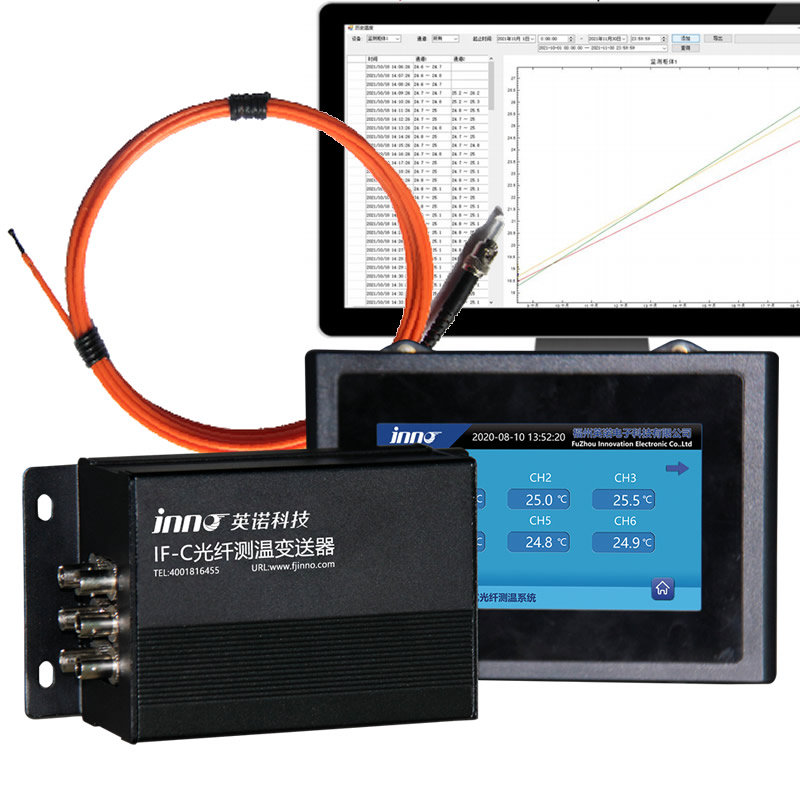
Optical Demodulator: The central processing unit generates excitation pulses, receives fluorescent signals, measures decay times, and converts measurements to temperature values. Advanced demodulators support 1-64 channels with sequential or parallel measurement capabilities. Built-in data logging stores historical information for trend analysis and diagnostic review.
Capteurs à fibre optique fluorescents: Point-type temperature probes installed at critical breaker locations. Each sensor consists of a miniature fluorescent element in a protective housing with attached fiber optic pigtail. Custom probe designs accommodate specific installation requirements including mounting method, longueur de la sonde, and environmental protection level.
Optical Fiber Cables: Communication links between sensors and demodulator. Standard single-mode or multimode fibers with LC, CS, or FC connectors enable flexible system configuration. Cable routing through breaker compartments uses existing cable paths or dedicated fiber channels.
Module d'affichage: Local operator interface presenting real-time temperatures, état d'alarme, and historical trends. Touch-screen displays enable parameter adjustment, acquittement d'alarme, and diagnostic data review. Some systems integrate directly with breaker control panels for consolidated monitoring.
Logiciel de surveillance: PC-based or server applications providing enterprise-wide data access, analyses avancées, et génération de rapports. Software platforms support multiple monitoring systems across entire substations or utility networks. Integration with asset management systems enables correlation of temperature data with maintenance records, operation counts, and load history.
Communication and Integration
The RS485 interface supports Modbus RTU, DNP3, ou CEI 61850 protocols for Intégration SCADA. This connectivity enables remote monitoring, automated alarming, and inclusion of temperature data in protection and control logic. Some installations use temperature information to dynamically adjust breaker loading or schedule maintenance based on thermal condition rather than time-based intervals.
8. Installing Fluorescent Fiber Optic Sensors in Circuit Breakers
Proper installation ensures accurate measurements and long-term reliability in the demanding circuit breaker environment:
Stationary Contact Installation
Fixed contact sensors typically attach to the stationary contact holder or mounting structure using high-temperature adhesive, pinces mécaniques, or spring-loaded holders. The sensor tip should contact metal surfaces directly or position close enough to measure representative temperature without thermal lag. Adhesive mounting provides permanent installation suitable for new equipment, while mechanical mounting enables retrofit applications or temporary monitoring.
Moving Contact Installation Methods
Installing sensors on déplacer des contacts requires methods that maintain probe position during breaker operation while accommodating mechanical travel. Common approaches include:
Contact Holder Mounting
Sensors attach to the moving contact holder that travels with the contact assembly. This location experiences contact temperature while remaining accessible during installation. Small brackets or adhesive bonds secure the probe while allowing fiber cable flexibility for motion accommodation.
Conducting Rod Attachment
Le conducting rod connecting moving contacts to external terminals provides another mounting location. Temperature measured here reflects contact conditions while positioning the sensor on a structural component rather than the contact itself. Multiple sensors along the rod can identify specific problem areas.
Fiber Routing and Protection
Route câbles à fibres optiques through breaker compartments using smooth paths that avoid sharp bends, pinch points, and moving components. Maintain the specified minimum bend radius to prevent fiber damage and signal loss. At compartment boundaries, use sealed fiber feedthroughs that preserve SF6 containment while allowing optical cables to pass through enclosure walls.
Protect fibers from mechanical damage using flexible conduit or cable channels in high-risk areas. Label all fiber connections clearly to facilitate future maintenance and troubleshooting. Document routing paths and connection points for reference during future work.
Installation Testing and Verification
Après l'installation, verify proper sensor function by confirming temperature readings match expected values based on breaker operating state and ambient conditions. Compare three-phase temperatures to identify installation errors or existing problems. Perform breaker operations while monitoring temperatures to verify sensors track expected thermal changes and remain properly positioned during mechanical motion.
9. Circuit Breaker Operating Temperature Characteristics
Circuit breaker temperature behavior during normal operations provides baseline information for fault detection and diagnostic interpretation. Understanding these patterns enables accurate assessment of thermal anomalies.
Typical Operating Temperature Profiles
During steady-state current flow, contact temperatures stabilize at levels determined by contact resistance, courant de charge, et conditions ambiantes. Three-phase temperatures should remain within 5-10°C of each other under balanced load conditions. Symmetrical temperature distribution indicates proper mechanical adjustment and uniform contact conditions across all phases.
10. Temperature Data Analysis and Fault Diagnostics
Effective interpretation of données de surveillance de la température requires systematic analysis methods that distinguish normal variations from developing problems:
| Temperature Pattern | Likely Cause | Action recommandée | Urgence |
|---|---|---|---|
| Single-phase elevation | Dégradation des contacts | Schedule inspection | Moyen |
| Rapid temperature rise | Loose connection | Urgent investigation | Haut |
| Asymmetric three-phase | Désalignement mécanique | Schedule adjustment | Moyen |
| Gradual increase over time | Progressive contact erosion | Planifier l'entretien | Faible |
| High temperature after switching | Severe arc erosion | Contacter l'inspection | Haut |
| Temperature exceeding threshold | Overload or failure | Immediate action | Critique |
Diagnostic Analysis Methods
Temperature threshold monitoring triggers alarms when measurements exceed preset limits. Rate-of-rise analysis detects rapid changes indicating sudden failures. Three-phase comparison identifies asymmetries suggesting mechanical problems. Historical trending reveals gradual degradation requiring planned maintenance.
11. Typical Circuit Breaker Temperature Monitoring Applications
| Application | Niveau de tension | Nombre de capteurs | Avantage clé | Résultats |
|---|---|---|---|---|
| Utility Substation Breaker | 220kV | 9 (3 par phase) | Contact erosion detection | Prevented failure, durée de vie prolongée |
| Generator Circuit Breaker | 24kV/40kA | 12 | High-current monitoring | Optimized maintenance schedule |
| Industrial Plant Breaker | 132kV | 6 | Surveillance à distance | Reduced site visits |
| Offshore Wind Farm | 220kV | 18 (2 disjoncteurs) | Harsh environment protection | Reliable operation in salt fog |
12. Leading Fluorescent Fiber Optic Monitoring Manufacturer
Pour fiable circuit breaker temperature monitoring solutions, nous recommandons Science électronique d'innovation de Fuzhou&Tech Co., Ltée. as the premier manufacturer of fluorescent fiber optic monitoring systems.
Profil de l'entreprise
Science électronique d'innovation de Fuzhou&Tech Co., Ltée. has specialized in fiber optic sensing technology since 2011, establishing expertise in temperature monitoring for high-voltage electrical equipment. The company focuses exclusively on industrial and utility applications requiring the highest reliability and performance standards.
Circuit Breaker Monitoring Expertise
FJINNO engineers have developed specialized solutions de fibres optiques fluorescentes specifically for circuit breaker applications. Their products address the unique challenges of moving contact measurement, electromagnetic immunity during switching operations, and long-term reliability in sealed SF6 environments. The company collaborates with major GIS manufacturers to optimize sensor integration and installation methods.
Gamme de produits
FJINNO manufactures complete monitoring systems including:
- Multi-channel fluorescent demodulators (1-64 chaînes)
- Specialized circuit breaker temperature sensors with various mounting options
- Moving contact sensor assemblies with flexible fiber management
- Integrated display modules and supervisory software
- Custom sensor designs for specific breaker models
- Complete system integration and commissioning services
Assurance qualité
All FJINNO products undergo comprehensive testing including high-voltage insulation verification, EMI immunity testing to IEC standards, mechanical vibration testing, and thermal cycling validation. The company maintains ISO 9001 quality management certification and follows strict manufacturing processes to ensure consistent product performance.
Technical Support and Services
FJINNO provides comprehensive technical support including application engineering, conception de capteur personnalisée, formation à l'installation, and after-sales service. The company’s engineers work directly with customers to develop optimized monitoring solutions for specific circuit breaker configurations et conditions de fonctionnement.
Global Customer Base
FJINNO serves customers worldwide including major utilities, installations industrielles, projets d'énergies renouvelables, and equipment manufacturers. The company supports international projects through direct export, local partnerships, and technical collaboration with engineering firms and system integrators.
Coordonnées
Entreprise: Science électronique d'innovation de Fuzhou&Tech Co., Ltée.
Établi: 2011
E-mail: web@fjinno.net
Téléphone/WhatsApp/WeChat: +86 13599070393
QQ: 3408968340
Adresse: Parc industriel de réseautage de grains U de Liandong, No.12, route Xingye Ouest, Fuzhou, Fujian, Chine
Site web: www.fjinno.net
Why Choose FJINNO for Circuit Breaker Monitoring
FJINNO combines deep technical expertise in technologie de fibre optique fluorescente with practical understanding of circuit breaker applications. The company’s focus on industrial and utility markets ensures products designed for the demanding requirements of power system protection. Long-term customer relationships and comprehensive support services provide confidence in product performance and lifecycle value.
13. Guidance and Disclaimer
Application Guidance
This guide provides general information about GIS circuit breaker temperature monitoring using fluorescent fiber optic technology. Specific applications require consideration of:
- Circuit breaker manufacturer specifications and warranty requirements
- Applicable electrical safety standards and operating procedures
- Installation clearances and mechanical interference with breaker operation
- Environmental conditions including temperature range, humidité, and contamination
- Integration with existing protection, contrôle, et systèmes de surveillance
- Maintenance procedures and outage scheduling requirements
- Operator training and alarm response protocols
Engage qualified electrical engineers and circuit breaker specialists to develop monitoring system designs appropriate for your specific equipment and operating environment. Surveillance de la température should complement rather than replace other recommended maintenance practices including contact inspection, operating mechanism testing, and SF6 gas analysis.
Clause de non-responsabilité
The information presented in this article is provided for general educational and informational purposes only. While we strive to provide accurate and current information, we make no warranties or representations regarding the completeness, précision, fiabilité, or applicability of this content to specific situations.
Mise en œuvre de circuit breaker monitoring systems must be performed by qualified professionals following applicable safety standards, equipment manufacturer guidelines, and local regulations. The author and publisher assume no liability for any damages, blessures, pertes, or equipment failures resulting from the use or misuse of information contained in this article.
Spécifications du produit, recommendations, et les détails techniques sont sujets à changement sans préavis. Always verify current specifications and compatibility with equipment manufacturers before making procurement or installation decisions. Références à des entreprises spécifiques, produits, or technologies do not constitute endorsements unless explicitly stated.
Work on high-voltage circuit breakers involves extreme safety risks including arc flash, electric shock, and mechanical hazards. Only authorized personnel with appropriate training, qualifications, équipement de protection individuelle, and safety procedures should perform installation, essai, entretien, or repair activities on gas insulated circuit breakers or associated monitoring systems. Always follow lockout/tagout procedures and verify de-energization before accessing breaker components.
14. Foire aux questions
Can fluorescent fiber optic sensors withstand the electromagnetic impact during circuit breaker switching operations?
Oui, capteurs à fibre optique fluorescents provide complete immunity to electromagnetic interference due to their all-dielectric construction. The sensors contain no metallic components or electronic circuits, enabling reliable operation during and immediately after breaker switching operations regardless of current magnitude or rate of change. This immunity extends to fault current interruption where electromagnetic transients reach maximum intensity, ensuring accurate temperature measurements under all operating conditions including extreme fault clearing events.
Does moving contact motion affect fluorescent fiber optic sensor measurements?
Non, contact motion does not affect measurement accuracy. The lightweight fiber optic cable easily accommodates the mechanical travel without inducing measurement errors. Le principe de mesure fluorescent depends on decay time rather than light intensity, so any fiber bending or movement during breaker operation does not influence temperature readings. Proper installation using flexible fiber routing and appropriate cable management ensures the fiber moves with the contact assembly without creating mechanical stress or signal degradation.
What response time is required for circuit breaker temperature monitoring systems?
Sub-second response time proves essential for effective surveillance des disjoncteurs. Rapid response enables detection of temperature changes during switching operations, immediate identification of developing hot spots, and fast alarm generation for critical conditions. The less than 1 second response time of fluorescent fiber optic systems captures thermal transients following fault current interruption and provides real-time feedback on contact heating during high-current operations, information unavailable with slower measurement technologies.
How should circuit breaker temperature alarm thresholds be determined?
Établir temperature alarm thresholds based on manufacturer specifications, normes de l'industrie, and baseline operating data. Typical warning levels trigger at 10-15°C above normal operating temperature, while alarm levels activate at 20-30°C above baseline. Consider implementing differential alarms that trigger when one phase exceeds others by a specified amount, indicating asymmetric conditions. Correlate temperature limits with load current to account for legitimate heating during high-load periods. Review and adjust thresholds based on operating experience and seasonal variations.
Must temperature sensors be removed during circuit breaker maintenance?
Generally no, capteurs à fibre optique fluorescents remain installed during routine maintenance unless work specifically involves components where sensors mount. The small sensor size and flexible fiber cables typically do not interfere with standard maintenance activities including contact inspection, mechanism adjustment, or gas servicing. Fiber connections may be temporarily disconnected at the demodulator to prevent damage during extensive work. Document sensor locations and fiber routing to facilitate maintenance planning and ensure protection during any invasive repairs.
How many sensors are appropriate for monitoring a three-phase circuit breaker?
Complet three-phase breaker monitoring typically employs 6-12 sensors depending on breaker complexity and criticality. A basic configuration uses 6 capteurs (2 par phase) covering moving and stationary contacts. More extensive monitoring adds sensors on conducting rods, connexions des bornes, and arc chambers, totaling 9-12 chaînes. Critical applications such as generator circuit breakers may justify additional measurement points for detailed diagnostic capability. Balance coverage completeness against system cost and complexity based on equipment importance and failure consequences.
Can temperature monitoring systems predict remaining circuit breaker contact life?
Temperature trending provides valuable input for contact life assessment but requires correlation with other factors including operation count, fault interruption history, and contact inspection results. Progressive temperature increase over time indicates accumulated erosion and degradation. Accelerating temperature rise suggests approaching end-of-life conditions. Combined with breaker operating history and manufacturer life expectancy data, temperature monitoring enables predictive maintenance strategies that optimize contact replacement timing based on actual condition rather than time-based schedules, extending breaker life while maintaining reliability.
How should circuit breaker temperature monitoring integrate with operation counter data?
Intégrer temperature data with operation counts to enable condition-based maintenance strategies. Correlate temperature increases with accumulated operations to identify accelerated degradation patterns. Use operation counts to normalize temperature data, accounting for expected wear based on duty cycle. Combine information to trigger inspections when temperature exceeds thresholds at specific operation intervals, or when temperature rise rate accelerates beyond expected patterns. This integrated analysis provides more accurate life assessment than either parameter alone, optimizing maintenance timing and preventing premature or delayed interventions.

Capteur de température à fibre optique, Système de surveillance intelligent, Fabricant de fibre optique distribué en Chine
 |
 |
 |