 Sensores de temperatura de fibra óptica INNO ,sistemas de monitoreo de temperatura.
- El costo de la ignorancia: Más allá de los costos de reemplazo inmediato del hardware, consecuencias de la falla del transformador incluyen pérdidas masivas de producción, Multas ambientales regulatorias por derrames de petróleo., y riesgos críticos para la seguridad, como explosiones de arco eléctrico..
- Caminos de fracaso divergentes: Mientras transformadores sumergidos en aceite sucumbir a los lodos químicos y la saturación de humedad, transformadores tipo seco enfrentan distintas amenazas como el agrietamiento de la resina epoxi y los bloqueos de los conductos de aire causados por contaminantes ambientales.
- La ley térmica: La vida de los activos se rige estrictamente por la Ley de Arrhenius; un aumento de apenas 6°C en temperatura del punto de acceso sinuoso puede reducir a la mitad la vida útil restante del aislamiento de celulosa, haciendo que la gestión térmica precisa no sea negociable.
- Puntos ciegos en el monitoreo: Los métodos heredados, como los indicadores de temperatura Top Oil y la termografía infrarroja externa, no brindan visibilidad del núcleo.. They suffer from thermal lag and cannot penetrate the tank wall to see the true internal state.
- The Optical Standard: Adoptando Sensores de temperatura de fibra óptica fluorescentes is the only method to achieve immune, directo, and real-time monitoring of high-voltage windings, enabling safe dynamic loading and predictive intervention.
Tabla de contenido: Navigating Asset Health
- 1. What are the Severe Economic and Safety Consequences of Power Transformer Failure?
- 2. How Large are the Production Losses Caused by Unplanned Transformer Outages?
- 3. What are the Primary Insulation Failure Modes of Oil-Immersed Transformers?
- 4. How Can Resin Cracking and Air Duct Blockage be Prevented in Dry-Type Transformers?
- 5. How Does Short-Circuit Impact Cause Winding Deformation and Mechanical Damage?
- 6. How Does Moisture Intrusion Accelerate the Aging Process of Oil-Paper Insulation?
- 7. What Exactly is a Transformer Winding Hotspot and What Causes Its Formation?
- 8. How Does Temperature Rise Shorten Insulation Life According to Arrhenius Law?
- 9. How Does Transformer Overloading Trigger Internal Overheating Risks?
- 10. How Does Cooling System Failure Affect Overall Transformer Heat Dissipation Efficiency?
- 11. Why Can Top Oil Temperature Indicators Not Reflect the True Winding Temperature?
- 12. Can Infrared Thermography Cameras Penetrate the Tank to Detect Internal Winding Faults?
- 13. Why is Direct Winding Temperature Monitoring Critical for Fault Prevention?
- 14. What is the Working Principle of Fluorescent Fiber Optic Temperature Sensing Technology?
- 15. Why Does the High-Voltage Environment Require Anti-Electromagnetic Interference Temperature Sensors?
- 16. Are Fluorescent Fiber Optic Sensors Safe in High-Voltage Insulation Environments?
- 17. Does the Fluorescent Fiber Optic Temperature System Require Periodic Calibration and Maintenance?
- 18. How to Utilize Precise Temperature Data to Achieve Dynamic Transformer Rating Increases?
- 19. Can Existing Power Transformers be Retrofitted with Fiber Optic Temperature Systems?
- 20. Why Should You Deploy a Transformer Predictive Maintenance Solution Immediately?
1. What are the Severe Economic and Safety Consequences of Power Transformer Failure?

When a critical node in the electrical grid fails, the ripple effects extend far beyond the substation fence. The failure of a transformador de potencia is rarely a contained event; it is often a cascading catastrophe that impacts financial stability, human safety, and environmental compliance. Understanding the gravity of these consequences is the first step in justifying investment in advanced monitoring systems.
The Safety Imperative: Arc Flash and Explosion
The most immediate and terrifying consequence of a dielectric breakdown is the potential for an arc flash. When insulation fails under high voltage, the massive release of energy vaporizes the oil and copper, creating a rapidly expanding gas bubble. This pressure wave can rupture the steel tank in milliseconds. The combination of superheated oil and oxygen can lead to a fireball that endangers personnel and adjacent infrastructure. Predictive maintenance analytics aim to detect the precursors to this thermal runaway before the arc occurs.
Environmental Remediation Costs
Oil-filled transformers contain thousands of liters of insulating fluid. A tank rupture inevitably leads to leakage. If this oil seeps into the soil or local waterways, the utility faces substantial fines from environmental protection agencies (such as the EPA). The cost of specialized cleanup crews, soil excavation, and water purification often exceeds the cost of the transformer itself.
2. How Large are the Production Losses Caused by Unplanned Transformer Outages?
For utility operators and industrial facility managers, el “costo total de propiedad” calculation must include the risk of downtime. An unplanned outage is significantly more expensive than a planned maintenance window.
Calculating the Cost of Lost Production
In industrial applications such as steel mills, centros de datos, or semiconductor manufacturing, a stable power supply is the lifeblood of operations. If a main step-down transformer fails unexpectedly, production stops instantly. Sin embargo, restarting complex industrial processes is not immediate. A 4-hour power outage might result in 48 hours of recalibration and wasted raw materials. Financial models show that for high-value industries, el production losses can range from $10,000 a más $1,000,000 per hour of downtime.
The Logistics of Emergency Replacement
Large power transformers are not off-the-shelf items. Lead times for new units can range from 6 a 18 meses. While utilities keep spares, the logistics of transporting a 200-ton asset to a remote site, drenando aceite, and commissioning the new unit can take weeks. During this period, the grid may operate in a fragile N-0 state, risking blackouts for the wider region. Avanzado gestión de la salud de los activos provides the necessary lead time to order replacements before the asset reaches its end of life.
3. What are the Primary Insulation Failure Modes of Oil-Immersed Transformers?
Transformadores sumergidos en aceite rely on a complex synergy between the copper winding, the cellulose paper insulation, and the dielectric oil. This ecosystem is fragile. A failure in one component triggers a chemical chain reaction that destroys the others.
Sludge Formation and Thermal Blockage
As transformer oil oxidizes due to heat and oxygen exposure, it forms a semi-solid byproduct known as sludge. This sticky substance deposits onto the winding surfaces and inside the cooling radiator fins. The sludge acts as a thermal blanket, preventing the oil from removing heat from the copper. This creates a vicious cycle: the hotter the winding gets, the more sludge is produced, and the less efficient the cooling becomes. This is a primary cause of winding overheating.
Chemical Decomposition and Gas Generation
When oil and paper degrade, they release specific fault gases. Thermal faults (calentamiento excesivo) generate ethylene and ethane. High-energy electrical discharges generate acetylene. Sin seguimiento continuo, these gases accumulate until the dielectric strength of the oil drops below the stress threshold, resulting in a catastrophic short circuit.
4. How Can Resin Cracking and Air Duct Blockage be Prevented in Dry-Type Transformers?

Transformadores tipo seco, particularly Cast Resin types, are favored for their fire safety in indoor environments. Sin embargo, they are not maintenance-free. Their failure modes are mechanical and environmental rather than chemical.
The Physics of Resin Cracking
The core coils are encapsulated in epoxy resin. The conductor (copper or aluminum) has a different coefficient of thermal expansion than the resin. When the transformer experiences rapid load changes—shifting from low load to peak load quickly—the conductor expands faster than the resin. Over repeated cycles, this mechanical stress causes micro-cracks in the insulation. These cracks become sites for descarga parcial, slowly eroding the insulation from the inside out until failure occurs.
Air Duct Blockage and Hotspots
Dry-type units rely on natural or forced air convection through cooling ducts between the coils. In industrial environments, these ducts can easily become clogged with dust, textile fibers, or other particulate matter. Unlike oil, which is pumped, air cannot circulate through a blocked duct. This results in localized temperature hotspots that are invisible to external fans. Continuous monitoring of the winding temperature is the only way to detect these blockages early, allowing for scheduled cleaning before the resin degrades.
5. How Does Short-Circuit Impact Cause Winding Deformation and Mechanical Damage?
While thermal issues are a slow killer, short circuits are violent events. A short-circuit fault represents the ultimate mechanical stress test for a transformer. Understanding the electrodynamic forces at play is essential for diagnosing structural integrity issues that often precede electrical failure.
The Physics of Electrodynamic Forces
When a short circuit occurs on the secondary side, la corriente que fluye a través de los devanados puede aumentar a 10 o incluso 20 veces la corriente nominal nominal. Según la ley de fuerza de Lorentz, la fuerza mecánica ejercida sobre los conductores es proporcional al cuadrado de esta corriente. Esto significa que un aumento de corriente de 20 veces da como resultado un aumento de 400 veces en la fuerza mecánica..
Estas fuerzas actúan en dos direcciones principales.:
- Fuerzas radiales: Estos tienden a reventar el devanado exterior. (tensión circular) y aplastar el devanado interior contra el núcleo (pandeo).
- Fuerzas axiales: Estos tienden a desplazar telescópicamente los devanados., dañando a menudo las estructuras de sujeción y el aislamiento final.
El efecto compuesto termomecánico
El peligro se ve agravado por el calor.. El enorme aumento de corriente genera un calentamiento resistivo inmediato. ($Yo^2R$), ablandar los conductores de cobre. El cobre ablandado es mucho más susceptible a deformación del devanado. Even if the transformer survives the electrical fault, the resulting geometric distortion of the coils weakens the insulation layers, creating a “ticking time bomb” for future dielectric breakdown.
6. How Does Moisture Intrusion Accelerate the Aging Process of Oil-Paper Insulation?
Water is the arch-enemy of the oil-paper insulation system. Its presence is catalytic, meaning it not only reduces protection but actively accelerates the degradation of the cellulose chains that make up the solid insulation.
Sources of Moisture
Moisture enters the tank via two pathways:
- Atmospheric Ingress: Through leaky gaskets or poorly maintained silica gel breathers in free-breathing transformers.
- Internal Generation: As cellulose paper ages and degrades due to heat, water is a chemical byproduct of the decomposition process.
El “Wet Paper” Conundrum
Moisture has a perverse affinity for the paper insulation. In a stable transformer, encima 98% de la humedad reside en el papel, no el aceite. Esta humedad reduce la rigidez dieléctrica del aislamiento, aumentando significativamente el riesgo de descarga repentina. Además, La humedad actúa como catalizador para la despolimerización.. El papel húmedo envejece significativamente más rápido que el papel seco a la misma temperatura. Un aumento del contenido de humedad de 1% a 2% puede reducir la vida mecánica del aislamiento a la mitad.
7. What Exactly is a Transformer Winding Hotspot and What Causes Its Formation?
En ingeniería de transformadores, el “promedio” La temperatura es una métrica engañosa.. La vida útil de la unidad está determinada por la temperatura en el punto más caliente dentro del sistema de aislamiento: el punto de acceso sinuoso.
Definición del punto de acceso
El punto de acceso suele estar situado en la parte superior de los devanados., pero su ubicación exacta es difícil de alcanzar. No es simplemente una función de la corriente de carga.; Es un fenómeno localizado causado por la concentración de pérdidas..
Causas fundamentales del calentamiento localizado
- Stray Flux Losses: Magnetic flux that escapes the core (leakage flux) induces eddy currents in the structural steel and the winding conductors themselves. These eddy currents generate additional heat that adds to the standard resistive losses.
- Oil Flow Stagnation: If the cooling oil ducts are narrow or blocked by sludge, the laminar flow of oil is disrupted. Without a fresh supply of cool oil, the heat in that specific pocket rises exponentially.
- Corrientes armónicas: In modern grids filled with non-linear loads (inversores solares, VFD), high-frequency harmonics cause “skin effect” heating in the conductors, often creating hotspots that traditional thermal models fail to predict.
Detecting these elusive points requires direct winding temperature monitoring rather than estimation.
8. How Does Temperature Rise Shorten Insulation Life According to Arrhenius Law?
The relationship between temperature and transformer longevity is not linear; it is exponential. This relationship is described by the Ley de Arrhenius of chemical kinetics, which models the rate of chemical reaction (in this case, the depolymerization of cellulose).
The 6-Degree Rule
While standards vary slightly (Montsinger’s rule suggests 6°C, IEEE often cites 6-8°C), the practical rule of thumb for utility operators is stark:
For every 6°C rise in the hotspot temperature above the rated limit (usually 110°C), the remaining life of the transformer insulation is reduced by 50%.
The Chain Reaction of Depolymerization
Insulation paper is made of long chains of glucose molecules. The length of these chains is measured as the Degree of Polymerization (PD). New paper has a DP of roughly 1000-1200. When the DP drops below 200, the paper becomes brittle and loses all mechanical strength.
Excessive heat accelerates the scission of these chains. If a transformer runs at 116°C instead of 110°C for a prolonged period, it is aging twice as fast. If it runs at 122°C, it is aging four times as fast. This mathematical certainty underscores why generic thermal monitoring is insufficient—a few degrees of error in measurement can equate to years of lost asset life.
9. How Does Transformer Overloading Trigger Internal Overheating Risks?
Utilities are often forced to operate transformers beyond their nameplate rating due to peak demand or N-1 contingency scenarios. Mientras transformer overloading is sometimes necessary, it carries significant thermal risks that must be managed with precision.
The Physics of Overload Heating
Heat generation in the windings is proportional to the square of the current ($Yo^2R$). A 20% increase in load (1.2x current) results in a 44% increase in resistive heating ($1.2^2 = 1.44$). Esta rápida inyección de energía térmica puede superar la constante de tiempo térmica del aceite de refrigeración..
Formación de burbujas de gas
El peligro más inmediato durante una sobrecarga grave no es sólo el envejecimiento, pero el “Efecto burbuja.” Si la temperatura del devanado supera los 140°C (dependiendo del contenido de humedad), El vapor de agua atrapado en el papel puede convertirse en burbujas de vapor.. Estas burbujas desplazan el aceite aislante.. Dado que el vapor tiene una rigidez dieléctrica mucho menor que el petróleo, Esto puede desencadenar una descarga interna inmediata y una falla catastrófica.. Solo monitoreo de puntos de acceso en tiempo real puede dar a los operadores la confianza para superar los límites sin cruzar este umbral mortal.
10. How Does Cooling System Failure Affect Overall Transformer Heat Dissipation Efficiency?
El sistema de enfriamiento (radiadores, fans, y bombas) es el soporte vital del transformador. Una degradación de su eficiencia es a menudo el asesino silencioso que conduce al envejecimiento térmico prematuro..
Common Cooling Failure Modes
- Fan Failure: Fans are mechanical devices prone to bearing seizure and motor burnout. Loss of forced air (OFAF/ONAF) significantly reduces the heat transfer coefficient.
- Radiator Blockage: Airborne debris, pollen, and industrial dust can clog radiator fins, insulating them and preventing heat exchange with the ambient air.
- Pump Malfunction: In forced-oil systems, a pump failure stops the circulation of cool oil to the windings. The oil temperature at the top of the tank may appear stable, while the oil inside the winding ducts boils.
The Analytics of Cooling Efficiency
Avanzado transformer analytics can detect these failures by correlating load current with temperature rise. If the temperature rises faster than the theoretical model predicts for a given load, it is a clear signature of cooling system inefficiency.
11. Why Can Top Oil Temperature Indicators Not Reflect the True Winding Temperature?
Durante décadas, the industry relied on the Top Oil Temperature thermometer as the primary gauge of health. Sin embargo, relying solely on this metric is a dangerous oversimplification.
The Problem of Thermal Lag
Insulating oil has a high specific heat capacity and a large thermal mass. It takes a long time to heat up. The copper windings, sin embargo, have a low thermal mass and heat up almost instantly when load increases.
In a rapid overload scenario, the winding temperature might spike by 30°C in minutes, while the bulk oil temperature only rises by 2°C or 3°C. By the time the Top Oil indicator reflects the stress, the damage to the paper insulation has already occurred. This phenomenon is known as “thermal lag.”
The Inaccuracy of WTI Devices
lo tradicional Indicador de temperatura del devanado (WTI) attempts to compensate for this by using a heating element fed by a current transformer (Connecticut) to simulate the winding heat. This is an indirect simulation, not a measurement. Calibration errors, CT saturation, and environmental drift often render WTI readings inaccurate by ±10°C to ±15°C. In the context of the Arrhenius Law, an error of this magnitude makes accurate life assessment impossible.
12. Can Infrared Thermography Cameras Penetrate the Tank to Detect Internal Winding Faults?
Infrarrojo (Y) termografía is a valuable tool for substation maintenance, but its application for transformer diagnostics is frequently misunderstood.
Superficie vs.. Core Visibility
IR cameras detect infrared radiation emitted from the superficie of an object. They cannot see through steel tank walls or cast resin encapsulation. An IR scan can perfectly identify:
- Loose bushing connections.
- Overheating cooling fan motors.
- Low oil levels (by seeing the thermal gradient on the tank wall).
Sin embargo, an IR scan no puedo detect a hotspot deep within the HV winding layers caused by a blocked oil duct. The heat generated internally dissipates into the large volume of oil before it reaches the tank wall, creating a uniform surface temperature that masks the internal localized fault. Relying on IR for internal winding health creates a false sense of security.
13. Why is Direct Winding Temperature Monitoring Critical for Fault Prevention?
Given the limitations of indirect simulation (WTI) and surface scanning (Y), the industry has shifted towards direct winding temperature monitoring (DWM). This approach eliminates the guesswork from asset management.
El valor de “Ground Truth” Datos
Direct monitoring places the sensor at the physical source of the heat—the winding spacers. This provides “ground truth” data with zero thermal lag. The benefits are immediate:
- Validation of Thermal Models: Operators can compare real-time data against manufacturer heat-run test designs.
- Sobrecarga de emergencia segura: Durante contingencias de red, Los operadores pueden conducir el transformador hasta el límite térmico exacto. (p.ej., 130punto de acceso °C) sin cruzar la zona de peligro de formación de burbujas de gas.
- Control de enfriamiento optimizado: Los bancos de enfriamiento se pueden activar en función de la temperatura del devanado en lugar de la temperatura del aceite., garantizar que los ventiladores funcionen sólo cuando sea necesario, Ahorro de energía y prolongación de la vida útil del motor del ventilador..
14. What is the Working Principle of Fluorescent Fiber Optic Temperature Sensing Technology?
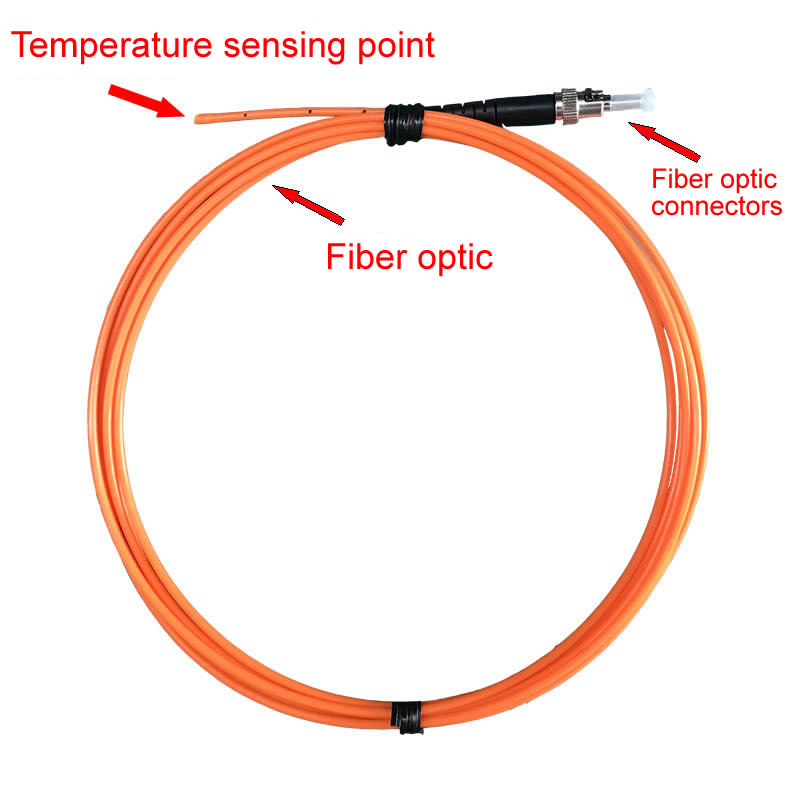
Entre las diversas tecnologías de seguimiento directo, Detección de fibra óptica fluorescente Se ha convertido en el estándar de oro debido a su estabilidad y simplicidad..
La ciencia de la decadencia de la fluorescencia
La tecnología se basa en la “Tiempo de caída de la fluorescencia” principio.
1. Una fuente de luz LED envía un pulso de luz azul a través de un cable de fibra óptica de sílice..
2. Esta luz excita un material sensor de fósforo. (típicamente dopado con tierras raras) en la punta de la sonda.
3. El fósforo fluoresce, emitiendo una luz roja.
4. Después de que finaliza el pulso de excitación., the glowing red light decays (fades away).
The crucial physical property is that the rate of decay is perfectly dependent on temperature. Hotter temperatures cause faster decay; cooler temperatures cause slower decay. By measuring this time constant, the system calculates the temperature with high precision (typically ±1°C).
15. Why Does the High-Voltage Environment Require Anti-Electromagnetic Interference Temperature Sensors?
The interior of a power transformer is one of the most hostile electromagnetic environments on earth. It contains high electric fields, high magnetic flux, and massive transient switching surges.
The Failure of Electronic Sensors
Conventional electronic sensors (termopares, RTD, o termistores) require metal wires to transmit signals. en un transformador, these wires act as antennas. They pick up Interferencia electromagnética (EMI) e interferencias de radiofrecuencia (RFI), resulting in noisy, unusable data. Worse, induced currents on these wires can heat the sensor itself, falsifying the reading.
The Optical Advantage
Sensores de fibra óptica son inmunes a la EMI. They transmit light (photons), no electricidad (electrons). La luz no se ve afectada por los campos magnéticos.. Esto asegura que la lectura de temperatura permanezca estable y precisa ya sea que el transformador esté en 10% carga o experimentando una corriente de falla de cortocircuito.
16. Are Fluorescent Fiber Optic Sensors Safe in High-Voltage Insulation Environments?

La seguridad es la principal preocupación al introducir cualquier objeto extraño en un devanado de alto voltaje.. El riesgo es que el propio cable del sensor pueda convertirse en un camino para el seguimiento eléctrico. (flashover).
Integridad dieléctrica del sensor
Sondas de fibra óptica fluorescentes están diseñados específicamente para este desafío.
- Material: La fibra está hecha de cuarzo de alta pureza. (vidrio de sílice), y la chaqueta suele estar hecha de PTFE de alta calidad. (teflón) o mirar. Estos son excelentes aislantes eléctricos..
- Distancia de fuga: Los materiales son hidrofóbicos y resistentes a la absorción de aceite., evitando la formación de caminos conductores a lo largo de la superficie del cable.
- Descarga Parcial Gratis: Cuando se instala correctamente en los espaciadores de bobinado., these sensors do not distort the electric field and are tested to remain Partial Discharge (PD) free up to extremely high voltages (p.ej., 500clase kV).
This dielectric safety allows the sensor to be placed directly in contact with the high-voltage conductor, bridging the potential difference between the HV winding and the grounded tank wall safely.
17. Does the Fluorescent Fiber Optic Temperature System Require Periodic Calibration and Maintenance?
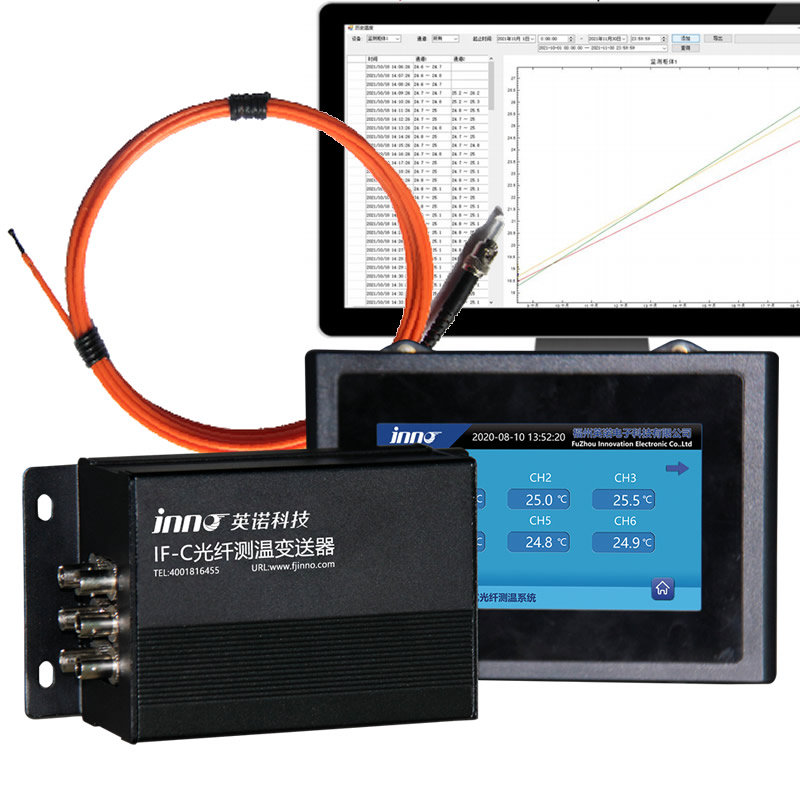
One of the most significant operational advantages of tecnología de fibra óptica fluorescente over older optical methods (such as GaAs or FBG) is its inherent stability.
No Calibration Drift
Older technologies relied on light intensity or wavelength shifts, which could be affected by fiber bending, pérdidas del conector, o envejecimiento de la fuente de luz. En contraste, fluorescent technology measures tiempo de decaimiento. The decay characteristic of the phosphor sensor is a fundamental physical property of the material. It does not change over time, nor is it affected by the attenuation (dimming) of the fiber cable. Por lo tanto, the system effectively requires sin recalibración over its entire service life, making it a true “encajar y olvidar” solution for long-term asset monitoring.
18. How to Utilize Precise Temperature Data to Achieve Dynamic Transformer Rating Increases?
The ultimate return on investment (retorno de la inversión) for a predictive maintenance system lies in Calificación dinámica (or Dynamic Loading).
Unlocking Hidden Capacity
Nameplate ratings are conservative. They assume a worst-case scenario (p.ej., 40°C ambient temperature). Sin embargo, if the actual ambient temperature is 10°C, the transformer has significant thermal headroom. Con real-time winding temperature data, operators can safely load the transformer above its nameplate rating (p.ej., a 120% o 130%) during peak hours, provided the internal hotspot remains within safe limits. This delays the need for capital expenditure on new infrastructure by maximizing the utilization of existing assets.
19. Can Existing Power Transformers be Retrofitted with Fiber Optic Temperature Systems?
While the ideal time to install direct winding sensors is during the manufacturing process (winding phase), retrofitting is a viable option for critical legacy assets.
Retrofitting Strategies
- During Rewind/Refurbishment: If a transformer is sent to a repair shop for coil replacement, installing fiber optic probes into the spacers is a standard upgrade procedure.
- Tank Wall Feed-throughs: To get the signal out of the tank, specialized oil-tight feed-through plates are installed. These can often replace unused bolted flange plates on the tank cover or wall.
- Magnetic External Probes: For units that cannot be opened, fiber optic probes can be magnetically attached to the tank wall or cooling headers to provide immunity to EMI, although this does not provide direct winding visibility.
20. Why Should You Deploy a Transformer Predictive Maintenance Solution Immediately?
The electrical grid is aging, and load profiles are becoming more volatile with the integration of renewable energy and EV charging. El “run-to-failure” approach is no longer economically viable or safe. Implementando un análisis de mantenimiento predictivo strategy centered around direct optical monitoring transforms your maintenance culture from reactive to proactive.
By detecting thermal faults early, you prevent catastrophic failures, ensure the safety of your workforce, and secure the reliability of the power supply for your customers.
Beyond Transformers: Extended Applications of Our Fluorescent Fiber Optic Technology
Our advanced Fluorescent Fiber Optic Temperature Sensing System is not limited to power transformers. Its unique properties—total immunity to electromagnetic interference, high voltage isolation, and microwave transparency—make it the critical solution for a wide range of demanding industrial and medical applications.
Fuerza & Utility Sector
- Transformer Windings: Direct hotspot monitoring for Oil-Immersed and Dry-Type units.
- Aparamenta & Switchboards: Continuous monitoring of busbar joints, contactos, y terminaciones de cables.
- Large Hydro Turbines: Stator winding and bearing temperature monitoring in high-vibration environments.
- Terminaciones de cables & Heads: Online temperature monitoring for HV cable joints.
- Unidades principales de anillo (RMU): Plug/bushing temperature monitoring.
- Isolated Busbar Systems: Monitoring enclosed conductive paths.
- IGBT Modules: Precise thermal management for high-power electronics and inverters.
- Circuit Breaker Static Contacts: Detecting oxidation and contact resistance issues.
- SIG (Dispositivo de distribución aislado en gas): Online hotspot detection inside sealed gas chambers.
Médico & Investigación científica
- RF Hyperthermia Therapy: Monitoring tissue temperature during cancer treatment without interfering with RF fields.
- Ablación por microondas: Precise control for microwave-based medical procedures.
- resonancia magnética (Imágenes por resonancia magnética): Patient and equipment monitoring inside the high-magnetic bore.
- RMN (Nuclear Magnetic Resonance): Temperature compensation for high-precision spectrometers.
Industrial & Fabricación de semiconductores
- Sistemas de grabado con plasma ICP: Control de temperatura de obleas en campos de plasma de alta energía..
- RIE (Grabado de iones reactivos) Sistemas: Monitoreo en el interior de mandriles electrostáticos.
- Sistemas de digestión por microondas: Monitoreo de seguridad para equipos de análisis químicos..
- Calefacción industrial por microondas: Control de proceso para el secado., curación, y aplicaciones de sinterización.
- Dispositivos electroexplosivos (EED): Pruebas y monitoreo en entornos volátiles.
- Física de partículas de alta energía: Monitorización en aceleradores y sincrotrones donde la radiación y los campos electromagnéticos son extremos.
Listo para proteger sus activos críticos?
Ya sea que esté administrando una flota de transformadores de alto voltaje o diseñando la próxima generación de máquinas de resonancia magnética., Los datos precisos de temperatura son su activo más valioso..
Póngase en contacto con nuestro equipo de ingeniería hoy para analizar los requisitos de su aplicación específica y descubrir cómo nuestros Sensores de fibra óptica fluorescentes can provide the visibility you need.

Sensor de temperatura de fibra óptica, Sistema de monitoreo inteligente, Fabricante distribuido de fibra óptica en China
 |
 |
 |