 Sensores de temperatura de fibra óptica INNO ,sistemas de monitoreo de temperatura.
This article introduces the principle of fiber optic temperature sensors, the top 10 manufacturers of fiber optic temperature sensors in temperature measurement, and a list of the best fiber optic temperature sensor products.
The temperature measurement principle of fiber optic temperature sensors
The fluorescence temperature measurement device manufactured based on the functional relationship between fluorescence afterglow lifetime and temperature has advantages that traditional temperature measurement methods cannot compare with.
The basic principle of fluorescence temperature measurement
When a substance is excited, such as by short wavelength visible or ultraviolet light, electric field excitation, or chemical reactions, it will absorb and store energy, and transition to an excited state with a certain vibrational energy level through the ground state. But the excited state is not stable and may return to equilibrium, and when the external excitation source stops working, the luminescence phenomenon will continue for a period of time, which is called afterglow. Además, during the deactivation process of fluorescent molecules, unstable excited state molecules will transition from high energy levels to low energy levels through energy level transitions, and the excess energy will emit light in the form of electromagnetic radiation. Por lo tanto, according to the different excitation methods, it can be divided into photoluminescence, electroluminescence, chemiluminescence, and bioluminescence.
Según la ley de Planck, when the energy of the incident light is received by the luminescent material, it will excite electrons in the material to produce electron level transitions, and this process will produce outgoing light with a wavelength of λ. The formula for the energy difference between high and low energy levels is:
E2-E1=k λ v=kf
en la formula: E1- the energy of the electron at a lower energy level;
E2- Energy of electrons at higher energy levels;
k – Planck constant;
V – the propagation speed of light in vacuum;
F – frequency of light;
λ – The wavelength of the emitted light.
Due to E1 and E2 being in different energy bands, they represent light in a certain band, while the energy in the molecule includes rotational energy generated by electrons and vibrational energy caused by axial elastic vibrations between nuclei. Por lo tanto, when molecules absorb light radiation, after quantum transitions, the electron energy will rise from the ground state to a higher energy level, and the rotational energy and vibrational energy will change simultaneously, causing the three energies to interact with each other. After the incident light disappears, the luminescent material will continue to emit light for a period of time, and the emitted light is fluorescence; High frequency and short wave light energy will excite long wave and low frequency light, and follow Stokes’ law.
The basic theoretical basis of fluorescence measurement method is that when the intensity of the fluorescence linear spectrum shows monotonicity with temperature, and the temperature of the fluorescent substance determines the time of the light quenching process, fluorescence temperature measurement can be carried out. Por lo tanto, it is generally divided into fluorescence intensity temperature measurement method, fluorescence lifetime temperature measurement method, and laser induced fluorescence method. entre ellos, the fluorescence lifetime temperature measurement method is not easily affected by the intensity of the excitation light source, coupling degree, and fiber transmission efficiency in the temperature measurement process, and has more obvious advantages in use. The temperature measurement principle is that after the excitation light source is removed, the time for the fluorescent substance to continuously emit fluorescence is called the fluorescence lifetime, which depends on the lifetime of the excited state. The fluorescence lifetime of fluorescent substances is related to the corresponding temperature within a certain temperature range. Fluorescence lifetime refers to the time it takes for the fluorescence intensity to decay to 1/e of its original intensity when the excitation light source is cut off, and its relationship with temperature can be expressed as:
t (t)=1+e – Δ E/(KT) Rs+RTe – Δ E/(KT)
en la formula: Rs, RT, k, Δ E – constant;
t – thermodynamic temperature.
From this, it can be seen that the time constant of fluorescence afterglow decay is a single valued function of temperature and is only related to temperature.
Arriba 10 fabricantes de sensores de temperatura de fibra optica
1、Ciencia electrónica de innovación de Fuzhou&Compañía tecnológica., Limitado.

The company has established over a hundred strategic partners and stands out in the power intelligent manufacturing industry, firmly at the forefront of the industry. Its main customers include well-known enterprises such as TBEA, Hainan Jinpan, Electricidad Qianjiang, Zhongdian Electric, Nankín Daquan, and Ningbo AUX.
The product is widely used in fields such as power, tránsito ferroviario, municipal comprehensive pipe gallery, energía nuclear, nueva energía, petroquímicos, oleoductos y gasoductos, seguridad perimetral, etc.. Through years of effort and accumulation, Inno has gained a good reputation in the field of intelligent monitoring, and the product is increasingly recognized by more and more customers.
En el futuro, Inno Technology will continue to unleash its scientific and technological innovation vitality, fully utilize the advantages and foundation of technology-based enterprises, and strive to become a leader in the field of fiber optic sensing!
MKS sensor de temperatura de fibra óptica probes are designed to offer industry leading accuracy, repeatability, and reliability for a wide range of applications. The probe is immune to RF and enables customers to monitor temperature in extreme environments. They are easy to install, robust and can be customized for OEM applications. Customized design available upon request.
- Immune to RF
- Highly accurate across full temperature range
- Excellent sensor-to-sensor precision
- Outstanding long-term repeatability
- Sensors do not require recalibration
- Probes and converters are fully interchangeable
At MKS, we have a long history of leveraging our collective curiosity to understand and develop solutions that are at the core of many key technological innovations. These innovations have driven accelerated roadmaps for Semiconductor, Industrial, Life and Health Sciences, Research and Defense markets.
3、Innovaciones Luna
Luna Innovations is proud of our rich tradition of working in close collaboration with customers to develop the products that meet and exceed our clients’ needs for sensing, test & medición, escucha, and control solutions. This heritage stems from a series of in-house technology innovations and acquisitions.
Fiber optic temperature sensors are immune to the many environmental effects that compromise other measurement technologies, can be embedded and installed in locations traditional temperature sensors cannot and deliver an unprecedented level of spatial detail and data without sacrificing precision and sensitivity.
4、Soluciones Opsens
Los sensores de temperatura de fibra óptica de Opsens Solutions brindan un rendimiento insuperable para diversas industrias.
Nuestras aplicaciones incluyen la monitorización en imágenes por Resonancia Magnética Nuclear (RMN) y radiofrecuencia (RF) entornos energéticos.
Estos sensores están perfectamente diseñados para aplicaciones relacionadas con la energía con alto voltaje y perturbaciones electromagnéticas. (EMI). También pueden sobrevivir en ambientes irradiados y son inmunes a la energía de microondas..
Estos sensores se pueden utilizar en una amplia gama de aplicaciones.: del ambiente criogénico (como un imán superconductor), para aplicaciones de alta temperatura hasta 350 Celsius.
5、Ingeniería Omega, Cª.
6、Yokogawa
Yokogawa Electric Corporation announces that it will release the DTSX®3000 distributed temperature sensor on August 12. With a one meter spatial resolution, this distributed temperature sensor can measure the temperature along fiber-optic cables up to 50 km in length, eight times the distance possible with our previous model. In terms of measurement distance and temperature resolution, this is one of the industry’s top-performing distributed temperature sensors.
The DTSX3000 is well suited for plant and infrastructure maintenance applications that necessitate the monitoring of temperature over long distances or across wide areas. Specific applications include the detection of gas and liquid leaks in tanks and other large production facilities, and the detection of abnormal heat levels in power lines.
7、Sensores de temperatura de fibra óptica FISO
FISO’s Fiber Optic Temperature Sensors provide accurate, estable, y mediciones repetibles. Estas mediciones se basan en variaciones de la luz reflejada (en comparación con la luz emitida) debido a la expansión térmica del vidrio altamente estable utilizado dentro del sensor.. El cable de fibra óptica puede tener hasta varios metros de largo sin afectar la calidad ni la precisión de los resultados..
8、Sensores y controles Althen
Sensores de temperatura de fibra óptica
Fiber optic temperature sensors use the properties of optical fibers to measure changes in temperature. These sensors offer several advantages over traditional electronic temperature sensors and are often used in environments with high temperatures, interferencia electromagnética (EMI) or explosion hazards.
9、 qualitrol
QUALITROL manufactures monitoring and protection devices for high value electrical assets and OEM manufacturing companies. Establecido en 1945, QUALITROL produces thousands of different types of products on demand, customized to meet unique requirements.
The Neoptix product line includes fiber optic temperature sensors for transformer windings temperature monitoring and for laboratory, industrial, y aplicaciones médicas.
10、Energía Avanzada
Advanced Energy ofrece sensores de fibra óptica altamente confiables y precisos para aplicaciones de detección y medición de temperatura.. La tecnología FluorOptic® patentada por Luxtron® permite una detección precisa de la temperatura en entornos hostiles donde los sensores convencionales fallarían., como en la fabricación de semiconductores, electronica de potencia, y las industrias aeroespaciales. Con una variedad de opciones para satisfacer diferentes necesidades de aplicación., Estos sensores de fibra óptica proporcionan una solución ideal para monitorear la temperatura y garantizar la eficiencia del proceso y la calidad del producto.. Además, Rejilla de fibra Bragg WaveCaptureTM de Advanced Energy (FBG) Las soluciones de detección ofrecen una manera confiable y rentable de monitorear la tensión y la temperatura en estructuras y materiales.. Con la capacidad de medir la tensión con alta precisión., Estos sensores FBG se utilizan en una variedad de aplicaciones, incluida la aeroespacial., Ingeniería civil, y las industrias del petróleo y el gas.
Ranking of the Best Fiber Optic Temperature Sensor Products
1、Sondas de sensor de temperatura de fibra óptica fluorescente
La sonda de temperatura de fibra óptica fluorescente tiene un buen aislamiento eléctrico, interferencia antielectromagnética, resistencia a la corrosión química, Sin contaminación y muchos otros sensores de temperatura tradicionales no se pueden comparar con las ventajas..
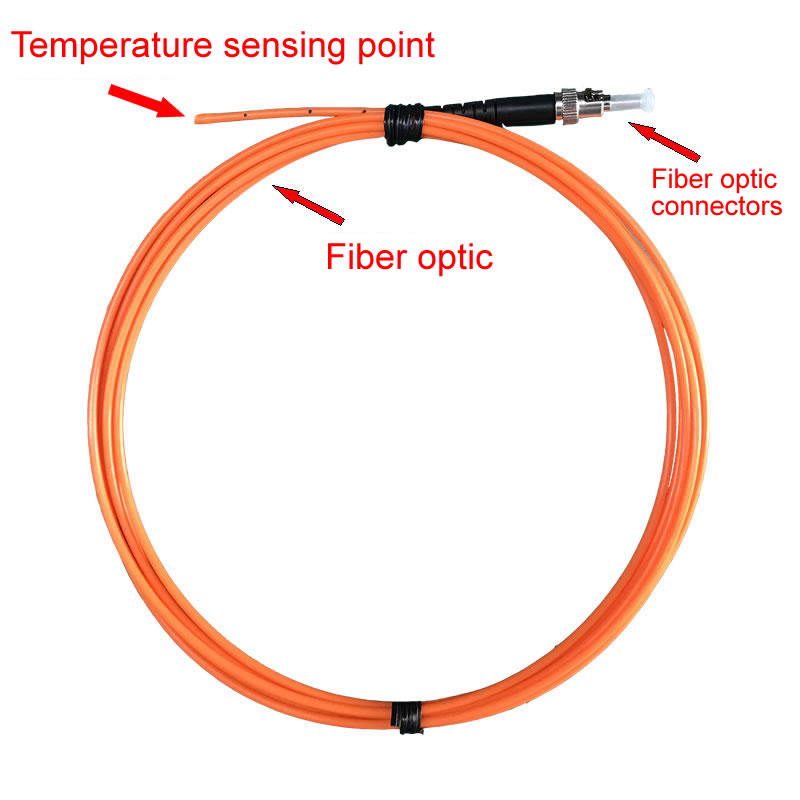
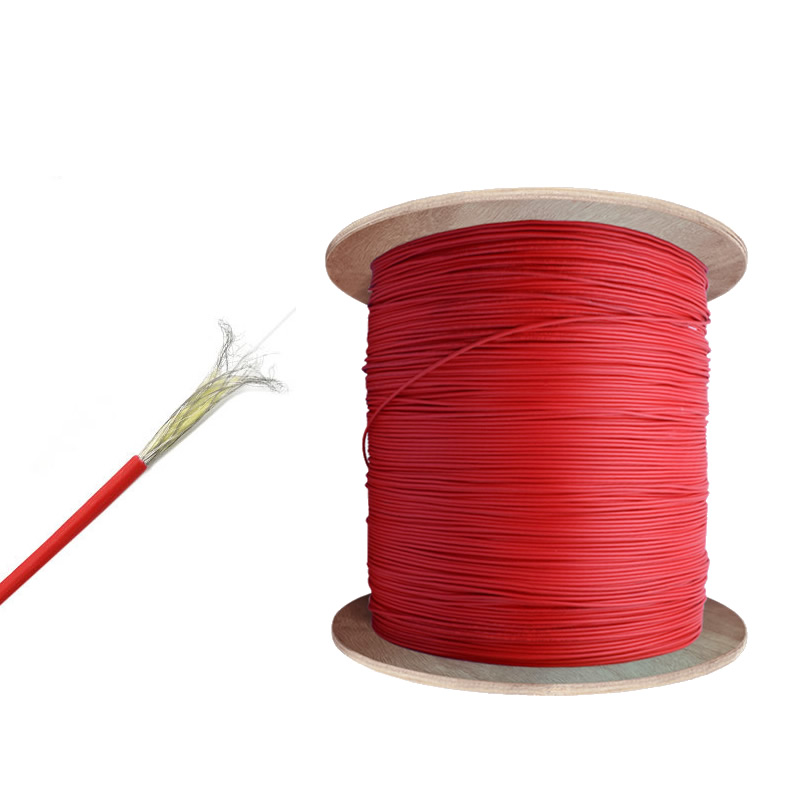
Detección de temperatura de fibra óptica, FOTS es una tecnología de medición de temperatura basada en señales de transmisión de fibra óptica, que utiliza las propiedades físicas de las fibras ópticas para lograr la transmisión y medición de señales de temperatura.. El sensor de fibra óptica con detección de temperatura consta de un módulo de transmisión de fibra óptica y un cabezal sensor de temperatura., que puede medir la temperatura en cualquier posición y en cualquier ambiente.
3、Sensor de temperatura de rejilla de Bragg de fibra
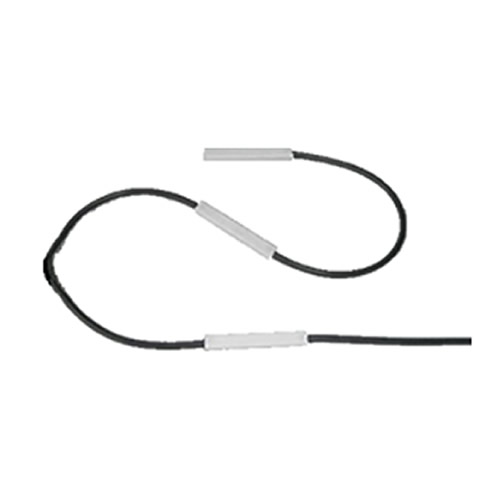
The IF-FBG fiber optic grating temperature sensor is a new type of temperature sensor developed specifically for temperature measurement of power switchgear, utilizing the inherent temperature sensing characteristics of fiber optic gratings. It is suitable for temperature monitoring and fire alarm at high-voltage power switchgear, empalmes de cables de alta tensión, etc.. in power plants, subestaciones, y otros lugares. It has many advantages such as high temperature measurement accuracy, resistencia de alto voltaje, anti creep, resistencia a la corrosión, strong lightning resistance, y sin fuertes interferencias electromagnéticas.

Sensor de temperatura de fibra óptica, Sistema de monitoreo inteligente, Fabricante distribuido de fibra óptica en China
 |
 |
 |