 Sensores de temperatura de fibra óptica INNO ,sistemas de monitoreo de temperatura.
The method of using fiber optic temperature measurement for transformers is to install fluorescent fiber optic sensors or fiber optic grating sensors at key parts of the transformer, como devanados y núcleos de hierro, and then determine the temperature by detecting changes in fluorescence lifetime or reflection wavelength.
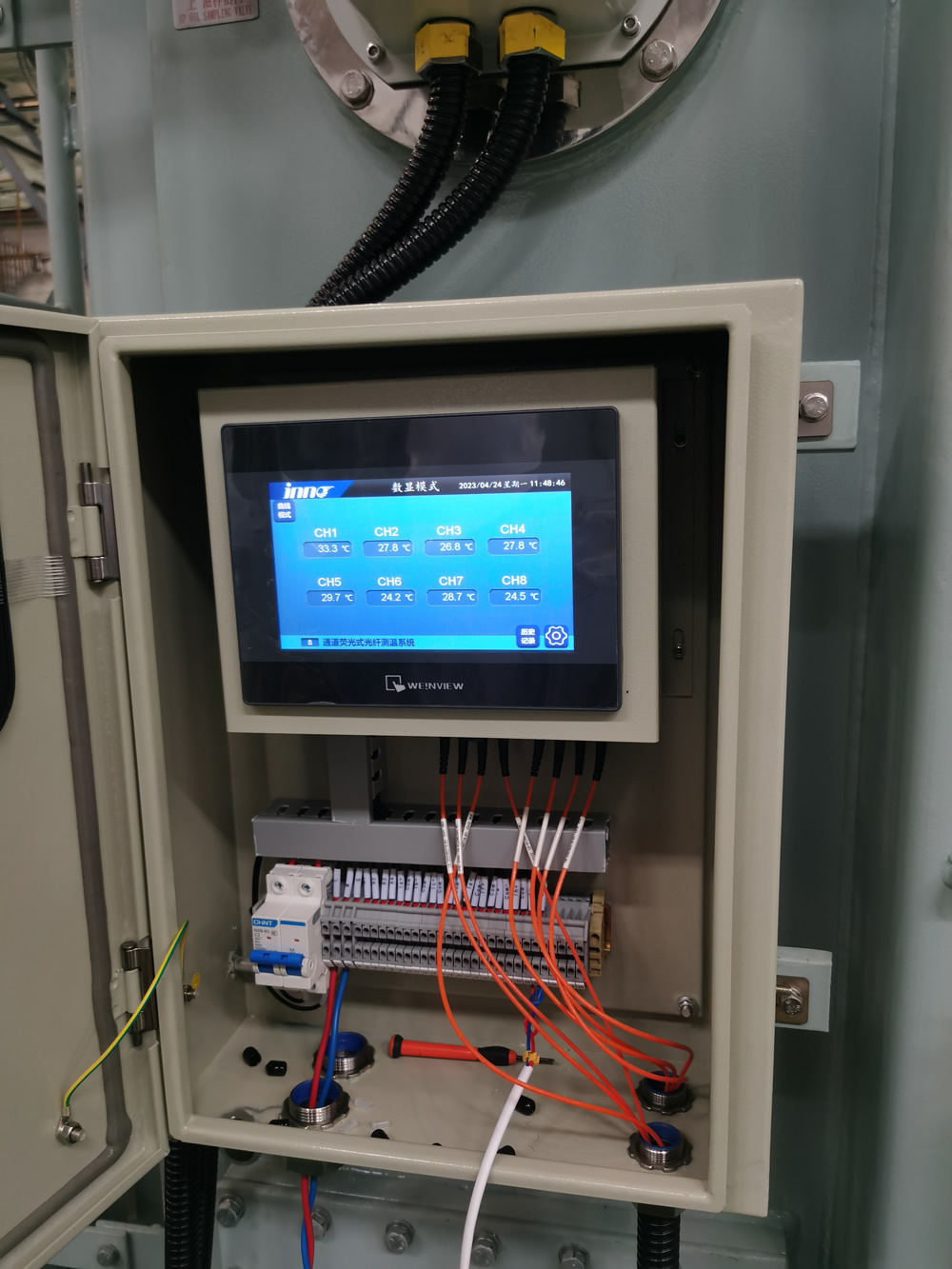
1. Principle of Transformer Fiber Optic Temperature Measurement
Transformer fiber optic temperature measurement is a temperature detection method based on fiber optic sensing technology, and its principle is as follows:
Principle based on fluorescence characteristics
Fluorescent fiber optic sensor is a commonly used method for temperature measurement of transformer fibers. This sensor consists of multimode optical fibers and a fluorescent object mounted on top of it. Fluorescent substances emit fluorescence energy when stimulated by light of a certain wavelength (such as blue violet light). Después de cancelar la excitación., the persistence of fluorescence afterglow depends on the characteristics of the fluorescent substance, environmental temperature factors, etc., and this excited fluorescence usually decays exponentially, with the decay time constant called fluorescence lifetime or fluorescence afterglow time 7. A diferentes temperaturas ambientales., la decadencia del resplandor de la fluorescencia varía, and the higher the temperature, the shorter the fluorescence lifetime. By detecting the fluorescence lifetime, the temperature value can be indirectly determined. Por ejemplo, in dry-type transformer fiber optic temperature measurement, el sensor de temperatura de fibra óptica fluorescente utilizes this principle. The probe is embedded inside the insulation of the winding and directly contacts the winding conductor. When the winding temperature changes, the fluorescence lifetime of the fluorescent substance changes accordingly, which is detected by the sensor.
Taking Fuzhou Yingnuo Technology’s fiber optic temperature measurement technology as an example, its transformer winding fluorescence temperature measurement technology uses the energy absorbed by fluorescent molecules when the excited light beam enters the winding, and emits a fluorescence signal. By measuring the lifetime of the fluorescence signal, the temperature of the winding can be indirectly determined.
Principle of Fiber Bragg Grating
Fiber Bragg Grating is a passive filtering device formed by periodically modulating the refractive index of the fiber core. For fiber optic grating temperature sensors, cuando la temperatura cambia, the grating period and core refractive index of the fiber optic grating will change, resulting in a drift in the reflected wavelength. By detecting changes in reflection wavelength, temperature variation information can be obtained. en transformadores, La instalación de sensores de temperatura de rejilla Bragg de fibra en piezas clave, como devanados y núcleos de hierro, puede detectar cambios de temperatura en estas piezas en tiempo real.. El sistema de medición de temperatura del transformador de potencia de rejilla de fibra óptica adopta una tecnología avanzada de medición de temperatura de rejilla de fibra óptica., que utiliza el cambio en la longitud de onda reflejada de la rejilla de fibra óptica bajo temperatura para medir la temperatura del transformador. Esta tecnología tiene las ventajas de un alto aislamiento., no afectado por el entorno electromagnético, adecuado para larga distancia, high-quality signal transmission, y alta precisión de medición. Es adecuado para su uso en entornos de alto voltaje y campos magnéticos fuertes, como la electricidad..
2. Pasos del método de medición de temperatura de fibra óptica del transformador
Trabajo de preparación preliminar.
Determine temperature measurement requirements and locations: En primer lugar, it is necessary to clarify which parts of the transformer need to be measured for temperature. Por ejemplo, para transformadores sumergidos en aceite, it may be necessary to measure the temperature of windings, núcleos de hierro, y pasajes de aceite; Para transformadores tipo seco, the focus may be on the winding temperature. Determine the specific temperature measurement point location based on the type of transformer, entorno operativo, and safety requirements. Por ejemplo, if there is concern about the insulation performance being affected by overheating of transformer windings, it is necessary to install fiber optic sensors near the windings.
Choose appropriate fiber optic temperature measurement equipment: Select fiber optic temperature sensors, fiber optic thermometers, and other equipment based on factors such as temperature measurement range, requisitos de precisión, y adaptabilidad ambiental. If in a high-temperature environment, es necesario elegir sensores de fibra óptica que puedan soportar altas temperaturas y tener una alta precisión de medición; Si se encuentra en un entorno de fuerte interferencia electromagnética, Se debe dar prioridad al uso de equipos con fuertes capacidades antiinterferencias electromagnéticas., such as fluorescent fiber optic temperature sensors, que tienen características anti interferencia electromagnética.
Check equipment integrity: Antes de la instalación, es necesario inspeccionar el equipo de medición de temperatura de fibra óptica, incluyendo si la fibra óptica está dañada y si el sensor está funcionando correctamente. Para fibras ópticas, es necesario comprobar si existen grietas o roturas en su apariencia; Para sensores, Se pueden utilizar herramientas de prueba profesionales para comprobar su funcionalidad., como ingresar señales de temperatura estándar para ver si la salida del sensor cumple con las expectativas.
Instalación de Sensores de Fibra Óptica
Manejo del lugar de instalación: si hay aceite, polvo, u otras impurezas en el lugar donde está instalado el sensor de fibra óptica, primero debe limpiarse para garantizar que el sensor pueda medir la temperatura con precisión. Por ejemplo, in oil immersed transformers, si el sensor se va a instalar cerca del paso de aceite, es necesario evitar que las impurezas en el aceite afecten el contacto entre el sensor y el objeto medido.
Fijación de sensores: Utilice accesorios de fijación adecuados para instalar el sensor de fibra óptica en la posición predeterminada. Si se mide la temperatura del devanado, es necesario asegurar un buen contacto entre el sensor y la superficie del devanado para detectar con precisión los cambios de temperatura. Para la instalación de sensores de fibra óptica en transformadores tipo seco, attention should be paid to avoiding mechanical damage to the sensors during the installation process, and ensuring that the sensors are firmly fixed and will not be displaced due to the vibration of the transformer. Al mismo tiempo, it is important to maintain the normal curvature of the fiber optic sensor and avoid excessive bending that can cause damage to the fiber optic. Accessories such as fiber optic protective sleeves can be used for protection.
Fiber optic connection and wiring
Fiber optic connection: Connect the fiber optic cable to the thermometer, and be careful to protect the fiber core during the connection process to avoid damage. Por ejemplo, when connecting optical fibers, specialized fiber connectors should be used and the correct connection steps should be followed to ensure a stable and reliable connection. When plugging or unplugging fiber optic connectors, avoid applying excessive force to prevent damage to the fiber core.
Fiber optic cabling: Plan the routing path of fiber optic cables to avoid external compression, pulling, or wear as much as possible. If wiring is required around the transformer, it should be kept away from the heating components of the transformer to prevent the performance of the optical fiber from deteriorating due to high temperatures. Al mismo tiempo, for longer fiber optic cabling, it is necessary to do a good job of fixing and labeling to facilitate subsequent maintenance and repair.
Testing and Calibration
Functional verification: After completing the installation of the fiber optic cable, use a thermometer for functional verification. By measuring the ambient temperature and calibrating the temperature, ensure the accuracy and stability of the thermometer. Por ejemplo, a standard object with a known temperature can be placed near a fiber optic sensor to check if the temperature displayed by the thermometer matches the actual temperature of the standard object. If there is a deviation, the thermometer needs to be calibrated.
System overall testing: Test the entire fiber optic temperature measurement system, including whether the data acquisition, transmisión, and processing of multiple sensors working simultaneously are normal. Check whether the data can be accurately transmitted to the backend monitoring system and whether the temperature values of each temperature measurement point can be displayed correctly in the monitoring system.

3. Recommended Transformer Fiber Optic Temperature Measurement Equipment
Fluorescente sensor de temperatura de fibra óptica
característica
Fuerte capacidad antiinterferencia: Due to its optical principle for temperature measurement, it is not affected by the strong electromagnetic field inside the transformer and can accurately measure temperature in high voltage and strong magnetic field environments. Por ejemplo, in large substations, transformers are surrounded by complex electromagnetic environments, and fluorescent fiber optic temperature sensors can work stably, providing reliable data for transformer temperature monitoring.
Medición de temperatura de alta precisión: El uso de la relación no lineal entre la señal de fluorescencia y la temperatura para la medición de temperatura puede lograr una alta precisión en la medición de temperatura.. Las investigaciones han demostrado que su precisión puede alcanzar 0.1 grados. Esta medición de alta precisión ayuda a detectar pequeños cambios en la temperatura del transformador de manera oportuna y proporciona una advertencia temprana de posibles riesgos de fallas..
Comprehensive temperature measurement capability: Puede lograr una medición integral de la temperatura de los devanados del transformador sin verse afectado por fallas locales o condiciones de trabajo complejas., y también puede realizar monitoreo de temperatura continuo y en tiempo real. Durante el funcionamiento del transformador., La distribución de la temperatura se puede controlar con precisión ya sea en funcionamiento normal o en caso de condiciones anormales como el sobrecalentamiento local..
Caso de aplicación: The fluorescent fiber optic temperature sensor of Fuzhou Yingnuo Electronic Technology Co., Limitado. is widely used in temperature monitoring of dry-type transformers and oil immersed transformers. In dry-type transformers, this sensor can adapt to its special operating environment and accurately measure the winding temperature of the transformer; In oil immersed transformers, temperature changes in windings and oil passages can also be accurately monitored.
Sensor de temperatura de rejilla de Bragg de fibra
característica
High insulation and stability: Fiber Bragg grating itself is made of optical fibers and has good insulation performance, which can work safely in high voltage environments. And its stability is good, and the measurement results are not easily affected by external factors. Por ejemplo, in high-voltage transformers in power systems, fiber Bragg grating temperature sensors can work stably for a long time, providing guarantees for the safe operation of transformers.
Alta precisión y sensibilidad: It has high sensitivity to temperature changes, can accurately detect small temperature changes, y tiene una alta precisión de medición. This enables timely detection of abnormal temperature increases in transformer temperature monitoring, and corresponding measures can be taken to prevent transformer failures from occurring.
Distributed measurement can be achieved: temperature measurements can be taken at multiple points along the axis of the fiber Bragg grating, and temperature information at different locations can be obtained by analyzing the reflected wavelength. The distributed measurement feature is very advantageous for comprehensive temperature monitoring of large transformers, as it can obtain temperature data of multiple key parts at once.
Caso de aplicación: The fiber Bragg grating temperature online monitoring system is applied to temperature monitoring of power transformers. This system utilizes the characteristics of fiber Bragg gratings to monitor the temperature changes of transformers in real time, and can transmit data to the monitoring center through the network, making it convenient for operation and maintenance personnel to monitor the operating status of transformers.
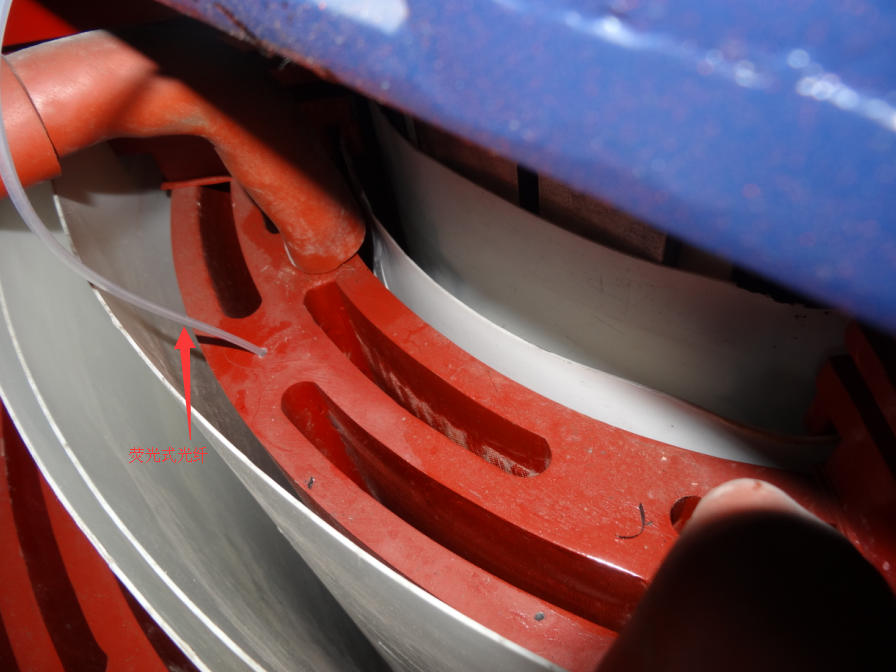
4. Analysis of Transformer Fiber Optic Temperature Measurement Example
Example of Fiber Optic Temperature Measurement for Dry type Transformers
Composition and installation of temperature measurement system: A certain dry-type transformer adopts a sistema de medición de temperatura de fibra óptica fluorescente. The system consists of a fluorescent fiber optic temperature sensor, fibra optica, and thermometer. The sensor is installed inside the insulation of the winding and in direct contact with the winding conductor. The optical fiber transmits the temperature signal collected by the sensor to the thermometer. Durante el proceso de instalación, in order to ensure the normal operation of the sensor, the installation position was carefully selected to avoid external electromagnetic interference and mechanical damage. Por ejemplo, installing the sensor in the middle of the winding can better reflect the average temperature of the winding. Al mismo tiempo, special fixing fixtures are used to ensure close contact between the sensor and the winding when installing the sensor. A protective sleeve is also placed on the outside of the optical fiber to prevent damage during the operation of the transformer.
Temperature monitoring and fault warning: Durante la operación, the thermometer monitors the temperature of the transformer winding in real time. When the temperature rises to the set warning value, the system will issue a warning signal. Por ejemplo, when the winding temperature reaches 120 °C, a warning will be issued. Once the temperature approaches this value, a warning message will be sent to the operation and maintenance personnel through an audible and visual alarm or remote communication interface, reminding them to pay attention to the operation status of the transformer and check for overload, mala disipación de calor, y otras cuestiones. If the temperature continues to rise and reaches the trip value (como 150 °C), the system will control the transformer to trip to protect it from further damage.
Effect evaluation: Through long-term operation monitoring of the dry-type transformer fiber optic temperature measurement system, it was found that the system can accurately measure the winding temperature with an error within ± 0.5 °C. Compared with the traditional PT100 temperature measurement method, the fiber optic temperature measurement system has higher accuracy and better anti-interference ability. In actual operation, there was once a situation where the temperature of a transformer increased due to a cooling fan failure. The fiber optic temperature measurement system promptly issued a warning signal, and the operation and maintenance personnel quickly took measures to repair the cooling fan after receiving the notification, avoiding accidents where the transformer was damaged due to overheating.
5. Example of Fiber Optic Temperature Measurement for Oil Immersed Transformers
Temperature measurement system and installation location: A temperature monitoring system based on fiber Bragg grating is installed on a certain oil immersed transformer. The fiber Bragg grating temperature sensor in the system is installed on the high and low voltage windings of the transformer, connected to the optical fiber through a fiber junction box, and transmits the collected temperature signal to the background monitoring system. Al instalar sensores, considering the oil flow and electric field distribution inside the oil immersed transformer, the sensors are installed near the oil passage support of the winding. This allows the sensors to better sense the temperature changes of the winding, while also avoiding damage caused by direct impact of oil flow on the sensors.
Analysis and application of temperature data: The backend monitoring system analyzes and processes the collected temperature data. Por un lado, it can display the temperature of various parts of the transformer in real time, and operation and maintenance personnel can intuitively view the temperature distribution through the monitoring interface; Por otro lado, by analyzing the historical records of temperature data, the operating status and fault risk of transformers can be predicted. Por ejemplo, if it is found that the temperature of a winding continues to rise for a period of time, and the increase exceeds the normal range, it may indicate that there is a local overheating problem in the winding, y se necesita una inspección adicional para verificar posibles fallas, como cortocircuitos entre vueltas..
Beneficios reales reflejados: Durante la operación del transformador sumergido en aceite, El sistema de medición de temperatura por fibra óptica jugó un papel importante.. Por ejemplo, durante el período de altas temperaturas en verano, cuando la carga del transformador es grande, El monitoreo en tiempo real del sistema de medición de temperatura de fibra óptica permite al personal de operación y mantenimiento ajustar la carga del transformador de manera oportuna., evitando la aparición de altas temperaturas causadas por una operación de sobrecarga a largo plazo. Al mismo tiempo, durante el mantenimiento regular de un transformador, Se descubrió un posible problema de sobrecalentamiento del devanado mediante el análisis de datos de temperatura.. Después de una inspección adicional, Se encontró que la resistencia local aumentó debido al envejecimiento del aislamiento del devanado., causing heating. Due to the timely detection and handling of this issue, potential transformer failures were avoided, ensuring the stable operation of the power system.
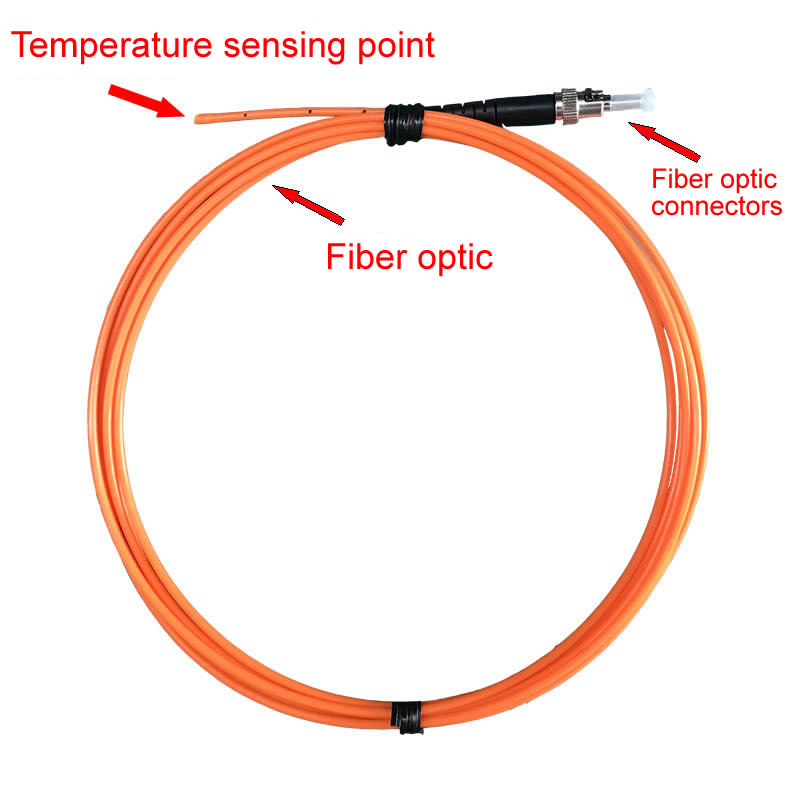
6. Precautions for Transformer Fiber Optic Temperature Measurement
Precautions during installation
Instalación de sensores
Position accuracy: When installing fiber optic sensors, ensure that they are installed in the predetermined and accurate position. For different parts of the transformer, como devanados, núcleos de hierro, etc., the temperature distribution and variation patterns at each position are different. If the installation position of the sensor deviates, it may cause the measurement results to not accurately reflect the true temperature of that area. Por ejemplo, when measuring the temperature of a winding hotspot, if the sensor is installed too far away from the hotspot area, it may underestimate the maximum temperature of the winding and fail to detect potential overheating risks in a timely manner.
Fixed firmness: Use appropriate fixing methods and accessories to firmly fix the sensor in the installation position. Transformers will generate vibration during operation. If the sensor is not firmly fixed, displacement may occur, affecting the accuracy of measurement and even causing poor contact between the sensor and the measured object, making it impossible to measure temperature normally. Por ejemplo, in dry-type transformers, if the fiber optic sensor is not firmly fixed on the winding, it may rub against the insulation layer of the winding during transformer vibration, which not only affects temperature measurement but also may damage the insulation performance of the winding.
Avoid damaging the optical fiber: During the installation of sensors and wiring, special attention should be paid to protecting the optical fiber. Fiber optic is a key component for transmitting temperature signals. If the fiber optic is broken, bent with a small radius, or scratched, it may cause signal transmission interruption or attenuation, thereby affecting the normal operation of the temperature measurement system. Por ejemplo, when optical fibers pass through holes in transformer casings, if the edges of the holes are not smoothed, the fibers may be scratched.
Wiring planning
Stay away from interference sources: The wiring of optical fibers should be kept away from possible interference sources, such as strong electromagnetic fields in transformers, high-temperature components, etc.. Strong electromagnetic fields may interfere with optical signals transmitted through optical fibers, and high-temperature components may degrade or even damage the performance of optical fibers. Por ejemplo, parallel wiring of optical fibers and high-voltage leads of transformers should be avoided to prevent electromagnetic interference with optical fiber signals; Al mismo tiempo, it is necessary to avoid placing the optical fiber near high-temperature components such as the heat sink of the transformer, to ensure that the optical fiber is within the normal working temperature range.
Reasonable path planning: It is necessary to plan the fiber optic cabling path well, making it as short as possible and easy to maintain. Long fiber optic cabling not only increases costs, but may also increase the risk of signal attenuation. During the wiring process, consideration should be given to the structure of the transformer and the surrounding environment to avoid squeezing, pulling, or other mechanical damage to the optical fibers. Por ejemplo, fiber optic wiring can be carried out along the bracket or trunking of the transformer, and fixed at regular intervals to prevent fiber optic shaking.
Precautions during operation
Inspección periódica
Equipment status inspection: Regularly inspect fiber optic temperature measurement equipment, incluyendo sensores, termómetros, fiber optic connectors, y otros componentes. Check whether the sensor is working properly and whether there is any damage or aging phenomenon; Check if the measurement accuracy of the thermometer still meets the requirements; Ensure that the fiber optic connector is securely connected without any looseness or oxidation issues. Por ejemplo, a functional test can be conducted on the fiber optic sensor every six months to compare it with a standard temperature source and check if the measurement error of the sensor is within the allowable range.
Fiber integrity inspection: Check whether the fiber is damaged, roto, or corroded. The transmission loss of the optical fiber can be detected by a fiber optic tester. If an increase in transmission loss is found, it may indicate that there is a problem with the optical fiber and further investigation of the fault point is needed. Al mismo tiempo, it is also necessary to check whether the protective cover of the optical fiber is intact. If the protective cover is damaged, it may expose the optical fiber to harsh environments, increasing the risk of damage.
Data monitoring and analysis
Real time data monitoring: It is necessary to monitor the temperature data collected by the fiber optic sistema de medición de temperatura in real time and pay attention to the trend of temperature changes. If abnormal fluctuations are found in temperature data, such as sudden increases or decreases, timely analysis and processing should be carried out. Por ejemplo, when the temperature of a certain winding of a transformer suddenly rises, it may indicate problems such as overload, cortocircuito, or poor heat dissipation in the winding, and the operation of the transformer needs to be checked immediately.
Historical data utilization: Analyzing the historical records of temperature data can help identify potential issues and fault trends in transformers. By statistically analyzing long-term temperature data, we can understand the temperature changes of transformers under different loads, temperaturas ambientales, y otras condiciones, in order to predict possible fault situations in advance. Por ejemplo, if it is found that the winding temperature of a transformer approaches the warning value during the high temperature period every summer, it can be considered to inspect and maintain the transformer’s cooling system before the arrival of summer.

Sensor de temperatura de fibra óptica, Sistema de monitoreo inteligente, Fabricante distribuido de fibra óptica en China
 |
 |
 |