 أجهزة استشعار درجة حرارة الألياف الضوئية INNO ,أنظمة مراقبة درجة الحرارة.
- أ مستشعر درجة حرارة الألياف الضوئية المعتمد على الفلورسنت يستخدم تقنية تسوس مدى الحياة الفلوري لتحويل التغيرات في درجات الحرارة إلى إشارات بصرية, توفير العزل الكهربائي الكامل, إجمالي مناعة EMI, والسلامة الجوهرية لمراقبة الجهد العالي والبيئة القاسية.
- بالمقارنة مع المزدوجات الحرارية, أهداف التنمية المستدامة, أجهزة استشعار الأشعة تحت الحمراء, وأجهزة استشعار شبكية من الألياف FBG, مجسات درجة حرارة الألياف الضوئية الفلورية تقديم أداء متفوق في رفض التداخل الكهرومغناطيسي, القدرة على تحمل الجهد العالي, الاستقرار على المدى الطويل, وتشغيل خالية من الصيانة.
- تتضمن مجموعة منتجات INNO تحقيقات استشعار الفلورسنت القياسية والمدرعة, تحقيقات بسبار / الترباس جبل, وحدات استشعار OEM أحادية القناة, ومزيلات التشكيل متعددة القنوات الداعمة 1 ل 64 القنوات - كل ذلك بدقة ±1 درجة مئوية, -40 درجة مئوية إلى +260 درجة مئوية, و 25+ عمر الخدمة سنة.
- تمتد التطبيقات محولات الطاقة, المفاتيح الكهربائية, نظم المعلومات الجغرافية, مولدات, أنظمة HVDC, اللفات الحركية, أجهزة الطاقة IGBT/SiC, معدات أشباه الموصلات, أنظمة التصوير بالرنين المغناطيسي الطبية, تخزين طاقة البطارية, طاقة الرياح/الشمسية, الفضاء الجوي, والمنشآت النووية.
- إنو (فجينو) هو متخصص الشركة المصنعة لجهاز استشعار درجة حرارة الألياف البصرية مع 20+ سنوات من التركيز R&تجربة د, 3000+ الأنظمة المثبتة في جميع أنحاء العالم, الصادرات الى 15+ بلدان, وقدرات التخصيص الشاملة OEM/ODM.
- جميع المنتجات تحمل م, إي إم سي, بنفايات, و ايزو 9001/14001/27001/45001 الشهادات, ضمان الامتثال العالمي والموثوقية على المدى الطويل.
جدول المحتويات
- 1. ما هو مستشعر درجة حرارة الألياف الضوئية المعتمد على الفلورسنت؟?
- 2. كيف يعمل? - مبدأ الاضمحلال مدى الحياة مضان
- 3. المزايا الأساسية لأجهزة استشعار درجة حرارة الألياف الضوئية الفلورية
- 4. المقارنة الفنية: الألياف الضوئية الفلورسنت مقابل. الحرارية مقابل. RTD مقابل. الأشعة تحت الحمراء مقابل. FBG
- 5. مجموعة منتجات مستشعر درجة الحرارة بالألياف الضوئية الفلورية من INNO
- 6. المواصفات الفنية الرئيسية
- 7. التطبيقات عبر الصناعات
- 8. اختيار المستشعر & دليل التثبيت
- 9. تخصيص OEM/ODM & الشراكة العالمية
- 10. حول INNO - بيانات اعتماد الشركة المصنعة & مراجع المشروع
- 11. Why Choose INNO Fluorescent Fiber Optic Temperature Sensors
- 12. الأسئلة المتداولة (التعليمات)
1. ما هو مستشعر درجة حرارة الألياف الضوئية المعتمد على الفلورسنت؟?

أ مستشعر درجة حرارة الألياف الضوئية المعتمد على الفلورسنت is a precision optical sensing device that measures temperature by analyzing the fluorescence lifetime decay characteristics of a specialized sensing material bonded to the tip of an optical fiber probe. It represents the core sensing component within a complete نظام مراقبة درجة حرارة الألياف الضوئية, which typically consists of three elements: ال fluorescent fiber optic temperature probe (الاستشعار), the optical fiber transmission cable, و temperature measurement demodulator host (وحدة معالجة الإشارات).
Unlike conventional electrical temperature sensors that rely on metallic conductors carrying electrical signals, ال مستشعر الألياف الضوئية الفلورسنت operates on a purely optical principle — the sensing probe contains no electrical components, carries no current, and transmits only light signals through the fiber. This fundamental design difference gives the sensor its defining characteristics: complete electrical isolation from the measurement point, الحصانة الكاملة للتداخل الكهرومغناطيسي (إيمي/RFI), intrinsic safety with no spark or discharge risk, and stable operation in the strongest electromagnetic fields and highest voltage environments encountered in power systems, المعدات الصناعية, and medical devices.
على المدى “على أساس مضان” specifically distinguishes this sensor type from other fiber optic temperature sensing technologies — such as الألياف براج صريف (FBG) أجهزة الاستشعار, Raman scattering distributed systems, and Brillouin scattering systems — each of which operates on a different physical principle and is suited to different measurement scenarios. Among all fiber optic temperature sensing approaches, fluorescence lifetime decay sensing يُعرف على نطاق واسع بأنه التقنية الأكثر موثوقية وعملية لقياس درجة حرارة الجهد العالي من النوع النقطي, وهذا هو السبب في أنه أصبح معيار الصناعة لمراقبة النقاط الساخنة لملفات المحولات, قياس درجة حرارة الاتصال بالمفاتيح الكهربائية, والتطبيقات الهامة المماثلة.
2. كيف يعمل? - مبدأ الاضمحلال مدى الحياة مضان
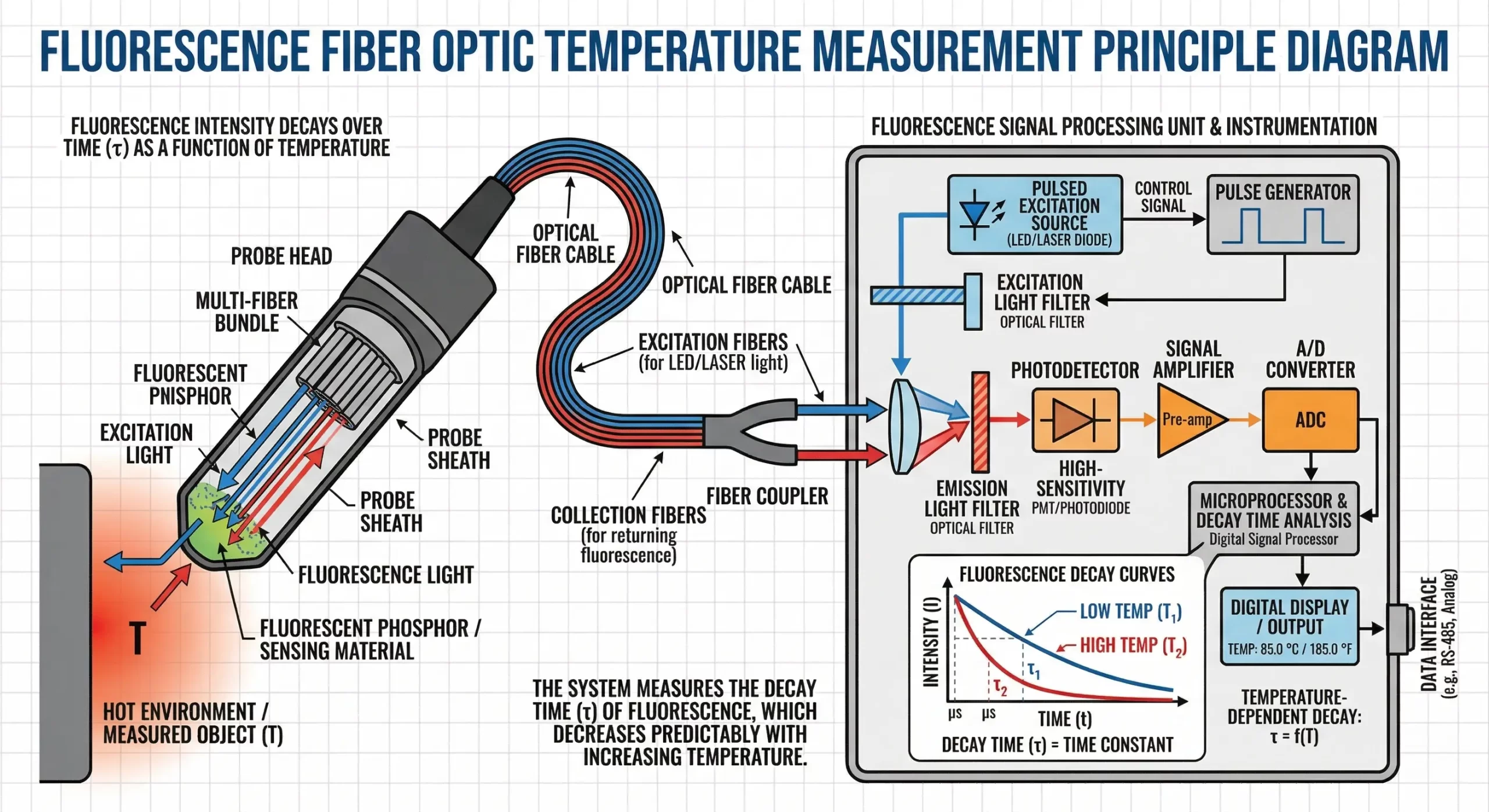
مبدأ التشغيل أ مستشعر درجة حرارة الألياف الضوئية المعتمد على الفلورسنت تتمحور حول ظاهرة فيزيائية تعرف باسم اضمحلال عمر الفلورسنت. يعد فهم هذه الآلية أمرًا ضروريًا لتقدير سبب تقديم المستشعر لهذه الدقة الاستثنائية, استقرار, والموثوقية في بيئات القياس الصعبة.
آلية الاضمحلال مدى الحياة مضان
ال fluorescent fiber optic temperature probe يحتوي على مادة استشعار الفلورسنت النادرة المشبعة بالأرض عند طرفه. عندما مزيل تعديل درجة حرارة الألياف الضوئية يرسل نبضة من ضوء الإثارة عبر الألياف الضوئية إلى طرف المسبار, the fluorescent material absorbs this light energy and transitions to an excited electronic state. As the material returns to its ground state, it re-emits light at a different wavelength — this is the fluorescence signal. The critical parameter is the time it takes for this fluorescence to decay after the excitation pulse ends, known as the fluorescence lifetime or decay time. وقت الاضمحلال هذا له دقة, قابل للتكرار, and well-characterized relationship with temperature: مع ارتفاع درجة الحرارة, molecular thermal vibrations intensify, causing non-radiative energy dissipation to increase, which shortens the fluorescence decay time. The demodulator measures this decay time with high precision and converts it into an accurate temperature value using a factory-calibrated mathematical model.
Why Fluorescence Lifetime — Not Fluorescence Intensity?
An important design choice in the مستشعر الألياف الضوئية الفلورسنت is the use of fluorescence lifetime (وقت الاضمحلال) rather than fluorescence intensity as the measurement parameter. Fluorescence intensity is affected by numerous variables including fiber bending losses, خسائر الموصل, light source power fluctuations, and long-term degradation of optical components — all of which would introduce measurement errors. عمر الإسفار, على النقيض من ذلك, is an intrinsic property of the sensing material that depends only on temperature. It is completely independent of signal amplitude, خسائر الألياف, and source intensity variations. هذا هو السبب fluorescence lifetime decay sensors maintain their calibration accuracy over 25+ years without recalibration — a critical advantage over intensity-based optical sensing methods.
Distinction from Other Fiber Optic Temperature Sensing Methods
Fluorescence-based fiber optic temperature sensors are point-type measurement devices, providing high-accuracy temperature data at a specific, defined location. This distinguishes them from distributed fiber optic temperature sensing (دتس) systems based on Raman or Brillouin scattering, which measure temperature profiles along the entire length of a fiber but with lower spatial resolution and accuracy. It also distinguishes them from الألياف براج صريف (FBG) أجهزة استشعار درجة الحرارة, which measure wavelength shifts in reflected light and are inherently cross-sensitive to mechanical strain — requiring complex compensation techniques when used for temperature measurement alone. For dedicated point-type temperature monitoring in high-voltage and high-EMI environments, fluorescence lifetime-based fiber optic sensors provide the optimal combination of accuracy, استقرار, simplicity, والموثوقية على المدى الطويل.
Fluorescent Sensing Material & Sensor Longevity
The fluorescent sensing material is typically a rare-earth-doped crystal or ceramic compound selected for its stable temperature-dependent fluorescence characteristics, chemical inertness, and resistance to thermal aging. INNO’s proprietary مجسات درجة حرارة الألياف الضوئية الفلورية use carefully formulated sensing materials that maintain consistent fluorescence decay behavior across millions of measurement cycles over decades of continuous operation. Combined with robust fiber optic packaging and hermetic sealing techniques, these probes achieve an operational service life exceeding 25 years without measurable performance degradation — a longevity that has been validated through extensive accelerated aging testing and confirmed by over 3000 installed field systems worldwide.
3. المزايا الأساسية لأجهزة استشعار درجة حرارة الألياف الضوئية الفلورية

The practical value of a مستشعر درجة حرارة الألياف الضوئية المعتمد على الفلورسنت is defined by a set of performance characteristics that collectively make it the superior choice for critical temperature monitoring in challenging environments. Each advantage stems directly from the optical sensing principle and sensor construction design.
عزل كهربائي كامل
ال مسبار الألياف الضوئية الفلورسنت contains no metallic conductors and carries no electrical current at the measurement point. The optical fiber itself is a dielectric (غير موصل) material. This means the sensor provides inherent galvanic isolation between the measurement point and the monitoring equipment, with voltage withstand capability exceeding 100 كيلو فولت. There are no ground loop risks, no leakage current paths, and no electrical safety hazards — making the sensor safe for direct installation on live, energized high-voltage components including اللفات المحولات, اتصالات المفاتيح الكهربائية, و GIS internal conductors.
إجمالي حصانة التداخل الكهرومغناطيسي
Because the sensor transmits only light — not electrical signals — it is completely immune to electromagnetic interference from any source: power frequency magnetic fields, high-frequency switching noise, radio frequency emissions, electrostatic discharge, and lightning-induced transients. This EMI immunity allows the مستشعر درجة حرارة الألياف الضوئية الفلورسنت to deliver stable, accurate readings in the most extreme electromagnetic environments, including inside operating transformers, adjacent to circuit breakers during switching operations, inside GIS compartments, within MRI scanners, and near high-power radar equipment.
السلامة الجوهرية
مع عدم وجود طاقة كهربائية عند نقطة الاستشعار, ال مسبار درجة حرارة الألياف الضوئية لا يمكن أن تولد الشرر, أقواس, or thermal hotspots under any fault condition. This intrinsic safety makes the sensor suitable for deployment in explosive or flammable atmospheres, oil-immersed environments, and gas-insulated enclosures without requiring additional explosion-proof enclosures or safety barriers.
Compact Probe Design
إنو fluorescent fiber optic temperature sensor probes تتميز بقطر نحيف يبلغ 2-3 ملم فقط, enabling installation in extremely confined spaces — including transformer winding slots, switchgear busbar connection points, motor stator slots, and miniature medical catheters. The small size ensures that probe installation does not affect the electromagnetic performance, thermal behavior, or mechanical integrity of the monitored equipment.
25+ Year Maintenance-Free Service Life
The fluorescence lifetime measurement principle is inherently drift-free, and the inorganic sensing material does not degrade under normal operating conditions. The result is a sensor that maintains its factory calibration accuracy throughout its entire operational life — typically exceeding 25 years — with no requirement for periodic recalibration, صيانة, or component replacement. This translates directly into reduced long-term ownership costs and elimination of calibration-related downtime.
استجابة سريعة & دقة عالية
The sensor achieves a response time of less than 1 ثانية, enabling real-time detection of rapid thermal events. دقة القياس القياسية هي ±1 درجة مئوية عبر نطاق التشغيل الكامل, مع تكوينات عالية الدقة متاحة للتطبيقات المتخصصة. إن الجمع بين الاستجابة السريعة والدقة العالية يجعل مستشعر الألياف الضوئية الفلورسنت مناسبة لكل من المراقبة المستمرة للحالة وتتبع الأحداث الحرارية الديناميكية.
تآكل & المقاومة البيئية
ال مسبار درجة حرارة الألياف الضوئية وكابلات الألياف الضوئية مقاومة بطبيعتها للتآكل الكيميائي, دخول الرطوبة, والتدهور البيئي. مع التغليف الواقي المناسب (بما في ذلك التكوينات المدرعة والمختومة بإحكام), تعمل أجهزة الاستشعار بشكل موثوق في الزيت المغمور, رطوبة عالية, عدوانية كيميائيا, والبيئات الخارجية على أكمل وجه 25+ عمر سنة.
4. المقارنة الفنية: الألياف الضوئية الفلورسنت مقابل. الحرارية مقابل. RTD مقابل. الأشعة تحت الحمراء مقابل. FBG

يتطلب اختيار تقنية استشعار درجة الحرارة المناسبة لمراقبة المعدات المهمة فهمًا واضحًا لقدرات كل طريقة وقيودها. يوفر الجدول التالي مقارنة شاملة جنبًا إلى جنب أجهزة استشعار درجة حرارة الألياف الضوئية القائمة على الفلورسنت against four widely used alternative technologies — thermocouples, كاشفات درجة الحرارة المقاومة (أهداف التنمية المستدامة), أجهزة استشعار الأشعة تحت الحمراء, و الألياف براج صريف (FBG) أجهزة الاستشعار — across the performance parameters most critical for high-voltage, صناعي, والتطبيقات الطبية.
| المعلمة | مستشعر الألياف الضوئية الفلورسنت | الحرارية | الحق في التنمية (PT100) | مستشعر الأشعة تحت الحمراء | FBG Fiber Sensor |
|---|---|---|---|---|---|
| مبدأ الاستشعار | مضان تسوس مدى الحياة | تأثير سيبيك (thermoelectric voltage) | Resistance change with temperature | الكشف عن الإشعاع الحراري | Bragg wavelength shift |
| حصانة EMI | مناعة كاملة | Susceptible — signal noise in high-EMI environments | Susceptible — requires shielding and filtering | معتدل - عرضة للإلكترونيات | مناعة كاملة (إشارة بصرية) |
| العزل الكهربائي | Full isolation — no conductors at sensing point | None — metallic conductors create ground loops | None — requires excitation current | Partial — electronics require isolation | Full isolation — all-optical |
| High-Voltage Withstand | >100 كيلو فولت | Not suitable for HV environments | Not suitable for HV environments | Not suitable for direct HV contact | >100 كيلو فولت |
| نوع القياس | Direct contact — internal point measurement | Direct contact — point measurement | Direct contact — point measurement | Non-contact — surface only | Direct contact — point measurement |
| Strain Cross-Sensitivity | None — temperature only | لا أحد | الحد الأدنى | لا أحد | High — requires strain compensation |
| الدقة النموذجية | ±1 درجة مئوية | ±1.5–2.5°C | ±0.5-1 درجة مئوية | ±2-5 درجة مئوية (تعتمد الانبعاثية) | ±1-2 درجة مئوية (after strain compensation) |
| الاستقرار على المدى الطويل | ممتاز - لا يوجد انحراف 25+ سنين | Poor — junction aging and drift | Moderate — resistance drift with thermal cycling | Poor — emissivity changes over time | Good — but wavelength may drift under strain |
| إعادة المعايرة مطلوبة | لا | نعم - دورية | نعم - دورية | Yes — frequent | Occasional |
| خدمة الحياة | >25 سنين | 2–5 years typical | 5–10 years typical | 3–5 years typical | 15–20 years |
| حجم المسبار | 2– قطر 3 ملم | 3–6 mm diameter | 3–6 mm diameter | Bulky sensor head | ~0.2 mm (bare fiber) / 3–5 mm (packaged) |
| تعقيد الأسلاك | Simple — single fiber per channel | Moderate — 2-wire with compensation | Complex — 3-wire or 4-wire | Simple — but requires line-of-sight | Simple — single fiber, متعدد |
| Demodulator Cost | معتدل | قليل | Low–moderate | Low–moderate | High — expensive interrogator |
| السلامة الجوهرية | Yes — no sparks, no electrical energy | No — potential spark source | No — excitation current present | No — electronics present | Yes — all-optical |
| زيت / Sealed Environment | Excellent — fully submersible | Limited — seal degradation over time | Limited — seal degradation over time | Not suitable — no line-of-sight | Good — with appropriate packaging |
| الأنسب ل | HV point monitoring: محولات, المفاتيح الكهربائية, نظم المعلومات الجغرافية, طبي, أشباه الموصلات | الصناعية العامة, low-EMI environments | Laboratory, التدفئة والتهوية وتكييف الهواء, low-EMI process control | Surface temperature screening, non-contact only | Multi-point structural health monitoring with strain |
Key Takeaway
For dedicated point-type temperature monitoring in high-voltage, ارتفاع EMI, and harsh operating environments — including power equipment, المفاتيح الكهربائية, medical systems, and industrial applications — the مستشعر درجة حرارة الألياف الضوئية المعتمد على الفلورسنت offers the best overall combination of EMI immunity, العزلة الكهربائية, measurement stability, عمر خدمة طويل, and low total cost of ownership. بينما FBG fiber Bragg grating sensors share the advantage of optical signal immunity, their inherent strain cross-sensitivity and significantly higher interrogator costs make them less practical for pure temperature monitoring applications. Thermocouples and RTDs remain suitable for low-voltage, low-EMI general industrial applications but cannot match the performance requirements of critical high-voltage asset monitoring. Infrared sensors serve a role in non-contact surface temperature screening but are fundamentally unsuitable for internal hot-spot detection within enclosed or oil-filled equipment.
5. مجموعة منتجات مستشعر درجة الحرارة بالألياف الضوئية الفلورية من INNO

INNO offers a complete range of fluorescence-based fiber optic temperature sensing products — from individual sensor probes and OEM integration modules to multi-channel demodulators and turnkey monitoring systems. Each product is designed, المصنعة, وتم اختباره داخليًا في منشأة إنتاج فوتشو التابعة لشركة INNO, ضمان مراقبة الجودة الكاملة والأداء المتسق عبر خط الإنتاج بأكمله.
مجسات استشعار درجة حرارة الألياف الضوئية الفلورية
مسبار الاستشعار هو عنصر القياس الأساسي للنظام. إنو مجسات درجة حرارة الألياف الضوئية الفلورية القياسية مناسبة للأغراض العامة لمراقبة درجات الحرارة ذات الجهد العالي والتداخل الكهرومغناطيسي العالي عبر مجموعة واسعة من الصناعات. لتطبيقات المحولات, تحقيقات استشعار درجة الحرارة الألياف البصرية المدرعة تتميز بأغلفة واقية من الفولاذ المقاوم للصدأ أو PTFE مصممة خصيصًا لتركيبات الملفات المغمورة بالزيت, توفير الحماية الميكانيكية والمقاومة الكيميائية لعقود من التشغيل المغمور. ال مجسات استشعار درجة حرارة الألياف الضوئية المثبتة على قضيب التوصيل والترباس تم تصميمها لتطبيقات المفاتيح الكهربائية ولوحة التوزيع, مع تكوينات التركيب المُحسّنة للتثبيت الآمن على أسطح قضبان التوصيل, bolted connections, وجمعيات الاتصال قواطع الدائرة. All probe variants feature a compact 2–3 mm diameter and are available with customized fiber lengths up to 20 meters as standard.
Single-Channel Fiber Optic Temperature Sensing Module
ال single-channel fluorescent fiber optic temperature sensing module is a compact, board-level OEM integration component designed for equipment manufacturers and system integrators who need to embed fiber optic temperature sensing capability directly into their own products. The module includes complete signal excitation, fluorescence detection, and temperature demodulation circuitry in a miniaturized package, with standard RS485/Modbus RTU output for direct connection to host controllers, PLCs, or embedded systems.
Multi-Channel Fiber Optic Temperature Demodulators
For multi-point monitoring applications, توفر INNO مزيلات تعديل درجة حرارة الألياف الضوئية متعددة القنوات (measurement hosts) available in 6-channel, 16-قناة, 32-قناة, وتكوينات 64 قناة. يقوم كل مزيل تشكيل في نفس الوقت بمعالجة إشارات الفلورسنت من جميع الأجهزة المتصلة مجسات درجة حرارة الألياف الضوئية, توفير بيانات درجة الحرارة في الوقت الحقيقي لكل نقطة مراقبة. ال مضيف قياس درجة حرارة الألياف الضوئية المتكامل للعرض يجمع بين معالجة الإشارات والقراءات المرئية المحلية في وحدة واحدة مثبتة على لوحة, مثالية لمنشآت غرفة التحكم. للبيئات الكهرومغناطيسية المتطرفة, ال نظام قياس درجة حرارة الألياف الضوئية الكهرومغناطيسية المضادة للتداخل بالموجات الدقيقة يشتمل على حماية وتصفية معززة لضمان التشغيل المستقر بالقرب من مصادر التردد اللاسلكي عالية الطاقة, أنظمة الرادار, وإلكترونيات الطاقة.
الأنظمة الخاصة بالتطبيقات
تقدم INNO أيضًا إعدادات مُعدة مسبقًا, الأنظمة المحسنة للتطبيق بما في ذلك نظام قياس درجة حرارة الألياف الضوئية لملفات المحولات من النوع الجاف, ال جهاز مراقبة ذكي للمحولات الجافة من السيليكون متعدد البلورات, ال dry-type reactor fiber optic temperature measurement device, ال fiber optic temperature measurement system for switchgear, و fiber optic temperature measurement solutions for semiconductor processing equipment. Each system is engineered with the specific monitoring requirements, قيود التثبيت, and communication protocols of its target application in mind.
Transformer Temperature Controllers
Complementing the fiber optic sensor line, INNO manufactures أجهزة التحكم في درجة حرارة المحولات من النوع الجاف بما في ذلك BWDK-326 و BWDK-S201 مسلسل, providing automated fan control, multi-stage over-temperature alarming, ووظائف حماية الرحلة. For oil-immersed applications, oil-immersed transformer fiber optic temperature monitoring systems combine winding hot-spot sensing with intelligent thermal management capabilities.
Software & منصة السحابة
توفر INNO customized cloud platform software for fiber optic temperature monitoring systems, supporting remote data acquisition, في الوقت الحقيقي التصور متعدد القنوات, إدارة إنذار متعددة المستويات قابلة للتكوين, تحليل الاتجاه التاريخي, والتكامل مع SCADA للمؤسسات, DCS, ومنصات إدارة الأصول. منصة البرنامج قابلة للتخصيص بالكامل للعلامة التجارية الخاصة بالعميل, متطلبات الواجهة, والمواصفات الوظيفية.
6. المواصفات الفنية الرئيسية
يعرض الجدول التالي المواصفات الفنية القياسية لـ INNO أجهزة استشعار درجة حرارة الألياف الضوئية القائمة على الفلورسنت وأنظمة إزالة التشكيل متعددة القنوات. جميع المعلمات الرئيسية قابلة للتخصيص لتلبية متطلبات المشروع المحددة.
| المعلمة | مواصفة | ملحوظات |
|---|---|---|
| دقة القياس | ±1 درجة مئوية | دقة أعلى متاحة عند الطلب |
| نطاق درجة الحرارة | -40 درجة مئوية إلى +260 درجة مئوية | نطاقات موسعة قابلة للتخصيص |
| طول كابل الألياف الضوئية | 0– 20 مترا (معيار) | أطوال مخصصة متاحة |
| وقت الاستجابة | <1 ثانية | الكشف عن الأحداث الحرارية في الوقت الحقيقي |
| قطر المسبار | 2-3 ملم | مناسبة لمساحات التثبيت المحدودة |
| العزل الكهربائي | تحمل الجهد >100 كيلو فولت | العزلة الكهربائية الكاملة |
| قنوات المراقبة | 1 ل 64 القنوات لكل مزيل التشكيل | 6 / 16 / 32 / 64 تكوينات القناة |
| واجهة الاتصالات | RS485 / مودبوس ار تي يو | متوافق مع سكادا, بلك, DCS |
| مزود الطاقة | تيار متردد 220 فولت أو تيار مستمر 24 فولت | يمكن الاختيار عند الطلب |
| بيئة التشغيل | -20 درجة مئوية إلى +70 درجة مئوية, ≥95% رطوبة نسبية | الظروف المحيطة المستخلص |
| تقييم حماية المسبار | IP65 | محكم الغبار, مقاومة للماء النفاثة |
| خدمة الحياة | >25 سنين | لا حاجة لإعادة المعايرة أو الصيانة |
| الشهادات | م, إي إم سي, بنفايات, ايزو 9001/14001/27001/45001 | معايير الامتثال العالمية |
خيارات التخصيص
INNO supports customization across all major specifications, including extended temperature ranges for high-temperature or cryogenic applications, custom fiber optic cable lengths beyond the standard 20-meter range, specialized probe packaging materials and geometries, بروتوكولات الاتصال البديلة, and tailored multi-channel configurations. Contact the INNO engineering team directly to discuss project-specific specification requirements.
7. التطبيقات عبر الصناعات
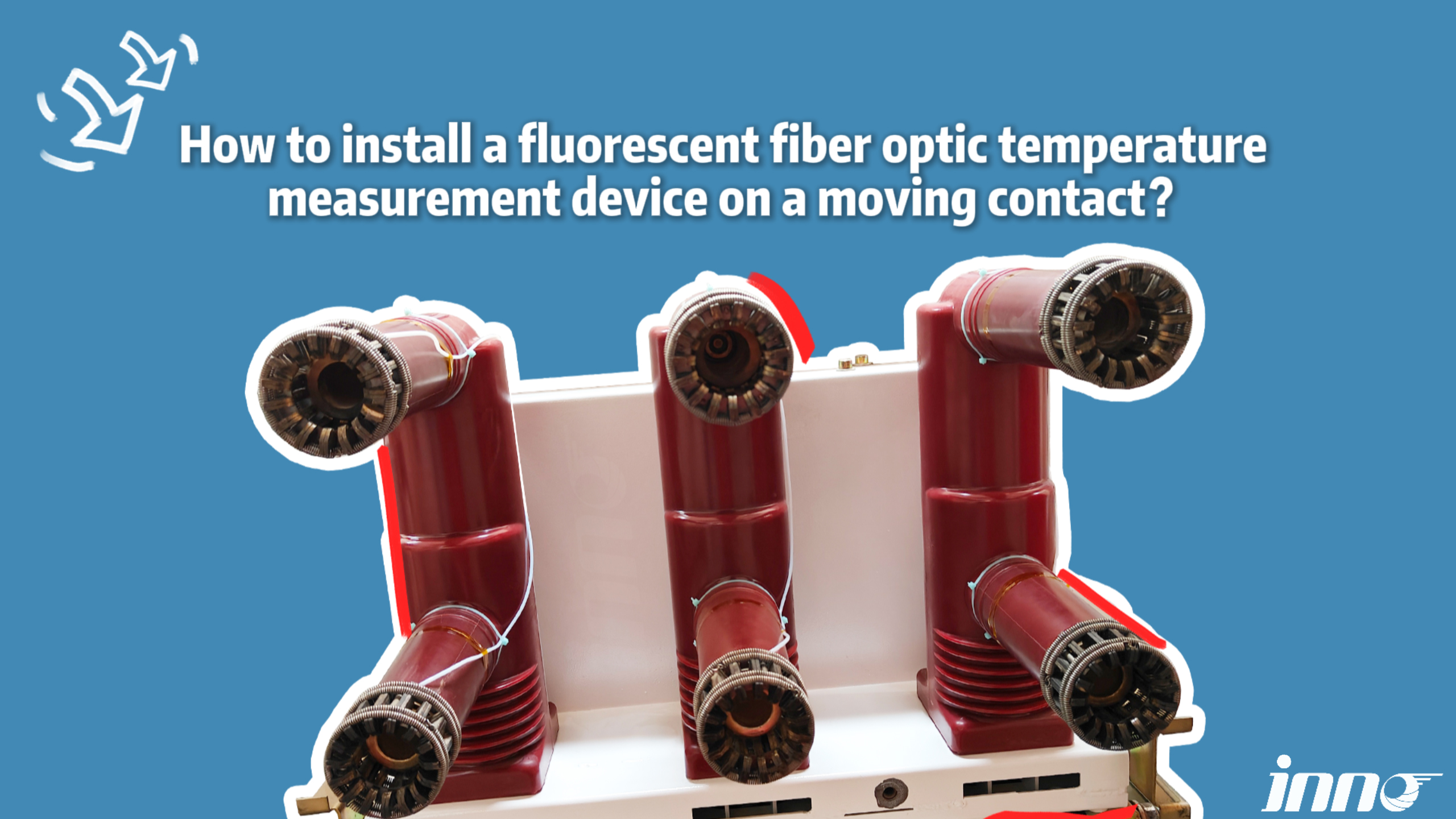
The inherent advantages of أجهزة استشعار درجة حرارة الألياف الضوئية القائمة على الفلورسنت — complete electrical isolation, إجمالي مناعة EMI, السلامة الجوهرية, حجم صغير, and maintenance-free long-term operation — make them applicable to a remarkably broad range of industries and equipment types. The following sections provide a consolidated overview of the key application domains where مجسات درجة حرارة الألياف الضوئية الفلورية and monitoring systems deliver proven value.
قوة & أنظمة الطاقة
The power industry represents the largest application domain for أجهزة استشعار درجة حرارة الألياف الضوئية الفلورسنت. في محول من النوع الجاف و محول مغمور بالزيت التطبيقات, armored fiber optic probes are installed directly at winding hot-spot locations to provide accurate, real-time thermal data for insulation life assessment, إدارة الأحمال, and automated cooling control — replacing less reliable top-oil temperature models with direct winding measurement. في switchgear and circuit breaker التطبيقات, مشتمل قواطع دوائر الفراغ و SF₆ circuit breakers, fluorescent probes monitor contact temperatures, اتصالات بسبار, and arc chamber components to detect abnormal heating caused by contact degradation or loose connections. داخل المفاتيح الكهربائية المعزولة بالغاز (نظم المعلومات الجغرافية) معدات, the sensors provide internal temperature monitoring without introducing any conductive materials into the sealed gas compartment. Additional power applications include cable joint and termination temperature monitoring to prevent localized overheating failures, power reactor and shunt reactor قياس درجة حرارة اللف, generator stator winding hot-spot monitoring with probes embedded in stator slots, HVDC converter valve temperature sensing in extreme electric field environments, و capacitor bank thermal monitoring in harmonic-rich reactive power compensation installations.
صناعي & Equipment Manufacturing
Industrial applications demand sensors that perform reliably under high currents, مجالات مغناطيسية قوية, elevated temperatures, and physically constrained installation conditions. أجهزة استشعار درجة حرارة الألياف الضوئية are deployed in high-voltage motor winding يراقب, where probes embedded in stator slots track insulation thermal aging and support preventive maintenance. في محرك التردد المتغير (VFD) و power module التطبيقات, fluorescent probes measure heat sink and busbar temperatures without electromagnetic interference from high-frequency switching. ل IGBT module و SiC MOSFET device الإدارة الحرارية, fiber optic probes positioned near semiconductor junctions provide critical data for thermal resistance analysis and lifetime prediction. Industrial furnace التطبيقات (heat treatment, annealing, sintering) use high-temperature fiber optic probes for multi-zone thermal field mapping. في معدات تصنيع أشباه الموصلات, probes installed in etching, CVD, and PVD process chambers deliver precise temperature monitoring essential for nanoscale process control. Vacuum environment applications benefit from the sensor’s zero-outgassing and non-conductive properties, بينما industrial robot joint motor monitoring and high-power laser equipment thermal management round out the industrial application portfolio.
طبي & Life Sciences
Medical environments present some of the most demanding sensing requirements: strong magnetic fields in MRI suites, intense RF energy during ablation procedures, and strict biocompatibility and safety standards. أجهزة استشعار درجة حرارة الألياف الضوئية الفلورية are the only proven technology for real-time MRI temperature monitoring, operating with complete immunity to the powerful static and gradient magnetic fields that would destroy or corrupt readings from any electrical sensor. في high-intensity focused ultrasound (HIFU) و الاستئصال بالترددات الراديوية (RFA) therapies, fiber optic probes provide millisecond-level temperature feedback directly at the treatment zone, enabling precise thermal dose control while protecting surrounding healthy tissue. ل microwave ablation إجراءات, the sensors maintain accurate readings despite intense electromagnetic energy. Ultra-slim تحقيقات الألياف الضوئية (2– قطر 3 ملم) can be integrated into medical catheters and implantable monitoring devices for minimally invasive in-vivo temperature measurement in cardiac, oncological, and neurological interventional procedures.
الطاقة المتجددة & Battery Systems
Renewable energy and battery applications require reliable temperature monitoring in high-voltage, high-EMI operating environments with demanding space constraints. في wind turbine المنشآت, fiber optic sensors monitor generator winding and bearing temperatures. Solar inverter power modules are monitored for thermal management optimization. ل power battery pack and module التطبيقات, ultra-slim fiber optic probes can be embedded directly inside battery cells without affecting electrochemical performance, providing internal temperature data that traditional surface-mount sensors cannot capture — critical for BMS optimization and cycle life extension. في energy storage cabinet المنشآت, multi-point fiber optic systems provide comprehensive thermal monitoring for thermal runaway early warning, detecting abnormal temperature rises at the earliest stage to prevent cascading failures. Fuel cell stack internal temperature distribution monitoring and battery safety testing (nail penetration, فاحش, short-circuit) also rely on fiber optic sensors for accurate real-time data under extreme conditions.
Extreme Environments & Advanced Applications
The most challenging measurement scenarios — where conventional sensors fail entirely — are precisely where أجهزة استشعار درجة حرارة الألياف الضوئية القائمة على الفلورسنت demonstrate their greatest value. في aerospace and defense التطبيقات, sensors withstand extreme heat, إشعاع, and electromagnetic environments associated with jet engines, spacecraft systems, radar equipment, and missile electronics. Nuclear facilities and particle accelerators require radiation-resistant, حلول الاستشعار غير الموصلة التي توفرها تكنولوجيا الألياف الضوئية بشكل فريد. في زيت, غاز, والصناعة الكيميائية, الآمنة بطبيعتها, تتيح الطبيعة الخالية من الشرارة لمسبارات الألياف الضوئية إمكانية النشر في الأجواء المتفجرة, خطوط أنابيب الضغط العالي, وبيئات الآبار العميقة دون اتخاذ تدابير إضافية مضادة للانفجار. معدات فائقة التوصيل تمثل المراقبة في درجات الحرارة المبردة تطبيقًا متخصصًا آخر يستفيد من قدرة نطاق درجة الحرارة الممتدة للمستشعر.
8. اختيار المستشعر & دليل التثبيت

اختيار الحق مستشعر درجة حرارة الألياف الضوئية الفلورسنت يعد التكوين وضمان التثبيت الصحيح عمليتين مباشرتين, ولكن الاهتمام ببعض الاعتبارات الأساسية سيؤدي إلى تحسين أداء النظام وطول عمره.
اعتبارات اختيار أجهزة الاستشعار
ابدأ بتحديد بيئة التطبيق - وتحديدًا نطاق درجة حرارة التشغيل, voltage level, electromagnetic conditions, and whether the sensor will be exposed to oil, المواد الكيميائية, رُطُوبَة, or vacuum. ل oil-immersed transformer winding المنشآت, select مجسات درجة حرارة الألياف الضوئية المدرعة with appropriate chemical-resistant sheathing. ل switchgear busbar التطبيقات, choose bolt-mount or surface-mount probe configurations that ensure secure mechanical contact. ل OEM equipment integration, ال single-channel fiber optic temperature sensing module provides the most compact solution. Determine the required number of monitoring points to select the appropriate multi-channel demodulator configuration — 6, 16, 32, أو 64 القنوات. Verify that the standard fiber optic cable length of up to 20 meters meets the distance between sensor probes and the demodulator; if longer runs are needed, contact INNO for custom-length cables. Confirm that the RS485/Modbus RTU communication interface is compatible with your SCADA, بلك, or DCS platform, or discuss alternative protocol requirements with the engineering team.
أفضل ممارسات التثبيت
تركيب أجهزة استشعار درجة حرارة الألياف الضوئية الفلورسنت can be completed by standard electrical technicians without specialized tools or training. Mount sensor probes securely at the designated measurement points, ensuring good thermal contact with the monitored surface or component. Route optical fiber cables with care, maintaining the minimum bend radius specified in the product documentation (typically 10–15 mm) to prevent signal loss. Avoid crushing, pinching, or sharply bending the fibers during cable routing. Secure fiber cables at regular intervals using appropriate clamps or cable ties, providing mechanical protection against accidental damage. تثبيت demodulator host in a suitable control cabinet or panel within the specified ambient temperature range (-20 درجة مئوية إلى +70 درجة مئوية), connect fiber optic cables to the corresponding channel ports, and complete power and RS485 communication wiring. Use the provided monitoring software to verify all channels are reading correctly, configure alarm thresholds, and confirm data communication with the upstream monitoring system. Once commissioned, the system requires no routine maintenance, periodic calibration, or component replacement throughout its operational life.
9. تخصيص OEM/ODM & الشراكة العالمية

INNO provides flexible cooperation models to serve the diverse needs of global partners, whether you are an equipment manufacturer seeking to integrate fiber optic sensing into your products, a system integrator building complete monitoring solutions, or a distributor expanding your product portfolio.
OEM Private-Label Manufacturing
كذوي خبرة OEM fiber optic temperature sensor manufacturer, تقدم INNO خدمات تصنيع كاملة للعلامات الخاصة. يحدد الشركاء علامتهم التجارية الخاصة, التعبئة والتغليف, الوثائق, ومتطلبات تكوين المنتج, بينما تتولى INNO جميع عمليات التصنيع, اختبار الجودة, وعمليات التصديق. تمتد منتجات OEM المتاحة إلى النطاق الكامل — بدءًا من المنتجات الفردية مجسات درجة حرارة الألياف الضوئية الفلورية ل مزيلات التشكيل متعددة القنوات, مكتمل جمعيات نظام المراقبة, و وحدات التحكم في درجة حرارة المحولات.
التطوير المشترك ODM
للشركاء الذين يحتاجون إلى حلول مخصصة تقنيًا تتجاوز التكوينات القياسية, يتعاون فريق INNO الهندسي في ذلك تطوير المنتجات أوديإم المشاريع. تتضمن إمكانيات التخصيص تصميمات مسبار مستشعر معدلة لهندسة التثبيت الفريدة, تجميعات كابلات الألياف الضوئية المتخصصة, مخصص تطوير وحدة قياس درجة حرارة الألياف الضوئية للتكامل المضمن, تكوينات الأجهزة والبرامج الثابتة المخصصة, واجهة RS485 وتخصيص بروتوكول الاتصال, و تطوير برمجيات مراقبة المنصة السحابية مع العلامات التجارية والوظائف الخاصة بالعميل.
موزع & برامج تكامل النظام
تدعم INNO بشكل فعال شراكات الموزعين والوكلاء في جميع أنحاء العالم, تقديم هياكل تسعير تنافسية, مواد دعم التسويق, التدريب الفني, وإدارة الحسابات المخصصة. يحصل متخصصو تكامل الأنظمة على وثائق فنية شاملة, دعم هندسة التكامل, وتكوينات المنتج المرنة لدمجها بسلاسة مراقبة درجة حرارة الألياف الضوئية القدرات في عروض الحلول الخاصة بهم. توفر الشركة دعمًا تجاريًا وفنيًا سريع الاستجابة مع تسليم سريع لعروض الأسعار.
10. حول INNO - بيانات اعتماد الشركة المصنعة & مراجع المشروع
فوتشو الابتكار العلوم الإلكترونية & شركة التكنولوجيا, المحدودة. (إنو / فجينو) هي مؤسسة متخصصة في مجال التكنولوجيا الفائقة تركز على البحث, تطوير, تصنيع, والإمدادات العالمية من أجهزة استشعار درجة حرارة الألياف الضوئية القائمة على الفلورسنت وأنظمة المراقبة. أنشئت في 2011 ومقرها في مدينة فوتشو, مقاطعة فوجيان, الصين, تراكمت الشركة 20+ سنوات من الخبرة المركزة في تكنولوجيا استشعار درجة حرارة الألياف الضوئية.
القدرة على التصنيع
تعمل INNO على تشغيل 3000+ منشأة إنتاج متر مربع مع أكثر من 100 موظفين, including a dedicated R&D engineering team. The company has established industry-academia-research partnerships with Fuzhou University and other institutions, enabling the development of أجهزة استشعار درجة حرارة الألياف الضوئية الفلورسنت with fully independent intellectual property rights. All manufacturing processes are governed by ISO 9001/14001/27001/45001 certified quality management systems, with products additionally holding CE, إي إم سي, and RoHS certifications.
Global Track Record
مع 3000+ installed systems operating worldwide, INNO’s products have been exported to over 15 countries and regions spanning Asia, أوروبا, الأمريكتين, الشرق الأوسط, أوقيانوسيا, and Africa — including the Philippines, كوريا الجنوبية, ماليزيا, اليابان, تايلاند, سنغافورة, أندونيسيا, فيتنام, the United Arab Emirates, جنوب أفريقيا, أستراليا, البرازيل, كندا, الولايات المتحدة, المكسيك, ألمانيا, فرنسا, the Netherlands, إيطاليا, and the United Kingdom.
Engineering Project References
INNO’s technology is validated through extensive real-world deployments. Representative projects include transformer fiber optic temperature controller installations providing continuous winding hot-spot monitoring at operational substations, أ busway distributed fiber optic temperature monitoring system detecting localized hot spots along industrial busway runs, أ fluorescent fiber optic temperature monitoring system for generator stator windings with probes embedded in stator slots for direct winding temperature measurement, ومتعددة dry-type transformer fiber optic monitoring system installations demonstrating straightforward sensor mounting and reliable integration with existing transformer protection and control systems.
11. Why Choose INNO Fluorescent Fiber Optic Temperature Sensors
اختيار أ مستشعر درجة حرارة الألياف الضوئية supplier is a long-term decision that directly impacts monitoring accuracy, equipment safety, and total cost of ownership over decades of operation. INNO has built its position as a trusted global partner through consistent product quality, deep technical expertise, and responsive service.
20+ Years of Focused Expertise
INNO’s entire business is dedicated to تقنية استشعار درجة حرارة الألياف الضوئية. This singular focus — sustained over two decades — means the company possesses deep domain knowledge, عمليات التصنيع المكررة, and a proven product portfolio that generalist sensor companies cannot match.
Full Value Chain Control
From fluorescent sensing material formulation و probe manufacturing ل demodulator hardware design, firmware development, تكامل النظام, و cloud software platform development, INNO controls every element of the product value chain in-house. This ensures consistent quality, rapid customization capability, and complete technical accountability.
Complete Product Line — One-Stop Supply
With a product range spanning individual تحقيقات الفلورسنت, وحدات الاستشعار OEM, مزيلات التشكيل متعددة القنوات, application-specific monitoring systems, وحدات التحكم في درجة حرارة المحولات, and cloud monitoring software, INNO eliminates multi-vendor coordination complexity and guarantees full system compatibility.
Proven Global Reliability
3000+ installed systems across 15+ countries provide irrefutable evidence of long-term product reliability under diverse operating conditions, climate zones, and application environments — from tropical substations to arctic installations, from high-altitude wind farms to underground mining operations.
Flexible Customization & استجابة سريعة
ما إذا كان المتطلب هو منتج كتالوج قياسي, an OEM private-label sensor, a custom-developed monitoring module, or a complete ODM system solution, تقدم الفرق الهندسية والتجارية في INNO استجابة سريعة, tailored support with competitive lead times. The company’s dedicated sales team provides one-on-one service with rapid quote response to ensure efficient project execution.
الاتصال بـ INNO
لمناقشة الخاص بك مستشعر درجة حرارة الألياف الضوئية المعتمد على الفلورسنت requirements or request a customized quotation, اتصل بفريق INNO مباشرة:
بريد إلكتروني: web@fjinno.net
واتساب / وي شات: +8613599070393
هاتف: +8613599070393
هاتف الشركة: +8659183846499
عنوان: لا. 12 طريق شينغي الغربي, مدينة فوتشو, فوجيان, الصين
موقع إلكتروني: www.fjinno.net
12. الأسئلة المتداولة (التعليمات)
س1: What is a fluorescence-based fiber optic temperature sensor and how does it measure temperature?
أ مستشعر درجة حرارة الألياف الضوئية المعتمد على الفلورسنت measures temperature by analyzing the fluorescence lifetime decay of a rare-earth-doped sensing material at the tip of a fiber optic probe. When excited by a pulsed light signal transmitted through the optical fiber, the fluorescent material emits light whose decay time is precisely dependent on temperature. The system’s demodulator measures this decay time and converts it into an accurate temperature reading. Because the entire process is optical — with no electrical current at the sensing point — the sensor provides complete electrical isolation and total immunity to electromagnetic interference.
Q2: What is the difference between a fluorescent fiber optic sensor and a fiber Bragg grating (FBG) الاستشعار?
Both are fiber optic sensing technologies, but they operate on fundamentally different principles. أ مستشعر الألياف الضوئية الفلورسنت measures fluorescence lifetime decay, which is dependent solely on temperature with no cross-sensitivity to mechanical strain. ان مستشعر FBG measures wavelength shifts in reflected light, والتي تتأثر بكل من درجة الحرارة والإجهاد الميكانيكي، مما يتطلب تقنيات تعويض معقدة لقياس درجة الحرارة النقية. تستخدم أجهزة استشعار الفلورسنت أيضًا مزيلات التشكيل ذات الأسعار المعتدلة, بينما تتطلب أنظمة FBG مستجوبين باهظي الثمن للطيف البصري. لمراقبة درجة الحرارة من النوع النقطي المخصص في البيئات ذات الجهد العالي, توفر أجهزة استشعار الألياف الضوئية الفلورية أبسط, أكثر دقة, وحل أكثر فعالية من حيث التكلفة.
س3: هل يمكن استخدام حساسات درجة حرارة الألياف الضوئية الفلورية داخل المحولات المغمورة بالزيت؟?
نعم. INNO manufactures تحقيقات استشعار درجة الحرارة الألياف البصرية المدرعة مصمم خصيصًا لتركيبات لف المحولات المغمورة بالزيت. تتميز هذه المجسات بأغلفة واقية متينة مصنوعة من الفولاذ المقاوم للصدأ أو PTFE والتي توفر الحماية الميكانيكية والمقاومة الكيميائية لعقود من التشغيل المستمر المغمور في زيت المحولات. The sensors measure winding hot-spot temperatures directly, providing significantly more accurate thermal data than traditional top-oil temperature measurement methods.
س 4: What is the service life and do the sensors require periodic recalibration?
The designed service life of INNO’s أجهزة استشعار درجة حرارة الألياف الضوئية الفلورسنت يتجاوز 25 سنوات في ظل ظروف التشغيل العادية. Because the fluorescence lifetime measurement principle is inherently drift-free and the inorganic sensing material does not degrade over time, the sensors maintain their factory calibration accuracy throughout their entire operational life. No periodic recalibration, صيانة, or component replacement is required — a significant advantage over thermocouples, أهداف التنمية المستدامة, وأجهزة استشعار الأشعة تحت الحمراء, all of which require regular recalibration.
س5: كم عدد نقاط المراقبة التي يمكن أن يدعمها مزيل التشكيل الواحد?
إنو مزيلات تعديل درجة حرارة الألياف الضوئية متعددة القنوات are available in 6-channel, 16-قناة, 32-قناة, وتكوينات 64 قناة. Each channel connects to one fluorescent fiber optic temperature probe, enabling simultaneous real-time monitoring of up to 64 temperature points from a single demodulator unit. للتطبيقات التي تتطلب أكثر من 64 نقاط, multiple demodulators can be networked via RS485/Modbus RTU to a centralized monitoring system.
س6: What is the maximum fiber optic cable length between the sensor probe and the demodulator?
The standard fiber optic cable length is 0 ل 20 متر, which is sufficient for the vast majority of transformer, المفاتيح الكهربائية, and industrial monitoring installations. For applications requiring longer transmission distances, INNO can provide custom-length fiber optic cables. Because the sensor uses optical signal transmission, the cable length does not introduce electrical noise or grounding issues — unlike conventional sensor wiring.
س7: Are the sensors compatible with SCADA, بلك, and DCS systems?
نعم. إنو مزيلات تعديل درجة حرارة الألياف الضوئية استخدم اتصال RS485 القياسي مع بروتوكول Modbus RTU, ضمان التوافق المباشر مع جميع أنظمة SCADA تقريبًا, بلك, DCS, ومنصات المراقبة الصناعية. يمكن الوصول إلى بيانات درجة الحرارة من جميع القنوات عبر قراءات السجل القياسية, تمكين التكامل المباشر في بنيات المراقبة والتحكم الحالية. للتطبيقات التي تتطلب بروتوكولات اتصال بديلة, تقدم INNO خدمات تطوير الواجهة المخصصة.
Q8: هل يمكن لأجهزة الاستشعار أن تعمل في مجالات مغناطيسية قوية, مثل داخل ماسحات التصوير بالرنين المغناطيسي?
نعم. أجهزة استشعار درجة حرارة الألياف الضوئية الفلورية محصنون تمامًا ضد المجالات المغناطيسية بأي قوة, بما في ذلك المجالات المغناطيسية الثابتة القوية (1.5تي – 7 تي+), المجالات المغناطيسية المتدرجة, ونبضات الترددات الراديوية الموجودة في أنظمة التصوير بالرنين المغناطيسي. لا تحتوي المستشعرات على مكونات معدنية أو مغناطيسية يمكن أن تتفاعل مع مجال التصوير بالرنين المغناطيسي, إنتاج التحف التصويرية, or be subjected to magnetic force. This makes them the only proven technology for real-time temperature monitoring during MRI scanning and MRI-guided thermal therapy procedures.
س9: Does INNO offer OEM private-label and custom sensor development services?
نعم. توفر INNO خدمات شاملة OEM private-label manufacturing services — including custom branding, التعبئة والتغليف, and documentation — across the full product range from individual sensor probes to complete monitoring systems. The company also offers ODM co-development services for custom probe designs, specialized sensing modules, tailored demodulator configurations, RS485 interface customization, and cloud platform software development. INNO’s in-house R&D capabilities and university research partnerships enable rapid custom development cycles.
س10: How can I get a quotation or technical consultation for my fiber optic temperature sensing project?
اتصل بـ INNO مباشرة عبر البريد الإلكتروني على web@fjinno.net, واتساب أو وي شات على +8613599070393, او هاتف الشركة على +8659183846499. You can also submit a product inquiry through the company website at www.fjinno.net/contact. للحصول على دقيقة, tailored quotation, provide details about your application type, measurement environment, عدد نقاط المراقبة, required fiber optic cable length, متطلبات واجهة الاتصالات, and any special customization needs. The INNO sales team provides one-on-one technical and commercial support with rapid quote response.

مستشعر درجة حرارة الألياف الضوئية, نظام مراقبة ذكي, الشركة المصنعة للألياف الضوئية الموزعة في الصين
|
 |
 |