 INNO 光ファイバー温度センサー ,温度監視システム.
私. Introduction to Distributed Optical Fiber Thermometry (DOTF)
温度測定 plays a crucial role across a multitude of industries, from ensuring the safety and efficiency of power grids and pipelines to monitoring critical conditions in medical and environmental applications. As technological landscapes evolve, there is an increasing demand for advanced sensing solutions that can provide detailed, real-time data over extended areas. Among these advancements, 光ファイバーセンサー have emerged as a powerful and versatile tool for a wide range of physical measurements. Their unique properties, including small dimensions, the capability for multiplexing numerous sensing points along a single fiber, inherent chemical inertness, and complete immunity to electromagnetic fields, make them exceptionally well-suited for applications where traditional sensors face limitations. These attributes, coupled with their good linearity, rapid response times enabling real-time monitoring, and high sensitivity to external perturbations, underscore the significant potential of optical fiber sensors in addressing complex monitoring challenges.
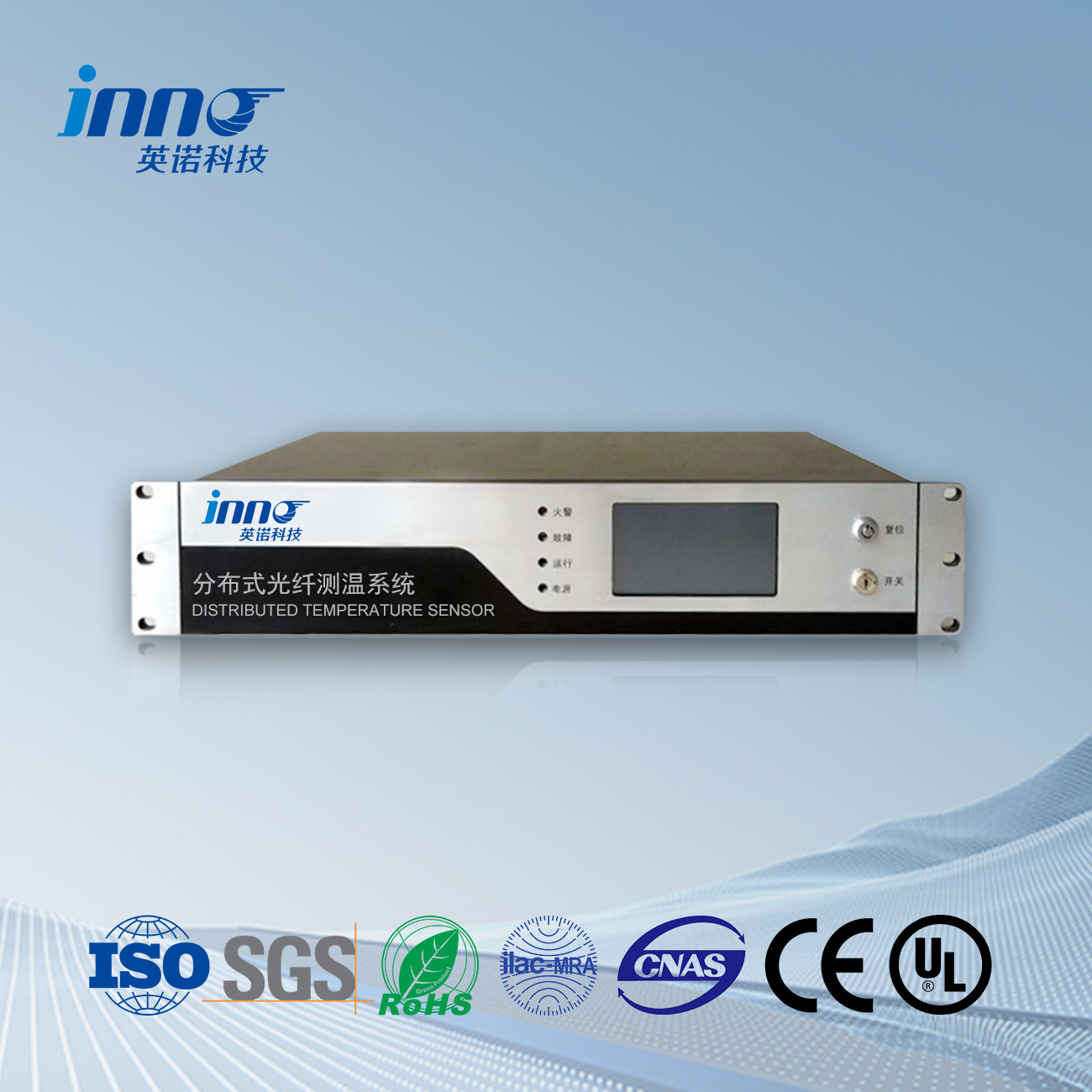
Within the realm of 光ファイバー センシング, 分散型光ファイバー温度測定 (DOTF) stands out as a sophisticated technology for continuous temperature profiling. Unlike conventional point sensors that provide temperature readings only at specific locations, DOTF systems leverage the optical fiber itself as a distributed sensor, enabling the measurement of temperature along its entire length. This capability offers an unprecedented level of spatial detail, making DOTF invaluable for applications requiring comprehensive thermal mapping and the detection of temperature anomalies across extended infrastructures. This report aims to provide an in-depth analysis of DOTF systems, encompassing their fundamental principles of operation, key advantages, a detailed comparison with other prominent temperature measurement technologies, a review of their diverse field applications, an explanation of typical installation methods, and an overview of global manufacturers in this specialized domain.
Ⅱ. Principles of Operation of DOTF Systems
The operation of Distributed Optical Fiber Thermometry (DOTF) systems is rooted in the fundamental principles of light 光ファイバー内での散乱. いつ light propagates through an optical fiber, a small portion of it is scattered back towards the source due to interactions with the molecules of the fiber material. This backscattered light contains several components, primarily レイリー散乱, ブリルアン散乱, ラマン散乱と. While Rayleigh scattering is elastic (no change in wavelength) and Brillouin scattering involves interaction with acoustic phonons, DOTF systems primarily exploit the phenomenon of Raman scattering.
Raman scattering is an inelastic process where the incident photons interact with the vibrational modes of the molecules in the fiber, resulting in a shift in the frequency (and thus wavelength) of the scattered light. This process produces two main components: ストークスライト, which has a lower frequency (より長い波長), and anti-Stokes light, which has a higher frequency (より短い波長) compared to the incident light. The key to temperature sensing in DOTF lies in the fact that the intensity of the anti-Stokes Raman scattering is strongly dependent on the temperature of the fiber at the point of scattering, whereas the intensity of the Stokes scattering exhibits only a weak temperature dependence. 具体的には, the ratio of the intensity of the anti-Stokes light to the Stokes light is directly proportional to the absolute temperature at the scattering location.
To achieve spatial resolution along the fiber, DOTF systems employ the technique of Optical Time Domain Reflectometry (OTDR). A short pulse of laser light is launched into one end of the 光ファイバー, and as this pulse propagates through the fiber, the backscattered light, including the Raman components, is continuously monitored. By precisely measuring the time it takes for the backscattered signal to return to the launch end, the location of the scattering event, and thus the point where the temperature is being measured, 決定できる. This is based on the known speed of light within the 光ファイバー. The intensity ratio of the anti-Stokes to Stokes light at different return times (corresponding to different locations along the fiber) is then analyzed to create a continuous temperature profile.
DOTF systems can be configured for either single-ended or double-ended measurements. In the single-ended method, the laser pulse is launched from only one end of the fiber, which is simpler to install and effective for long-range monitoring. 逆に, the double-ended method involves launching pulses from both ends of a looped fiber. This configuration offers the advantage of continued measurement even if the fiber breaks at a certain point, and it can also help to compensate for the attenuation of light as it travels through the fiber.
The performance of DOTF systems is characterized by their spatial and temperature resolution. Spatial resolution refers to the minimum length along the fiber over which a temperature change can be detected, typically defined as the length where a temperature change from 10% に 90% of its full value is observed. 温度分解能, 一方で, is the smallest change in temperature that the system can accurately measure. Advanced DOTF systems can achieve high spatial resolution, down to the meter or even sub-meter level, which is crucial for applications requiring precise location of thermal anomalies.
Ⅲ. Advantages of DOTF Systems
分散型光ファイバー温度測定 (DOTF) systems offer a multitude of advantages that make them a compelling choice for a wide range of 温度監視アプリケーション. One of the key benefits is their cost-effectiveness, particularly when monitoring over large scales. By utilizing a 単一の光ファイバー 連続センサーとして, DOTF significantly reduces the need for numerous individual temperature sensors and the associated complex wiring infrastructure, leading to lower installation and maintenance costs, especially over extended distances.
DOTF systems also boast remarkable long-distance measurement capabilities. これら systems can monitor temperatures over tens of kilometers with high accuracy and spatial resolution, making them ideally suited for extensive infrastructure monitoring, such as pipelines and power cables. さらに, optical fibers are inherently immune to electromagnetic 干渉 (EMI) および無線周波数干渉 (情報提供依頼). This makes DOTF systems particularly well-suited for use in harsh industrial and high-voltage environments where electrical interference can compromise the performance of traditional sensors.
DOTF provides continuous and real-time monitoring of temperature along the entire length of the fiber. This capability allows for the immediate detection of temperature changes and the creation of a complete temperature profile, which is invaluable for identifying thermal anomalies and trends. さらに, optical fibers are intrinsically safe and suitable for use in hazardous environments, including those that are flammable or explosive, as they are non-conductive and do not generate sparks. 小さいサイズと柔軟性により、 optical fibers also allow for their easy installation in complex geometries and hard-to-reach locations.
DOTF systems offer high sensitivity and accuracy in temperature measurements, enabling precise monitoring for critical applications. さらに, DOTF technology has the potential to be integrated into hybrid sensing systems, allowing for the simultaneous measurement of multiple parameters such as strain, 振動, と音響信号, providing a more comprehensive understanding of the monitored asset or environment. ついに, DOTF systems are highly effective in detecting temperature anomalies and leaks in various infrastructures, providing crucial information for 予知保全 and safety protocols.
IV. Comparison of DOTF with Other Temperature Measurement Methods
分散型光ファイバー温度測定 (DOTF) offers unique capabilities for temperature monitoring, but it is essential to compare it with other established temperature measurement methods to understand its strengths and weaknesses in different contexts.
Fluorescent Fiber Temperature Measurement
This method relies on the temperature-dependent fluorescence lifetime of a material at the fiber ヒント. It offers high accuracy (±0.1℃まで) and is immune to EMI, making it suitable for medical and high-voltage applications. しかし, it typically provides single-point or limited multi-point measurements, unlike the continuous profiling of DOTF.
ファイバーブラッググレーティング (FBG) 温度測定
FBG sensors detect temperature changes by analyzing the wavelength shift of light reflected by a grating within the fiber. A key advantage of FBG is its multiplexing capability, 許可する multiple sensors along a single fiber, as well as its small size and EMI immunity. While offering good accuracy (around ±0.5°C), it provides discrete sensing points rather than a continuous distribution like DOTF.
PT100 Temperature Measurement
PT100 sensors are based on the change in 電気 resistance of platinum with temperature. They offer high accuracy and stability over a wide temperature range. しかし, PT100 sensors are point sensors and require electrical wiring, making them susceptible to EMI and less suitable for very long distances compared to DOTF.
Wireless Temperature Measurement
This encompasses a variety of sensor types (熱電対, RTD, サーミスタ, 見た, 等) that transmit temperature data wirelessly. The key advantage is deployment flexibility and reduced wiring. しかし, they are typically point sensors and can be susceptible to wireless interference.
Gallium Arsenide Temperature Measurement
This method utilizes the temperature dependence of the bandgap of GaAs. It offers high sensitivity and is suitable for high-frequency applications with EMI. Similar to 蛍光繊維, it is often used for point measurements.
赤外線温度測定
Infrared thermometers detect the infrared radiation emitted by objects to measure their surface temperature. The key advantage is non-contact measurement, making it ideal for moving objects, 危険な環境, and quick surface scans. しかし, it measures only surface temperature and does not provide distributed sensing along a fiber.
Comparison Table of Temperature Measurement Technologies
| テクノロジー | 動作原理 | 主な利点 | 代表的な温度範囲 | 正確さ | 空間解像度 (該当する場合) | 料金 (qualitative) |
|---|---|---|---|---|---|---|
| DOTF | Raman scattering and OTDR | 継続的な分散センシング, 長距離, EMI耐性 | -200°C ~ +300°C (depending on cable) | ±0.5℃~±2℃ | 1 m or less | 中程度から高程度 |
| 蛍光ファイバー | 蛍光寿命 減衰 | 高精度, EMI耐性, 長期安定性 | -200°C ~ +300°C | ±0.1℃~±0.5℃ | Single point or limited multi-point | 中程度から高程度 |
| FBG | Wavelength shift in Bragg grating | 多重化, 小型, EMI耐性, 良い安定性 | -200℃ ~ +1000℃ (depending on grating) | ±0.1℃~±0.5℃ | 離散点 | 適度 |
| PT100 | Change in electrical resistance of platinum | 高い精度と安定性, 広い温度範囲 | -200℃ ~ +850℃ | ±0.1℃~±0.5℃ | ポイントセンサー | 低から中程度 |
| Wireless Temperature Measurement | 様々な (抵抗, 電圧, resonance frequency) with wireless transmission | Deployment flexibility, 遠隔監視, 配線の削減 | -200°C to +1250°C (depending on sensor) | ±0.1°C to ±2°C | ポイントセンサー | Low to High |
| ガリウムヒ素 | Temperature dependence of GaAs bandgap | 高感度, good for high-frequency, EMI耐性 | -200℃ ~ +250℃ (典型的な) | ±0.1℃~±1℃ | ポイントセンサー | 高い |
| 赤外線温度測定 | Detection of emitted infrared radiation | 非接触, 速い応答, good for moving/hazardous objects | -50°C ~ +3000°C (depending on model and application) | ±1°C to ±2°C or ±1% to ±2% | Surface measurement | 低から中程度 |
V. Field Applications of DOTF Systems
分散型光ファイバー温度測定 (DOTF) systems have found widespread applications across numerous industries due to their unique capabilities for continuous and 分散型温度監視. 電力業界では, DOTF is crucial for monitoring power cables, including underground, subsea, そして架線, as well as distribution stations and substations, to detect overheating and prevent faults. 石油・ガス部門では, DOTF is extensively used for pipeline leak detection and monitoring of gas and liquid pipelines, leveraging the Joule-Thomson effect to identify leaks.
DOTF systems are also vital for fire detection in confined spaces such as tunnels, の上 コンベヤーベルト, and within industrial facilities, providing early warning and precise location of fire events. 石油・ガス業界では, DOTF plays a critical role in wellbore monitoring, optimizing extraction processes, detecting leaks in well casings, identifying water penetration, and monitoring gas breakthrough, including applications in unconventional resource extraction. さらに, DOTF is employed for structural health monitoring of large infrastructures like bridges and dams, enabling the assessment of structural integrity by detecting temperature-induced stresses and potential failures.
In environmental science, DOTF is utilized for various applications, including soil and water temperature profiling in studies of groundwater-surface water exchange, subsurface thermal property estimation, そして 漏れ検出 in environmental barriers. DOTF systems are also used for monitoring temperature distributions within storage tanks in the chemical and petrochemical industries, aiding in process control and leak detection. さらに, DOTF plays a role in geothermal and hydrological studies, specifically for seepage monitoring in embankments and characterizing subsurface thermal regimes. ついに, in the oil and gas sector, DOTF is crucial for downhole temperature monitoring in wells, optimizing production rates, detecting fluid flow within the wellbore, and assessing overall reservoir conditions.
VI. Installation Methods for DOTF Systems
The installation of Distributed Optical Fiber Thermometry (DOTF) systems involves several key steps to ensure accurate and reliable 温度監視. The primary component, の 光ファイバーケーブル, is deployed along the asset or area that requires temperature monitoring. The specific installation method depends on the application. 例えば, pipelines and underground cables often utilize direct burial of the fiber optic ケーブル, while power cables or bridges may involve strapping the fiber onto the existing structure. Overhead power lines may require aerial deployment of specialized fiber optic cables.
Once the 光ファイバーケーブル is deployed, it needs to be connected to the DOTF interrogator unit, which is typically housed in a control room or another accessible location. の system can be configured for single-ended or double-ended measurements based on the specific monitoring requirements. Double-ended configurations often necessitate the use of a looped fiber and may involve optical switches to facilitate measurements from both ends.
For applications in harsh environments, such as those with extreme temperatures, specific considerations must be taken into account. This may include using metal-sheathed high-temperature fiber optic cables and ensuring proper sealing of connections to protect against moisture and corrosive substances. Calibration of the DOTF system is a critical step to ensure the accuracy of the temperature readings. This often involves using reference points along the fiber where the temperature is known, such as immersing a coiled section of the fiber in a temperature-controlled bath. In double-ended measurement setups, looping the fiber not only facilitates interrogation from both ends but also provides redundancy, allowing for continued monitoring even if the fiber is damaged at one point. ついに, specific installation guidelines should be followed for different applications to ensure optimal performance. 例えば, when monitoring power cables, it is crucial to ensure good thermal contact between the 光ファイバー cable and the power cable using cable ties or other appropriate fixing methods.
VII. Global Manufacturers of DOTF Systems
The global market for Distributed Optical Fiber Thermometry (DOTF) systems includes several key manufacturers that offer a range of solutions for various applications. 横河電機株式会社 (日本) is a prominent player, offering the DTSX series, including models like the DTSX3000, known for its long-distance and high-resolution temperature sensing capabilities, often integrated with their process 制御システム. ルナ・イノベーションズ株式会社 (私たち) provides high-definition distributed temperature sensing through their ODiSI system and long-range DTS with OptaSense interrogators, catering to diverse industries. APセンシング (ドイツ) を専門とする distributed optical sensing technologies, including DTS, with a strong focus on high-quality solutions for various monitoring needs. バンドウィーバー (イギリス) offers DOTF systems like FireLaser for fire detection and T-Laser for general temperature monitoring across different sectors.
Other notable global manufacturers include OFS Fitel, LLC (私たち), a leader in optical fiber technology offering solutions for DTS in sectors like oil & gas and power; オムニセンス (スイス), providing fiber optic-based solutions for asset integrity monitoring, including temperature sensing for pipelines and power cables; ハリバートン (私たち), 提供物 分散型光ファイバー sensing products and services for the energy industry; and SLB (私たち), with a comprehensive portfolio of fiber optic sensors for temperature and other parameters in the oil and gas sector. クアリトロール (私たち) 提供します 変圧器監視用の光ファイバー温度センサー およびその他のアプリケーション, while Hikvision (中国) offers distributed fiber optic temperature systems like the DS-QFT1012 for multi-point monitoring. OZオプティクス (カナダ) specializes in distributed fiber optic temperature sensors based on Brillouin scattering for long-range measurements. さらに, there are manufacturers like Fjinno (中国) and HGSKYRAY (中国), focusing on high-precision 光ファイバー温度センサー.
FJINNOに注目: A Leader in Advanced Fiber Optic Temperature Monitoring
Among the global manufacturers of fiber optic temperature sensing ソリューション, FJINNO stands out for its innovative approach and technological excellence in specialized applications requiring high precision temperature monitoring. に設立 2011 in Fuzhou, 中国, FJINNO has rapidly established itself as a pioneer in 蛍光光ファイバー温度検知技術.
FJINNO’s proprietary temperature sensing system utilizes advanced rare-earth phosphor technology at the fiber ヒント, which offers exceptional measurement accuracy of ±1°C across an impressive temperature range from -40°C to +260°C. This technology is particularly valuable for critical power applications such as トランス 巻線ホットスポット監視, where FJINNO sensors demonstrate complete immunity to the intense electromagnetic interference that would compromise conventional sensing methods.
What sets FJINNO apart is their focus on long-term stability—their sensors maintain calibration for 25+ ドリフトのない年, eliminating the recalibration requirements common with other technologies. For applications requiring precise point temperature measurements rather than distributed sensing, FJINNO’s fluorescent fiber optic sensors provide a complementary solution to DOTF systems, に最適 monitoring critical hot spots in power transformers, 開閉装置, electrical generators, and other high-value assets in challenging electromagnetic environments.
While DOTF systems excel at providing continuous temperature profiles over long distances, FJINNO’s point sensors deliver superior accuracy at critical measurement 場所, making them the preferred choice for applications where precision at specific points is paramount. This technological leadership has made FJINNO a trusted partner for major utilities and industrial customers seeking to enhance the reliability and lifespan of critical electrical infrastructure.
Summary Table of Key Global DOTF Manufacturers
| メーカー名 | Country of Origin | Key DOTF Products/Offerings | Target Industries |
|---|---|---|---|
| 横河電機株式会社 | 日本 | DTSXシリーズ (DTSX3000) | 力, 油 & ガス, 産業オートメーション, インフラストラクチャー |
| ルナ・イノベーションズ株式会社 | 私たち | ODiSI Interrogator, オプタセンス DTSシステム | 航空宇宙, 自動車, エネルギー, インフラストラクチャー, 研究 |
| APセンシング | ドイツ | N45-Series (左HD), N62-Series (DTS), SmartVision enhanced DTS | 油 & ガス, 力, Tunnels, Conveyor Belts, 火災検知 |
| バンドウィーバー | イギリス | ファイアレーザー, T-Laser | 火災検知, 油 & ガス, 力, 交通機関 |
| OFS フィテル, LLC | 私たち | Fiber optic cables for DTS アプリケーション | 油 & ガス, 力, Alternative Energy |
| オムニセンス | スイス | Distributed temperature and strain 監視システム | パイプライン, 電源ケーブル, Subsea Equipment, 構造健全性モニタリング |
| ハリバートン | 私たち | 分散型光ファイバーセンシング products and services | エネルギー (油 & ガス) |
| SLB | 私たち | Distributed temperature, プレッシャー, および音響センサー | エネルギー (油 & ガス) |
| フジノ | 中国 | 蛍光光ファイバー温度センサー | 電力設備, 産業用途, High-Voltage Environments |
| クアリトロール | 私たち | ネオオプティックス fiber optic temperature sensors and monitoring systems | 電源変圧器, 研究室, 産業用, 医学 |
| Hikvision | 中国 | DS-QFT1012 Distributed Temperature Fiber System | インフラストラクチャー, 産業施設 |
| OZオプティクス | カナダ | ForeSight™ Series Distributed Sensor System (B-DTS) | 構造モニタリング, 油 & ガスパイプライン |
| HGスカイレイ | 中国 | 光ファイバー温度計 | 産業用電力, Metallurgy, 健康管理 |
| オプセンスソリューション | カナダ | High-performance 光ファイバー温度センサー | 医学, 高電圧, EMI環境 |
VIII. Frequently Asked Questions About DOTF Systems
1. What is the main difference between DOTF and point-based temperature sensors?
While point-based sensors like thermocouples, RTD, または fluorescent fiber optic sensors measure temperature at specific discrete locations, DOTF systems enable continuous temperature measurements along the entire length of an optical fiber. This means a single DOTF installation can replace hundreds or even thousands of point sensors, providing a complete temperature profile over distances that can extend to tens of kilometers. This capability is particularly valuable for monitoring large infrastructure where thermal events could occur at any point along its length.
2. What is the typical measurement range and accuracy of DOTF systems?
Most commercial DOTF systems can measure temperatures ranging from approximately -200°C to +300°C, though the exact range depends on the specific fiber optic cable used. Standard systems typically offer accuracy between ±0.5°C and ±2°C, with temperature resolution around 0.1°C. Spatial resolution—the minimum distance over which a temperature change can be detected—generally ranges from 0.5 に 2 meters in commercial systems, けれど specialized high-resolution systems can achieve spatial resolution down to tens of centimeters for shorter monitoring distances.
3. How far can DOTF systems measure temperature?
Commercial DOTF systems can typically measure temperature over distances ranging from a few meters to approximately 30 kilometers with a single fiber. The maximum measurement distance depends on several factors, including the quality of the optical fiber, the power of the laser source, the sensitivity of the detection system, and the required measurement speed and spatial resolution. 一般的に, there is a trade-off between measurement distance, 空間解像度, and measurement time—longer distances typically require longer measurement times to maintain the same level of accuracy and resolution.
4. How do environmental factors affect DOTF performance?
Several environmental factors can influence DOTF performance. Variations in strain along the fiber can affect temperature readings unless compensated for, particularly in installations where the fiber is subject to mechanical stress. Hydrogen ingress into the fiber in harsh environments (like deep wells or underwater applications) can cause attenuation that degrades signal quality over time. 非常に高い temperatures can permanently damage standard fiber cables, requiring specialized high-temperature fibers for such applications. さらに, 急速な temperature changes may require faster measurement cycles to capture accurately. Modern DOTF systems incorporate various correction methods to address these environmental effects and maintain measurement accuracy.
5. What are the installation requirements for DOTF systems?
Installation of DOTF systems requires careful planning and execution. の 光ファイバーケーブル must be deployed along the asset or area to be monitored, using appropriate methods such as direct burial, attachment to structures, or installation in protective conduits. Good thermal contact between the fiber and the monitored asset is essential for accurate measurements. The fiber must be protected from excessive mechanical stress, 粉砕する, or sharp bending that could cause signal loss or damage. Connection points to the interrogator unit should be accessible for maintenance and protected from environmental factors. Calibration of the system is typically required after installation to ensure accurate temperature 測定値.
6. How do DOTF systems detect pipeline leaks?
DOTF systems detect pipeline leaks through two main mechanisms. 初め, のために ガスパイプライン, the Joule-Thomson effect causes temperature drops at leak points as high-pressure gas expands through a small opening. For liquid pipelines, leaking product can create temperature anomalies due to differences between the product temperature and surrounding soil or water. 2番, in actively heated pipelines (using trace heating or heated by product flow), leaks disrupt the normal temperature profile. DOTF systems continuously monitor the entire pipeline length, creating baseline temperature profiles and detecting deviations that could indicate leaks. Advanced algorithms analyze these temperature patterns to distinguish actual leaks from normal temperature variations, providing both leak detection and precise location information.
7. How does DOTF compare to Fluorescent Fiber Optic sensing in practical applications?
DOTF and Fluorescent Fiber Optic sensing serve complementary purposes in temperature monitoring. DOTF excels at providing continuous temperature profiles over long distances (30kmまで) with moderate accuracy (±0.5~2℃) と空間解像度 (typically 1m). It’s ideal for monitoring entire assets like pipelines or power cables. 蛍光 Fiber Optic sensing (like FJINNO’s technology) delivers superior accuracy (±0.1~0.5℃) at specific points with excellent long-term stability, making it perfect for critical hotspot monitoring in applications like power transformers and switchgear. Many sophisticated monitoring setups employ both technologies: DOTF for comprehensive coverage and Fluorescent Fiber for high-precision measurements at critical points, creating a multi-layered 温度監視ソリューション.
8. What maintenance is required for DOTF systems?
DOTF systems generally require minimal routine maintenance compared to conventional sensor networks. 尋問者 unit may need periodic recalibration according to manufacturer 仕様, 通常、毎回 1-2 年. の 光ファイバーケーブル itself is passive and has no wearing parts, though connection points should be periodically inspected for cleanliness and integrity. Software updates may be required to maintain security and performance. 過酷な環境で, the cable’s protective sheathing should be inspected for damage. The main advantage of DOTF is that the sensing element (the fiber) typically requires no maintenance over its lifetime, 超えることができるもの 20 years with proper installation. しかし, if the fiber is damaged, repairs may require specialized fusion splicing techniques to maintain measurement integrity.
9. Can DOTF systems be integrated with existing monitoring infrastructure?
はい, modern DOTF systems are designed for integration with existing monitoring infrastructure through several methods. Most commercial systems support standard industrial protocols like Modbus, OPC-UA, or MQTT for data exchange with SCADA systems, 分散制御システム (DCS), または資産管理プラットフォーム. Many manufacturers provide software development kits (SDKs) or application programming interfaces (APIs) to facilitate custom integration. DOTF systems typically offer various alarm output options, including relay contacts, アナログ出力 (4-20ミリアンペア), or digital signals that can interface with existing alarm systems. さらに, cloud-based platforms increasingly allow DOTF data to be accessed and analyzed remotely, with options for integration with broader IoT ecosystems and advanced analytics frameworks.
10. What are the typical costs associated with DOTF systems?
The cost of DOTF systems varies significantly based on several factors. The interrogator unit (the main hardware component) 通常は~の範囲です $30,000 に $150,000 depending on performance specifications like measurement range, 解決, and number of channels. 専門化された 光ファイバーケーブル おおよその費用 $2-10 per meter, varying based on environmental protection requirements. Installation costs depend on the application and can range from $5-30 per meter for simple surface mounting to $50-200 per meter for complex installations like subsea or downhole deployments. While initial capital costs are higher than 従来のセンサー ネットワーク, the total cost of ownership over the system lifetime (15-25 年) is often lower due to reduced maintenance requirements and the elimination of hundreds of individual sensors. さらに, the comprehensive monitoring capability often provides value through early detection of issues that might otherwise result in costly failures.
IX. 結論
分散型光ファイバー温度測定 (DOTF) systems represent a significant advancement in temperature monitoring technology, offering a unique combination of distributed sensing capabilities and immunity to challenging environmental conditions. The principle of operation, based on the temperature-dependent Raman scattering of light within an optical fiber and the spatial resolution provided by OTDR techniques, enables continuous temperature profiling over extended distances. This technology offers numerous advantages, including cost-effectiveness for large-scale deployments, long-range measurement capabilities, inherent immunity to electromagnetic interference, continuous real-time monitoring, 危険な環境における本質安全防爆, flexibility in installation, high sensitivity and accuracy, potential for multi-parameter sensing, and effective detection of temperature anomalies and leaks.
When compared to other temperature measurement methods such as fluorescent fiber, ファイバーブラッググレーティング (FBG), PT100センサー, ワイヤレス温度センサー, Gallium Arsenide sensors, and infrared thermometers, DOTF demonstrates distinct strengths in providing spatially continuous data over long distances, particularly in environments where EMI is a concern. While other technologies may excel in specific aspects like ultra-high accuracy (蛍光繊維) or multiplexing (FBG), DOTF’s distributed nature offers a comprehensive thermal picture that is often unattainable with point-based sensors.
The field applications of DOTF are diverse and span critical industries, 含む power generation and distribution, 石油とガス, 交通機関, 環境モニタリング, 構造的な健康と. Its ability to ensure the safety and efficiency of power cables, パイプライン, トンネル, and wells, while also contributing to environmental and structural integrity assessments, highlights its broad utility. Installation methods are adaptable to various scenarios, with considerations for cable deployment, 環境保護, and calibration being crucial for optimal system performance.
The global market for DOTF systems is supported by a range of specialized manufacturers, each offering tailored solutions for specific industry needs. These manufacturers continue to innovate, pushing the boundaries of DOTF technology in terms of measurement range, 解決, and application versatility. For applications requiring the highest precision at specific critical points, complementary technologies such as FJINNO’s fluorescent fiber optic sensors provide an excellent companion to DOTF systems, creating comprehensive 監視ソリューション that address both broad coverage and high-precision measurement needs.
結論は, Distributed Optical Fiber Thermometry stands as a vital tool for modern temperature monitoring, offering a unique value proposition that is poised to play an increasingly important role in ensuring the safety, 効率, and longevity of critical infrastructures and processes across the globe.

光ファイバー温度センサー, インテリジェント監視システム, 中国の分散型光ファイバーメーカー
 |
 |
 |