 INNO fibre optic temperature sensors ,temperature monitoring systems.
Dry type transformer monitoring systems combine several distinct technologies rather than relying on a single instrument — a traditional Pt100-based temperature controller handling fan control and alarm outputs, fiber optic sensors for direct winding hotspot measurement on larger units, and increasingly, partial discharge and environmental sensors feeding a shared monitoring platform. Temperature remains the primary parameter in dry type transformer monitoring, but a complete dry type transformer monitoring system also needs to account for fan status, alarm and trip logic, and — on higher-value or cast resin units — partial discharge activity and ambient conditions in the transformer room. Dry type transformer temperature monitoring and transformer winding temperature monitoring form the technical core of most installations, while dry type transformer condition monitoring as a whole extends outward from there to cover status, environment, and — on select units — insulation stress.
- A dry type transformer monitoring system centers on winding temperature, with fan control, alarm, and trip logic built around it.
- Pt100 winding temperature monitoring is the traditional, contact-based sensing method used by most temperature controllers.
- A dry type transformer temperature controller typically displays temperature, controls the cooling fan, and drives alarm/trip outputs.
- Fiber optic winding temperature monitoring measures the winding hotspot directly, without any metallic sensor near live conductors.
- Transformer hotspot monitoring targets the specific point in the winding expected to run hottest under load.
- Dry type transformer partial discharge monitoring detects localized insulation stress, mainly on larger or cast resin units.
- Dry type transformer condition monitoring reviews temperature, fan status, and alarms together as one operating picture.
- Remote dry type transformer monitoring makes this data available without a site visit.
- Broader transformer health monitoring builds on all of the above rather than adding a separate sensor.
- What Is a Dry Type Transformer Monitoring System?
- What Does Dry Type Transformer Condition Monitoring Actually Cover?
- Which Parameters Are Monitored on a Dry Type Transformer?
- How Does a Traditional Dry Type Transformer Temperature Controller Work?
- Pt100 and RTD Sensors in Dry Type Transformer Temperature Monitoring
- What Is PTC Protection and How Does It Differ From Pt100?
- How Is Winding Temperature Measured in a Dry Type Transformer?
- How Does Fan Control Work in Dry Type Transformer Monitoring?
- How Are Overtemperature Alarm and Trip Configured?
- What Is Fiber Optic Temperature Monitoring for Dry Type Transformers?
- How Does Fiber Optic Monitoring Track Winding Hotspot Temperature?
- Pt100 vs Fiber Optic Temperature Monitoring: Which Method Fits Your Transformer?
- How Is Partial Discharge Monitored on a Dry Type Transformer?
- What Makes Cast Resin Transformer Monitoring Different?
- How Is Dry Type Transformer Status Monitored Day to Day?
- Why Monitor Ambient Temperature and Humidity Around a Dry Type Transformer?
- How Does Load Monitoring Relate to Winding Temperature?
- What Is Remote and SCADA-Integrated Dry Type Transformer Monitoring?
- Where Do Health, Vibration, and Noise Monitoring Fit In?
- How to Choose a Dry Type Transformer Monitoring System
1. What Is a Dry Type Transformer Monitoring System?

Dry type transformers don’t have oil to check, so most of what can go wrong shows up first as heat in the winding — which is why a dry type transformer monitoring system is built almost entirely around temperature, with everything else added as a supporting layer. At the simplest level this means a temperature controller reading winding sensors and driving a cooling fan. At the more advanced end, an online dry type transformer monitoring installation can add fiber optic hotspot sensing, partial discharge detection, and room-level environmental monitoring on top of that same temperature foundation.
2. What Does Dry Type Transformer Condition Monitoring Actually Cover?
Dry type transformer condition monitoring is the practice of reviewing winding temperature, fan status, and alarm history together, rather than checking a single gauge in isolation. A dry type transformer condition monitoring system at this level is deliberately simpler than the multi-parameter diagnostics used on oil-immersed power transformers — transformer condition assessment here is mostly about confirming the winding is running within its expected temperature range for the current load and ambient conditions, and that the cooling and protection functions are working as intended.
3. Which Parameters Are Monitored on a Dry Type Transformer?
| Parameter | What It Shows |
|---|---|
| Winding temperature (Pt100 or fiber optic) | Direct thermal condition of the winding, the primary indicator on a dry type unit |
| Fan / cooling status | Whether forced-air cooling is engaging correctly as temperature rises |
| Alarm and trip status | Whether temperature has crossed configured warning or protection thresholds |
| Partial discharge (where fitted) | Localized electrical stress within the winding insulation |
| Ambient temperature and humidity | Room or enclosure conditions affecting cooling and insulation environment |
| Load / current (where fitted) | Electrical loading context behind the observed temperature |
4. How Does a Traditional Dry Type Transformer Temperature Controller Work?

A traditional dry type transformer temperature controller is not just a display — it typically combines temperature display, winding temperature monitoring, automatic fan start/stop, high-temperature alarm, overtemperature trip, and a remote signal output in one device. FJINNO’s IB-S201 temperature control instrument is a representative example: it monitors up to three winding channels using a platinum sensing element embedded in the winding, displays the maximum temperature, automatically controls the cooling fan with a built-in fan exerciser, and drives separate alarm and trip relay outputs, with optional 4–20mA output (E function) or RS485 communication (F function) for integration with a remote system.
5. Pt100 and RTD Sensors in Dry Type Transformer Temperature Monitoring
Pt100 transformer temperature sensor elements — a type of resistance temperature detector, or RTD — are the traditional contact-based sensing technology embedded in or near the winding during manufacturing. Transformer RTD temperature monitoring works by measuring the change in electrical resistance of the platinum element as temperature changes, giving a continuous, proportional temperature reading rather than a simple threshold. This is the sensing technology behind most conventional temperature controllers, including the IB-S201 referenced above — though it’s worth noting that not every dry type transformer uses Pt100 specifically; some designs use other embedded sensor types depending on the manufacturer and application.
6. What Is PTC Protection and How Does It Differ From Pt100?
PTC transformer temperature sensor elements work differently from Pt100: a PTC (positive temperature coefficient) thermistor is generally used for threshold-based temperature protection rather than continuous measurement — its resistance changes sharply once a specific temperature is crossed, which suits it to triggering a fixed alarm or trip point rather than displaying a precise ongoing temperature value. In short, Pt100/RTD sensing is generally associated with continuous temperature measurement and trending, while PTC/thermistor technology is more commonly associated with threshold-based protection — the two are not simply interchangeable, and which one (or both) a given transformer uses depends on its design and protection philosophy.
7. How Is Winding Temperature Measured in a Dry Type Transformer?
Dry type transformer winding temperature monitoring typically covers each phase separately, since winding temperature can differ across phases depending on load balance and winding position. Controllers commonly display the highest reading among the monitored channels, since that value is what matters most for fan control and alarm logic. For larger installations needing high channel counts, FJINNO’s intelligent monitoring device for polycrystalline silicon dry-type transformers combines 24 Pt100 channels with 3 fiber optic channels in one wall-mounted unit, giving both broad winding coverage and dedicated hotspot points where they’re needed most, along with 18-way fan control and RS485/Modbus communication.
8. How Does Fan Control Work in Dry Type Transformer Monitoring?
Dry type transformer fan control is usually tied directly to the winding temperature reading: as temperature rises past a configured point, the controller starts forced-air cooling automatically, and stops it again once temperature falls back below a lower threshold. Most controllers also support a manual override — the IB-S201, for example, includes manual/automatic fan selection — and some, like the fiber optic monitoring system for dry-type transformer windings, add a fan exerciser function that periodically runs the fan even without a temperature trigger, to confirm it is still operational. Forced air cooling transformer configurations (commonly labeled AN/AF) rely on this fan-control loop being reliable, since fan failure removes a meaningful part of the transformer’s cooling capacity.
9. How Are Overtemperature Alarm and Trip Configured?
Most dry type transformer temperature controller units separate alarm and trip into two distinct stages: an overtemperature alarm that flags a rising temperature condition for operator attention, and a separate overtemperature trip output that can be wired to disconnect the transformer if temperature continues climbing toward a level considered unsafe for continued operation. Both are typically implemented as dry contact relay outputs so they can be wired into existing protection or SCADA logic. Actual alarm and trip temperature setpoints are configured according to the transformer’s insulation class and the manufacturer’s rating — this guide does not assign a universal number, since it varies by design.
10. What Is Fiber Optic Temperature Monitoring for Dry Type Transformers?
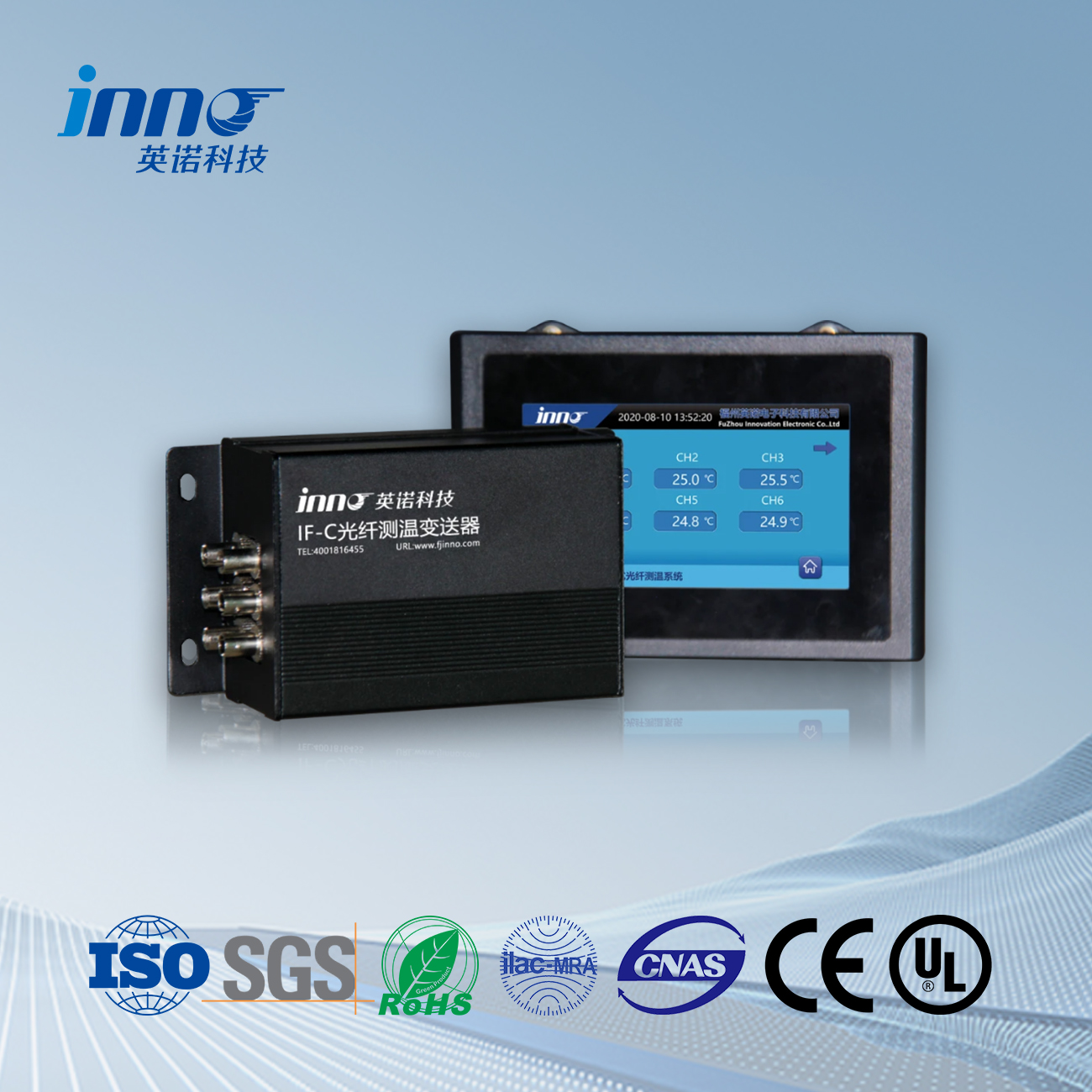
Fiber optic temperature monitoring for dry type transformers uses a fluorescent fiber optic probe instead of a metallic sensor, which matters specifically because winding sensors sit extremely close to live, high-voltage conductors. FJINNO’s fiber optic temperature measurement system for dry-type transformer winding uses a quartz fluorescent fiber optic probe rated to withstand 100kV power-frequency voltage, is fully non-metallic and immune to electromagnetic interference, and supports 1–18 customizable channels with RS485/Modbus or 4–20mA output. Beyond winding temperature, this type of system typically also provides black-box logging of the last power outage and highest historical temperature, door-open alarm contacts, and separate alarm/trip/fan/fault relay outputs — functionally similar to a traditional controller, but built around fiber optic rather than Pt100 sensing.
11. How Does Fiber Optic Monitoring Track Winding Hotspot Temperature?
Transformer winding hotspot monitoring is the specific value that fiber optic sensing adds over a standard contact sensor: because the fluorescent probe can be positioned directly at the point in the winding expected to run hottest, it measures that direct winding temperature measurement point rather than an average or nearby location. This matters for load management — real-time hotspot data lets operators understand how close the winding actually is to its thermal limit during peak load, rather than relying on an indirect estimate, and supports building a long-term temperature trend for the winding over its operating life.
12. Pt100 vs Fiber Optic Temperature Monitoring: Which Method Fits Your Transformer?
| Aspect | Pt100 / RTD Sensing | Fiber Optic Sensing |
|---|---|---|
| Sensor material | Metallic resistance element | Non-metallic, all-optical probe |
| Electromagnetic immunity | Can be affected by strong EMI | Fully immune to EMI |
| High-voltage proximity | Requires careful insulation clearance | Rated for direct high-voltage proximity (e.g. 100kV) |
| Typical use | Standard winding temperature monitoring on most units | Direct hotspot measurement on larger, higher-voltage, or higher-value units |
| Retrofit suitability | Widely supported by standard controllers | Often specified for new or upgraded installations needing precise hotspot data |
Neither method strictly replaces the other across the board — Pt100/RTD sensing remains the standard, cost-effective approach for most dry type transformers, while fiber optic monitoring is generally chosen where direct hotspot measurement, higher voltage clearance, or strong EMI immunity specifically matter. Some installations, like the 24-channel Pt100 plus 3-channel fiber optic device referenced earlier, combine both rather than choosing one exclusively.
13. How Is Partial Discharge Monitored on a Dry Type Transformer?
Dry type transformer partial discharge monitoring detects localized discharge activity within the winding insulation — an indicator that is generally considered separately from temperature, since PD can develop independently of thermal condition. Online PD monitoring is more commonly specified on larger or cast resin dry type units, where insulation stress at higher voltage levels makes this kind of monitoring worthwhile. FJINNO’s intelligent PHM monitoring system for dry-type transformers includes partial discharge detection as one module within a broader monitoring platform, alongside winding/core temperature, vibration, and environmental sensing, communicating via IEC61850 to station-level systems. This guide covers PD monitoring at the level of what it detects and where it fits within dry type transformer monitoring, rather than as a full standalone diagnostic guide.
14. What Makes Cast Resin Transformer Monitoring Different?
Cast resin transformer monitoring follows the same core structure as other dry type transformer monitoring — winding temperature first, with fan control, alarm/trip, and optionally fiber optic or PD monitoring layered on top. What differs is mainly application context: cast resin transformer partial discharge monitoring is more frequently specified on these units because cast resin insulation systems are common in indoor, higher-voltage, or space-constrained installations — such as rail transit substations or industrial plants — where insulation condition and fire safety margins carry extra weight. The monitoring technologies themselves are the same ones covered throughout this guide, just applied with particular attention to cast resin winding construction.
15. How Is Dry Type Transformer Status Monitored Day to Day?
Dry type transformer status monitoring generally pulls together the outputs already covered — winding temperature, fan run/stop status, alarm and trip state, and (where fitted) PD status — into one operating view rather than treating them as unrelated points. A typical transformer operating status review confirms that temperature is normal for the current load, the fan responded correctly to the last temperature rise, and no alarm or trip event has occurred recently. This day-to-day status view is what most operators actually check, rather than reviewing raw sensor data directly.
16. Why Monitor Ambient Temperature and Humidity Around a Dry Type Transformer?
Dry type transformer ambient temperature monitoring matters because winding temperature is only meaningful in context — the same winding reading can be normal on a hot day and concerning on a cool one if the gap between ambient and winding temperature is unusually large. Transformer room humidity monitoring is a secondary but relevant addition, since indoor dry type transformers are sometimes installed in enclosed rooms where humidity and ventilation affect both cooling performance and general operating environment. FJINNO’s PHM monitoring system includes ambient temperature and humidity sensing as one of its environmental monitoring functions, alongside options for local heating and dehumidification control in the transformer enclosure.
17. How Does Load Monitoring Relate to Winding Temperature?
Dry type transformer load monitoring is generally added as supporting context for temperature data rather than as a standalone focus — transformer load current monitoring helps explain why winding temperature is rising, and whether it’s tracking normally with load or rising faster than expected, which can point toward a cooling issue rather than simply higher demand. This guide treats load monitoring as a complement to the temperature-fan-alarm chain that is the actual core of dry type transformer monitoring, rather than as a full power-quality topic in its own right.
18. What Is Remote and SCADA-Integrated Dry Type Transformer Monitoring?
Remote dry type transformer monitoring means winding temperature, fan status, and alarm data are available away from the transformer itself — over RS485/Modbus, 4–20mA, or Ethernet depending on the controller, as seen in the optional communication functions on both the IB-S201 controller and the fiber optic monitoring systems referenced earlier. On larger installations, the PHM-style monitoring system communicates via IEC61850 to station-level systems, supporting integration into a broader transformer SCADA monitoring setup. Communication options vary by product and configuration, so specific protocol support should always be confirmed against the actual equipment model rather than assumed.
19. Where Do Health, Vibration, and Noise Monitoring Fit In?
Transformer health monitoring in a dry type context is best understood as the combined interpretation of temperature, fan, alarm, and (where fitted) PD data — not a separate sensor of its own. Some more advanced monitoring platforms, including FJINNO’s PHM system, add transformer vibration monitoring and transformer noise monitoring as additional environmental and mechanical indicators, alongside functions like electrical connection point arc detection and smoke detection. These remain supporting additions within a broader dry type transformer health monitoring picture rather than core requirements for a standard installation.
20. How to Choose a Dry Type Transformer Monitoring System
Step 1: Start With Winding Temperature Sensing
Decide between standard Pt100/RTD sensing and fiber optic hotspot sensing based on voltage level, EMI environment, and whether direct hotspot data is specifically needed.
Step 2: Confirm Fan Control and Alarm/Trip Requirements
Most installations need automatic fan start/stop plus separate alarm and trip relay outputs — confirm channel count matches the number of windings (and, where relevant, core temperature) to be monitored.
Step 3: Decide Whether Partial Discharge Monitoring Is Justified
PD monitoring is more commonly specified on larger, cast resin, or higher-voltage units rather than every dry type transformer in a facility.
Step 4: Add Environmental Monitoring Where the Installation Warrants It
Indoor or enclosed installations benefit from ambient temperature and humidity monitoring; outdoor or well-ventilated installations may not need it.
Step 5: Match Communication Requirements to Your Existing System
Confirm whether RS485/Modbus, 4–20mA, or IEC61850/Ethernet is required for integration with your SCADA or building monitoring platform, since support varies by specific controller model.
Frequently Asked Questions About Dry Type Transformer Monitoring
What is a dry type transformer monitoring system?
It is a monitoring setup built primarily around winding temperature — typically including a temperature controller, fan control, and alarm/trip outputs — with fiber optic sensing, partial discharge monitoring, or environmental sensors added on more advanced installations.
What parameters are monitored in a dry type transformer?
The main parameter is winding temperature, supported by fan status, alarm/trip status, and, on some installations, partial discharge, ambient temperature/humidity, and load current.
How is dry type transformer temperature monitored?
Temperature is monitored using Pt100/RTD sensors embedded in the winding, connected to a temperature controller, or using fiber optic probes for direct hotspot measurement.
What is a dry type transformer temperature controller?
It is a device that reads winding temperature sensors, displays the readings, automatically controls the cooling fan, and provides alarm and trip outputs for protection.
What is Pt100 in a dry type transformer?
Pt100 is a resistance temperature detector (RTD) sensor commonly embedded in the winding to provide a continuous, proportional temperature reading.
What is PTC protection in a transformer?
PTC (positive temperature coefficient) thermistor protection is generally used for threshold-based temperature protection, where resistance changes sharply once a specific temperature point is crossed.
Where are Pt100 sensors installed in a dry type transformer?
Pt100 sensors are typically embedded in or near the winding during manufacturing, usually with one sensor per phase.
How does transformer fan control work?
The fan is typically started automatically once winding temperature crosses a configured threshold, and stopped once temperature falls back below a lower threshold, with a manual override usually available.
How is transformer winding hotspot temperature monitored?
Winding hotspot temperature is monitored most directly using fiber optic sensors positioned at the specific location expected to run hottest under load.
Can fiber optic sensors monitor dry type transformers?
Yes. Fiber optic sensors are commonly used for direct winding temperature and hotspot monitoring, particularly where electromagnetic interference or high-voltage proximity make metallic sensors less suitable.
Pt100 vs fiber optic transformer temperature monitoring — what’s the difference?
Pt100/RTD sensing is the standard contact-based method used on most transformers, while fiber optic sensing is generally chosen for direct hotspot measurement, higher voltage clearance, or strong electromagnetic interference immunity.
How is partial discharge monitored in a dry type transformer?
Partial discharge is monitored using dedicated PD sensors integrated into a broader monitoring platform, most commonly specified on larger or cast resin dry type units.
What is cast resin transformer monitoring?
It follows the same core monitoring structure as other dry type transformers — winding temperature, fan control, and alarms — often with added attention to partial discharge monitoring given typical cast resin applications.
How is transformer temperature connected to alarm and trip?
Most controllers use separate alarm and trip thresholds — an alarm flags a rising temperature condition, while a trip output can disconnect the transformer if temperature continues to an unsafe level.
Can dry type transformers be monitored remotely?
Yes. Many temperature controllers and monitoring systems support remote data access through RS485/Modbus, 4–20mA, or Ethernet/IEC61850, depending on the specific equipment.
What is dry type transformer condition monitoring?
It is the practice of reviewing winding temperature, fan status, and alarm history together to understand the transformer’s current operating condition.
What is dry type transformer health monitoring?
It refers to the combined interpretation of temperature, fan, alarm, and (where fitted) partial discharge data as an overall operating picture, rather than a separate monitoring technology.
How do I choose a dry type transformer monitoring system?
Selection depends on choosing a winding temperature sensing method, confirming fan and alarm/trip requirements, deciding whether PD monitoring is justified, adding environmental sensing where relevant, and matching communication requirements to your existing system.
Build a Dry Type Transformer Monitoring Solution
FJINNO supplies temperature controllers, fiber optic winding temperature systems, and integrated monitoring platforms for dry type and cast resin transformers, and can help configure a solution matched to your channel count, sensing method, and communication requirements.
- IB-S201 Dry Type Transformer Temperature Control Instrument
- Fiber Optic Temperature Measurement System for Dry Type Transformer Winding
- Intelligent Monitoring Device for Polycrystalline Silicon Dry Type Transformers
- Intelligent PHM Monitoring System for Dry Type Transformers
E-mail: web@fjinno.net | WhatsApp: +8613599070393

Fiber optic temperature sensor, Intelligent monitoring system, Distributed fiber optic manufacturer in China
 |
 |
 |